Anne Frank’s The Diary of a Young Girl is the personal diary of a Jewish teenager who hid with seven other people in a secret annex behind her Amsterdam house while the Nazis occupied the Netherlands. She wrote it from June 1942 to August 1944, and her father Otto Frank published it in 1947 after the war. This Anne Frank The Diary of a Young Girl study guide covers the historical context, the eight people in hiding, the major themes, the diary form itself, and the study questions teachers actually use, all on one free page.
Two versions of this guide live on the internet and neither is much use on its own. The student version stops at plot summary; the teacher version stops at a paywall.
What follows is the middle: the literary analysis and the classroom material in one place, with answer guidance instead of a locked answer key.
Last reviewed for 2026, using the current English-language Definitive Edition and the historical record kept by the Anne Frank House in Amsterdam. If you are teaching this book next week, start with the timeline and finish with the study questions.
Table of Contents
- What Is Anne Frank’s The Diary of a Young Girl About?
- Historical Context: Why Anne Frank Wrote Her Diary
- Anne Frank The Diary of a Young Girl Study Guide: Key Facts at a Glance
- Who Are the Main Characters in The Diary of a Young Girl?
- Anne Frank
- Otto Frank
- Edith Frank
- Margot Frank
- Peter Van Pels
- Hermann van Daan
- Auguste van Daan
- Fritz Pfeffer, called Dussel
- Miep Gies and the helpers
- What Are the Major Themes in Anne Frank’s Diary?
- Identity and self-invention
- Adolescence against adult authority
- Isolation and confinement
- Hope against evidence
- Family relationships
- The power of writing
- How Does Anne Use Her Diary as a Literary Device?
- How Does the Setting Shape Anne Frank’s Writing?
- What Important Events Happen in The Diary of a Young Girl?
- What Makes Anne Frank’s Writing Memorable?
- How Should You Analyze Anne Frank’s Diary?
- Study Questions and Essay Prompts for Your Class
- Comprehension questions
- Analysis questions
- Essay prompts
- Frequently Asked Questions
- Was Anne Frank LGBTQ+?
- What were Anne Frank’s last words before she died?
- Did Anne Frank ever kiss a boy?
- Who survived the Secret Annex?
- What grade level is The Diary of a Young Girl?
- Should I teach the diary or the 1955 play?
What Is Anne Frank’s The Diary of a Young Girl About?
It is the record of two years and one month spent hiding, written by a girl who was thirteen when she started and fifteen when she was arrested, and it reads like a diary because it was one.
Anne began writing on her thirteenth birthday, 12 June 1942, after her parents gave her a locked diary as a present. Her first entry is about paper and pens. She argues with her father about whether a diary counts as a real birthday gift and settles for being delighted. From there the pages run nearly unbroken through August 1944, when the family is arrested.
The reason they were hiding matters more than anything else in the book. Germany had invaded the Netherlands in May 1940 and began applying anti-Jewish laws one at a time. Then Margot, Anne’s older sister, received a call-up notice summoning her to a work camp. Otto Frank decided the family would go into hiding rather than answer it. They moved into the secret annex, and the eight people crammed into it wrote, argued, cooked, studied, kissed and waited.
It gets read in classrooms for two reasons at once. As history, it is one of the most widely read firsthand accounts of the Holocaust written by someone who did not survive it. As literature, it is a coming-of-age narrative about identity, family friction and hope, told by a narrator whose voice is unmistakably thirteen. The best study guides hold both readings instead of picking one.
Historical Context: Why Anne Frank Wrote Her Diary
The diary only makes sense against the German occupation of the Netherlands, which turned everyday Dutch life into a slow series of restrictions and then into a hunt.
Germany invaded in May 1940. The occupation began relatively mildly, and for the first years many Dutch people expected it to pass. Antisemitic measures arrived in layers: registration of Jewish residents in 1941, then bans on public transport, on shopping, on cinemas, on owning bicycles. Then came the part students find hardest to believe, the part where the country sorted itself out. Dutch volunteers were recruited to round up other Dutch Jews.
By the time Anne started her diary in June 1942, Amsterdam Jews were required to wear a yellow star, and the Frank family’s business had already collapsed under anti-Jewish measures. Margot’s call-up notice in July 1942 was the immediate trigger. Otto, an engineer, had been sketching out a quieter role for himself and had worked out an alternative route through several friends. He switched to the plan that kept his family together, and that decision put eight people behind a bookcase at Prinsengracht 263.
Anne Frank The Diary of a Young Girl Study Guide: Key Facts at a Glance
A fact table like this one gets quoted more than any other part of a study guide, so it is worth printing.
| Detail | Answer |
|---|---|
| Author | Anne Frank, born 12 June 1929 in Frankfurt, Germany; died March 1945 at Bergen-Belsen |
| Dates written | 12 June 1942 to 1 August 1944 |
| Setting | The secret annex behind a house at Prinsengracht 263, Amsterdam |
| People hiding there | Eight: Otto, Edith, Margot and Anne Frank; Hermann, Auguste and Peter van Daan; and Fritz Pfeffer, whom Anne calls Dussel |
| Original title | Het Achterhuis, published in Dutch in 1947 |
| Who published it | Otto Frank, who edited and shortened his daughter’s notebooks before publication |
| Form | Diary, written as letters addressed to an imaginary friend Anne names Kitty |
| Grade range | Most commonly taught grades 7-10, with adapted editions for younger readers |
| Companion version | A 1955 stage play, written by Goodrich and Hackett from the published book |
| Survivors | Otto Frank and Miep Gies, who kept the notebooks safe during the war |
Who Are the Main Characters in The Diary of a Young Girl?
Eight people hid in the annex, and each one behaves like a small argument the book is making about family, fairness or the kind of person who survives.
Anne Frank
The narrator and the argument in human form. She is funny, restless, vain about her writing and quick to judge. She fights with her mother most and loves her most, and she is not always fair about either. Reading her well means resisting two temptations: treating her as a flawless symbol, and treating her as a spoiled teenager. She is neither.
Otto Frank
Her father, an engineer who moved the family into hiding after Margot’s call-up. He is calm, practical, moral and exhausted. His letter to Anne at the end of the notebook, about who she is versus who she plays, is the most adult thing in the book and the easiest passage to quote in an essay.
Edith Frank
Anne’s mother, and the most quietly drawn character. The diary shows her repairing clothes, cooking, stretching food and absorbing the household friction Anne creates, often without answering back. Students notice how rarely she defends herself, and how much of the diary’s stress lands on her.
Margot Frank
Sixteen when the family hides, older and far more frightened than Anne, and far more obedient. She studies, she keeps her head down, she does not talk back. Her silence is her way of coping, and it is what makes the sisters’ relationship one of the sharper tensions in the book.
Peter Van Pels
Sixteen, in hiding since he was thirteen, and the person Anne knows best after her family. She complains about him, describes his face and his voice, resents being treated like a child, and then turns out to be writing about him constantly. He is also the only person in the annex with nothing much to do and nowhere to go, which shows in every entry about him.
Hermann van Daan
Peter’s father, loud, practical and often unreasonable. He bickers about furniture, shares food grudgingly and complains. Anne treats him as comic relief, and the diary is at its funniest when he is arguing about a cupboard.
Auguste van Daan
Peter’s mother, whose directness and rows with Mrs. Frank supply much of the annex’s friction. She is unpolished and hard, and Anne both admires and resents her. Groups who reduce her to a villain miss how much of the warmth in that household comes from her.
Fritz Pfeffer, called Dussel
A Jewish dentist twice Anne’s age, added to the household in November 1942. He argues over furniture, over sleeping arrangements, and eventually over Anne’s noise at night. The friction between them is uncomfortable and easy to teach, because it shows how scarce resources turn decent people petty.
Miep Gies and the helpers
Not residents, but impossible to leave out. Hermine Santruschitz, her husband Jan and Jan Kralowski bring food and news through the years. Mr. Bolkestein, Anne’s former Latin teacher, brings secondhand papers. Miep Gies, the Frank family’s secretary, and her husband Jan preserve the notebooks after the arrest, which is the only reason any of this survives.
What Are the Major Themes in Anne Frank’s Diary?
Identity, coming of age, confinement, hope, family, and the diary itself. Anne does not state these as arguments. She proves them by living them, which is why her text supports them so well.
Identity and self-invention
Anne writes about building a self out of nothing more interesting than the one she is given. She invents names, adopts voices, decides who she is in front of her imagined friend. The tension runs through the whole notebook: she wants to be good, she wants to be interesting, and she knows the two are not always compatible.
Adolescence against adult authority
Almost every quarrel in the diary is a teenager losing an argument with her parents about clothes, manners, lateness, money or noise. Read closely, these entries show an adolescent calibrating herself against adults she loves. Read carelessly, they show a sullen girl, which is a misreading she would not thank you for.
Isolation and confinement
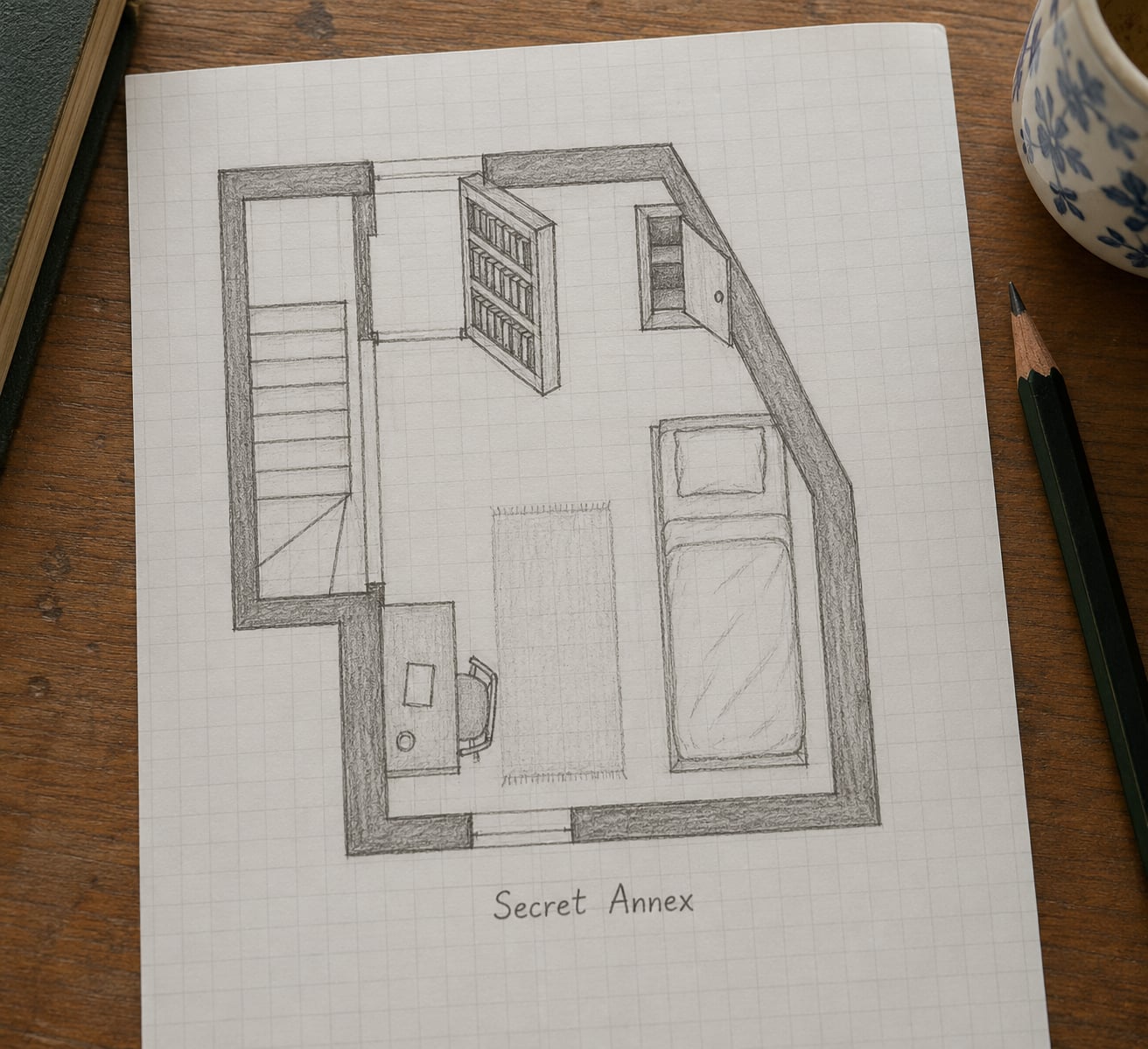
The annex gets described with catalogue precision because Anne is bored, and boredom makes her inventory her surroundings. A shared room, a shared bathroom, a cupboard she treats as a room of her own. The book shows what happens to a person with no space, no work and no way out.
Hope against evidence
Her best-known line is also the thesis of the book: in spite of everything, she still believes that people are really good at heart. It sits in the notebook among reports of arrests, hunger and betrayal, which is what makes it remarkable. Strong essay answers argue about whether that hope is strength, denial, or both, and use the diary’s own counter-evidence.
Family relationships
The diary is unusually honest about a mother-daughter bond that starts tense and turns warmer in the final months. Anne criticizes Edith constantly and then mourns her with real grief. Otto is the one she argues with least and relies on most.
The power of writing
Anne writes because she has to. The diary is her reader, her confessor and her reason to stay herself while everything around her is dismantled. When she says that paper is more patient than people, the book is describing its own method.
How Does Anne Use Her Diary as a Literary Device?
The diary form gives readers something no history book can offer: the inside of one person’s head, at one moment, in real time, including the parts that contradict each other.
Dated entries create a timeline without narration. Students can track the war and the private mood side by side, then watch the entries change in kind as the danger increases.
First-person narration makes every claim hers. When Anne says the Van Daans are terrible, that is a fifteen-year-old’s account of two adults she also has to live with. Reading the diary well means holding her perspective without accepting every judgment in it.
Direct address to Kitty turns a reader into a presence. Anne explains, apologizes to, corrects and occasionally scolds her imaginary friend. That intimacy is the engine of the form, and it is why the book feels private rather than published.
Revision and self-correction show a writer thinking. Anne rereads, disagrees with her earlier self and adds notes. That visible editing habit is also a safe topic for students who assume good writing comes out finished on the first try.
Humor as armor appears constantly. Much of the funny material is aimed at adults, which is both comic relief and a way of surviving them. The contrast between the jokes and what is coming is one of the book’s hardest effects, and it never fully resolves.
Silence and gaps matter as much as the words. Entries stop mid-thought, conversations get summarized rather than recorded, and the diary simply ends. The abrupt ending is the form’s final statement.
How Does the Setting Shape Anne Frank’s Writing?
Almost nothing in Anne’s writing is a stylistic accident. It all comes from the fact that she is a fourteen-year-old trapped indoors.
Time without occupation produces the diary’s real texture. With no school, no friends and no chores worth the name, Anne fills hours with reading, writing, complaining and quarrelling. Long stretches are boredom, and that boredom is what makes close reading possible, because nothing important happens on the surface.
Close quarters turns every domestic detail into drama. A cupboard, a bathroom schedule, a cat, a shared meal. Conflicts escalate fast because nobody can walk out of the room. The annex behaves like a pressure cooker, and the diary records the pressure.
Distance from the war creates an odd double exposure. Outside, people were being rounded up. Inside, the biggest event of a week might be a fight over a window. Later in the diary, news arrives through the helpers and through overheard radio reports, and the mood changes sharply. That gap between the bubble and the world is the setting’s most important effect.
No privacy means everything is performed. Anne writes about Edith, Peter and the Van Daans knowing she is writing about them, and she adjusts. A diary that cannot be private becomes something else, which is a good question to hand a class.
What Important Events Happen in The Diary of a Young Girl?
The diary covers a little over two years, and nearly everything in it hangs off a small number of dated moments.
- 12 June 1942: Anne begins the diary on her thirteenth birthday and immediately negotiates with her father about whether it is a real present.
- Early July 1942: Margot receives the call-up notice for a work camp. The family decides to hide within days.
- 6 July 1942: The Franks move into the annex behind the bookcase at Prinsengracht 263, joined shortly after by the Van Daan family.
- Autumn 1942: Eight people share two rooms, and quarrels over furniture begin almost immediately. Fritz Pfeffer arrives in November, and Anne starts writing to him as Dussel.
- Late 1943: The mood darkens. News from outside gets worse, food gets scarcer, and the arguments indoors get sharper. Dussel’s complaints about noise reach their peak.
- 29 March 1944: Anne hears that the Nazis are collecting diaries and searching for unauthorized writing. Her entries shift from private teenage concerns to a partial record of the war, and she works out a shorthand code.
- May 1944: The relationship with Peter softens. They spend time together, and the entries about him change noticeably in tone.
- Late July 1944: The annex has been betrayed. The last entries show the household disorganized and in disarray, with the adults packing and the girls crying.
- 4 August 1944: The eight people are arrested. The diary stops there, which is why there is no authenticated final entry.
- 1947: Otto Frank publishes the notebooks in Dutch as Het Achterhuis, after editing them and cutting material he considered unsuitable or unverified.
What Makes Anne Frank’s Writing Memorable?
She is memorable because she was not writing to be read, which is exactly why she reads so well.
Specific detail. Anne names the dress she wanted, the paper she wanted, the exact noise the upstairs neighbors made. The diary is full of floor-level texture, and readers attach to that texture instead of to abstraction.
Disagreement with herself. Two weeks apart, the same person writes about her mother in ways that cannot both be final. Readers who quote only one version miss the real subject, which is a girl trying to understand adults from inside the same house.
Ordinary worries beside catastrophe. The famous hope line is not a slogan in a speech. It follows weeks of hunger, theft and news of arrests, and it is written by someone who does not know what has happened to her. That placement is the whole effect.
Voice under stress. When things get worse, the jokes get sharper and the paragraphs get shorter. Point students at that shift. It is visible on the page and nobody in the book ever explains it.
How Should You Analyze Anne Frank’s Diary?
A method that beats summary-plus-themes is to move through the text in passes. Each pass answers one question and produces quotable evidence.
1. Track the tone. Read entries from three dates: the first month, the middle, and the last weeks. Note what Anne jokes about and what she stops joking about. That change is your evidence.
2. Build a dated timeline. Put events beside feelings. When Margot’s call-up notice is processed by the whole household, or when the diary collection news arrives, write down what Anne says that day or the day after. History and feeling rarely line up neatly, and the gap is worth an essay.
3. Follow one character. Pick Edith, Margot, Peter or Dussel and read every entry that mentions them, then write a single paragraph on what changed. Characters look flat until you collect their entries, which is the whole point.
4. Test the themes against the text. For each theme, find one entry that supports it and one that complicates it. The hope theme has excellent counter-evidence in the last months, and a strong answer acknowledges it.
5. Separate the person from the narrator. Ask what Anne reports, what she concludes, and what a source outside the annex might say about the same event. That is how a study guide teaches historical thinking instead of hero-worship.
6. Handle the difficult material deliberately. Read the arrest and the final entries in advance. Warn students plainly, make a quiet option available, and tell them that grief responses are normal and that stepping out is fine.
Study Questions and Essay Prompts for Your Class
These are grouped by skill level, with short answer guidance, so you can use them without buying a separate key.
Comprehension questions
- Why did the Frank family go into hiding rather than answer Margot’s call-up notice? Name the specific 1942 event that forced the decision.
- Who are the eight residents, and which two joined after Anne started the diary? Check your list against the Quick Facts table.
- What changes in Anne’s writing after 29 March 1944, and what news caused the change?
- Name two conflicts in the annex that never involve the war directly. What do they suggest about life in a crowded space?
Analysis questions
- How does Anne’s perception of the adults around her change across the two years? Support it with one early entry and one late entry.
- In what ways does the Secret Annex isolate its residents from the wider Holocaust, and how does news from outside reach them?
- Compare Anne’s relationship with her parents to Margot’s. Whose coping style does the diary treat more sympathetically, and how can you tell?
- How does the diary form shape the reliability and the intimacy of what Anne reports?
- Is Anne an unreliable narrator? Argue it in one direction using at least two entries.
Essay prompts
- Arguing the line: does Anne’s belief that people are good at heart hold up against her own evidence? Quote both sides.
- Sympathy or criticism: write a paragraph that treats Anne as a flawed teenager rather than a symbol, and defend each judgment with a dated entry.
- Adaptation: compare one entry with its scene in the 1955 play and account for what the scriptmaker changed and why.
Two classroom habits make this book land. Have students keep a side-by-side page of dated entries and historical events, so the distance between the private and the public keeps widening in front of them. And read the ending in class instead of assigning it silently, because the questions that follow the arrest are the ones students remember years later.
Frequently Asked Questions
Was Anne Frank LGBTQ+?
There is no evidence for it. Anne’s diaries contain no reference to any same-sex attraction or relationship. Viral posts claiming otherwise trace back to a fake magazine article and a page taken out of context, and the claims have been checked and debunked by the Anne Frank House. Anne writes often about Peter van Pels, but that is an adolescent crush, not a documented same-sex relationship. The rumor resurfaces every few years, so fact-check it before it reaches your class.
What were Anne Frank’s last words before she died?
Nobody knows, and any quote presented as her final words is unverified. The diary ends abruptly in early August 1944, with the household in disarray after the betrayal was discovered. Anne died at Bergen-Belsen in March 1945, and the last authenticated written words in the notebooks come from 1944. Treat any circulating last-words quote as a retelling rather than a document.
Did Anne Frank ever kiss a boy?
Anne wrote about being attracted to Peter van Pels and about a first kiss during their time in hiding, but the details vary between retellings and the historical record is thin on the point. Peter died at Auschwitz in 1944, so no living account has confirmed it. If a student asks, the honest answer is that the diary records her feelings clearly and the specific question far less clearly.
Who survived the Secret Annex?
Otto Frank was the only member of the Frank family to survive the war, and Auguste van Daan also came through Auschwitz and Bergen-Belsen alive. Everyone else who hid in the annex died in the camps. Miep Gies, the family secretary who preserved the notebooks, survived as well and died in 2003 without ever speaking publicly about what she had done.
What grade level is The Diary of a Young Girl?
Most commonly taught in grades 7 through 10, with adapted editions for younger readers in grades 5 and 6. Reading level matters less than a content warning: the closing entries include arrest, hunger and implied deaths, and many middle school classes read the diary in sections. Preview the ending, warn students ahead of time, and keep a quiet option available.
Should I teach the diary or the 1955 play?
Teach the diary first when the course is literature, since the voice, the form and the 1944 shift in content are the whole point. Teach the play when time is short or the focus is drama, because Goodrich and Hackett condensed the book into two acts. The play omits the original German passages, some of the raw adolescent writing and Otto’s editing. Assigning both makes the comparison work.