Macbeth is a tragedy by William Shakespeare, written around 1606, in which a respected Scottish general is told by three witches that he will become king. He kills the reigning king to make it true, and the guilt, paranoia and moral collapse that follow destroy him, his wife and his rule.
That is the whole story in three sentences. This guide goes further: the five-act plot, the eight characters who actually drive it, the five themes that examiners return to again and again, the quotations worth memorising, and a revision sequence you can follow over a fortnight. It works for GCSE, A-level and AP English Literature, and it assumes nothing beyond the play itself.
Students who revise this text badly treat it as a wall of isolated lines. Students who revise it well treat it as a chain of cause and effect: an ambition created by prophecy, a guilt created by action, and a ruler undone by both. Everything below is built on that second idea.
Table of Contents
- Macbeth Study Guide for Students at a Glance
- What Is Macbeth About?
- Macbeth Study Guide for Students: Plot and Scene Summary
- Act 1: The prophecy and the decision
- Act 2: The murder and its immediate cost
- Act 3: Consequences multiply
- Act 4: Malcolm assembles an army
- Act 5: The end of the rule
- The 10 most important scenes
- Who Are the Main Characters in Macbeth?
- Macbeth
- Lady Macbeth
- Banquo and Duncan
- The three witches
- Macduff, Malcolm, and the opposition
- What Are the Major Themes in Macbeth?
- How Does Ambition Drive the Tragedy?
- How does guilt change Macbeth’s behaviour?
- What does the play say about fate and free will?
- Why is appearance against reality a major theme?
- What does the play say about power, legitimacy, and masculinity?
- What role do fear and time play?
- Which Scenes and Quotations Should Students Know?
- How Does Shakespeare Use Imagery, Repetition, and Contrast?
- How Should Students Study Macbeth for an Exam or Essay?
- A revision plan you can actually follow
- How to build an argument rather than a summary
- Study questions by exam level
- Five mistakes students make
- A short glossary
- Frequently Asked Questions
- What is the shortest summary of Macbeth?
- Is Macbeth a tragic hero?
- How many acts and scenes are in Macbeth?
- Why can’t Lady Macbeth sleep?
- How do I start an essay about Macbeth?
- Conclusion: Where Should Students Begin?
Macbeth Study Guide for Students at a Glance

Before you read a line of the play, put these facts down. They come up in quizzes, in the opening of essays, and in the first three minutes of nearly every exam discussion.
| Question | Answer |
|---|---|
| Who wrote it? | William Shakespeare, probably with collaborators in the scenes conventionally attributed to Thomas Middleton |
| When was it written? | Around 1606 |
| When was it first performed? | Probably 1611, at the Globe |
| What genre is it? | Tragedy, in the Jacobean sense as well as the modern one |
| How long is it? | Five acts and 29 scenes |
| Where is it set? | Medieval Scotland, with brief excursions to England |
| What is the main source? | Holinshed’s Chronicles, a 1577 history of the Scottish kings |
| Who is the intended audience? | A playgoing public in King James I’s London, two years after the Gunpowder Plot |
That last row matters more than students expect. James I was a committed Christian monarch who believed kingship was a divine appointment, and he had just survived a plot to blow up parliament. A play about a man who destroys a lawful king to seize his throne was not an abstract exercise for the people in the front rows.
What Is Macbeth About?
Macbeth is about a man who is offered his own ambition by people he should not trust, and who spends the rest of the play discovering that a prediction is not an excuse. The play is about the distance between what Macbeth wants and what he is, and about how quickly that distance collapses once he starts killing.
The simple plot: the three witches prophesy that Macbeth will be king, that Banquo’s children will follow him, and that Macbeth must be more careful than Banquo. Macbeth writes to his wife, Lady Macbeth begins to treat the prophecy as an instruction rather than a warning, and together they murder King Duncan in his own bed. Every subsequent death follows from that one: Banquo, Macduff’s family, the young Siward, and finally Macbeth himself.
The deeper argument sits underneath the plot. Shakespeare is not really asking whether Macbeth was fated to do this; he is asking what it means to be responsible when you had time to stop.
Macbeth has genuine freedom throughout. He chooses to write the letter, chooses to accept his wife’s plan, chooses again before Duncan enters, and chooses again at every step afterwards. The play keeps insisting on that choice, and the guilt he feels is the evidence of it.
It also asks what power actually requires. Malcolm, the rightful king who was never crowned, is calmer, kinder and more articulate than Macbeth, and the play wants us to notice that legitimacy is not just about having a claim. It comes from how you behave once you have it.
Macbeth Study Guide for Students: Plot and Scene Summary
Act 1: The prophecy and the decision
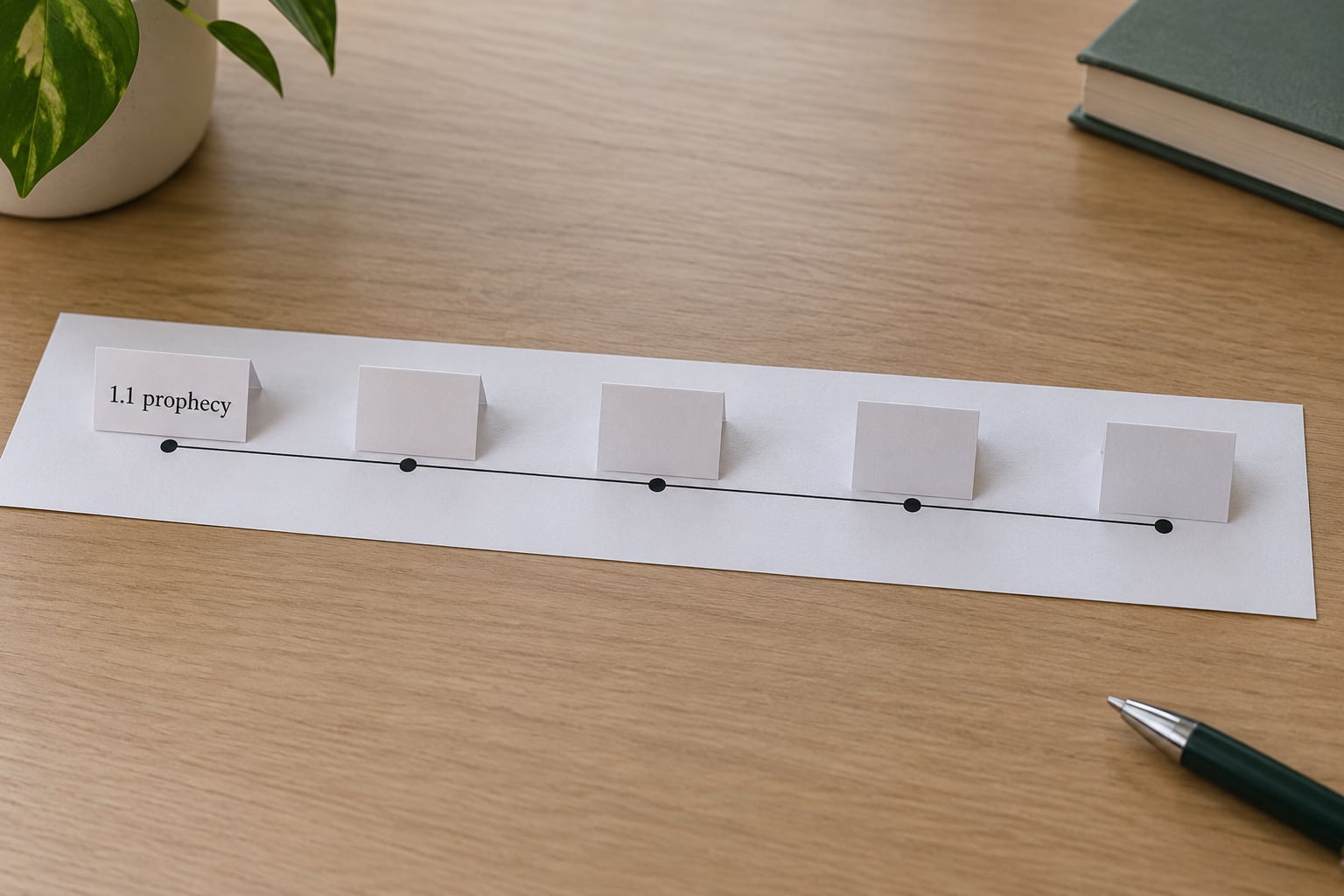
A storm on a heath. Three witches, or the Weird Sisters, meet to wait for Macbeth, Banquo and the arriving Thane of Cawdor. They greet him with three promises: he will be Thane of Glamis, then Thane of Cawdor, and then king. They also promise him three pieces of information about Banquo, and they vanish before Banquo arrives, so he asks Macbeth what they said and gets a partial, evasive answer (1.1 and 1.3).
Ross arrives with news that the battle is won and that Macbeth has been given the title of thane of Cawdor. In the same scene the witches predict that Banquo’s descendants will be kings and that Macbeth will be the one to kill them, and they show him a floating dagger as a reward.
Macbeth tells his wife in a letter, and his reaction in 1.3 is the play’s most important piece of hesitation. He says that if the prophecy had told him to kill Duncan, his ambition would be blind. He is not yet blind, and he tells himself he has no spur to prick the sides of his intent.
Lady Macbeth reads the letter, works out that her husband will not do it on his own, and begins to argue. Her speech in 1.7 is the play’s most quoted instruction: “When you durst do it, then you were a man.” She is not actually calling him a coward. She is telling him that the man he believes himself to be is the man who acts, and she is defined by doing whatever is required. “Come what come may” is Macbeth’s surrender, not a decision.
They plan it for the night Duncan sleeps in their house, and the act closes with Macbeth walking in the dark, seeing a floating blade, hearing a voice, and feeling nothing.
Act 2: The murder and its immediate cost
Macbeth sees a dagger before the door in 2.1 and speaks his way through it. The speech is not a hallucination so much as a description of a choice he has already half made. He says the thought has no heat in it, that he is not a man of the act, and he asks the dagger to be a spur rather than a blade. The fantasy ends with “I have no spur to prick the sides of my intent.” The buckling and the heaving of his soul in the same speech show the argument happening in real time.
He kills Duncan in his bed, and immediately says that blood will have blood. He is heard outside, which proves the others did not keep the plan. He returns to Lady Macbeth carrying the daggers, and she takes them back to plant them, returning visibly disturbed. The act ends on a knocking at the door: the Macduffs have arrived, having left Macbeth at the outer gate, and the moment the king is dead they are the natural suspects.
The Porter scene in 2.3 is worth thirty seconds of revision attention. A comic relief, technically, but it is also the one place in the play where ordinary Scotland describes the murderers. The Porter reels off a list of trades and figures who have knocked Macbeth down before, says that beggary will not save the man who did it, and drops the name of Macduff. He puts the word hell in an ordinary Scottish mouth, and he makes the audience wait for a knock that is already coming.
Macduff reports the body: he found the king in his bed and has run to raise the alarm. The news spreads through a hall already in chaos, and Duncan’s sons Malcolm and Donalbain are both in the building and both flee, which removes anyone who might have traced the night.
Angus remarks on the strange storm. Then a huge cry goes up in the dark, and a crowd reports that Macduff’s wife and children have been murdered in his own house.
Act 3: Consequences multiply
In 3.1 Macbeth studies a list: he has read it in the sleepwalking forecast, and it is the list of the kingly names and their successors. Macduff and the English army are on it, so he hires men to kill them, and the play gives us the instructions in full while keeping the act itself offstage. Banquo is in the house and Fleance, who is to become a king, is sent out of harm’s way. The murderers return and say only that Banquo is dead and that Fleance has escaped. This is the moment where ambition turns into administration, and the horror is administrative. Later in the act Banquo’s ghost appears at the feast, and the guests see an apparition only Macbeth can explain away.
In 3.3 Macbeth revisits the witches, who confirm that Banquo’s son will be king, that no one of woman born can kill him, and that Malcolm will not be crowned until Birnam Wood moves to Dunsinane. They again choose equivocation over truth. Macbeth takes this as a licence to stop feeling guilty, which is the deepest horror in the play.
Macbeth also learns in 3.3 that his wife has died, and replies that she would have died sooner anyway. The news lands as relief, which tells the reader how far apart they have drifted.
Act 4: Malcolm assembles an army
England. Malcolm gathers Siward’s forces, and the audience learns that it was Macduff who discovered the king’s body only when his own wife is named, which lets the play share Macbeth’s uncertainty for a scene. In 4.1 Malcolm tests Macduff’s loyalty with a series of admissions, from evil deeds he never had the mind to do to a hypothetical monstrous act, and Macduff answers every one of them with a statement of support.
Meanwhile the witches show Macbeth an apparition of the future: Banquo’s descendants as kings, and Macduff holding a head, with a tree before the castle, and one of the witches crying “Macduff must be slain.” He accepts this reading.
Act 5: The end of the rule
The castle sits at Dunsinane. In the night Lady Macbeth walks with a taper, trying to clean imaginary blood from her hands. She repeats sleep, guilt, blood, the murder, the helm on a pillar and the sound of a cry, and finally says the time will come for Macbeth.
It is a scene in which two realities play out at once, because she has gone back to the night of the murder. The Doctor’s line here diagnoses Macbeth’s hallucinations, which by this point are a permanent condition.
Malcolm’s army approaches. In 5.4 Macbeth’s thanes are already deserting him, and it is clear that his rule is finished before anyone fights for it. He leaves the castle to meet his fate.
In 5.5 the news of his wife’s death comes, and he begins “Tomorrow, and tomorrow, and tomorrow.” His response is not grief but a man whose sense of time has been destroyed, because death makes identity trivial.
He moves from a walking shadow to the blood of a man as the messenger reports the deaths, and on to dust.
The final scene changes everything. Malcolm, Macduff, Ross and Angus enter the ruined castle. Macduff is the man who was not born of woman, and the news breaks the certainty Macbeth has been living inside for four years. The witches’ prophecies all still stand as riddles, which is the point: it was never the prophecy that was doing the killing. Macduff fights Macbeth, and kills him. Malcolm is crowned at Scone, and the play ends with the judgment that nothing in his life became him like the leaving it.
The 10 most important scenes
If your exam is tomorrow, read these ten and nothing else. Between them they carry the prophecy, the murder, the consequences, the opposition and the ending.
- 1.1 — the witches and the opening argument about appearance. Nothing later is comprehensible without it.
- 1.3 — the letter, the Banquo prophecy and the floating dagger, which is where Macbeth stops resisting.
- 1.5 — the letter read, the sleepwalking plot devised, and Lady Macbeth’s “come, thick night”.
- 1.7 — Lady Macbeth’s speech that changes Macbeth’s mind. The most examined scene in the play.
- 2.1 — the dagger speech, and the clearest close-reading passage in the text.
- 2.2 — the murder, “blood will have blood”, and “Macbeth does murder sleep”.
- 3.2 — the banquet, the ghost of Banquo and Macbeth’s “I am a man of substance”, which is the play’s turning point in his self-image.
- 4.1 — Malcolm’s test of Macduff, and the contrast that proves Macbeth’s rule illegitimate.
- 5.1 — the sleepwalking scene, “out, damned spot”, and Lady Macbeth’s collapse.
- 5.5 — “tomorrow, and tomorrow, and tomorrow”, and the death of the only person Macbeth could still talk to.
Who Are the Main Characters in Macbeth?
| Character | Role | What they want | Fate or choice | Consequence |
|---|---|---|---|---|
| Macbeth | General, then Thane of Glamis, then king | Validation, prophecy fulfilled, security | Choice, repeatedly delayed then made | Tyrant, destroyed by his own guilt |
| Lady Macbeth | Lady Macbeth, his wife | Power for him, a role for herself | Choice, and the more active one | Mad, then dead, before he is |
| Duncan | King of Scotland | Good government; to be a good king | Fate, murdered in his bed | Dead, and the murder plants the seed of the whole play |
| Banquo | General, and the other prophesied line | Honour, and safety for his sons | Trusts Macbeth, and rightly is trusting | Murdered on Macbeth’s instruction, on his own |
| The three witches | Prophets of the plot | Unknown, they act only to give Macbeth a shape for his own desire | Ambiguous; they tell truths and equivocate | Make him think he is safe, and he stops feeling guilty |
| Macduff | Thane of Fife, then enemy commander | Justice for his murdered family, and for Duncan | Choice, and the right one | Kills Macbeth, having already lost his own son |
| Malcolm | Duncan’s son, heir, then king | The throne, held legitimately | Fate, tested but untempted | Proves that the play was not inevitable |
| Lady-in-Waiting (Gentlewoman) | Lady Macbeth’s attendant | To do her duty | Witness | Carries the secret, and the audience’s access to it |
Macbeth
Macbeth is the most discussed character in the play and the least consistently understood. He is not simply ambitious, because ambition comes from outside him. He is a man with a real imagination of what a life could be, and with a real talent for warfare, who is shown what he wants in advance of his having to choose it. The dagger speech is the centre of him: a man who can describe a decision in exquisite detail and then find he cannot make it move.
His arc runs in three stages. Before Duncan’s death, he is a general with a private moral life. After it, he becomes a ruler who cannot stop, because every new killing is an attempt to end the anxiety that the last one produced. The most defensible reading is that the man in the grave-yard scene who is “too much of the prisian” to tell the truth is the play’s only glimpse of a man he might have been.
Lady Macbeth
Lady Macbeth is the most misread character in English literature. The popular version is a shrieking, unfeeling monster, and students who stop there lose the argument.
She is a woman in a world where women have no political agency, and the play is aware of it. In 1.3 she says that the sphere of a woman is not a public one, and she is right, because there is no version of this in which she can seize power. Her only route runs through her husband, which is why the murder is her route to significance.
What does she mean by “unsex me here”? She is asking to be given, in the language of the period, the strength and resolve that she believes are male. She is not questioning her own gender; she is asking Macbeth to give her a temporary identity that would make the act possible, and to take the ordinary constraints of her position off her. The scene is strange precisely because the request is odd, and that strangeness is what the Jacobean audience responded to.
Her collapse is the play’s most economical piece of writing. The one woman who could act without hesitation is the one who forgets everything except her guilt.
The message is not that she deserved it. It is that she suppressed the part of herself that could have stopped it, and nothing else was left.
Banquo and Duncan
Banquo is Macbeth’s equal and his contrast, and the play pairs them from their first meeting. Both fight the same battle and both receive the same prophecy, and where Macbeth says the witches made his ambition blind, Banquo says they would tempt him to the evil rather than to the good.
Banquo then does the thing Macbeth never does: he asks directly what the women said, and he names them as instruments of darkness in Act 1 Scene 3. It is the immediate model for what Macbeth cannot do, which is change another person’s mind.
He is murdered on his own return from the ride, in a scene Shakespeare gives almost entirely to Macbeth’s instructions. Banquo is the play’s reminder of what ambition actually costs other people, which is why he cannot be left alive.
Duncan is more brief and more straightforwardly good: he pays Macbeth in gratitude, offers the succession on trust, and is killed in his sleep at the house of the man he has just praised. The order matters, because Duncan’s innocence is established before the murder, so the audience judges Macbeth against the best available example of the role he is taking.
The three witches
The witches are never the villain of the play, because they are never on stage and never kill anyone. They tell Macbeth a set of facts, some flattering and some not, and they leave him to act on them. Their status is deliberately uncertain: they may be real, or a reading of Macbeth’s own mind that he needs in order to do what he wants.
Two details are worth knowing for essays. First, they use equivocation, and they are scrupulous about it: none of woman born, until Birnam Wood moves to Dunsinane, and the cryptic imagery of a forest and a head.
Second, they reward Macbeth with a floating dagger in 1.3, before he has any use for it. That is either a promise of the method or a reflection of what he has already been thinking, and reading the witches as Macbeth’s conscience is at least as defensible as reading them as the supernatural.
Macduff, Malcolm, and the opposition
Macduff is the play’s action. Unlike the others he is not driven by prophecy or by ambition, he is driven by a fact: his wife and children were killed on Macbeth’s orders, in a scene played offstage.
That restraint is deliberate, because Shakespeare never shows you the children. It is the single most effective piece of economy in the play, and it is the reason Macduff is its most sympathetic character.
Malcolm is the play’s argument against Macbeth, and his test in 4.1 is the subtlest writing in the text. He does not defend himself. He volunteers a series of confessions of terrible sin, in ascending order, and waits for Macduff to withdraw his support, which would kill the campaign. Macduff answers each one, and the demonstration that works is that Macbeth needed a Malcolm who would not have given it. Malcolm is decent, then, and Macbeth is king, and the play finds that as the most damning fact of all.
The Gentlewoman, Lady Macbeth’s attendant, is worth a sentence in any answer on guilt. She refuses to explain, and her silence is the reason we know what has happened before the Doctor arrives. In a play full of characters who talk too much, she is the reliable witness.
What Are the Major Themes in Macbeth?
If you have five themes to name in an exam, name these five, in these words, and you will match most mark schemes.
- Ambition. Macbeth wants more than he has, and the wanting is the tragedy, not the killing.
- Guilt and conscience. Doing the deed does not end the mind’s work on it; it begins it.
- Fate versus free will. The witches predict; they do not compel. The play measures the gap between the two.
- Appearance versus reality. Fair is foul, false faces, the murdered king’s body moved, and a murdered king called murdered.
- Moral order and legitimacy. The play treats the killing of a king as a break in the world, not just in a family.
Beyond those five, four more carry weight in almost every essay.
How Does Ambition Drive the Tragedy?
Ambition in Macbeth is never a single thing, and the play is careful to show the difference. Macbeth’s ambition is a leap of the imagination: he is shown a possible self and leaps. Lady Macbeth’s ambition is a much more practical hunger for standing, and she is the one who supplies a plan. Then comes a third kind, which examiners sometimes call corruption rather than ambition: the sense that having started, Macbeth can never stop, so he kills to keep the position he has taken. That is why the hit list in 3.1 is a list, and why it is read aloud as a schedule.
The witches push first, by making the future visible. Lady Macbeth pushes harder, by making the present unbearable. And Macbeth pushes himself, hardest of all, every time he decides the crime that has already happened was not enough.
The tragedy is that ambition becomes destructive exactly when the two motives fuse. Ambition alone might have faded, as Macbeth himself admits it would have done, if it had arrived without the pressure of prophecy behind it. Guilt alone might have been survivable. It is the combination of a promise and a fear that leaves him with no state to return to.
Two short scenes are where the argument lives. In 1.7 Lady Macbeth says the only thing needed is a fixed resolve, and that once the deed is done no further effort will matter.
She is wrong about the last part, and she will die having learned it. In 3.3 the instruments of darkness tell him truths and plunge him into the fire, and the word to watch afterwards is enemies. He has moved from guilt to strategy, and strategy is the last place the play can still reach him.
How does guilt change Macbeth’s behaviour?
Guilt in this play is psychological and almost physical. Macbeth is not sorry that Duncan is dead; he is ruined by having killed him. The difference is worth a sentence in an essay, because it is what separates tragedy from remorse. His guilt shows up as a lack of sleep, as a compulsion to repeat the act, as a need to be alone with the murderer, and eventually as a self-justifying speech to the dead body that stops in the middle of a sentence.
Lady Macbeth’s guilt is the inverse. She kills more easily than he does, and she is the one who cannot sleep, which is why the sleep motif is not a metaphor for her alone. Macbeth murders sleep in the moral sense; Lady Macbeth is destroyed by the sleep she refused to give him.
What does the play say about fate and free will?
Read the prophecies carefully and you will find that none of them mentions the murder. The witches say Macbeth will be king, that he will be the one to kill Banquo’s descendants, that no man of woman born will kill him, and that Birnam Wood will move to Dunsinane.
Every one of those is ambiguous, and none of them says Duncan will be the one who dies.
That is the play’s argument. The prophecy supplies Macbeth with a shape for his desires, and everything after that is his own doing. He is aware of the gap: when he tells himself that a thought which did not arrive of its own accord has no power to move him, he is admitting that he has to invent his own motive. A student who writes that the witches make Macbeth king is describing a line nobody in the play says.
The counter-argument is that the play keeps inviting us to hear prophecy everywhere, from the thunder, from the apparitions, from the vision of the armed head. The best essays sit with both and argue about the difference between being told a future and consenting to it.
Why is appearance against reality a major theme?
The play’s first line is the argument: fair is foul, and foul is fair. Everything after is a version of it, and Duncan’s sons Malcolm and Donalbain are in his house the night he dies and both run for their lives, so the two people best placed to explain the night are gone before anyone can question them.
Malcolm then plays the appearance of a tyrant in England, having never done anything, so that Macduff will trust him. Macbeth appears to be a loyal subject at the start and a crowned king at the end, and the audience watches both appearances collapse.
The best evidence is the blood. Duncan says, before he dies, that it is the least of the harms that will follow, and he is right. Hypocrisy, disguise and rearrangement are the play’s real subject, and the most exam-friendly line to quote is Lady Macbeth’s speech about borrowing a face in 1.7.
What does the play say about power, legitimacy, and masculinity?
On power: the play measures rule. Malcolm argues with a king’s authority in 4.1, while Macbeth kills a king in his bed, cannot sleep, and then begins ordering the deaths of everyone who might carry a claim. Legitimacy is treated as a matter of conduct rather than blood, which is why Malcolm’s reign can begin before the play ends without anyone questioning it.
On masculinity: the play uses it as a demand rather than an achievement. “When you durst do it, then you were a man” is not a compliment, it is a test, and Lady Macbeth abandons the identity she adopted in 1.7. By 5.1 the roles are reversed: she says “I have given him the rarest kind of love,” and Macbeth is the one still awake, still armed, still waiting for the dawn.
What role do fear and time play?
Fear is the play’s clock. Macbeth’s fear is not terror of the law, it is fear of the inside of his own head, and it drives him to preemptive killing. The final scenes give him a fear that is neither fear nor doubt but resignation: “I bear a charmed life which must not yield to one of woman born.” Time, in 5.5, is the last thing he loses. After Lady Macbeth’s death, the future stops meaning anything to him, and the speech’s repetition of “tomorrow” is the sound of a man who has lost the ability to plan.
Which Scenes and Quotations Should Students Know?
Learn these as three things: the line, what it means in plain English, and what it is doing at that moment. A quotation without its situation is a decoration, and examiners mark on the situation.
1.1 — “Fair is foul, and foul is fair.” In plain English: things are not what they look like, and what is foul will be called fair. It establishes the play’s argument, sets the storm, and tells the audience they should not trust appearances, which they will need to remember when a dead king is carried in by two men.
1.1 — “When shall we three meet again / In thunder, lightning, or in rain?” In plain English: the three of us will meet again in a storm. It tells the audience that the weather is wrong, and it introduces the witches as creatures of disturbance rather than as goddesses or demons.
1.3 — “If chance will have me king, / Why, chance may crown me, / Without my stir.” In plain English: if the gods want this, I do not have to do anything for it to happen. It is Macbeth at his most honest, and it is the sentence he spends the rest of the play contradicting. For an essay on fate and free will, this is the line to start from.
1.4 — “There is no art / To find the mind’s construction in the face.” In plain English: you cannot read a person’s thoughts from their face. It is Duncan, and it is the play’s clearest statement of the appearance theme, delivered by the one man who is about to be deceived about his own face.
1.5 — “Come, thick night, / And pall thee in the dunnest smoke of hell.” In plain English: cover the country in darkness. It is Lady Macbeth asking for concealment, but the light-and-dark image is already the play’s language for what is coming, and it returns every time a crime is discussed in the dark.
1.7 — “When you durst do it, then you were a man.” In plain English: you are not a man until you prove it. It is a challenge, not an insult, and Macbeth accepts it in the same speech with “We will proceed no further in this business.” Also in 1.7: “Come what come may”, which is the surrender, and the “false face” lines, which show her being deliberately dishonest.
2.1 — “Is this a dagger which I see before me, / The handle toward my hand?” In plain English: is this a real knife, or a picture of one in my head? It is worth pairing with the same speech’s “I have no spur to prick the sides of my intent”, which is the opposite of a man who has already decided. The speech is a close-reading gift: the man describes the act in detail and then finds he cannot begin it.
2.2 — “Will all great Neptune’s ocean wash this blood clean from my hand?” In plain English: can any amount of water make my hands clean. It marks the instant the murder becomes irreversible, because Macbeth believes the problem is now physical rather than moral.
2.2 — “Methought I heard a voice cry ‘Sleep no more! / Macbeth does murder sleep.” In plain English: I heard a voice telling me that I will never sleep again, because of what I have done. He murders sleep in the moral sense, and from this point his lack of sleep is both a symptom and a punishment.
2.2 — “The labour we delight in, physics pain.” In plain English: the work we enjoy turns into pain. It is Lady Macbeth walking in the night, and it is the play’s clearest signal that the murder has separated them permanently.
3.3 — “The instruments of darkness tell us truths / And plunge immediately into the fire.” In plain English: the darkness told me something I did not want to hear. It shows Macbeth choosing the story that lets him live, and the play’s judgement is in what follows, when he tells himself he will never feel fear again.
4.1 — “Macbeth shall never vanquish’d be.” In plain English: no man born of a woman will ever defeat Macbeth. It is the wrong branch of the prophecy, read by a man who has stopped checking his own reasons, and it is the reason he is still alive in 5.7.
5.1 — “Out, damned spot! Out, I say!” In plain English: get rid of the blood, get rid of it, I am telling you. The word “damned” is a religious and legal word in the period, and it is used by a woman who has done nothing damned except share her husband’s crime.
5.2 — “It is the disease of the mind.” In plain English: he is ill, and the illness is in his head. The Doctor cannot name it because the play has no medical vocabulary for guilt, and the line is the play’s way of saying that Macbeth is his own illness. The Doctor then says the patient needs a physican, which is both physician and healer, and the wordplay is doing real work: the play offers no cure.
5.5 — “Tomorrow, and tomorrow, and tomorrow.” In plain English: there is no point in planning, because nothing you plan will happen. Then: “Life’s but a walking shadow, / A poor player / That struts and frets his hour upon the stage.” It is Macbeth telling us that the future, which was the whole content of his ambition, is now empty.
5.5 — “The play’s done.” In plain English: it is finished. Three words, and the whole of the play is in them: everything he was willing to do to be king, done with, and only now.
4.2 — “A plague o’ both your houses!” In plain English: may something terrible happen to both families, the one Macbeth has married into and the one that ordered his wife and children killed. It is Malcolm, and it is the moment when the play’s two families become one disease.
5.11 — “Nothing in his life became him like the leaving it.” In plain English: death suited him better than life. It is Malcolm’s closing judgment on Macbeth, and the last line of the play.
| Theme | Quote | Scene |
|---|---|---|
| Ambition | “I have no spur to prick the sides of my intent” | 1.3, 2.1 |
| Guilt and conscience | “Macbeth does murder sleep” | 2.2 |
| Fate and free will | “If chance will have me king” | 1.3 |
| Appearance and reality | “Fair is foul, and foul is fair” | 1.1 |
| Appearance and reality | “There is no art to find the mind’s construction in the face” | 1.4 |
| Moral order | “Blood will have blood” | 2.2 |
| Power and legitimacy | “A plague o’ both your houses” | 4.2 |
| Masculinity and loss | “When you durst do it, then you were a man” | 1.7 |
Note how few scenes the important material comes from. Ten of the play’s twenty-nine scenes carry almost everything an exam rewards, and 2.2 alone contains four of the eight quotations above.
How Does Shakespeare Use Imagery, Repetition, and Contrast?
Most marks for language come from noticing a pattern, not a single line. Find the word that keeps coming back and the argument of the scene usually becomes visible.
Blood. It is the most obvious image and the one that changes. It begins as something physical, on Duncan’s hands and on the chamber floor, and ends as something Macbeth thinks of as a stain on his own life.
Lady Macbeth’s “Out, damned spot” is the same image from the other side: the one woman trying to clean what cannot be cleaned.
Sleep. Sleep is the play’s condition of innocence, and the play says so. Lady Macbeth asks for a decent night’s sleep and never has one again, and Macbeth murders sleep in the moral sense. The metaphor carries a religious charge too, since sleep in the period is a picture of death and of spiritual peace.
Darkness and night. Almost every important action in the play happens at night and is described in the language of night: “Come, thick night”, “a candle in the dark”, “a liquor of damnation”, “a paralyzer of eyes”. The time of the play moves steadily toward night, and the climax, the meeting at Dunsinane, happens in the dark.
Daggers and knives. The images in 1.3 and 2.1 are deliberately identical, a thing that happens before it happens. Study the pair as a sequence and the difference between a promise and an act is visible in the two images alone.
Hands. Duncan’s hands, Macbeth’s hands, Lady Macbeth’s hands. The guilt of this play is repeatedly in the hands, and the hands are also what a murderer uses to conceal his own face, which is the point.
Masks and unfitting clothes. The play’s recurring figure for disguise: false faces, borrowed robes, a “tattered ancient”, and the murderers’ masks. The clearest case is the discovery of the body, where the men who found it are the only two who can be certain no one else did. A man who cannot appear as himself is a man who has nothing left to be.
Weather. The play opens in a storm, and the weather keeps mirroring the state of the kingdom. In 5.4 Macbeth calls the coming day a “dulled” one and a time of darkness. The porter’s door, with its knock, knock, knock, breaks the pattern deliberately: it is a moment of bad weather, in a play of bad weather.
Unborn children. The “pale end of the earth”, the chest that no man born may open, and Macduff, who was not of woman born, form one image. Macbeth’s ambition is repeatedly described as a child he will never have, and the man who defeats him is a man who was carried out of his mother’s womb before he was born.
Repetition. “Tomorrow, and tomorrow, and tomorrow”, repeated three times, and “Sleep no more”, repeated by Macbeth and by the voice. Both repetitions are a character telling us something has changed and cannot be changed back. Repetition in this play is not emphasis, it is obsession.
Contrast. The play’s contrasts are the point of its structure: daylight and dark, sleep and waking, appearance and reality, and above all Macbeth and Malcolm. Both men are asked to cross a line, and one crosses it while the other is asked to confirm he has not.
How Should Students Study Macbeth for an Exam or Essay?
A revision plan you can actually follow
- Get the plot down in one page, not five. Read an act-by-act summary and write one sentence per act. If you can do that, you can recall the order of events without rereading the play.
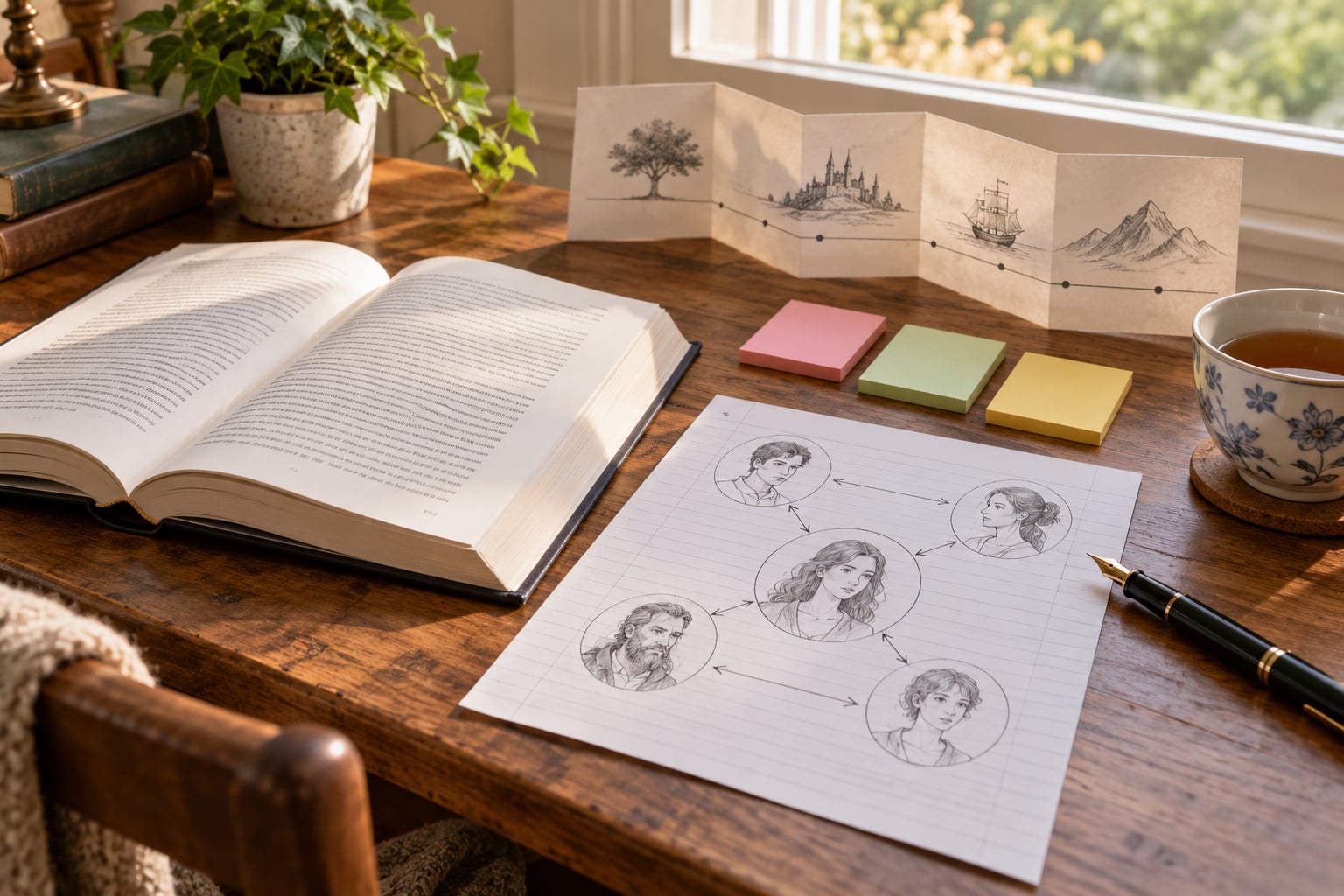
- Build a character map. One page, with each character and what they want, what they do about it, and what it costs them. Most marks are lost here because students treat characters as a list of traits instead of a list of motives.
- Track the three progressions. Sleep, blood and darkness. Note where each one appears, in order, and by the end you will have the play’s structure without having memorised it.
- Learn ten quotations properly. Not ten lines, but ten quotations with their scene, their paraphrase and one sentence of analysis. Ten is enough to write any essay; twenty is not enough to write any well.
- Read four scenes closely. One from each act, and never the whole text. Choose 1.1, 2.2, 4.1 and 5.5 as a starting set, because between them they cover the witches, the murder, the opposition and the collapse.
- Write one paragraph a week. A single analytical paragraph on a chosen quotation. Paragraphs are the unit examiners mark, and most students revise for hours without writing one.
How to build an argument rather than a summary
A summary sentence tells the examiner what happened. An analytical sentence tells them what it means and what it is doing. Compare these two:
Macbeth is alone in Act 2 Scene 1, and he talks to a dagger. That is the summary version: no argument, nothing to mark.
Macbeth addresses a floating dagger in Act 2 Scene 1 to delay the murder he has already agreed to, and the fact that he describes the blade in this much detail means he has imagined the act many times before he performs it. That is the analytical version: a claim, a quotation, and a reason.
A simple formula for a thesis, if you are stuck: in the given scene, Macbeth’s chosen word, shown by a quotation, reveals how a named theme works across the play. A worked version: in Act 2 Scene 2 Macbeth’s refusal to admit that a drop of water can clean his hands shows that guilt in this play is physical rather than moral, and it explains why he can never stop killing.
Study questions by exam level
GCSE level. These reward a clear position and one or two references.
- How does Shakespeare present ambition as dangerous in Macbeth?
- How does the play present the relationship between Macbeth and Lady Macbeth, and how does it change?
- How does Shakespeare use dramatic irony in the first act?
- “Blood will have blood.” How does Shakespeare present guilt in Macbeth?
For a model structure, take the first question and answer it in three paragraphs: define ambition, use the witches and Lady Macbeth as evidence, then use 5.5 to show ambition destroyed by its own result. That is enough for the top band if the quotations are integrated into sentences about the play.
A-level level. These reward sustained argument and an awareness that characters can be read more than one way.
- To what extent is Macbeth a tragic hero?
- “Is this a dagger which I see before me” – how does Shakespeare use the supernatural to explore Macbeth’s psychology?
- How far does Shakespeare suggest that the play is about the collapse of political order rather than one man’s ambition?
- How successfully does Shakespeare present Lady Macbeth?
For the tragic hero question, a strong answer argues both sides: he has status, he has a tragic flaw, and he meets a violent death, but a tragic hero’s death redeems the order. Macduff’s last act and Malcolm’s closing line make that redemption impossible.
AP level. These reward close reading of language and the ability to write about a text without assuming the audience knows it.
- How does Shakespeare use repetition to develop the theme of guilt in Act 2?
- Discuss the dramatic function of the porter scene.
- How does the play’s language of light and dark work against the character of Malcolm?
- What does the play suggest about the relationship between prophecy and choice?
For the porter question, the answer is that the comic scene does three jobs at once: it gives the play a change of rhythm at its darkest moment, it puts the word “hell” in an ordinary Scottish mouth, and it makes the audience wait for Macduff, which raises the dread.
Five mistakes students make
Treating Macbeth as simply a villain. The play gives him a real capacity for tenderness and imagination, and that is what makes the fall tragic. A villain would not hesitate at the door.
Treating the play as a simple warning. It warns, yes, but the real subject is what guilt does to a mind over two months, and how quickly a man can talk himself past a moral objection. A purely moral reading misses the psychology.
Assuming the witches cause the murder. They never mention Duncan. Macbeth’s own letter to his wife, and his own decision before Duncan enters the room, are the murder.
Quoting without the scene. Mark schemes reward act and scene references, and they are also how you check you are remembering the right version of the line.
Reading the language word by word. Early Modern English is a barrier, and the way through it is to read a scene once for the meaning and once for the words. The meaning is almost always available in the surrounding lines.
A short glossary
Thane — a Scottish noble rank. Regicide — the killing of a king. Soliloquy — a speech made by a character alone on stage, and the audience overhears it. Iambic pentameter — the five-beat rhythm of most of the play’s verse, and the reason the speeches feel like speeches. Foreshadowing — a hint of something later, as in the daggers and the apparitions. Hubris — excessive pride. Equivocation — saying something true in words that can be interpreted more than one way, which is the witches’ method. Unsex — in Lady Macbeth’s invocation, to be given a different, supposedly masculine nature.
Frequently Asked Questions
What is the shortest summary of Macbeth?
Macbeth is a Scottish general who is told by three witches that he will become king. Encouraged by his wife, he murders the king in his own bed, then kills anyone he fears might take the throne from him. Haunted by guilt, sleepless and paranoid, he is finally killed by Macduff, who was not born of woman, and Malcolm is crowned king.
Is Macbeth a tragic hero?
Most teachers say yes, with a caveat. He has rank, a fatal flaw, and a violent death that reinforces a moral order, which are the usual ingredients. But unlike Hamlet, his death does not restore anything: it removes a tyrant rather than redeem a good man. A strong answer argues that he is a tragic hero in form and a failed one in effect.
How many acts and scenes are in Macbeth?
Macbeth has five acts and twenty-nine scenes, and the divisions are uneven. Act 2 and Act 3 are the long ones, while Act 4 is short and largely set in England. For revision, learn the act structure first, then the ten scenes that carry the plot and the major quotations, because that is a far smaller job than memorising the whole text.
Why can’t Lady Macbeth sleep?
Her sleeplessness is guilt made physical. She pushed her husband into the murder and treated it as work to be done, suppressing every doubt until the deed was done. Once it is done, the suppressed part returns as an unstoppable compulsion: she walks in the night, tries to clean imaginary blood from her hands and repeats the words sleep, guilt and blood until the doctor calls it a disease of the mind.
How do I start an essay about Macbeth?
Start with a debatable claim, not a summary. Say who is arguing with whom and over what: whether Macbeth is destroyed by fate or by his own choices, or whether the play condemns ambition itself or only ambition untethered from morality. Then use one short quotation in your introduction to signal the argument, and structure the body paragraphs around scenes rather than around characters.
Conclusion: Where Should Students Begin?
Begin with the five acts. Learn what happens in each one in a single sentence, and the rest of the play stops feeling like a wall. Then follow the two threads that explain everything else: ambition produces guilt, and guilt produces more killing.
After that, work through the ten scenes that carry the plot and the quotations, and make sure you can say, for each of your quotations, what is happening on stage when it is spoken. That last part is what separates a student who has memorised lines from a student who can write about the play.
A macbeth study guide for students is only useful when the parts are connected. Characters explain themes, themes explain images, and images explain why a particular line matters. Study them separately and you will remember plenty of words and nothing about the play.