The Canterbury Tales is a 14th-century collection of 24 stories by Geoffrey Chaucer, written in Middle English between roughly 1387 and 1400. A group of pilgrims travelling to the shrine of Thomas Becket at Canterbury Cathedral take turns telling stories to win a contest, and Chaucer left the project unfinished.
This is the canterbury tales study guide for students who want the poem to make sense rather than a list of summaries. Read the General Prologue first, because almost every question you will be asked later grows out of it.
Is it a hard read? In modern English, no. The difficulty is language rather than ideas: Chaucer wrote in Middle English, and the verse was built for the ear, with the rhyme carrying the meaning. Give it an hour of decoding practice and the tales themselves are short, funny, and often rude in ways that make them easier to remember than most of the syllabus.
Table of Contents
- What Is The Canterbury Tales?
- Key facts at a glance
- Who Are the Main Pilgrims in The Canterbury Tales?
- The Knight
- The Miller, the Reeve and the Summoner
- The Wife of Bath
- The Pardoner and the Friar
- The Clerk of Oxford and the Franklin
- The Nun’s Priest and the Manciple
- How Does the Pilgrimage Frame the Stories?
- Which Tales Should Students Read First?
- The Canterbury Tales Study Guide for Students: Key Tales at a Glance
- What Are the Major Themes and Ideas?
- How Does Chaucer Use Language and Narrative Technique?
- How Do You Write About The Canterbury Tales?
- What Context Should Students Know About Medieval England?
- Frequently Asked Questions
- How many stories are in The Canterbury Tales?
- Why did Chaucer leave The Canterbury Tales unfinished?
- Is The Canterbury Tales based on a real pilgrimage?
- What is the most important theme in The Canterbury Tales?
- How should I study The Canterbury Tales for an exam?
- Conclusion
What Is The Canterbury Tales?
The Canterbury Tales is an unfinished collection of 24 stories written by Geoffrey Chaucer in Middle English between about 1387 and 1400. It is a frame narrative: pilgrims meet at an inn outside London, agree to tell stories on the walk to Canterbury, and Chaucer describes each speaker before and during their tale.
Chaucer himself appears as a character, a cheery, harmless man who excuses himself from telling a serious story. That is deliberate. It gives the author a place in his own work and lets him comment on his fellow pilgrims without having to defend any of them.
Key facts at a glance
| Detail | Answer |
|---|---|
| Author | Geoffrey Chaucer, c. 1343 to 1400 |
| Dates written | c. 1387 to 1400 |
| Language | Middle English, written in verse |
| Form | Frame narrative with 24 embedded tales |
| Setting | A pilgrimage from the Tabard Inn in Southwark to Canterbury Cathedral |
| Pilgrims described | About 29, drawn from across medieval English society |
| Tales completed | 24 of the planned four per pilgrim |
| Narrator | Chaucer, in the first person |
| Main destination | The shrine of Thomas Becket, martyred in 1170 |
The famous opening line, written in Middle English, is worth learning because almost every quiz question about the poem can be traced back to it: Whan that Aprill with his shoures soote, roughly, when April with its sweet showers.
Who Are the Main Pilgrims in The Canterbury Tales?
The pilgrims represent the three traditional estates of medieval English society, clergy, nobility and commoners, plus lawyers, merchants, scholars and household servants who sat awkwardly across those lines. Chaucer praises some and mocks others, but he rarely tells you which he is doing. Reading the portraits as social types rather than as villains is usually the mark of a strong essay.
The Knight
A knight who has fought for the Church in the Holy Land and now rides to Canterbury out of genuine devotion. Chaucer gives him a calm, quiet authority and a beard of white. His tale, told in heroic couplets, is a romance of love tested by loss and separation.
The Miller, the Reeve and the Summoner
These three are comic, often crude figures drawn from the working countryside and the village. The Miller is loud, roughly dressed and fond of a joke at other people’s expense. His tale, in octosyllabic couplets and rime couee, is a farcical story of a carpenter’s wife and an extra door.
The Reeve is harder to read. Chaucer describes him as a small, thin man with a beard, and he tells a tale of betrayal among farm workers that embarrasses him as he narrates it. That gap between the teller and the tale is one of the most useful things in the collection to write about.
The Wife of Bath
She is the most argued-over pilgrim in English literature. She has been married five times, rides to Canterbury on a fine horse, and wears a fine cloak. Her prologue argues that women want sovereignty over their husbands, and her tale, about a knight forced to answer a court of women, argues that obedience is worth something too.
The Pardoner and the Friar
The Pardoner is a cleric licensed to sell indulgences, and Chaucer portrays him as a cheerful fraud who preaches loudly against greed while living off it. The Friar is similarly generous on the surface and quietly acquisitive underneath, buying influence around the friary. Put them side by side and the religious hypocrisy theme writes itself.
The Clerk of Oxford and the Franklin
The Clerk is a thin student who has never earned money, so he cannot spend any. He is not mocked so much as admired, and his tale, about a student clerk and a magician, turns learned logic into comic romance. The Franklin, by contrast, is a prosperous freeholding landowner who claims gentility as a matter of birth, and his tale pairs an expensive setting, a magic ring and a self-effacing gentleman with a serious question about what anyone owes to anyone.
The Nun’s Priest and the Manciple
The Nun’s Priest is a small, cautious man who nevertheless tells one of the longest and liveliest tales in the collection, a fable about a rooster, a fox and a poor widow’s inheritance. The Manciple is a purchasing agent who, by Chaucer’s joke, always wins when bargaining, because the trader who overcharges the buyer still comes out ahead.
How Does the Pilgrimage Frame the Stories?
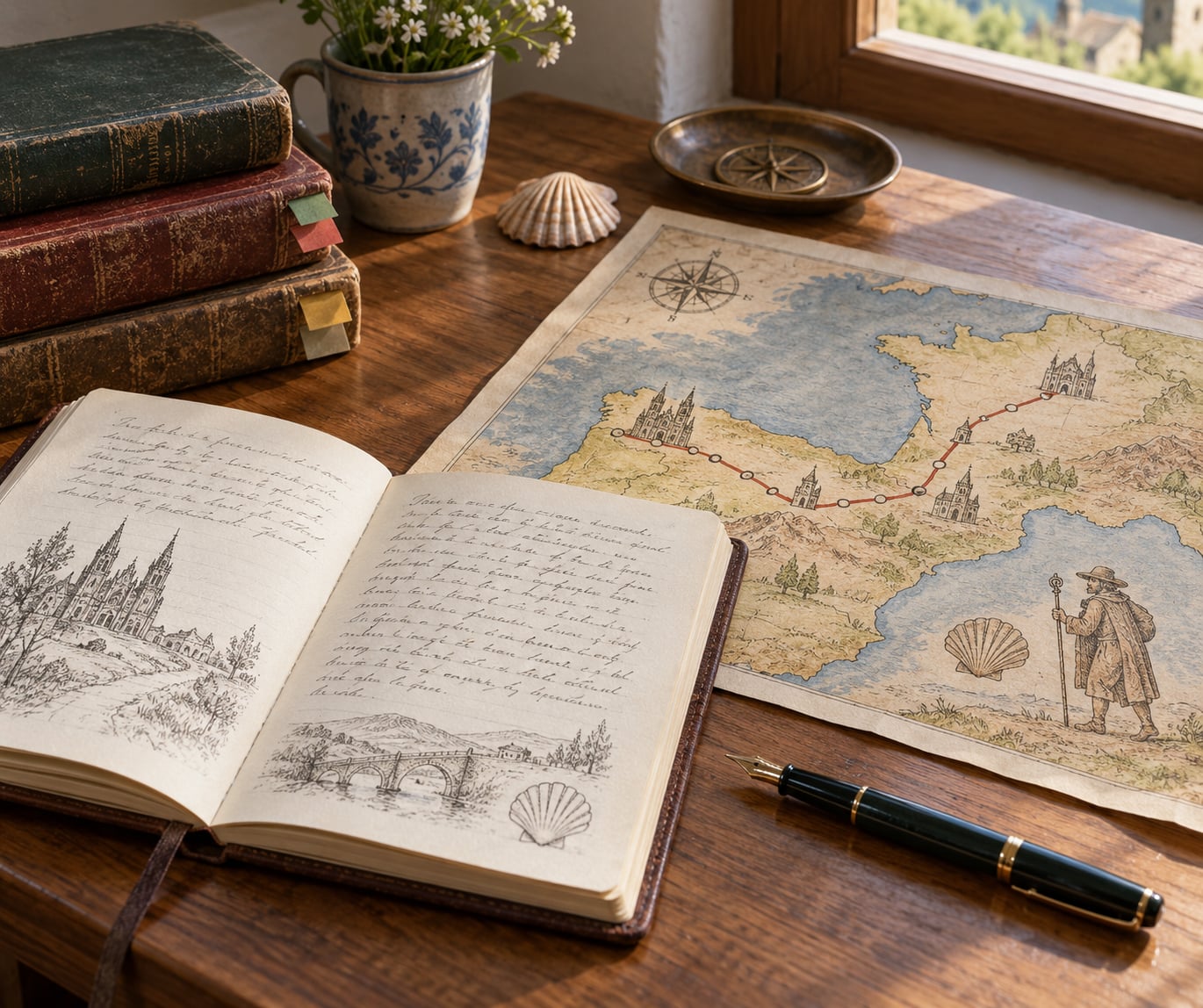
The frame is a pilgrimage from the Tabard Inn in Southwark, on the south bank of the Thames, to Canterbury Cathedral. Harry Bailey, the Host and innkeeper, proposes that every pilgrim tell two stories going and two coming, with the person who tells the best tales winning a free supper paid for by everyone else.
This gives Chaucer a reason to assemble a cross-section of English society in one room, and it gives every tale a speaker. That matters more than it sounds: a story about greed told by the Pardoner is different from a story about greed told by a knight, because the narrator shapes what the story means.
The General Prologue is the engine of the whole design. Chaucer introduces each pilgrim in turn with a physical description and a few telling details, the way you might sketch a stranger in a crowd. Then, when the pilgrims set off, the poem stops. The narrator falls behind, badly behind, and spends the next tale chasing his own ideas about sound, colour, and the difference between the sentence and the showing of it.
So the pilgrims never finish their journey on the page. Chaucer completed about 24 of roughly 116 planned tales before he died, and the closing passage known as Chaucer’s Retractions lists the works he considered sinful, including his own, and calls God the cure. Many students find that ending more revealing than any of the tales.
Which Tales Should Students Read First?
A sensible order starts with the Prologue, then moves to the tales your teacher is most likely to examine. For most syllabuses that means the Knight’s, the Wife of Bath’s Prologue, the Miller’s and the Nun’s Priest’s, with the Pardoner’s and the Franklin’s next.
That order works because each one shows a different part of Chaucer’s range. The Knight’s Tale is elevated romance. The Miller’s Tale is farce. The Wife of Bath’s Prologue is argument. The Nun’s Priest’s Tale is fable. The Pardoner’s Tale is a sermon about money that the preacher does not believe. The Franklin’s Tale is sentiment and coincidence, handled with a straight face that is clearly not straight at all.
Read the Miller’s Tale immediately after the Knight’s. The contrast is the lesson: Chaucer drops from heroic couplets into rough comic couplets within one page, and the change of voice tells you more about him than a textbook paragraph would.
The Canterbury Tales Study Guide for Students: Key Tales at a Glance
Here is the short version of the tales most often assessed, with the point of each one and why a teacher keeps coming back to it.
| Tale | Narrator | Genre | Central situation | Main theme | Study value |
|---|---|---|---|---|---|
| General Prologue | Chaucer | Frame narrative, portraiture | Pilgrims gather at the Tabard Inn and agree on the contest | Social class and the gap between appearance and reality | The entry point for nearly every other question |
| The Nun’s Priest’s Tale | Nun’s Priest | Fable | A widow is talked out of her inheritance by a lying fox | Clerical deception and how stories teach greed | Best comic plot in the collection and easy to analyse |
| The Pardoner’s Tale | Pardoner | Moral tale | Three rioters find gold and a man who refuses to drink | Greed as the last vice standing | The narrator’s hypocrisy is the whole argument |
| The Wife of Bath’s Prologue and Tale | Wife of Bath | Sermon and fable | A wife argues for female sovereignty, then retells Arthur’s knight | Gender, marriage and the problem of freedom | The most quotable argument in Middle English literature |
| The Miller’s Tale | Miller | Fabliau, farce | An old carpenter’s wife is seduced through a new door | Desire and comic disorder | Short, funny and packed with incident |
| The Man of Law’s Tale | Man of Law | Hagiography and romance | A princess converts her persecutors and is rescued | Law, faith and the limits of earthly justice | Shows Chaucer borrowing from saints’ lives and from legal practice |
| The Franklin’s Tale | Franklin | Romance | A squire wins a wife with a magic ring on a condition he cannot keep | Generosity and the cost of self-denial | Chaucer’s ironic tone is the whole subject |
What Are the Major Themes and Ideas?
Social class is the largest theme, and the one most likely to be the answer to any question asking for the main idea. Chaucer puts a knight, an abbot, a pardoner, a miller and a cook in the same inn, then describes them all with the same dry attention. His judgement comes from the details he chooses rather than from labels.
Appearance against reality runs underneath everything. The Pardoner is loud about charity. The Reeve’s tale embarrasses him as he tells it. The Miller’s tale undercuts whatever moral the Knight has just offered. When you write on this theme, quote the physical detail, not your own summary of the character.
Greed and religious hypocrisy get their own treatment. The Pardoner’s Tale preaches that money is the root of all evil while the Pardoner openly admits he does it for profit. The Friar, the Summoner and the Cook do versions of the same thing at different social heights.
Gender and marriage run through the Wife of Bath’s Prologue, the Clerk’s Tale and the Merchant’s Tale. The Wife’s argument, that women want the higher hand and that sovereignty has its costs, is argued rather than asserted. Her tale, where obedience turns out to be the husband’s undoing, is usually read as the practical rebuttal.
Storytelling itself is a theme. Contest rules shape who tells what, the narrator’s self-interest shapes how we hear it, and Chaucer’s closing complaint about words and music suggests that he never fully trusted the whole enterprise of telling stories for a living.
Fortune, and the gap between promise and outcome, runs through the Knight’s Tale, the Man of Law’s Tale and the Franklin’s Tale. Ask of each one whether the ending is a reward for merit or a reminder that character does not guarantee outcome.
How Does Chaucer Use Language and Narrative Technique?
Middle English is closer to modern English than most students expect. It is not Chaucer mumbling in Old English. It shares most of its vocabulary with modern English, drops most of the endings, and adds a few syllables that later disappeared, which is why word order often seems backwards until you notice rhyme doing the work.
Two habits solve most of the reading. First, end of line words ending in -le or -re take an extra syllable before the rhyme, so lit- and oure rhyme at the end and pull a soft syllable in front. Second, rhyme, not sense, is the organising principle, which is why a single line often has three possible translations. Pick one that rhymes and keep moving.
Reading it aloud helps more than it looks like it should. The verse was built for the ear, and once the metre clicks the words stop feeling like a puzzle. On the forums where students discuss Chaucer, reading aloud with a modern pronunciation and letting the rhythm carry the stresses is the most commonly repeated piece of advice, and it is good advice.
Beyond language, three techniques carry the collection. Chaucer shifts narrator constantly, so meaning changes with the teller. He uses comic realism, drawing ordinary bodies, ordinary food and ordinary bad luck into serious frameworks. And he builds irony by letting a narrator describe himself accurately while missing what he has just revealed.
How Do You Write About The Canterbury Tales?
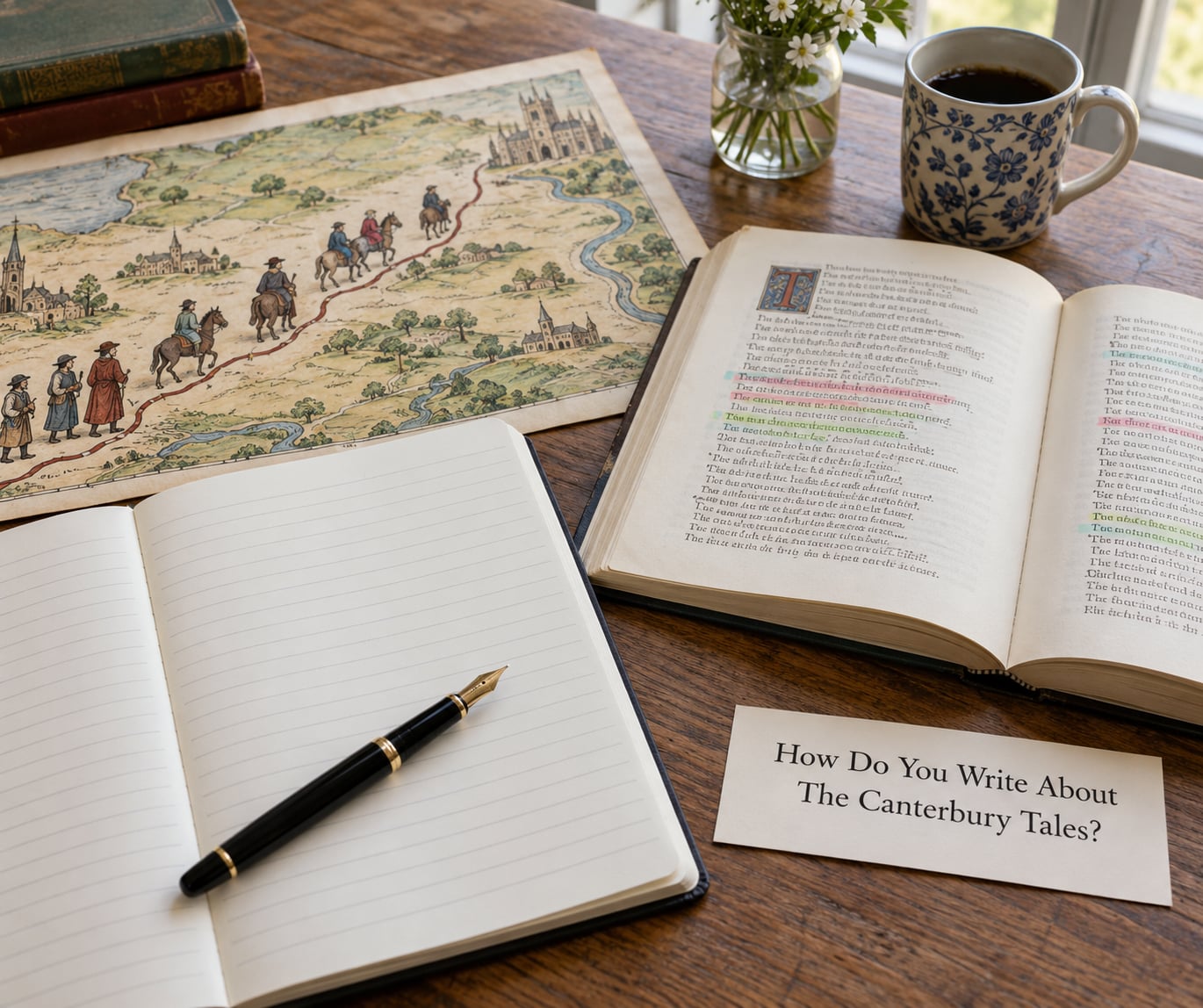
Most marks are lost on retelling the story, not on arguing. A retold plot can earn you nothing, because the reader can get it anywhere. Marks come from the four moves below, in order.
One focused claim. Say something arguable about method or theme, not about plot. “The Pardoner is a hypocrite” describes a character. “Chaucer uses the Pardoner’s own admission of profit to attack the institution of the indulgence” is a claim you can prove with evidence.
One short quotation, read closely. Pull out a word and look at it. In the General Prologue, the pardoner’s description of being “a noble ecclesiastic” landing on “a man that is a seller of pardons” is worth more than three lines of summary because the reader can see the mechanism.
Context that does the work. One sentence explaining the social or religious context, then back to the quotation. Social estates, church finance, the rules of medieval marriage. Add only what the reader needs to understand your point.
A comparison that earns its place. Compare two pilgrims or two tales, not Chaucer to a modern novelist. The Miller’s rude couplets against the Knight’s heroic couplets is a comparison that shows you have read the verse, not just the summaries.
If you take one habit from a good student essay, make it this: every paragraph returns to a word in the text. That is what separates a B answer from an A answer more reliably than anything else.
What Context Should Students Know About Medieval England?
Medieval English society was organised into three estates: those who prayed, those who fought, and those who worked. Clergy, nobility and commoners. Chaucer is interested in the people who do not fit neatly, lawyers, notaries, merchants and yeomen, because their existence was new and unsettled.
The Church of England was one institution across the whole country, and it ran courts, collected dues and licensed people to do religious work, including selling indulgences. That is why the Pardoner’s Tale is a financial story before it is a moral one.
Pilgrimage was ordinary rather than exotic. People travelled to shrines in numbers, often in organised groups, and the trip could be a genuine act of devotion or a social occasion, sometimes both. Pilgrims’ privileges governed who could be admitted and where, which is the legal backdrop of the Man of Law’s Tale.
Women could not generally own property or choose a husband on their own terms in the legal sense, though practice varied widely by region and class. The Wife of Bath’s argument, that she has had five husbands and learned how to use it, sits inside real constraints rather than outside them. And the Black Death, which reshaped labour and inheritance across the century, helps explain the fixed estates you are asked to look for in the portraits.
Frequently Asked Questions
How many stories are in The Canterbury Tales?
Chaucer completed 24 of the roughly 116 tales he had planned for the pilgrimage. Each pilgrim was to tell two stories on the way to Canterbury and two on the return, but the poem stops after the General Prologue and 24 tales. The pilgrims never reach Canterbury on the page, and the closing Retractions suggests Chaucer lost interest in the project or changed his mind about it.
Why did Chaucer leave The Canterbury Tales unfinished?
The honest answer is that we do not know. Chaucer stopped writing the tales some years before his death in 1400, and the passages known as Chaucer’s Retractions list works he considered sinful, including his own, then calls God the cure. Scholars argue about whether he grew bored, lost interest, or deliberately undermined the serious project. The unfinished shape is part of the poem’s meaning.
Is The Canterbury Tales based on a real pilgrimage?
Partly. Pilgrims really did travel to Canterbury Cathedral to visit the shrine of Thomas Becket, who was murdered in Canterbury Cathedral in 1170, and large organised pilgrimages happened regularly. Chaucer himself made the journey, apparently in 1382 and possibly more than once. The invented elements are the inn, the Host’s contest, and the gathering of exactly this company of pilgrims.
What is the most important theme in The Canterbury Tales?
If you have to name one, choose social class and the satire of the estates, and support it with the General Prologue. Chaucer places clergy, nobility, commoners, lawyers and merchants in the same inn and describes them all in the same dry voice, letting chosen physical details carry the judgement. Appearance against reality is the stronger supporting theme because it shows how he does it.
How should I study The Canterbury Tales for an exam?
Read the General Prologue closely first and make a table with one row per pilgrim: social role, Chaucer’s physical description, and what the choice of detail suggests. Learn the six core tales by narrator and central situation rather than by plot detail. Practise quoting two or three words from a portrait and analysing them, since that is what exam questions usually ask for.
Conclusion
Start where Chaucer starts. Read the General Prologue in full, note the social role of every pilgrim, and mark the detail Chaucer chose for each one. That single exercise covers the frame narrative, the estates satire, the appearance and reality theme, and half the characters you will be asked about.
Then read the tales in the order above and keep one question in your head: what does this narrator want me to think? Almost everything in this study guide for students follows from that habit, and it will carry you through the exam.