
Walt Whitman’s Leaves of Grass is a poetry collection first published in 1855 and revised by Whitman himself until his death in 1892, which makes it the rare American classic that is really several books in one volume. It holds hundreds of poems, many written in free verse with lines long enough to unnerve a reader trained on iambic pentameter. This reading guide explains what the collection is doing, how to pick an edition, which poems to start with, and how to read the form without getting lost.
If you are new to Whitman, you do not need to read all of it, and you will not be able to on a single sitting. What you need is a starting point, a sense of the historical ground the poems stand on, and permission to find it strange at first. That is what the sections below give you.
Table of Contents
- What Is Leaves of Grass About?
- How Did Walt Whitman Write Leaves of Grass?
- Walt Whitman Leaves of Grass Reading Guide: Essential Poems
- Song of Myself: the book in miniature
- I Hear America Singing: democracy as a chorus
- Out of the Cradle Endlessly Rocking: elegy and renewal
- Crossing Brooklyn Ferry: the self and the crowd
- When Lilacs Last in the Dooryard Bloom’d: mourning Lincoln
- Beat! Beat! Drums!: the war seen from below
- When You Read This in Future: time and mortality
- What Are the Main Themes in Leaves of Grass?
- How Do You Read Whitman’s Free Verse?
- What Historical Context Should You Know?
- How Can You Use This Leaves of Grass Reading Guide in Class?
- Frequently Asked Questions
- Which version of Leaves of Grass should I read?
- What is the most famous line in Leaves of Grass?
- Why was Leaves of Grass so controversial when it was published?
- Is Leaves of Grass hard to read?
- How many editions of Leaves of Grass exist?
- Do you have to read all of Leaves of Grass?
What Is Leaves of Grass About?
Leaves of Grass is Walt Whitman’s collection of poems about the self, the body, the nation and death, written and expanded by Whitman between 1855 and 1892. Its central claim is that every individual is sacred and that American democracy should be built on that fact. In his 1855 Preface Whitman says America “encloses the past and the future,” and that Americans “have probably the greatest average poem yet discovered.”
The book’s subject is the ordinary human being. Whitman turns ordinary things into material for poetry: a worker’s body, a sleeping child, a dying man, a boat crossing a river at dusk. He also insists repeatedly that he is not writing about a private self alone. The speaker in Song of Myself claims to contain multitudes, and the collection keeps testing what that claim means.
Three things keep coming back. The body, described as a temple and a place of divine presence. Nature, which is never scenery but a living system that absorbs and renews individuals. And death, which Whitman treats not as an ending but as a passage back into the same unity he finds in grass.
Because Whitman kept adding to the book for nearly forty years, it is also a document of a life and a country changing. The 1855 poems sound like a young man declaring a new poetry. The war poems of the 1860s sound like a man counting the wounded. The late revisions sound like someone tidying a will. Reading more than one edition lets you see that arc.
How Did Walt Whitman Write Leaves of Grass?
Whitman wrote in free verse but never in careless verse. In the 1891-92 edition he calls his form “a new and national declamatory expression,” which tells you the intention: this is meant to be spoken aloud, at volume, to a crowd or to one patient listener.
His main tools are catalogs and lists. He names type after type after type, the workers, the wounded, the sleepers, the places, and the reader is expected to feel the size of the nation inside the running sentence. I Hear America Singing is built almost entirely this way: each new voice joins the previous ones and the poem grows.
Repetition does the work music usually does. Anaphora, the repetition of a phrase at the start of successive lines, drives poems forward and gives a chant-like pull. In Beat! Beat! Drums! the opening word of line after line lands like a drum hit.
Line length is the trick that unsettles readers. Whitman’s lines can run twenty or thirty words, so the eye has to keep travelling without a metrical bar to rest on. Sentences rarely end where lines end, so meaning spills across the break. Read the line breaks as breathing marks, not as small buckets holding complete thoughts.
He mixes registers freely, placing archaic words beside slang and street vocabulary beside scripture. Words like “methinks,” “haply,” and “pave” are deliberate choices. Whitman also drops Sanskrit-derived terms such as “moksha” into Song of Myself without explanation, on the theory that a reader can absorb a word’s music before its meaning. Some of that feels like showing off. Some of it works.
Walt Whitman Leaves of Grass Reading Guide: Essential Poems
These are the poems that appear most often on reading lists, and they cover the range of the collection from 1855 to the Civil War years. Read them in this order on your first pass.
Song of Myself: the book in miniature
Song of Myself opens by cataloguing the speaker’s body, mind, senses and history, then claims each self he has ever lived as his own. The central idea is that the individual is not a small thing enclosed by the world but a point where everything touches. Watch for grass as a symbol of death and renewal, and for the repeated return to “I” as a word that keeps enlarging its own meaning.
Close-reading question: when the speaker says he contains multitudes, does the poem offer any evidence, or is it a claim without proof?
I Hear America Singing: democracy as a chorus
Each stanza gives the voice of one trade, from the mechanic to the mother. No single voice dominates, and the poem’s structure says something about democracy that its stated theme only hints at. Its famous closing lines tie the singing to birth and death in the same breath.
Close-reading question: does listing everyone equally flatten their differences, or is that equality the point?
Out of the Cradle Endlessly Rocking: elegy and renewal
Whitman wrote this after his father’s stroke and the death of his sister at infancy. It is a rocking hymn built around a repeated refrain, and it refuses to separate grief from joy. The songbird at the child’s cradle is the image everything else orbits.
Close-reading question: why does the poem end with the word “doubt” if its whole movement is toward faith?
Crossing Brooklyn Ferry: the self and the crowd
A ferry ride from Manhattan to New Jersey at dusk, written in 1862, becomes an image of democratic passage. Boats, passengers, tides and stars merge into one continuous motion, and the speaker realizes he is not separate from the crowd he watches.
Close-reading question: what shifts between the first stanza and the last, and why does the poem only admit it at the end?
When Lilacs Last in the Dooryard Bloom’d: mourning Lincoln
This is Whitman’s elegy for Abraham Lincoln, written in 1865. The lilac as a symbol of renewal appears again here, but grown into something autumnal, and flowers become the agents of mourning rather than consolation.
Close-reading question: how does the poem make grief communal instead of private?
Beat! Beat! Drums!: the war seen from below
The drums approach, then the armies, then the wounded, then the prisoners, and finally the Native American being driven west. The form narrows like a lens: a distant public spectacle turns into one man’s face. This is the poem most often used to discuss how Whitman handled the country’s racial politics.
Close-reading question: the poem ends with a mother’s cry. Why a mother, and why last?
When You Read This in Future: time and mortality
A late poem that sounds almost like a self-addressed note from the far side of life. It is short and rarely assigned, but it makes the collection’s central bargain explicit: the reader and the dead belong to the same continuity.
Close-reading question: does the poem console the reader, or is it a warning about how they will be remembered?
What Are the Main Themes in Leaves of Grass?
The big themes are democracy and equality, the sacred self, the body, nature, nationhood, death and rebirth, sexuality, and the dignity of ordinary work. They are worth reading as one bundle rather than as a list of topics, because Whitman argues they are the same claim from different angles.
Democracy and equality. Every soul is equally divine in Whitman’s scheme. I Hear America Singing states it socially, with one trade per stanza; Song of Myself states it spiritually, with the speaker absorbing every life he can reach. That ambition is also where the criticism bites, since the poems repeatedly speak for workers, soldiers and the poor in a voice that belongs to a white man who was never poor. Reading Whitman well means holding both halves of that sentence.
The self. The first-person speaker is enormous and unstable. He claims to be a cosmos, a leaf of grass, a union of all previous selves. Students sometimes find this arrogant until they notice how often the poem admits failure, fatigue and desire for something beyond words.
The body. Whitman makes the body a religious object. I Sing the Body Electric treats flesh, breath, hair and sexuality as the vehicles of the soul, and the poem argues against the convention that beauty must be pale and refined.
Nature. Grass, lilacs, birds, water, the sea and night are not backdrops. They are the mechanism through which individual lives join something larger, and the natural world also carries the book only metaphor of mortality.
Death and mourning. The Civil War poems and the elegies hold the collection together. Whitman’s position is unusual: death is not a separate realm but a re-entry, and grief is best carried by continuing to move.
Sexuality. The Calamus poems, written in the 1860s and only published complete in 1891-92, describe attachment between men as the highest form of comradeship. For a century they circulated only in censored or expurgated form. Modern scholarship reads them as early American queer writing, and Whitman is now frequently claimed as an important ancestor by that tradition.
How Do You Read Whitman’s Free Verse?
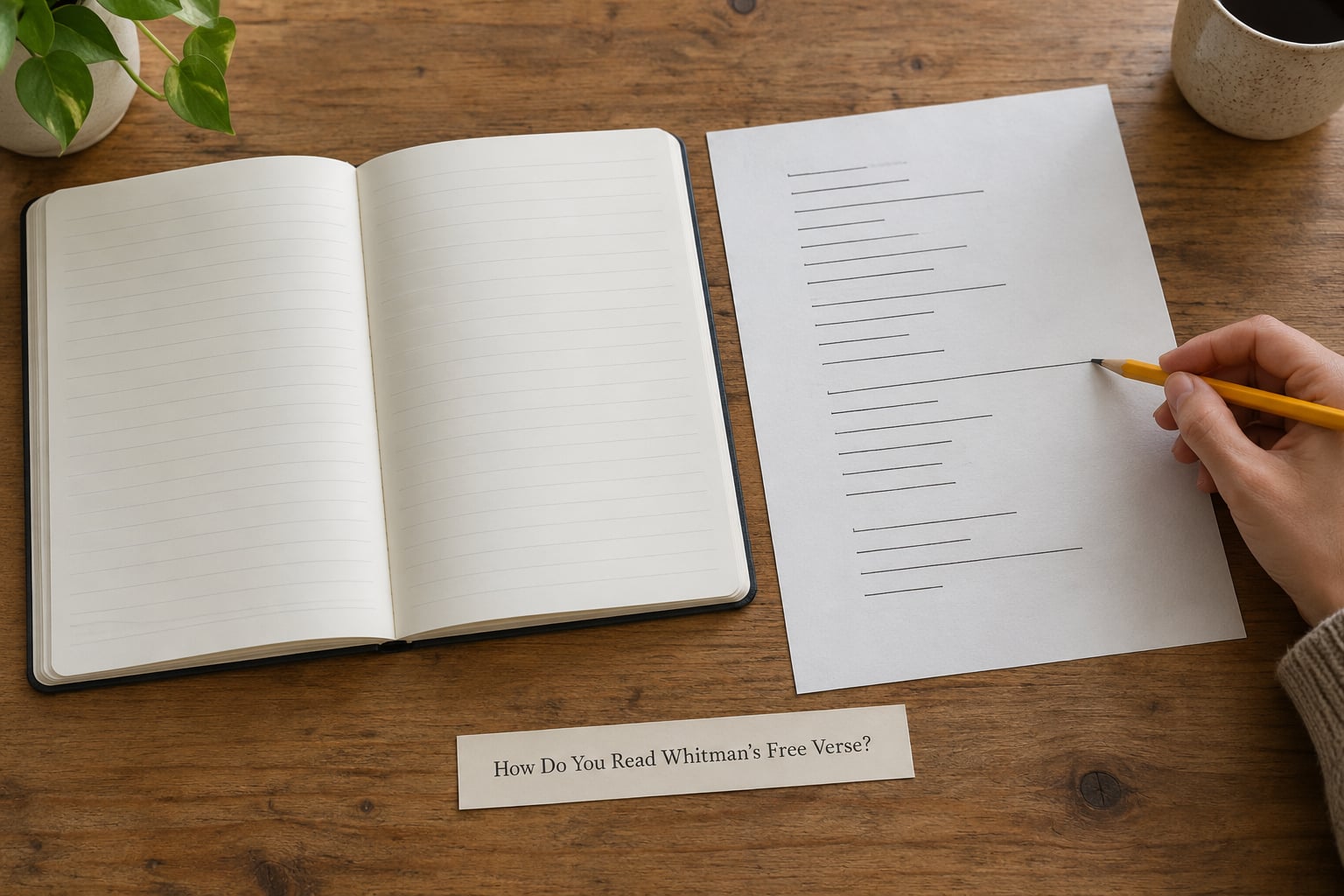
Read it out loud. That is the whole trick and it solves most problems. Whitman’s lines are built for the voice, and a line that looked absurd on the page turns out to have a rhythm once you hear it. If your reading slows down in the wrong place, the line break is not the cause, and the poem gets clearer rather than blurrier.
Then track sentences instead of lines. Mark where each sentence starts and stops, and note which sentences cross several lines. Those crossings are where the meaning gets its forward lean. A poem can read as a wall of similar-length lines and actually be three long sentences rushing past each other.
Next, count the repetition. Anaphora, refrains and recurring words are the load-bearing structure of a Whitman poem. When a phrase comes back, ask what has changed around it. In Beat! Beat! Drums! the same vocabulary returns at a colder temperature each time.
Finally, watch the scale. Whitman moves constantly between a single body part and a continent, a single day and all of time. Those leaps are intentional, and marking them on the page usually reveals the poem’s actual shape.
A workable routine for one poem: read it twice aloud, mark sentence boundaries in one colour, mark repetitions in another, then write three sentences on what the form is doing. You will have a usable close reading in about twenty minutes.
What Historical Context Should You Know?
Whitman insisted on this himself. In his 1892 afterword, “A Backward Glance O’er Travel’d Roads,” he says it would be useless to try to read the book without first tallying the preparatory background in your mind. That is unusually direct permission from an author, and most readers who take him up on it report the same thing: the difficulty drops once you know the ground.
The ground is 1850s America, a country arguing about what it was. Slavery was still legal, abolitionism was growing louder, and the nation was expanding westward at the cost of the peoples already living there. Whitman admired Abraham Lincoln and read the writings of the transcendentalists in New England, where Emerson would become both his friend and his most famous advocate.
Whitman worked as a newspaper editor, a clerk and a nurse. During the Civil War he volunteered in army hospitals in Washington and later in Fredericksburg, moving among the wounded and the dying. Drum-Taps and Sequel grew out of that work, which is why they read as eyewitness rather than rhetoric. He suffered a stroke in 1872, moved to Camden, New Jersey in 1873 to live with his brother George, worked on Specimen Days in his rooms, and died there in 1892.
Publication history matters too, because the book was attacked on release. Whitman printed the first edition himself in 1855, with 95 pages and 12 untitled poems, selling copies from his brother’s print shop because publishers refused it. Ralph Waldo Emerson wrote an anonymous review calling it “the most extraordinary piece of wit and wisdom that America has yet contributed,” which pushed the book into the controversy it was already in. Critics called it incoherent and its sexual poems obscene, and later editions of Calamus were altered or cut. Whitman’s standing as a national poet grew slowly over the following decades, largely through scholars and the Beat poets who claimed him for the twentieth century.
How Can You Use This Leaves of Grass Reading Guide in Class?
Here is a sequence that works for a term with limited time. Week one: read the Preface and Song of Myself aloud in class. Week two: I Hear America Singing and Crossing Brooklyn Ferry, with attention to catalogs. Week three: When Lilacs Last in the Dooryard Bloom’d and Out of the Cradle Endlessly Rocking as elegies. Week four: Beat! Beat! Drums! and one Calamus poem.
For a close-reading workshop, give students one poem and ask them to mark sentences, mark repetitions, and then write a paragraph on the effect of a single repeated word. Twenty minutes of work produces something usable in an essay, because the paragraph is descriptive before it is argumentative.
For discussion, the sharpest questions come from putting Whitman next to someone who disagrees with him. Pair Song of Myself with a poet who distrusts the first person, or set the 1855 Preface against a poem about the Civil War written thirty years later. The question of who gets to speak for whom becomes sharper and less abstract.
A group presentation works well on a single poem, with each member taking one device: catalog, anaphora, lineation, imagery, diction. Short timed sections, ten minutes, beat three presentations of a whole section.
One thing to flag before you assign anything. Whitman’s 1855 poems about Native Americans contain period racial slurs, and some poems elsewhere use crude language about disabled people. Rather than skipping those poems, tell students what is there and let the class decide how the book treats the people it claims to speak for. That conversation is part of studying the 1850s, not an interruption to it.
Frequently Asked Questions
Which version of Leaves of Grass should I read?
Start with a modern complete edition that prints the 1891-92 revisions, such as the Library of America or Penguin Classics volume edited by Malcolm Cowley. If you specifically want the debut version, find a 1855 facsimile or reliable scholarly reprint. Use the Norton Critical Edition when you want essays and commentary alongside the poems, and the Inclusive Edition when you want modern annotations on Whitman’s diction.
What is the most famous line in Leaves of Grass?
The most quoted lines come from Song of Myself: I celebrate myself, and sing myself, and what I assume you shall assume, and every atom of my blood, form’d from this soil, this air. The phrase do not go gentle into that good night from the 1950 film adaptation is not actually in the collection, so check the source before you quote it in an essay.
Why was Leaves of Grass so controversial when it was published?
Whitman published the first edition himself in 1855 and gave it no author name on the cover. Critics objected to the loose form, to what they called incoherent cataloguing, and most sharply to the poems on the body and sexuality. Emerson praised the book in a review that helped it find readers, which made it even more embarrassing to its detractors. Whitman never stopped revising it.
Is Leaves of Grass hard to read?
Yes, and saying so early saves time. The difficulty is mostly surface rather than depth: very long lines, near-rhyme, catalogs and a nineteenth century vocabulary. Read aloud, start with Song of Myself or I Hear America Singing rather than opening at random, and use one of the modern annotated editions for the first ten poems. The ideas tend to land even when the line lengths feel strange.
How many editions of Leaves of Grass exist?
Whitman produced substantially revised versions in 1855, 1860, 1881-82 and the final 1891-92 death-bed edition, and he kept adding or rewriting lines until he died in 1892. Modern editions are usually based on the death-bed text, sometimes with earlier readings restored or tracked in the notes. Any guide worth trusting should say which text it is following.
Do you have to read all of Leaves of Grass?
No. Almost nobody does, and nobody expects you to. A first pass of fifteen to twenty poems gives you the major themes and the range of the form in a few hours. Read the Preface, Song of Myself, I Hear America Singing, Out of the Cradle Endlessly Rocking, Crossing Brooklyn Ferry, When Lilacs Last in the Dooryard Bloom’d and Beat! Beat! Drums! first, then expand into the sections your course actually assigns.
Start with the Preface and Song of Myself, read them aloud, and let one week of attention do more than an hour of skimming. Pick the edition that prints the 1891-92 text with good notes, and if you want the full public-domain text without buying anything, it is also available free from the Whitman Archive and Project Gutenberg. The rest of this reading guide will make more sense once you have a poem in your mouth and one question about it in your head.