
If you have picked up a Hughes poem and put it down twice, that is common. His lines look plain on the page, then refuse to stay still in your head. This langston hughes poems reading guide gives you a method: name the speaker and the situation, listen to the form, connect it to a theme, and back your reading with exact lines.
Start with the three poems almost every anthology agrees on. They are short, widely taught, and each one teaches a different reading skill.
- “The Negro Speaks of Rivers” (1921) — his first published poem, and a lesson in how an image can carry history.
- “Harlem” (1951) — the deferred-dream poem, a lesson in how a question changes meaning across a poem.
- “The Weary Blues” (1925) — the blues-form poem, a lesson in reading sound as meaning.
Those three will get you through most classrooms. None of them, though, tells the whole story of a poet who wrote on race, work, family, exile, and the shape of America for roughly sixty years. That gap is the reason so many readers think of Hughes as the man who wrote two lines about broken wings.
Table of Contents
- How to Use This Langston Hughes Poems Reading Guide
- Step 1: Name the speaker and the situation
- Step 2: Listen to the form before you parse the line
- Step 3: Connect the poem to a theme
- Step 4: Support the interpretation with evidence
- Who Was Langston Hughes?
- What Are the Main Themes in Langston Hughes’s Poetry?
- Race, racism, and the violence of segregation
- Black identity and cultural pride
- Deferred dreams and the American dream
- Family, endurance, and inheritance
- Nature as spiritual and emotional register
- Langston Hughes Poems Reading Guide: A Quick Overview
- Which Langston Hughes Poems Should Students Read First?
- 1. “The Negro Speaks of Rivers”
- 2. “Mother to Son”
- 3. “The Weary Blues”
- 4. “Harlem”
- 5. “Theme for English B”
- How Do You Analyze a Langston Hughes Poem?
- A repeatable five-move structure
- Worked example: anaphora in “Harlem”
- Device glossary with a Hughes example each
- Why Did Langston Hughes Write in Different Forms?
- How Does Nature Function in Hughes’s Poetry?
- What Makes Hughes’s Simulated Oral Poetry Distinctive?
- Frequently Asked Questions
- What are the easiest Langston Hughes poems to begin with?
- Which Langston Hughes poem is most commonly analyzed in school?
- How do I write a strong analysis of a Langston Hughes poem?
- What does Langston Hughes’s use of blues and dialect mean?
- Which Langston Hughes poems are best for a school assignment?
- Where to Begin
How to Use This Langston Hughes Poems Reading Guide
Read Hughes in four passes, and you will not need a glossary open by the third one.
Step 1: Name the speaker and the situation
Who is talking, to whom, and in what physical place? In “Mother to Son” the speaker is a woman on a staircase talking to her child. That detail alone explains the monosyllables, the refusals, and the lack of punctuation at the line breaks. Do this before you decode anything.
Step 2: Listen to the form before you parse the line
Say it out loud. Hughes built much of his work on blues and jazz structures, so your ear catches rhythm, repetition, and pauses before your eye catches grammar. If a line stumbles when you read it aloud, that stumble is usually doing work.
Step 3: Connect the poem to a theme
Choose one theme and hold it to the text. Race, identity, deferred dreams, family endurance, and the failures of the American dream all run through his poems, and most good essays move between two of them rather than one.
Step 4: Support the interpretation with evidence
Three quoted lines with commentary is usually enough for a paragraph. Quote exactly, then say what the words do — rhyme, repeat, shift, contrast. Students lose marks most often by paraphrasing instead of analyzing.
Work through the steps in order. If you start with theme before form, you will argue for a reading the poem never offered.
Who Was Langston Hughes?
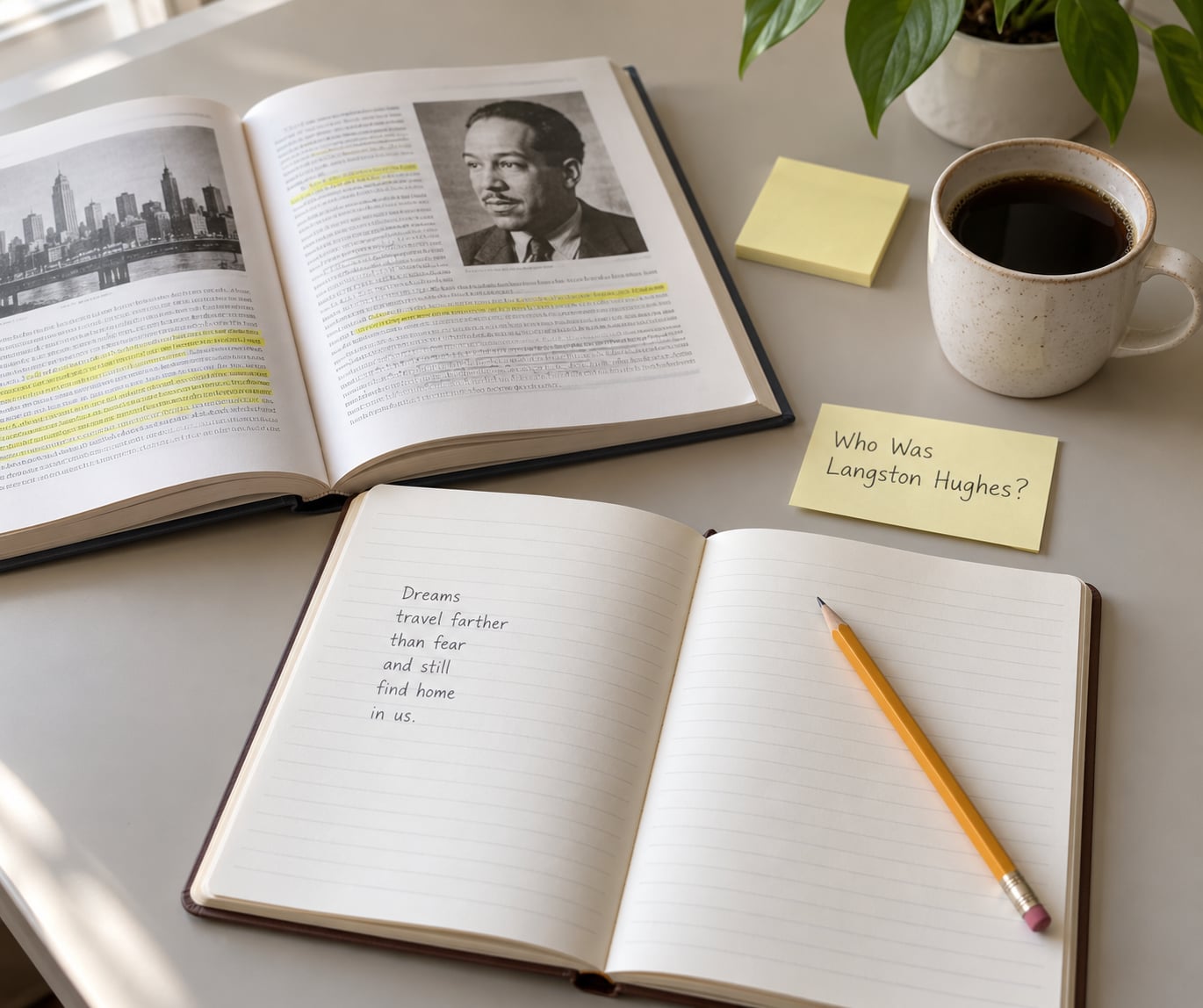
Langston Hughes was an American poet, novelist, playwright, and journalist who wrote from 1919 until his death in 1967. He is the most taught Black poet of the twentieth century, and for decades he was also the least fully read one.
He was born in Joplin, Missouri, in 1901. His father, James Hughes, was an African American lawyer who resented the United States; his mother, Carrie Eliza Jones Hughes, was from a Kansas family with Cherokee and Irish ancestry. Yes, Langston Hughes was biracial, a fact that shaped both his writing and the criticism he received. He often said he was half Indian, half Negro, and the whole of himself — and poems such as “The Indian to the African in America” and “Cross” take that mixed inheritance seriously rather than treating it as a problem to solve.
His childhood was spent largely in Mexico with his mother after she separated from his father. Spanish became his second first language, and the desert light, stone, and cactus flowers of Mexico run through images that later poems give a specifically American resonance.
He attended Columbia University in New York in 1920 and left after his first year, spending decades afterward working odd jobs — dishwasher, bellhop, messenger, sailor — while writing constantly. In 1925 he published “The Weary Blues” and won a literary prize from Opportunity magazine. In 1926 he published his essay “The Negro Artist and the Racial Mountain”, a short statement of intent that reads as a manifesto for everything he did afterward: he would write about ordinary Black life rather than answer white expectations.
From there came a career with an unusual volume. Hughes wrote children’s books, translated plays, wrote for newspapers, and spent sixteen years as a correspondent in Spain and Mexico in the late 1930s. He collected folk songs from rural Black communities, collected Black folk plays, and helped fund the careers of other Harlem Renaissance writers through the Opportunity prizes he won.
He read Walt Whitman and Paul Laurence Dunbar, and said both shaped him. He called himself the “poet of the people” at a time when “people” was considered a poor subject for poetry. Later critics have argued about that label from both directions: some say it undersold how formally ambitious his work is, others say it is exactly right.
What Are the Main Themes in Langston Hughes’s Poetry?
The main ideas running through Hughes’s poems are race and racism, Black identity and culture, family, the deferred American dream, and survival under pressure. Very few poems handle only one of them.
Race, racism, and the violence of segregation
“The Ballad of the Landlord” and “Let America Be America Again” deal directly with Black tenants, white landlords, and a nation that claims equality while denying it. In “Let America Be America Again”, anaphora — the repetition of “Let America be America again” at the top of every stanza — turns a slogan into an accusation.
Black identity and cultural pride
“I, Too” and “The Negro Speaks of Rivers” claim a place for Black people inside America rather than outside it. “I, Too” answers Whitman’s “I Celebrate Myself” with the line “I, too, sing America,” then corrects the version of America that excludes him.
Deferred dreams and the American dream
“Harlem” asks what happens to a dream that is postponed. “Dreams” makes the same point in eight lines, which is why it is the version most people know and the version least representative of his political work.
Family, endurance, and inheritance
“Mother to Son” turns hardship into persistence through the staircase metaphor. “The Negro Speaks of Rivers” stretches a single speaker’s life across ancient rivers, linking Black history to beginnings rather than to absence.
Nature as spiritual and emotional register
Rivers, seas, trees, moonlight, and storms in Hughes’s poems are rarely backdrop. They carry weight that dialogue cannot, and they connect the speaker to something older than any single moment of hardship.
Langston Hughes Poems Reading Guide: A Quick Overview
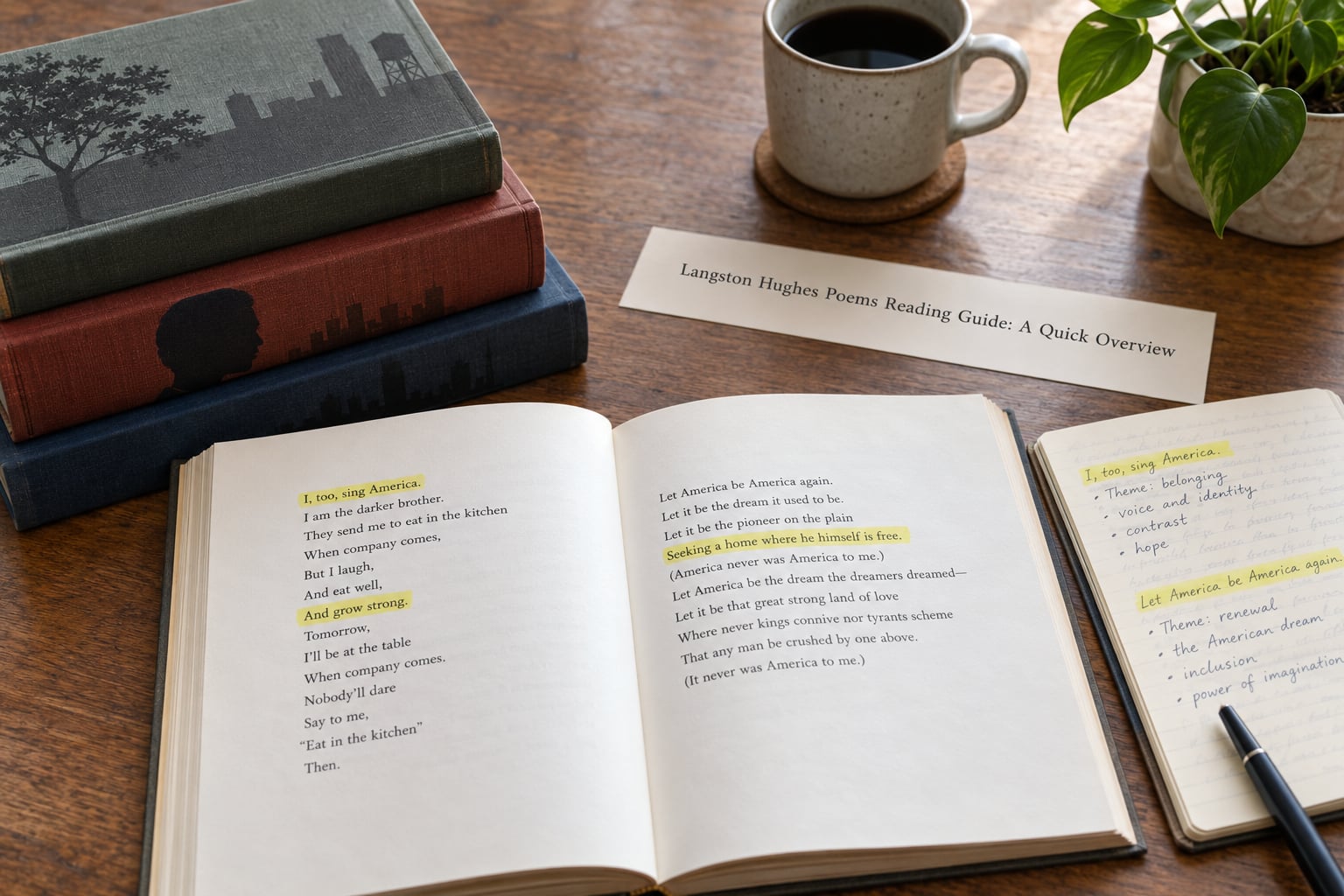
This table pairs eight essential poems with their central idea, the technique that carries it, and why each one rewards close reading.
| Poem | Central idea | Key technique | Why read it closely |
|---|---|---|---|
| “The Negro Speaks of Rivers” (1921) | Black history as ancient and living | Time collapse; catalogs of rivers | His first published poem, and the shortest route into his imagery |
| “The Weary Blues” (1925) | Endurance expressed as music | Blues form; repeated line; syncopation | Sound and meaning are the same thing here |
| “Mother to Son” (1925) | Perseverance against all odds | Extended metaphor; dialect; polysyndeton | Shows how a single conceit can hold an entire poem |
| “I, Too” (1925) | Claiming a place in America | Anaphora; allusion to Whitman | Short enough to memorize, dense enough to analyze |
| “Let America Be America Again” (1925) | The gap between national ideal and reality | Anaphora; refrain; polysyndeton | A slogan poem, and the model for reading political repetition |
| “Dreams” (1922) | What a postponed dream costs | Metaphor; parallel structure | Anthologized far beyond Hughes’s other work — read it critically |
| “Harlem” (1951) | The fate of a deferred dream | Question structure; ambiguity; sibilance | The most quotable poem, and the least definite in meaning |
| “Theme for English B” (1951) | Alienation and self-invention | Dramatic monologue; irony; allusion | The longest of the essentials, and the best window into Hughes’s longer work |
Which Langston Hughes Poems Should Students Read First?
Begin with “The Negro Speaks of Rivers”, then “Mother to Son”, then “Harlem”. That order moves from image, to voice, to ambiguity.
1. “The Negro Speaks of Rivers”
Short, confident, and free of technical obstacles. It rewards first-time readers because the imagery does the explaining, and it is the poem that opens The Weary Blues (1926), the collection most students should own.
2. “Mother to Son”
The first real test of reading voice. The staircase is an extended metaphor, the diction is deliberately plain, and the line breaks push the speech forward like someone climbing.
3. “The Weary Blues”
Read aloud. Its musicality is audible before it is analytical, and it makes the case for Hughes’s methods better than any summary can.
4. “Harlem”
By this point you will be ready for a poem that refuses a single answer. It also prepares you for the essay question most commonly set on Hughes.
5. “Theme for English B”
A step up in length and difficulty. It is a dramatic monologue, so you will be tracking a speaker whose words and situation pull in different directions.
Three paths through the rest of the work, depending on why you are reading.
- Casual reader: “The Negro Speaks of Rivers” → “The Weary Blues” → “Mother to Son” → “Dreams” → “Harlem”.
- Student writing an essay: the same five, plus “Let America Be America Again” and “Theme for English B” for technique and context.
- Poetry student: read the collections in publication order — The Weary Blues (1926), Fine Clothes to the Jew (1927), Afro-American Fragments (1930), Montage of a Dream Deferred (1951), Words Like Freedom (1965) — and watch the voice shift as the century does.
How Do You Analyze a Langston Hughes Poem?
Analyze a Hughes poem by moving from what the poem says, to how its sound and shape work, to what that produces in the reader, and only then to a wider theme.
A repeatable five-move structure
- Locate the speaker. Who is this, and what would they say out of character?
- Name the form. Fixed stanza pattern, free verse, blues form, dramatic monologue, sonnet?
- Mark the music. Note repeats, internal rhyme, line-ending punctuation, and where the breath stops.
- Quote and analyze. Take one line and say what the repetition, image, or syntax does.
- Connect outward. Link the poem to a theme, then to context, then to another poem.
Worked example: anaphora in “Harlem”
The poem is built from one image — a dream postponed and left to fester — and the speaker’s repeated question “What happens to a deferred dream?” The repetition works as a refrain, and it refuses the comfort of an answer. Move one step further and the sibilance in “ain’t nobody…” and “maybe it just burst” makes the deterioration sound like a fuse burning down.
Device glossary with a Hughes example each
- Anaphora — a word or phrase repeated at the start of successive lines or stanzas. Example: “Let America be America again” in “Let America Be America Again”.
- Polysyndeton — more conjunctions than grammar needs, to slow a line down. Example: “Life for me ain’t been no crystal stair” building through “but all the time” and “still”.
- Enjambment — a line break with no punctuation, so meaning runs past the line end. Example: the turns in “Mother to Son”.
- End-stopped lines — a full stop at the line end, which slows reading and gives each thought weight. Hughes uses them in the blues poems deliberately.
- Extended metaphor — one image carried through a whole poem. Example: the staircase in “Mother to Son” and the river in “The Negro Speaks of Rivers”.
- Dramatic monologue — a single speaker addressing a silent listener, with a gap between the speaker’s words and the truth. Example: “Theme for English B”.
Why Did Langston Hughes Write in Different Forms?
Hughes changed form because he was after a sound that matched how Black Americans actually spoke and sang, and because he refused to let one house style represent a whole people.
He wrote sonnets and formal odes early, including “The Weary Blues”’s era, and wrote free verse for the rest of his career. He wrote narrative poems with plot and character, ballads with a repeated tune and a moral, and short lyrics where a single image carries everything.
The shift matters for reading. Formal verse signals a speaker who values order; free verse signals a speaker who values speech. When you see Hughes move to looser lines, ask what the looseness is doing — imitating conversation, imitating music, or imitating a mind under pressure.
There is a practical argument here too. Varying form kept his work out of the single anthologized lane that “Dreams” eventually fell into. The man who wrote sonnets, ballads, dramatic monologues, folk plays, and children’s books is not the man summarized by two lines.
How Does Nature Function in Hughes’s Poetry?
Nature in Hughes’s poems is a second voice. Rivers, seas, trees, moonlight, and storms carry emotion and history that the speaker cannot state directly.
In “The Negro Speaks of Rivers” the water images place Black history at the origin of human speech and civilization, which is a claim as much as a picture. In “Merry-Go-Round” the sea keeps moving while human lives loop the same tired circuit, and that contrast is the point.
Storms work similarly. In Hughes’s poetry a storm is rarely an event; it is an emotional pressure with weather. Rain poems such as “April Rain Song” use the downpour for release, while storms in the blues poems carry grief that has nowhere else to go.
When you analyze a Hughes nature image, ask three questions: what tradition is the image drawn from, what feeling does it carry, and what work would the poem fail to do without it.
What Makes Hughes’s Simulated Oral Poetry Distinctive?
Hughes’s blues and work-song poems imitate performance. They use repeated lines, call-and-response structure, dialect, syncopation, and a first-person voice that sounds spoken rather than printed.
“The Weary Blues” is the clearest case. The poem repeats its title line in every other line, which is exactly how a blues chorus behaves in performance, and the singer’s voice alternates between despair and musical release without either winning. The musical notation in the poem, including the written directions for the singer, is not decoration. It tells you the poem is a score.
Call and response shows up across the work, including in “Harlem”, where the single speaker’s question functions as a call with no answering chorus. Repetition does the same work: it insists, the way a chorus insists, and it turns a personal feeling into something communal.
Dialect is the trickiest element and the one students hesitate over. Hughes’s speakers use vernacular phrasing, grammar, and idiom, and this is a deliberate choice about who is speaking. The vocabulary gap between speaker and reader is part of the poem, not an obstacle to it.
One warning for older editions: some collections reproduce Black dialect in a form many readers now find degrading. Modern editions have revised this. If you are teaching from an older text, mention the language issue directly rather than ignoring it.
Frequently Asked Questions
What are the easiest Langston Hughes poems to begin with?
Start with The Negro Speaks of Rivers, Mother to Son, and The Weary Blues. The first is short, purely imagistic, and free of technical difficulty. The second teaches you to follow a voice and an extended metaphor. The third teaches you to read sound. Together they cover the three things students most often miss: imagery, voice, and music. Harlem comes after those three, because it depends on tolerance for ambiguity.
Which Langston Hughes poem is most commonly analyzed in school?
Harlem, published in 1951 in Montage of a Dream Deferred, is the one analyzed most often. It is short, quotable, and built on a single deferred-dream premise, which makes it easy to write about and easy to oversimplify. Good analysis goes past the dream itself to the poem’s form: the repeated question, the shift from hopeful to menacing imagery, and the sibilant sounds that make the poem’s decay audible.
How do I write a strong analysis of a Langston Hughes poem?
Work in four moves: identify the speaker and setting, describe the form and sound, quote one or two exact lines and explain what they do, then connect that to a theme. The step most students skip is the third one. Quoting a line is not analysis. Say instead that the repeated refrain refuses an answer, or that the monosyllables make the speaker sound tired, or that the line break pushes the thought forward.
What does Langston Hughes’s use of blues and dialect mean?
Hughes treated blues and work-song structures as serious poetic form, borrowing repetition, call and response, syncopation, and musical notation from performance. Dialect puts the poem in the mouth of a specific speaker rather than a neutral narrator. This was a deliberate literary argument: that Black speech and Black music were valid material for poetry at a time when the academy largely disagreed.
Which Langston Hughes poems are best for a school assignment?
For a short close-reading task, choose Harlem, Dreams, or Mother to Son, since each is under thirty lines and turns on a single clear device. For a longer comparison essay, pair Dreams with Harlem to argue about how the same idea is treated as private in one and political in the other, or pair I, Too with Let America Be America Again to compare two forms of anaphora.
Where to Begin
Pick one accessible poem today — “Mother to Son” is a good default — and run the four-part reading process on it once. Write down three pieces of textual evidence before you attempt a thesis, because the evidence usually picks the argument for you.
Then read one more poem from a different decade than the first. Hughes in 1926 and Hughes in 1951 are not the same writer, and noticing that gap is the fastest way past the single-poem version of him that anthologies create.