
May Swenson poems explained simply: she was an American poet who wrote about animals, cities, astronauts, snow and mothers, and she often arranged her words into shapes on the page. Students usually struggle for two reasons — the rhyme runs in unexpected directions, and the meaning arrives through pictures instead of statements. This guide gives you a repeatable way to read her work, then walks through the five poems teachers assign most often.
Everything below is built from published collections rather than from study-site summaries, because much of what circulates online about Swenson is wrong or vague. If you only have twenty minutes, go straight to the close-reading section and pick the poem you have been assigned.
Table of Contents
- May Swenson Poems Explained: What Should Readers Know?
- Who Was May Swenson?
- Major collections in publication order
- What Makes May Swenson’s Poetry Hard to Understand?
- Surprise out of plain subjects
- Rhyme that pulls the syntax sideways
- Shaped typography
- Shifts in speaker and scale
- Compressed, elliptical syntax
- Humor in serious material
- How Do You Read May Swenson Poems?
- 1. Read it out loud, twice
- 2. State the literal situation
- 3. Find the one image that carries the poem
- 4. Track the shifts
- 5. Test your reading against the lines
- 6. Write a claim, not a summary
- What Are the Main Themes in May Swenson’s Poems?
- Wonder at ordinary things
- The natural world and animals
- City life, work and money
- Human relationships and family
- Death, aging and mortality
- Science, space and the modern world
- Play, language and word games
- The tension between observation and wonder
- How Do Images and Symbolism Work in Her Poems?
- Animals as mirrors, not metaphors
- Weather and season as emotional pressure
- Bodies and movement
- City surfaces
- Objects with a private history
- Exaggeration and scale shifts
- A short glossary of devices, with Swenson examples
- May Swenson Poems Explained Through Close Reading
- How Everything Happens: the questions children ask about it most
- Women: how the shapes and the irony work
- Motherhood: affection without softness
- The Moose: a meeting that changes the watcher
- It Is Interesting: attention as the subject
- How Do You Write an Analysis of a May Swenson Poem?
- The thesis formula
- The paragraph shape
- The evidence checklist
- Six prompts that work on her poems
- What Are Common Misreadings of May Swenson’s Poems?
- Treating a literal image as the final meaning
- Reading the poem silently
- Ignoring the humor
- Assuming the speaker is the poet
- Reading ambiguity as carelessness
- Substituting biography for evidence
- Working from a bad source
- Frequently Asked Questions
- What are May Swenson’s poems usually about?
- Which May Swenson poems are easiest for beginners to understand?
- Are the animals in May Swenson poems meant to be literal or symbolic?
- Why does May Swenson use humor in serious poetry?
- How is May Swenson’s style different from traditional narrative poetry?
- How should students write an analysis of a May Swenson poem?
- Conclusion: Start with One Image
May Swenson Poems Explained: What Should Readers Know?
May Swenson wrote poems in which the meaning hides inside an image, so the reader has to do part of the work. A poem might show you a dandelion, a swan’s neck, or a woman reaching down to pick up her child, and the feeling or idea arrives through that picture rather than through a sentence explaining itself.
That method is why her work rewards attention and frustrates people who read it only silently. Swenson built her sound, her shape and her surprise into the same poem, so removing the sound or the shape strips away part of the meaning.
A useful starting framework has four parts: the central image, the voice speaking, the sound of the words, and the shape of the poem on the page. Work through all four and most Swenson poems become readable, even the ones that seem to have no story at all.
Who Was May Swenson?
May Swenson was born Anna Thilda May Swenson on May 28, 1913, in Logan, Utah, to Swedish immigrant parents, and she died on December 4, 1989, in Oceanview, Delaware. The Academy of American Poets, the standard biographical source, gives 1913 as her birth year; several study sites print 1919, so cite 1913 if you need a date.
She studied at Utah State University and moved to New York in 1935, where she became associated with the loose, informal group later called the New York School. Unlike some of her contemporaries, she kept publishing for nearly fifty years, and her late collections are the ones most often assigned in classrooms today.
She won the Bollingen Prize and the Shelley Memorial Award, received grants from the National Endowment for the Arts and a MacArthur Fellowship, and served as chancellor of the Academy of American Poets from 1980 until her death. She also translated the Swedish poet Tomas Tranströmer, and that work sharpened her sense of compressed syntax and shifted grammar.
Swenson said she thought a poem should be autonomous and should explain itself. She also wrote the 1966 essay “The Experience of Poetry in a Scientific Age,” where she argues that poetry and science share a hunger for accuracy about the real world.
Major collections in publication order
Her bibliography moves from short lyric collections to experiments in visual form and then to longer reflective work. Knowing where a poem was published makes citation easier, and students who pick a poem at random often land in a much harder late style than they expected.
| Collection | Year | What is inside |
|---|---|---|
| Another Animal | 1954 | Early animal poems and short lyrics, including “The Trumpet” |
| A Cage of Spines | 1958 | Sharper shorter lyrics, including “The Moose” |
| To Mix With Time | 1963 | Longer poems built from sequences of images |
| Half Sun, Half Sleep | 1967 | The mature long-poem mode, including “How Everything Happens” |
| Iconographs | 1970 | Poems typed into shapes, including “Women” |
| New & Selected Things Taking Place | 1978 | Selected poems plus new work |
| In Other Words | 1987 | Late poems, including “Motherhood” |
| Poems to Solve | 1966 | Riddle poems written for younger readers |
Two posthumous books are useful too. May Out West, published by Utah State University Press in 1996, gathers early and previously unpublished work, and The Complete Love Poems of May Swenson, published by Houghton Mifflin in 2003, collects a strand of her writing that regular anthologies leave out.
What Makes May Swenson’s Poetry Hard to Understand?
Difficulty in a Swenson poem usually comes down to six habits, not from deliberate obscurity. Once you know them, you know what to look for, and the poem stops feeling like a puzzle with a missing page.
Surprise out of plain subjects
A sparrow, a bus, a parking meter, a person tying a shoe. Swenson takes something ordinary and lets it turn strange, so the poem feels like a joke landing. Nothing has been left out of your edition; the strangeness is the point.
Rhyme that pulls the syntax sideways
She rhymes densely, often with near-rhymes and echoes rather than tidy couplets. The line twists to meet the sound, which means the sentence order is unusual and the grammar is hard to follow. Students who read silently lose this entirely, because they never hear the machine that bends the lines.
Shaped typography
In Iconographs she types words into outlines — a snowflake, an umbrella, a human figure. The arrangement is part of the meaning, and when a poem is reprinted as plain text in a study guide, the shape disappears and the argument collapses. If your assignment came from a photocopy, find the original layout first.
Shifts in speaker and scale
A poem will move from a child’s voice to an adult’s, or from a person to an animal to an astronaut, without warning. There is no marker telling you the speaker changed, so track the pronouns and the tense instead.
Compressed, elliptical syntax
Sentences start, stop and restart. What connects the clauses is often an image rather than a connective word, and that gap is where students lose the thread. Read the poem aloud and the gaps usually reveal themselves as pauses.
Humor in serious material
Swenson is funny in poems about death, work and money. The joke does not cancel the seriousness; it is how she keeps the subject bearable. Ignoring the humor is a big reason her poems get described as cold or confusing.
Difficulty and vagueness are different things. Swenson can be hard and still be exact — she names concrete objects, specific actions and real places. If a reading of her poem could be pasted onto a poem by any other poet, it is probably too general to be right.
How Do You Read May Swenson Poems?
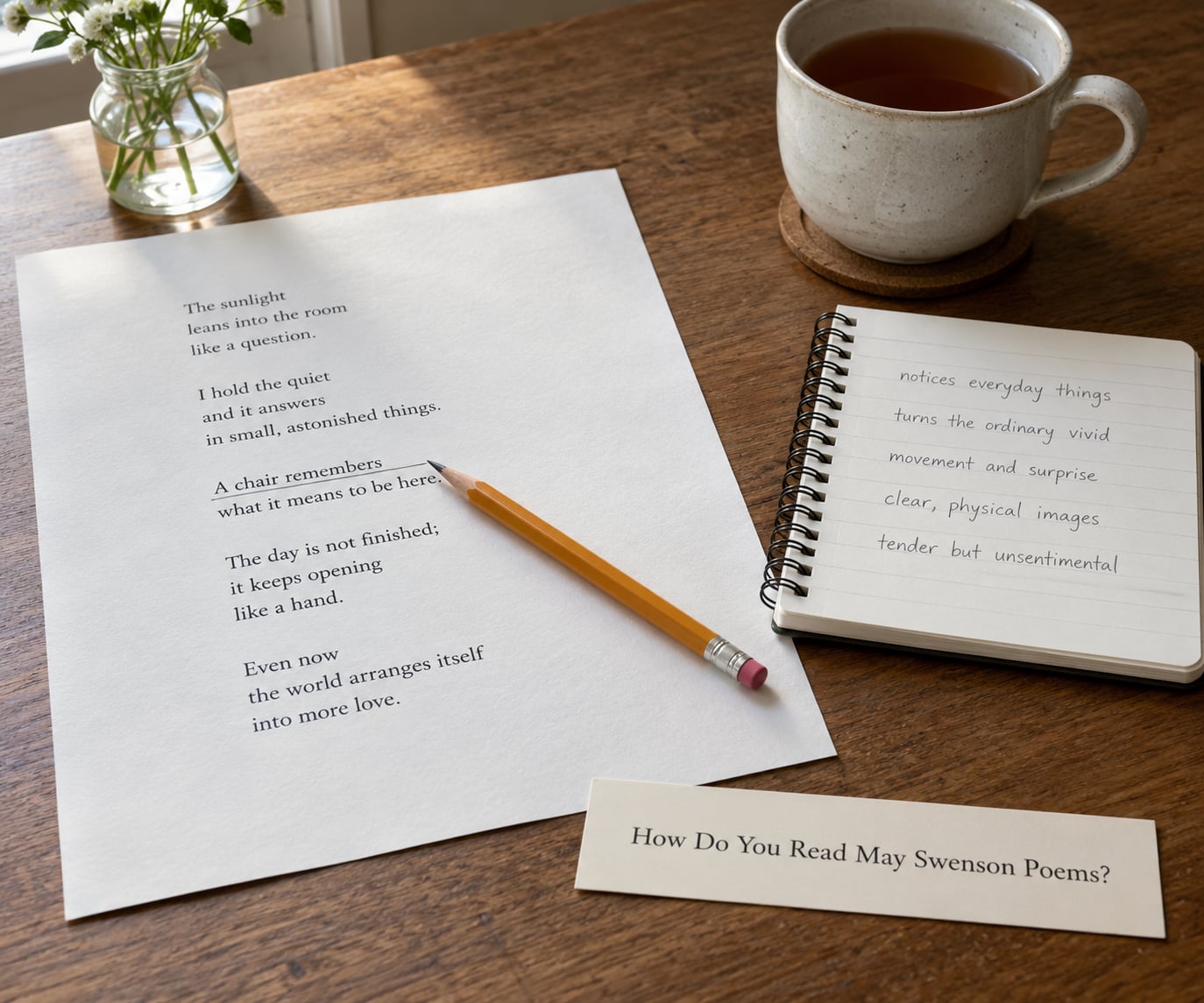
Read it in six steps, in this order, and you will not need a summary to tell you what it means. The method works on her shaped poems, her long narrative poems and her riddles alike.
1. Read it out loud, twice
The first time, just let your ear work. The second time, mark the end words of each line and see where the sound lands. If a line feels like it stops early, write down the word that broke the rhyme — it is usually where the meaning turns.
2. State the literal situation
Describe what is physically happening, in plain terms, with no interpretation. “A woman watches a bird land near her” is a description; “a woman feels hope” is already an interpretation. Get the first one clear before you reach for the second.
3. Find the one image that carries the poem
Ask which picture you would draw. Swenson usually builds everything around a single central image, and the other details orbit it. If you can name that image in five words, you have the poem’s spine.
4. Track the shifts
Circle every place the speaker, the tense or the point of view changes. Note whether the poem moves from outside to inside, or from looking to doing. Shifts in a Swenson poem are where the argument usually lives.
5. Test your reading against the lines
Write down your interpretation, then go back and find two or three lines that either support it or trouble it. A reading that needs every line to work is usually too big. If a line resists your reading, that resistance is worth a sentence in your essay.
6. Write a claim, not a summary
A summary says what happened. A claim says what the poem is doing and how you know. “The poem is about a bird” is a summary; “the poem turns a small domestic moment into a question about whether attention can rescue us from boredom” is a claim.
One warning about the method: resist the urge to find a single correct meaning. Swenson wrote poems that hold two readings at once on purpose, and a good essay can name that double movement rather than resolving it.
What Are the Main Themes in May Swenson’s Poems?
Eight concerns run through her work, and each one shows up in her most-assigned poems. Knowing them helps you recognize a theme when it appears in a form you have not seen before.
Wonder at ordinary things
Her central move is attention. A common object, seen closely enough, becomes strange and lovely. This is not escapism for her; it is an argument that paying attention is a form of hope.
The natural world and animals
Animals appear as fellow creatures rather than symbols to be decoded. In the essay “May Swenson and Other Animals,” she wrote of herself as an animal among animals, and her poems treat animals with a respect that unsettles easy human superiority.
City life, work and money
Swenson wrote about commuters, offices, subways and payrolls. Her poems about labor are funny and unsentimental, and they treat routine as a subject worth taking seriously rather than a default state.
Human relationships and family
Mother and child gets her clearest attention, especially in “Motherhood.” Partnership, friendship and the small frictions of living together recur across her collections, often with more affection than sentimentality.
Death, aging and mortality
Death shows up plainly and without consolation, then often arrives at a turn of phrase that catches you off guard. She does not soften the subject, and readers who want reassurance find her difficult for that reason.
Science, space and the modern world
She took an early interest in astronauts, DNA and medical imaging, and she treated scientists as people with strange new questions to ask. Poems like “August 19, Pad 19” show the space program as work, paperwork included.
Play, language and word games
Sound, puns, alliteration and misdirection are central rather than decorative. Her books for younger readers, Poems to Solve and More Poems to Solve, apply the same playful logic in riddle form.
The tension between observation and wonder
Underneath most of the poems is the question of what looking costs and what it buys. Does seeing more connect you to the world, or does it hold you slightly apart from it? Swenson keeps both answers alive.
How Do Images and Symbolism Work in Her Poems?
Swenson builds meaning bottom-up. She starts with a specific physical detail and stacks relationships until the reader arrives at an idea the poem never states. Knowing her recurring materials makes that stack easier to see.
Animals as mirrors, not metaphors
An animal in a Swenson poem is usually behaving like itself, and the reader supplies the human parallel. In “The Moose,” the encounter is startling because the animal is treated as an equal party to a strange meeting, and the human being is the one who changes afterward.
Weather and season as emotional pressure
Snow, heat, frost and wind are frequently the outside condition of a poem’s inner state. When a poem’s weather changes in the middle, treat it as a change in the speaker’s situation rather than as decoration.
Bodies and movement
Her poems are full of arms, backs, hands, wings and walking. Movement verbs carry the emotional charge, and this is why her poems read well when performed or read aloud.
City surfaces
Pavement, subway grates, windows and streetlights fill many poems. The city is where her speakers are stuck, distracted or newly awake, and the surfaces she chooses often double as emotional states.
Objects with a private history
A basket, a card, a letter or a piece of furniture may carry an entire relationship inside it. Ask what the object has already been used for; that is usually where the poem’s meaning is stored.
Exaggeration and scale shifts
Swenson happily enlarges one thing until it fills the poem, or shrinks another to nothing. Because an image can carry more than one reading, a good analysis will say what the reading does rather than insisting it is the only one.
A short glossary of devices, with Swenson examples
| Device | What it does | Where to see it in Swenson |
|---|---|---|
| Alliteration | Repeats initial consonant sounds to make a line stick | Common in her animal and weather poems, where the sound mimics the subject |
| Assonance | Repeats vowel sounds for music without a full rhyme | Carries much of the mood in her longer poems, where the rhyme is thin |
| Metaphor | Calls one thing another to transfer meaning | Her defining move: an object is compared to a feeling or a creature |
| Simile | Compares two things using like or as | Used sparingly, usually to slow down an image you might read too fast |
| Personification | Gives human traits to non-human things | Frequent in poems about cities and animals, often with a comic edge |
| Paradox | States something contradictory that still holds together | Central to poems that resolve differently from how they open |
| Enjambment | Runs a sentence past the line break | Common in her narrative poems, and the reason her syntax feels compressed |
| Image-writing | Carries the whole idea in one concrete picture | Her own term for the practice behind her shaped poems |
May Swenson Poems Explained Through Close Reading
Below are the five poems students are asked about most, in the order they usually come up. Each section gives the literal situation, the central image, the main themes, the craft, and a takeaway sentence you can adapt.
How Everything Happens: the questions children ask about it most
Here is what Swenson is doing in this poem: a parent explains to a child how life begins, changes and ends, and the explanation keeps outrunning the child’s ability to hold it. The literal situation is an explanation given to a young listener; the central image is a chain of transformations the child keeps asking to have named.
The poem’s structure is a question-and-answer loop. A child asks, an adult answers with a fact, and the fact immediately produces the next question. Because the questions escalate, the poem moves from conception to birth, to death, to what happens afterward, and the child’s persistence does the philosophical work that the speaker never states.
The tone is tender and slightly comic, and the humor matters. Swenson keeps the voice warm while the content turns serious, so the poem never becomes a lecture. Her view is that the honest answer is never complete, which is why the explanation keeps failing and restarting.
Craft-wise, the poem is built from repetition and variation: similar sentences return with slight changes, and the sound ties them together while the meaning shifts. Notice how often a rhyme pulls a line toward a word the logic alone would not have chosen — that pull is where the strangeness lives.
One-sentence takeaway: the poem argues that coming to terms with how everything happens means accepting answers that arrive with new questions attached, and that wonder, not certainty, is the lasting response.
Women: how the shapes and the irony work
Here is what Swenson is doing in this poem: she arranges text about women into shapes on the page, and the arrangement makes the argument that the images themselves form. The literal situation is a reader moving through statements about women’s lives; the central image is the outline the words create.
Ask what shapes you can see in this concrete poem, and the honest answer depends on the copy you are reading, because the layout varies between editions. In every version the words describe women in family and society in doubled terms — faithful and restless, conventional and rebellious, public and private at once.
The irony is structural, not sneering. Swenson states social expectations plainly, then lets the shape of the poem undercut the linearity of the statements, so the reader sees the pattern and the people inside it at the same moment. That combination of affection and critique is the part students most often miss.
To read it, track three things: what the words claim, what the shape shows, and where the two disagree. The disagreement is the poem’s argument.
One-sentence takeaway: by setting statements about women’s lives inside a visual frame, the poem shows that the roles are patterns rather than definitions, and that recognizing the pattern does not require accepting it.
Motherhood: affection without softness
Here is what Swenson is doing in this poem: a mother speaks to or about her child, and the physical fact of writing on paper becomes a figure for writing on a body. The literal situation is a parent addressing a child; the central image is a surface being marked, whether it is a page or skin.
Because the poem is collected in In Other Words, it belongs to her late period, where her syntax is looser and her humor more prominent. The tone is proud and amused rather than reverent, which is why some readers find it startling. Swenson treats childbirth as a physical event that is also an intellectual and linguistic event.
The imagery links writing, carrying and making. Words arrive in the same world as blood and bone, and the poem refuses to keep those categories apart. That refusal is the theme: parenthood as a form of authorship, where the child is both the text and the reader.
For a paper, the strongest move is to notice where the humor appears. A joke placed inside a serious passage is a deliberate choice about tone, not a lapse in seriousness, and saying so shows you are reading the whole poem.
One-sentence takeaway: the poem presents motherhood as a way of writing a life into another person, and it holds that idea with pride, physical detail and a comic edge.
The Moose: a meeting that changes the watcher
Here is what Swenson is doing in this poem: a person has an unexpected nighttime encounter with a moose and comes away different, though almost nothing in the world has actually changed. The literal situation is simple, an encounter on a road; the central image is the animal standing still while the human being tries to make sense of it.
The poem is a study in attention. The speaker is stopped, forced to look, and unable to look away, and that looking produces a kind of knowledge that is emotional rather than factual. Swenson wrote the animal as a full participant in the meeting, which is why the poem resists being read as a symbol with a fixed meaning.
Tone is quiet and unsettled, with an ending that returns the speaker to ordinary life without resolving anything. That refusal to resolve is deliberate. Poems about animals often end with the human changing rather than the animal being explained.
One-sentence takeaway: the poem argues that an encounter with a fellow creature can unsettle a person’s sense of scale and solitude without providing comfort in return.
It Is Interesting: attention as the subject
Here is what Swenson is doing in this poem: she takes the act of noticing something and makes it the event. The literal situation is a speaker observing the world closely; the central image is whatever small thing the poem lingers on longest.
The poem keeps turning on the word interest itself, and the play on the word’s two senses — curiosity and financial return — quietly links attention to money. That is a recurring Swenson move: an ordinary double meaning carrying a second theme underneath the first.
Craft-wise, short lines and abrupt stops imitate the flicker of noticing one thing and then another. Read it aloud and you will hear the rhythm of looking, which the printed page hides. A good essay on this poem can connect the speaker’s curiosity to the economic undertone without forcing the two together.
One-sentence takeaway: the poem presents close attention as a genuine form of knowledge, and shows that curiosity about ordinary things is a choice rather than a mood.
Other poems worth knowing about include “The Trumpet” from Another Animal, “Horses in Central Park” with its city setting, “A Thank-You Letter” for its plainspoken affection, and the riddle poems collected in Poems to Solve. If your assignment names one of these, the same six-step method applies.
How Do You Write an Analysis of a May Swenson Poem?
Most students lose marks on Swenson by describing instead of arguing. A description tells the reader what the poem contains; an analysis tells the reader what the poem is doing and how the words achieve it. The fix is structural.
The thesis formula
Use this shape: in [poem title], Swenson uses [specific device or image] to suggest [interpretation], and the effect is [what it does to the reader]. Then narrow it. “The poem is about nature” is not a thesis; “the poem uses the repeated image of the bird’s return to argue that attention is a form of commitment” is.
A model thesis for “How Everything Happens”: in “How Everything Happens,” Swenson structures the poem as a chain of questions so that the parent’s explanations keep producing new confusions, and the result is a poem that treats wonder as the honest response to knowledge rather than as a failure to understand.
The paragraph shape
One idea per paragraph, in this order: a short claim, the lines that prove it, an analysis of how those lines work, and a sentence connecting that move back to your thesis. Most first drafts skip the third part, which is where the actual analysis lives. A useful sentence starter is “The word [x] matters here because…”
The evidence checklist
Before you submit, confirm that you have quoted at least three specific lines, explained the rhyme or sound pattern at least once, addressed the shape or line breaks if the poem is a shaped poem, offered one competing reading, and named what your interpretation cannot fully account for. That last item is the one strong essays include and weak ones skip.
Six prompts that work on her poems
First, trace how a single recurring image changes meaning across one poem. Second, compare Swenson’s speaker in “It Is Interesting” with the speaker in “Motherhood” and argue for what the comparison reveals about her idea of attention. Third, explain what the shape of “Women” contributes that the same words in a straight column would not. Fourth, argue whether the humor in “Motherhood” strengthens or weakens the poem’s claim, using at least three lines. Fifth, describe what Swenson’s rhyme does to a passage you find difficult, and why. Sixth, analyze how an animal functions in “The Moose” and in one poem of your choosing.
Each prompt produces a different essay, so do not write a paragraph that fits all of them. Pick one and stay with it.
What Are Common Misreadings of May Swenson’s Poems?
Most misunderstandings come from skipping one of the six habits described earlier. These are the errors that show up most often in student work, along with the fix for each.
Treating a literal image as the final meaning
A student writes that the poem is about a bird, stops there, and calls it interpretation. Fix: complete the sentence with what the bird does in the poem, then ask what that action implies about people, attention or the world.
Reading the poem silently
The rhyme is a meaning-bearing structure, not decoration, and it disappears in silence. Fix: read aloud and mark the end words before writing anything down.
Ignoring the humor
Students read “Motherhood” or “It Is Interesting” as solemn and then call the poem cold. Fix: find the comic line, ask why it is placed there, and treat the joke as a tonal choice.
Assuming the speaker is the poet
A poem’s voice is a construction, not a diary entry. Fix: describe who is speaking and to whom, then keep your claims about the speaker separate from claims about Swenson’s life.
Reading ambiguity as carelessness
Two readings can both be defensible, and Swenson built that openness into poems like “Women.” Fix: present both, say what each one emphasizes, and explain which the form supports more strongly.
Substituting biography for evidence
Bringing up Swenson’s Utah childhood tells a reader nothing about how a particular line works. Fix: keep biography for context in one sentence, then return to the words.
Working from a bad source
Study pages frequently misattribute her poems or invent summaries, and at least one widely linked explanation never names her as the author of “Motherhood.” Fix: check the collection and year against a published book or the Academy of American Poets before you cite anything.
Frequently Asked Questions
What are May Swenson’s poems usually about?
Her poems are usually about close attention to ordinary things: animals, city streets, work, weather, science and space, mother and child, and the ways people behave when nobody important is watching. A Swenson poem usually takes one concrete image and lets it carry an idea she never states outright, so the theme arrives as a picture rather than a proposition. Her collections range from Another Animal (1954) to In Other Words (1987).
Which May Swenson poems are easiest for beginners to understand?
Start with poems that have a clear situation and a strong central image. The Trumpet from Another Animal and The Moose are common starting points because both follow a single encounter from beginning to end. Women is approachable if you have the original shaped layout in front of you, since the arrangement carries meaning. How Everything Happens is longer and harder, so leave it until the short lyrics make sense to you.
Are the animals in May Swenson poems meant to be literal or symbolic?
Both readings are defensible, and Swenson usually supports each one. In The Moose the animal behaves like a real creature in a real encounter, and the meaning depends on how you read that meeting. She wrote of herself as an animal among animals, which resists turning animals into symbols for human problems. A strong analysis names what the literal detail does first, then shows what the symbolic reading adds.
Why does May Swenson use humor in serious poetry?
Humor is how she keeps heavy subjects bearable without softening them. In Motherhood and It Is Interesting, jokes sit beside material about birth, death and money, and removing the jokes would make the poems sound false to her. The humor also creates distance, which lets a reader approach a difficult topic without surrendering to it. Treat a comic line as a deliberate choice about tone rather than as a lapse in seriousness.
How is May Swenson’s style different from traditional narrative poetry?
Traditional narrative poetry tells a story with characters, plot and a clear sequence of events. Swenson usually refuses that structure: her poems move through images, sound patterns and shifting speakers, and the logic connecting the parts is often emotional rather than causal. She also typed words into shapes, as in the collection Iconographs (1970), which makes the arrangement of the page part of the meaning. Read her work for the pressure of one image on another rather than for a plot.
How should students write an analysis of a May Swenson poem?
Build the essay around one claim about what the poem does, not one summary of what happens in it. Open with a thesis that names a specific device or image, quote at least three lines, and explain how those lines work rather than restating them. Address the rhyme pattern and the line breaks, since both carry meaning in her work. Finally, include one competing reading and note something your interpretation cannot explain; that admission usually strengthens the argument.
Conclusion: Start with One Image
Reading Swenson is not a matter of finding her hidden meaning. It is a matter of noticing what she put in front of you: one image, one voice, one rhyme pattern, one shape, and then asking what each of those is doing.
So start small. Pick one poem, read it out loud twice, state in a single sentence what is physically happening, and name the picture you would draw if you had to illustrate it. Build from there, and the rest of the poem tends to open up on its own.