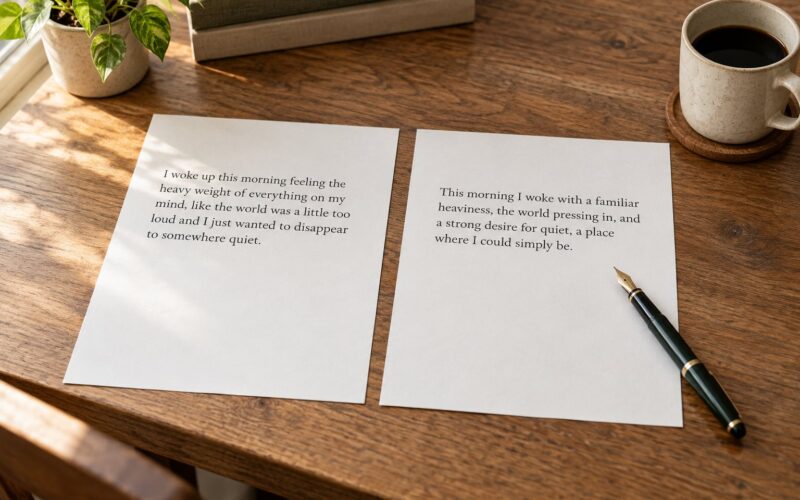
Denotation is the literal, dictionary meaning of a word. Connotation is the feeling, association, and cultural baggage a word carries on top of that literal meaning. Get this one distinction right and you can explain why writers choose “home” over “house”, why a politician says “tax relief” instead of “tax cut”, and why a poem’s plainest word is often doing the heaviest work.
Most people mix these two up once, usually in an exam, and never unlearn it. So this guide builds the distinction from the dictionary up, then gives you twelve worked denotation vs connotation examples you can reuse in essays and class discussion.
Table of Contents
- denotation vs connotation with examples at a Glance
- What Is Denotation?
- What Is Connotation?
- What does connotative mean?
- How to Tell Denotation and Connotation Apart
- Denotation vs connotation with examples: one sentence, two readings
- 12 Denotation vs Connotation Examples
- 1. House vs. home
- 2. Cheap vs. economical
- 3. Thin vs. slender vs. skinny
- 4. Curious vs. nosy
- 5. Sick vs. ill
- 6. Prisoner vs. detainee
- 7. Dove vs. pigeon
- 8. Savage vs. primitive
- 9. Crazy vs. unusual
- 10. Freedom fighter vs. insurgent
- 11. Cluttered vs. busy
- 12. Die vs. pass away
- Literal vs Figurative Meaning in Literature
- Why connotation is not the same as symbolism
- Why Context Changes the Meaning
- Common Denotation and Connotation Mistakes
- Frequently Asked Questions
- What is the difference between denotation and connotation?
- Is denotation always the dictionary definition of a word?
- Can a word’s denotation change over time?
- Why can two people have different connotations for the same word?
- How do you identify connotation in a poem or novel?
- Is figurative language always connotative?
- Conclusion
denotation vs connotation with examples at a Glance
| Criterion | Denotation | Connotation |
|---|---|---|
| What it is | The literal, explicit meaning a word names | The implied, emotional, or cultural meaning attached to it |
| Where it lives | The dictionary entry | The community of readers who use the word |
| Type of information | Factual and definitional | Associative and interpretive |
| Key question | What does it literally name? | What does it suggest and make me feel? |
| Verb form | To denote, designate, signify directly | To connote, suggest, imply |
| Agreement between readers | High, once you agree on the definition | Variable, since it shifts with experience and culture |
| Short example | A “cottage” is a small dwelling | A “cottage” suggests rusticity, charm, and an unhurried life |
If you remember one row, make it the first. Literal naming is shared ground; associations are where readers disagree.
What Is Denotation?
Denotation is the direct, explicit meaning of a word or phrase, roughly what you would find in a dictionary. The word comes from the Latin denotare, “to note down”, which fits: denotation is the note you write in the margin.
Denotation is not quite frozen, though. Context narrows it. “She grew up in a house” gives a physical building. “She grew up in a house of cards” gives you fragility and collapse, and the dictionary definition alone will not get you there.
That narrowing is the practical difference. Denotation gives you the shared starting point every reader agrees on before argument, subtext, or tone begins.
What Is Connotation?
Connotation is everything a word drags along with it that a dictionary does not list: feelings, cultural references, register, history, and implication. The root is connotare, “to note together”, because connotation is what a group of readers notes together without ever saying it out loud.
Connotation is why “cheap” stings and “inexpensive” does not, even though both denote a low price. It is why a sports team’s nickname reads as an insult to outsiders and as affection to supporters.
Because connotation lives in a community rather than a dictionary, two readers can honestly disagree about it. A word you grew up hearing as neutral may land as bragging or hostility to someone who learned it in a very different household.
What does connotative mean?
Connotative is just the adjective form. A connotative meaning is the implied layer a word carries; denotative is the literal one. In practice you will see “connotative meaning” and “connotative language” used interchangeably with “the emotional or cultural associations of a word”.
How to Tell Denotation and Connotation Apart
Use three moves in order: look up the word and write down its literal meaning, ask what the word suggests beyond that definition, then ask what would change if the writer swapped it for a neutral synonym.
If the swap costs the sentence something, that something is the connotation. If the swap costs nothing, you were looking at denotation all along.
Denotation vs connotation with examples: one sentence, two readings
Consider “The council slashed the budget again.” Denotation: the council reduced the budget by a large amount, and “again” marks it as recurring. Connotation: “slashed” carries violence and suddenness, and “again” implies incompetence, so the sentence quietly indicts the council without stating an opinion.
Swap “slashed” for “reduced” and the denotation survives untouched. The connotation is what disappears.
12 Denotation vs Connotation Examples
Each pair below shares a denotation and splits on connotation. I have kept them deliberately different from one another, since most lists recycle the same three or four pairs and students never get past them.
1. House vs. home
Denotation: both denote a building where people live.
Connotation of home: warmth, safety, family, belonging.
Connotation of house: neutral, structural, sometimes cold.
Effect: “She went home” is a different sentence from “she went to the house”.
2. Cheap vs. economical
Denotation: both denote a low price.
Connotation of cheap: poor quality, stinginess, or both.
Connotation of economical: prudence, and a faint self-congratulation.
Effect: same purchase, very different judgment of the buyer.
3. Thin vs. slender vs. skinny
Denotation: all denote a person of small girth.
Connotation: thin is clinical, slender is admiring and formal, skinny is blunt and can be cruel.
Effect: register does the work; two of these three words insult someone.
4. Curious vs. nosy
Denotation: both can denote a wish to know something.
Connotation of curious: open-minded, even admirable.
Connotation of nosy: intrusive, boundary-crossing.
Effect: identical curiosity, opposite moral standing.
5. Sick vs. ill
Denotation: both denote the condition of suffering from a disease.
Connotation of sick: informal, blunt, sometimes dismissive (“sick of this”).
Connotation of ill: formal, clinical, distant.
Effect: British and American writers pick different defaults, and readers hear the difference as tone.
6. Prisoner vs. detainee
Denotation: both denote a person being held by authorities.
Connotation of prisoner: guilt, punishment, a sentence.
Connotation of detainee: procedural language that implies no wrongdoing.
Effect: the euphemism changes what readers assume happened before a single fact is established.
7. Dove vs. pigeon
Denotation: both denote a common bird of the pigeon family.
Connotation of dove: peace, purity, the Holy Spirit in Christian iconography.
Connotation of pigeon: city nuisance, vermin.
Effect: in political headlines the same bird becomes a claim about the speaker’s intentions.
8. Savage vs. primitive
Denotation: both are used to mean uncivilized or early.
Connotation: savage reads as cruel and brutal; primitive reads as merely early, and sometimes as simple or pure.
Effect: writers have moved toward primitive in academic prose because savage carries a moral accusation.
9. Crazy vs. unusual
Denotation: crazy denotes mentally unwell; unusual denotes deviating from the norm.
Connotation of crazy: dismissive, and now often used about ordinary disagreement.
Connotation of unusual: mildly intriguing, faintly flattering.
Effect: the substitution lets a writer dismiss an argument by disguising an insult as a description.
10. Freedom fighter vs. insurgent
Denotation: both denote an armed person fighting against a government or occupying force.
Connotation of freedom fighter: noble, disinterested, heroic.
Connotation of insurgent: unlawful, domestic, therefore suspect.
Effect: identical facts, opposite moral framing, which is why the choice of noun is never innocent.
11. Cluttered vs. busy
Denotation: both denote having a lot going on.
Connotation of cluttered: disorganized, out of control.
Connotation of busy: productively occupied, almost admirable.
Effect: a room description becomes a judgment about the person who owns it.
12. Die vs. pass away
Denotation: both denote the cessation of life.
Connotation of die: blunt, secular, sometimes brutal.
Connotation of pass away: softened, reverent, and in older English also faintly sporting.
Effect: obituaries and eulogies show which register a community finds bearable.
Literal vs Figurative Meaning in Literature
Denotation maps onto literal language: what is stated on the surface. Connotation is where figurative language does its work, arriving through imagery, tone, irony, simile, and word choice rather than through statement.
Close reading means tracing both. In The Great Gatsby, the green light at the end of the Dockerys’ dock is denotatively a light, repeatedly described and reachable. What it connotes is unreachable longing, the past as an ideal, and Gatsby’s entire rewrite of his life around it. Nothing is said outright, and everything is said.
Works like that are why teachers insist on both layers. A student who stops at “it is a light” has read the denotation and missed the sentence. A student who reports “it means he can never have what he wants” has the connotation and no evidence.
Why connotation is not the same as symbolism
Symbolism attaches a whole meaning to an object or action: a dove carrying a peace symbol, a storm standing for a coming reckoning. Connotation is weaker and more ordinary. Most words carry some, and that is normal.
Connotation is what “shrewd” adds to “clever”. Symbolism is what a fox standing outside the house is doing in a play. The test is whether the meaning belongs to the word in general, or to that specific object in that specific text.
One more layer exists if you study semiotics. Roland Barthes split signification into a first stage, where a sign denotes its obvious referent, and a second stage, where an entire cultural ideology settles onto that first image and is read as if it were simply natural. That second-order reading is connotation doing the heavy lifting in photography, film, and packaging.
Why Context Changes the Meaning
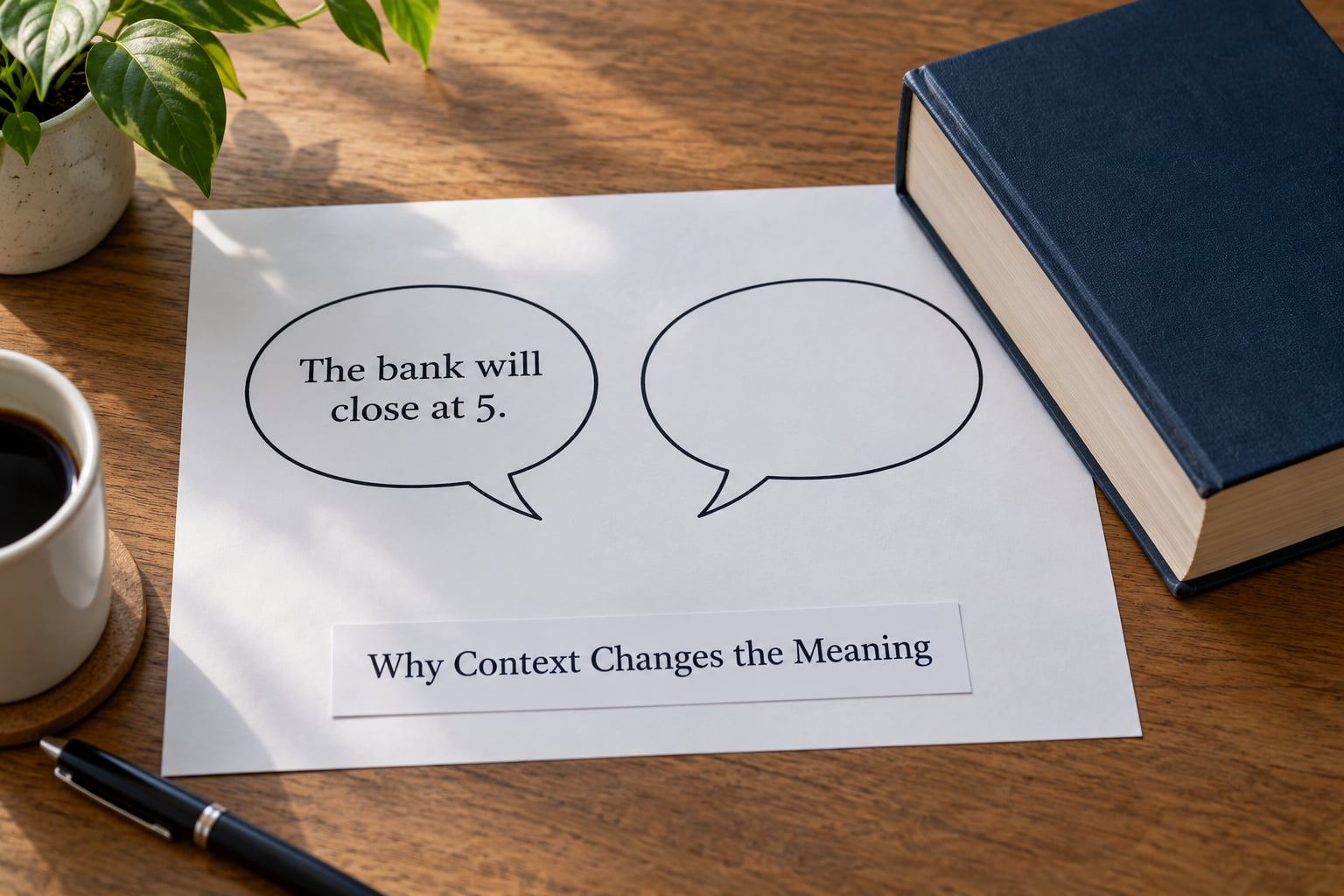
The denotation of a word can shift with a technical or legal context, but it usually stays recognisable. Connotation moves constantly, and five things move it: speaker, setting, genre, historical period, and audience.
Period matters more than students expect. Words gain and lose charge across decades, so reading an older text with modern ears can invert an insult into a compliment. Audience matters just as much. A euphemism that reads as respectful in a hospital reading list may read as evasive in a news report, and the identical phrase carries a different charge depending on who is holding it.
For second-language learners, the useful framing is this: denotation is owned by the dictionary, connotation is owned by the community. You can look up “shrewd” and get “clever and able to make good decisions”. Nothing in that entry tells you whether the speaker in front of you is admiring someone or cutting them down, and only the surrounding community can.
Genre sets the default too. A romance novel and a police procedural both use “his jaw tightened”, but the connotation lands differently because of what each genre has taught you to expect from a tightening jaw.
Common Denotation and Connotation Mistakes
Reversing the terms. Students reliably treat denotation as the deeper meaning and connotation as the literal one. Fix it with a sentence you cannot argue with: the dictionary is one layer, the associations are the other, and the dictionary layer comes first.
Treating connotation as the dictionary definition. If you can find a feeling in a dictionary entry, it is part of the denotation, not a bonus meaning. “Dead” is denotatively unconscious or non-living. It is not connotatively asleep.
Assuming one universal feeling per word. “Shrewd” reads as clever to one reader and devious to another, and both are reading the connotation correctly. Say “often connotes” rather than “connotes”.
Confusing connotation with theme. Theme is the argument the whole text makes. Connotation is the local charge a single word contributes to that argument. A novel can carry a heavy theme through entirely neutral wording.
Assuming every noun is a symbol. This is the most common one in classrooms. A word with connotation is not thereby a symbol, and not every word has a strong connotation at all.
Frequently Asked Questions
What is the difference between denotation and connotation?
Denotation is the literal, dictionary-level meaning of a word: what it explicitly names. Connotation is the implied layer, the emotional, cultural, and contextual associations a word carries. House and home denote the same building, but only home connotes warmth and family. Most analysis errors come from swapping the two, so anchor on the dictionary layer first.
Is denotation always the dictionary definition of a word?
It is the closest thing to it. Dictionary entries record a word’s settled literal meanings, which is what denotation tracks. But specialist contexts narrow the denotation: the medical sense of a term in a chart differs from its everyday sense. Context selects among established meanings rather than inventing new ones.
Can a word’s denotation change over time?
Rarely, but slowly. Words gain and lose literal senses as usage shifts, and new senses often settle into the dictionary over decades. The far faster change happens at the level of connotation: words keep their denotation while their associations shift with culture, politics, and who is using them.
Why can two people have different connotations for the same word?
Connotation lives in a shared community rather than in a dictionary, and people join that community with different experiences. A nickname that reads as affection to one reader may read as an insult to another. Both readers are drawing on real patterns of use, which is why connotation claims are argued rather than simply looked up.
How do you identify connotation in a poem or novel?
Look up each loaded word’s literal meaning first, then ask what it suggests beyond that. Next, test it: swap in a neutral synonym and see what disappears from the line. If something is lost, that loss is the connotation. Reading aloud also helps, since rhythm and stress carry tone the eye skips.
Is figurative language always connotative?
Figurative language nearly always carries connotation, since metaphor, simile, and irony work by suggesting rather than stating. But the two are not identical. A figure of speech is a construction that departs from literal statement; connotation is the felt meaning any word picks up, figurative or not.
Conclusion
More examples on a page will not help you much. Start with the literal meaning, write it down, then ask what the word is doing that the definition cannot say. When you swap in a neutral synonym and something disappears, you have found the connotation. That one move, repeated sentence by sentence, is what turns a definition you memorised into analysis you can actually write.