Sojourner Truth (c. 1797 to November 26, 1883) was the name Isabella Baumfree chose for herself in 1843. Born into slavery in Ulster County, New York, she became a nationally known abolitionist, women’s rights activist, and itinerant preacher who was still lecturing audiences in the year she died.
Her story gets flattened into a single speech almost everywhere it is retold. That speech matters, but it is one episode in eighty-six years of public work, and the text most people quote was written down more than a decade after she spoke it.
This guide walks through her childhood in bondage, the legal fight that bought her freedom, the autobiography she dictated because she could not read or write, the Akron convention, the argument she had with Frederick Douglass about whose vote to fight for first, and the activism that came after the Civil War. It also separates what the record supports from what later retellings added.
Table of Contents
- Sojourner truth life and legacy explained: key facts at a glance
- What shaped Sojourner Truth’s early life?
- How did Sojourner Truth become an abolitionist and activist?
- What were Sojourner Truth’s major speeches and writings?
- Sojourner truth life and legacy explained in dates, 1797–1883
- Why is “Ain’t I a Woman?” important to her legacy?
- How does Sojourner Truth’s life connect to American literature?
- What is Sojourner Truth’s lasting legacy?
- What should students remember about Sojourner Truth?
- Discussion and essay prompts for the classroom
- Primary sources and further reading
- Frequently Asked Questions
- What was Sojourner Truthu0026rsquo;s real name?
- Did Sojourner Truth really say u0026ldquo;Ainu0026rsquo;t I a Woman?u0026rdquo;?
- How did Sojourner Truth write her speeches and her book?
- What did Sojourner Truth fight for?
- Why is Sojourner Truth important to American literature?
- Was Sojourner Truth missing a finger?
- Conclusion
Sojourner truth life and legacy explained: key facts at a glance
- Birth name: Isabella Baumfree, born around 1797 on the Hardenbergh estate at Swartekill in Ulster County, New York.
- Name change: She called herself Sojourner Truth by the early 1840s and used it publicly from 1843 onward.
- Freedom: She bought her own freedom from the Van Wagenen family for twenty dollars, helped by New York’s gradual emancipation law.
- Autobiography: The Narrative of Sojourner Truth appeared in 1850, dictated to Olive Gilbert and published with a preface by William Lloyd Garrison.
- Famous address: She spoke at the Woman’s Rights Convention in Akron, Ohio, in 1851.
- Literacy: She never learned to read or write in English; every text in her name was transcribed by someone else.
- White House: She visited President Abraham Lincoln in Washington in 1864 during the Civil War.
- Death: She died in Battle Creek, Michigan, on November 26, 1883, aged about eighty-six.
What shaped Sojourner Truth’s early life?
Isabella Baumfree was born into slavery on a farm in the Hudson Valley, the daughter of Elizabeth French Baumfree and an enslaved man named Johannes Baumfree who belonged to John Hardenbergh. She grew up speaking Dutch, the common language of Dutch-settled Ulster County, which is one reason her later audiences sometimes struggled to follow her.
As a child she was sold away from her parents, and over the years she passed through several owners, including John Neely, Martinus Schryver, and eventually John Dumont at West Park. Her account of her enslaver-husband Thomas is the most painful material in the Narrative: he forced her into a marriage she did not consent to, and she bore five children.
Two of her children were sold. She was separated from her daughter Diana for years, and her son Peter, born after the New York emancipation law took effect, was technically free but still kept as a servant. That separation shaped nearly everything she did for the rest of her life, including her later insistence that mothers and children be reunited.
Known and uncertain: her birth year is given as 1797 or 1798 because no record of her birth survives, only later recollection. Her account of violence at the hands of Thomas comes from her own dictation and is the best evidence available, but historians note that dictated narratives mixed memory, sermon, and legal argument, so some details are shaped by purpose rather than pure recall.
How did Sojourner Truth become an abolitionist and activist?
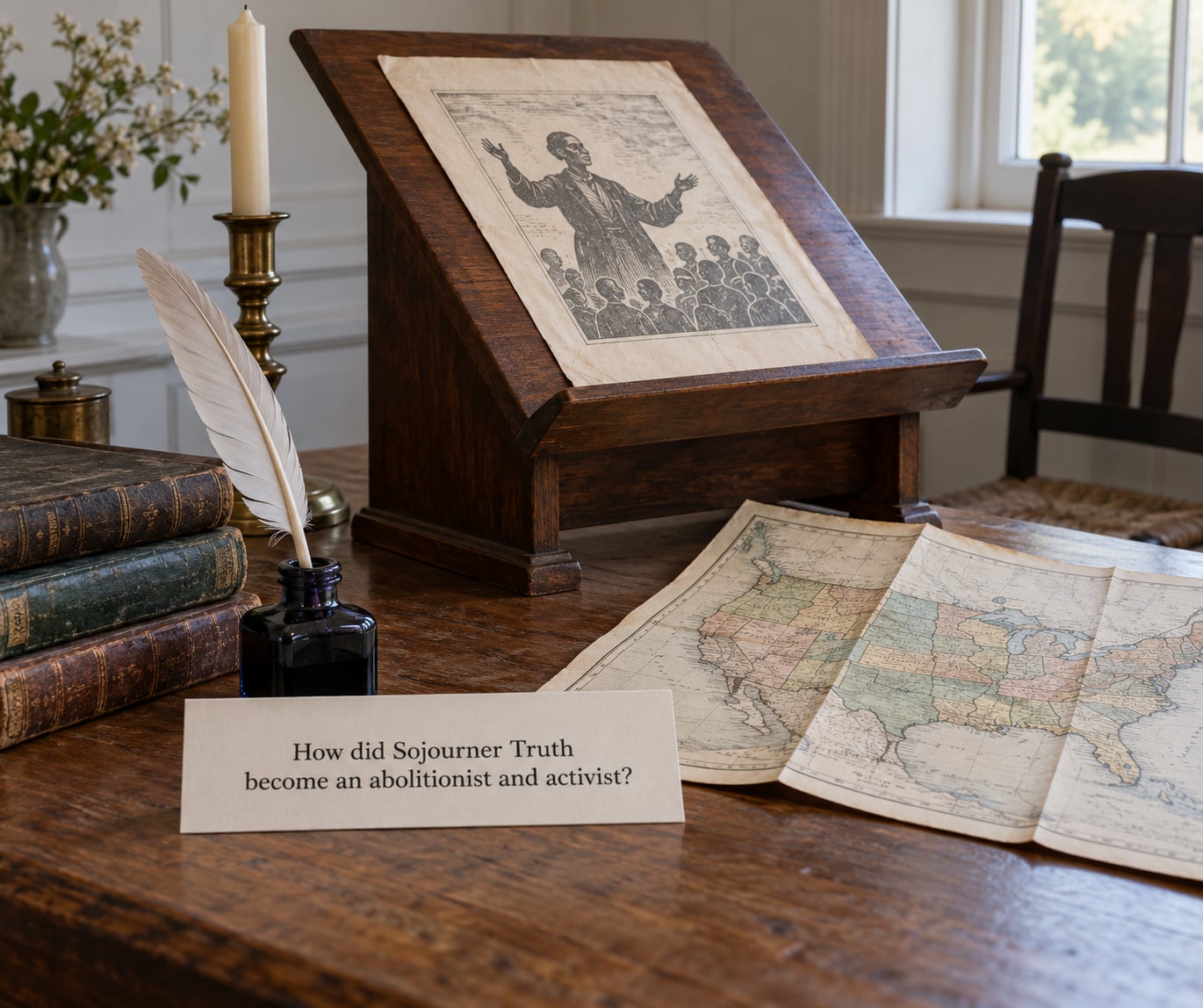
She walked away from Dumont’s farm around 1835 and spent the next several years working as a domestic worker while looking for a way to make her freedom legal. She found it by exploiting a gap in New York law.
New York’s act of gradual emancipation, passed in 1827, ended slavery for most adults immediately but freed only children born after a set date, when they reached age twenty-five. Baumfree argued that her son Peter fell under that provision. She hired attorney James C. Matthews, and after two years of litigation she won his release in 1828. Then Samuel Van Wagenen, a childhood acquaintance, bought her for twenty dollars so she could leave legally and on her own terms.
By 1843 she had taken the name Sojourner Truth and begun working as an itinerant preacher, lecturing in Quaker meeting houses and revival settings from New York into the Midwest. She met William Lloyd Garrison and Frederick Douglass in the Northampton Association of Education and Industry in Massachusetts, a commune where abolitionists, Quakers, and fugitive slave workers lived and worked together.
The Fugitive Slave Act of 1850 changed her movements. That law empowered slaveholders to seize people who had escaped and empowered federal commissioners to compel witnesses to testify, so she spent years lecturing in Canada and the Northwest, away from the states where she was most exposed to seizure.
Her method was unusual for the period. Rather than reading from a text, she told her own story and used scripture as argument, and she tied abolition to rights for women because, as she put it in the Narrative, women’s rights had been twisted into a pretext for keeping women subordinate.
What were Sojourner Truth’s major speeches and writings?
Her most important published work is The Narrative of Sojourner Truth, issued in 1850. She dictated the story to Olive Gilbert, a New England schoolteacher, who wrote down what she said, and Garrison added a preface that insisted the book be read as history rather than fiction. Sales copies went to fund the freedom of her siblings and other people still held in bondage, which made the book an abolitionist fundraising tool as well as a testimony.
The most famous speech was given at the Woman’s Rights Convention in Akron, Ohio, in 1851, where she spoke for about two hours on the intersection of race, sex, and class. Frances Dana, who attended, remembered it as an event that changed her own thinking.
Another address, delivered to the American Equal Rights Association in 1867, survives in a published version in which she lists what the law allows a man: owning property, voting, going to church, and travelling without a master if he can pay for the ticket, and asks what those same freedoms amount to for a woman.
She also disagreed publicly with Frederick Douglass. After the Fifteenth Amendment extended the vote to Black men in 1870 without touching women’s suffrage, she backed the American Equal Rights Association’s push for universal suffrage and Douglass backed the narrower goal. Several years earlier she had been more cautious with him in a private letter, warning him that raising the question of Black male suffrage alone would split the movement. Historians treat the quarrel as a disagreement over strategy, not over whether slavery and race mattered.
Sojourner truth life and legacy explained in dates, 1797–1883
| Year | Event |
|---|---|
| c. 1797 | Born as Isabella Baumfree on the Hardenbergh estate, Swartekill, Ulster County, New York. |
| c. 1827 | Hires attorney James C. Matthews to petition for the freedom of her son Peter under New York’s emancipation law. |
| 1828 | Peter freed by court decision; Samuel Van Wagenen buys her freedom for twenty dollars. |
| 1843 | Uses the name Sojourner Truth publicly and begins lecturing as an itinerant preacher. |
| 1850 | The Narrative of Sojourner Truth published, dictated to Olive Gilbert with a Garrison preface. |
| 1851 | Speaks at the Woman’s Rights Convention in Akron, Ohio. |
| 1857 | Speaks at the Woman’s Rights Convention in New York; collects signatures for petitions for freed people to receive land. |
| 1863–64 | Aids refugee and relief work, helps recruit Black Union soldiers, and meets President Lincoln at the White House in 1864. |
| 1865–67 | Works with the Freedmen’s Bureau and at Freedmen’s Hospital in Washington, and campaigns for a national Freedmen’s Savings Bank. |
| 1870 | Backs the American Equal Rights Association in the suffrage split with Frederick Douglass. |
| 1883 | Dies in Battle Creek, Michigan, on November 26; buried in Oak Hill Cemetery. |
Why is “Ain’t I a Woman?” important to her legacy?
The speech works as a rhetorical trap. She takes the catalogue of rights her listeners take for granted, working, earning, owning property, voting, going to court, and then holds each one up against the reality of a Black woman in the United States, and she does it in the plainest possible idiom, without allegory.
The device that carries the argument is arithmetic. She lines up the number of fingers, the number of heads, the number of years, and then points out that the arithmetic does not change when you subtract race and sex. That contrast between what a person can count and what law and custom count for them is the intellectual core of the speech, and it is why it still travels.
It also attacks a specific target. The line about not having a country, a flag, or a lord came at a moment when some white women’s rights advocates argued that the vote and legal standing were matters of property-holding citizens rather than of sex, and her speech was answering that argument directly, in front of the women’s rights movement itself.
Here is the part that deserves care. The version everyone knows was published in 1863 in The Independent, twelve years after she spoke, and no stenographic transcript of the 1851 speech survives. The earliest print accounts are later recollections: Marius Robinson published his version in 1863, Frances Dana, who was in the room, published a recollection in the same year, and the published version credited to George Francis Train spread widely through The Independent. Each is a genuine witness or near-witness writing from memory, and each differs in wording.
So the speech is real and the debate is not evidence that she did not make it. What readers should hold onto is that the memorable sentences were assembled and edited by others after the fact. That is a fact about the archive and about who was considered a reliable speaker in 1851, and it does not shrink what she argued.
How does Sojourner Truth’s life connect to American literature?
She belongs to the slave narrative tradition, a body of testimony written or dictated by formerly enslaved people to argue against slavery. What distinguishes hers is the structure: she does not present her life as a sequence of sufferings, but as a spiritual conversion that ends in public authority. The voice is scriptural, rhythmic, and built for a room rather than a page.
That oral form has a cost that literary critics have spent decades describing. Because she could not read or write, the texts attributed to her passed through at least one other person’s hand in every case, from Gilbert’s transcription to the newspaper versions of the speech. Reading her means reading both her argument and the editorial decisions that carried it.
She also sits inside several literatures at once: the abolitionist press that Garrison used to reach sympathetic readers, African American rhetorical and spiritual traditions, and women’s writing in a period before women could vote, hold most professions, or be admitted to most colleges.
The Narrative circulated widely in the 1850s and was widely read aloud, including by people who could not read it themselves, which makes it a useful case study for classes on orality, authorship, and the nineteenth-century press.
What is Sojourner Truth’s lasting legacy?
Her legacy does not stop in 1851. For two decades after the Akron speech she kept collecting petitions, speaking, and organising, including drives to sign freed people up for land and for a national Freedmen’s Savings Bank, a campaign the federal government blocked.
During the Civil War she worked with the Freedmen’s Bureau, spent time at Freedmen’s Hospital in Washington, helped recruit Black soldiers, and pushed President Lincoln directly on the treatment of Black people, including the arming of Black troops. Accounts from her later life describe her arguing on a Washington streetcar after being refused a seat, and challenging her fellow passengers when they objected to a Black woman riding with them.
Her impact on the movement that followed is harder to measure than the fame of one speech. The rights argument she made in 1851 was repeated, adapted, and organised for another thirty-seven years before the Nineteenth Amendment was ratified in 1920, and her death in 1883 falls in the middle of that span. Long after her voice was gone, her formulation of the problem kept circulating in movement arguments.
Modern commemoration caught up slowly. A United States postage stamp appeared in 1986, statues were dedicated in Battle Creek and Northampton, and her work became required reading in many schools. The most influential scholarly treatment is bell hooks’ essay “Ain’t I a Woman? Black Women and Feminism” from 1981, which used the speech’s title as a provocation for Black feminist criticism. Stage and film portrayals have brought the name to audiences who will never open the Narrative.
What should students remember about Sojourner Truth?
Remember the person, not the quotation. She was her own agent for roughly fifty years, from the moment she walked away from bondage to her death at eighty-six, and she never waited for permission to speak, organise, or publish.
Remember her as a writer even though she could not write. The Narrative, the petitions, and the speeches are hers in argument and voice even though other hands held the pen, which makes her a useful case for discussing how authorship works when the author is voiceless.
For a student in 2026 meeting her for the first time, the habit worth building is reading the footnotes, not just the famous line. Knowing that the speech text came from 1863 remembrances, and that Robinson and Dana are named sources you can actually look up, turns a memorised slogan into evidence.
Discussion and essay prompts for the classroom
- Compare the 1863 published version of the Akron speech with Frances Dana’s recollection. What changes when a text is edited by someone other than the speaker?
- Trace how the speech answers the argument that voting rights belonged to property-holding citizens. Why did a women’s rights convention make sense as the place to make that argument?
- How does the arithmetic passage, with fingers and heads and years, do work that a statistical argument could not do?
- Compare the Douglass disagreement over the Fifteenth Amendment with the earlier conflict between Truth and white suffragists who sidelined Black women. What changed in the coalition at each point?
- Using her post-1865 petitions and Freedmen’s Bureau work, argue for or against the claim that her legacy rests on one speech.
Primary sources and further reading
- The Narrative of Sojourner Truth, dictated to Olive Gilbert, with a preface by William Lloyd Garrison (1850); later editions from any reputable scholarly press are fine for citation.
- Marius Robinson, “Reminiscences of Sojourner Truth” (1863), and Frances Dana, “Sojourner Truth” (1863), both reprinted in collections of early women’s-rights documents.
- The published 1863 version of the Akron speech as printed in The Independent, useful precisely because of how much it differs from the recollections.
- bell hooks, “Ain’t I a Woman? Black Women and Feminism” (1981), for the modern critical reading.
- Institutional collections: the Library of Congress holds manuscripts and printed broadsides related to her tours, and the National Park Service and the Smithsonian’s National Museum of African American History and Culture hold material on the abolitionist and women’s rights movements she joined.
Frequently Asked Questions
What was Sojourner Truthu0026rsquo;s real name?
Her birth name was Isabella Baumfree, which is how she was recorded in New York records as an enslaved child. She began calling herself Sojourner Truth in the early 1840s and used that name in print from 1843 onward, but the name was her own choice rather than a family or legal designation. Both names appear on her own tombstone in Battle Creek, Michigan.
Did Sojourner Truth really say u0026ldquo;Ainu0026rsquo;t I a Woman?u0026rdquo;?
She gave an address at the 1851 Womanu0026rsquo;s Rights Convention in Akron, Ohio, and several witnesses recorded it afterwards. The wording now famous comes from versions published in 1863, including recollections by Marius Robinson and Frances Dana and a printed version circulated in The Independent. So the speech happened, but the exact text was reconstructed from memory more than a decade later.
How did Sojourner Truth write her speeches and her book?
She dictated them. She never learned to read or write English, so The Narrative of Sojourner Truth was transcribed in 1850 by Olive Gilbert from what she said, and published with a preface by William Lloyd Garrison. Her speeches were written down by whoever hosted or reported on them. This is why students are asked to think about authorship when they read her.
What did Sojourner Truth fight for?
Her work centred on ending slavery, securing rights and suffrage for women, and improving conditions for newly freed Black people. During and after the Civil War she aided refugee relief, worked with the Freedmenu0026rsquo;s Bureau and Freedmenu0026rsquo;s Hospital, helped recruit Black soldiers, petitioned for land for freedpeople, and pressed President Lincoln directly. She also argued publicly with Frederick Douglass over the priority of Black male suffrage.
Why is Sojourner Truth important to American literature?
She is a central figure in the slave narrative tradition and in abolitionist print culture, and her dictated autobiography was widely read and read aloud in the 1850s. Her rhetorical style, scriptural and built for oral delivery, shaped how Black experience was argued in public. Her work also gives students a clear case for studying orality, transcription, and contested authorship.
Was Sojourner Truth missing a finger?
The story that she lost part of a finger as a child appears in later retellings, often attached to an account of a beating as a young girl. Nineteenth-century documents and her own dictated account do not confirm it, and historians treat the detail as unverified. It is a good example of a detail that spread widely without documentary support.
Conclusion
Sojourner Truth’s life and legacy explained comes down to more than one address. Start by reading The Narrative of Sojourner Truth alongside a full modern biography, then read the 1863 versions of the Akron speech and compare them with each other. That pairing is where the real learning starts: what she argued, how faithfully it survives, and why an enslaved Black woman had to fight for both her freedom and her voice.