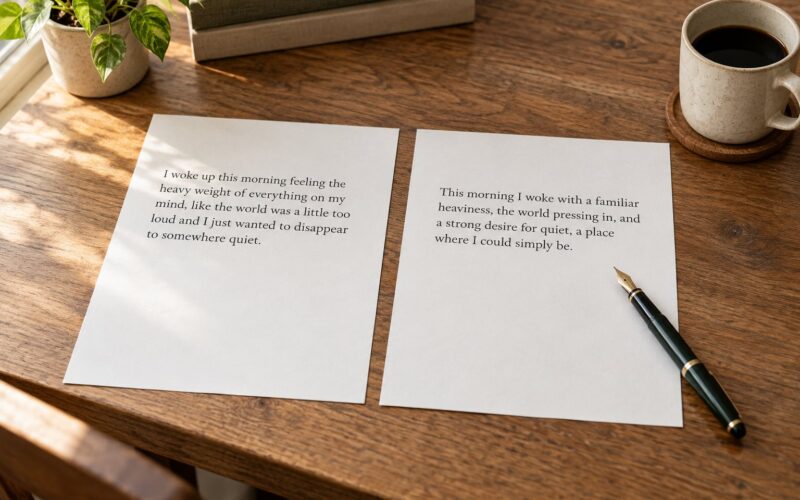
First person vs third person narration comes down to one question: who is telling the story, and what is that narrator allowed to know? First-person narration uses I or we, so the reader lives inside a single character’s memory, bias and blind spots. Third-person narration uses he, she, or they, so the writer steps back from the events and decides how much to reveal — one mind at a time in third-person limited, or every mind at once in third-person omniscient.
Neither one is more professional than the other, and plenty of excellent books use each. What actually changes when you switch is the reader’s position: close enough to feel a thought before it is explained, or far enough back to watch a character from the outside. This guide breaks down both, shows the same scene written twice, and gives you a way to decide which suits the story in front of you. Everything here holds up for 2026 classrooms and for writers drafting at midnight.
One note before we start. Point of view, or POV, is a technical term that sounds clinical. In practice it just means: whose eyes, whose knowledge, whose voice.
Table of Contents
- First Person vs Third Person Narration at a Glance
- What Is First Person Narration?
- How first person creates immediacy
- Where first person gets in the way
- What Is Third Person Narration?
- Third-person limited keeps one mind in focus
- Third-person omniscient opens the whole world
- How First Person vs Third Person Narration Changes a Scene
- Five things that actually changed
- Which Perspective Is More Emotional or Objective?
- Which Perspective Should You Choose?
- Five questions that settle the choice
- The rewrite-it-twice test
- Five common POV mistakes and how to fix them
- Mixing first and third person on purpose
- Frequently Asked Questions
- Is first person or third person better for telling a story?
- Can you switch between first and third person narration?
- Does first person narration use past tense?
- What is the difference between third person limited and third person omniscient?
- Can a first person narrator lie or be unreliable?
- How do I change a story from third person to first person?
- Conclusion
First Person vs Third Person Narration at a Glance
The table below sets first person next to the two forms of third person. Third person is not one thing, and most arguments about this topic go wrong because someone compares first person against both third-person modes at once.
| What changes | First person | Third person limited | Third person omniscient |
|---|---|---|---|
| Pronouns | I, me, my, mine, we, us, our | He, she, they, his, her, their | He, she, they, and everyone at once |
| Narrator position | Inside one character | Just outside one character | Above the whole world |
| What the reader knows | Only what the narrator knows | Only what the POV character knows | Everything, including off-screen events |
| Narrative distance | Very close | Close, with one thin layer between | Wide or adjustable |
| Emotional intensity | Highest | High, slightly filtered | Variable, can be tender or cool |
| Where suspense lives | In what the narrator refuses to say | In what the POV character misreads | In withheld information and timing |
| Flexibility | Lowest — locked to one viewpoint | Medium — one character per chapter | Highest — can jump anywhere |
| Voice | The character’s own | Close to the character’s, but not identical | The writer’s own, or a distinct narrator’s |
| Main risk | Monotony, too much interior monologue | Head hopping, drifting into first person | Distance, telling not showing |
| Suits best | Memoir, coming-of-age, thrillers, YA, comedy | Literary fiction, romance, most adult commercial fiction | Family sagas, fantasy epics, historical fiction |
| Classic examples | Jane Eyre, Gone Girl, The Catcher in the Rye | The Great Gatsby, A Room of One’s Own | A Christmas Carol, Middlemarch |
There is a third option people forget: second person, which uses you and your. It is powerful and much harder to sustain than beginners expect, because you does not automatically feel intimate — it often feels like a manual. Save it for a short story or a single sustained sequence, not a whole novel.
What Is First Person Narration?
First-person narration is a story told from inside a character using the pronouns I, me, my, mine, and — when the speaker is part of a group — we, us, our. The narrator is a character in the scene, not a voice hovering above it.
That single rule explains almost everything about how first person feels. The narrator can describe what they saw, heard, thought and misread. They cannot describe what happened in the next room while they were asleep. That is not a limitation you work around; it is the engine of the technique.
How first person creates immediacy
Readers get the character’s thought and the narrator’s interpretation at the same moment, with no gap in between. Nothing has to be translated before it reaches you.
First person also gives you voice for free. A working-class teenager, a retired naval officer and a frightened nine-year-old all sound different in I, and you never have to write a paragraph explaining that the narrator is being dishonest. On writing forums, writers regularly describe POV choice as a voice decision rather than a distance decision, and that is exactly right.
Retrospective first person adds a further layer. When the narrator is looking back from later in life, the prose can carry the weight of hindsight — a detail that seems decorative now, the reader already knows it matters.
Where first person gets in the way
Three limitations come up constantly. First, monotony: a chapter of nothing but internal monologue reads as nothing happening. Second, blind spots become a burden, because anything the narrator cannot see is unavailable to you. Third, past-tense slips are easy, because a first-person narrator is thinking in the present while writing in the past.
So first person gives you intimacy and voice, and charges you for it in range and pace.
What Is Third Person Narration?
Third-person narration uses he, she, it and they. The narrator stands outside the story and refers to characters rather than being one of them. But third person is really two separate techniques sharing a set of pronouns.
Third-person limited keeps one mind in focus
Third-person limited, often called close third, restricts interior access to a single character per chapter or per section. The narrator knows what that character knows and nothing more, but the narration is written in the writer’s words rather than the character’s.
That is the practical difference from first person. In I, the prose is the character talking. In close third, the prose is the writer describing a person from just outside them, and the sentences are usually cleaner and less mannered.
When close third slips toward the character’s idiom — She was already late, eleven minutes late, and the letter was still in her coat — you are using free indirect discourse, narration that carries a character’s voice without quotation marks. It is the bridge between the two POVs, and it is the single most useful technique in this article if you write close third.
Third-person omniscient opens the whole world
Omniscient narration lets the narrator enter any character’s mind, describe events that are happening off-screen, and comment on the whole scene from above. Dickens does this constantly: we watch Scrooge argue with an unseen visitor and know exactly what he is feeling while he refuses to acknowledge it.
The birds-eye quality makes omniscient superb for scale. Family sagas, epic fantasy and historical fiction rely on it, because a story spanning three generations needs a narrator who can hold more than one life at a time.
The risk is distance. An unfiltered omniscient narrator who reports events without colouring them can read like a transcript. Give that narrator a personality, an attitude, a reason to be watching.
How First Person vs Third Person Narration Changes a Scene

Here is the same scene written twice. Nothing has changed except the person holding the pen.
Third person, close to Nell:
The rain had already soaked through her coat when Nell reached the platform. The station clock above the ticket hall read eleven minutes late, and she could not remember whether she had packed the letter. She told herself it did not matter. People missed trains; it was hardly a catastrophe. The thought was supposed to steady her. Instead it made her look up at the departures board as if the answer might be written there.
First person:
I reached the platform with my coat soaked through. The clock above the ticket hall read eleven minutes late, and I could not remember whether I had packed the letter. I told myself it did not matter. People miss trains. It is not a catastrophe. The thought was meant to steady me and instead I found myself staring at the departures board as if the answer might be printed there in green.
Nothing dramatic happened. Both versions deliver the same facts, the same setting, the same character. Yet they read differently, and the difference is worth more than the pronoun swap that caused it.
Five things that actually changed
- The psychology became private. “The thought was supposed to steady her” states what Nell is doing. “The thought was meant to steady me” implies it and lets the reader reach the conclusion a half-second earlier.
- The self-deception got quieter. “It is not a catastrophe” sounds more like someone talking themselves into believing it than the declarative “it was hardly a catastrophe”.
- Distance collapsed by a degree. In close third you watch Nell think. In first person you are inside the thinking, and the reader’s own memory starts supplying her fear before you name it.
- Information control tightened. Ask what the first-person version can no longer do: report on the letter’s contents, describe the taxi driver Nell never sees, or reveal what the board said. The narrator was not there, so it is gone. That is why first person creates suspense so efficiently — omission is built into the form.
- Pacing shifted. First person moves faster because the writer filters everything through one consciousness. Close third allows a sentence of commentary, or a look at a second face, that first person cannot afford.
Now rewrite the scene in omniscient and watch it balloon. You could open the paragraph on the taxi driver, explain why he is driving to the wrong station, cut to the letter in the coat pocket, then return to Nell on the platform. Richer, and much harder to keep tense.
Which Perspective Is More Emotional or Objective?
First person is usually more emotional; third person can be more objective. That is the honest short answer, and it has two qualifications worth holding onto.
First, there is no neutral third person. Even an omniscient narrator chooses what to notice, and that choice is a mood. The version of the station scene that never mentions the departures board is not objective, it is evasive.
Second, emotional weight and emotional intensity are not the same thing. Third person limited can break a reader harder than first person, because a close-third narrator can withhold what a character feels and let the reader notice the gap. Sorrow that is described bluntly is less powerful than sorrow that a narrator refuses to name.
Readers and writers do not agree on the answer either, which is worth knowing if you are writing for an audience. Readers tend to state a mild preference for first person because of voice and intimacy. Writers tend to state a mild preference for third person limited because it is easier to move around in. Both positions are about the same thing: control.
Which Perspective Should You Choose?
Use these five questions in order. Most drafts are decided by the third one.
Five questions that settle the choice
- Is the story about a voice? If the character has an unusual way of seeing the world, write it in first person. The prose does half the characterisation work for you.
- Does the story need information your protagonist cannot get? If yes, you need third person. Suspense built on concealment is much harder in first person, and much easier in close third, because the narrator can hover just outside.
- How wide is the cast? One viewpoint that carries the book, first person. Several viewpoints you intend to rotate, third person limited, one character per chapter. Large groups across time, omniscient.
- What is the reader meant to feel? Close and complicit, first person. Observing and slightly outside, close third. Held at a distance with a wide view, omniscient.
- What does your genre expect? Young adult and coming-of-age lean first person, often with alternating narrators. Adult commercial fiction usually leans close third. Literary fiction uses all three, so this question counts for less there.
If the answers are split, start in third person limited. You can drop into a first-person insert later without restructuring anything, and close third is the easiest POV to move around in while drafting.
The rewrite-it-twice test
Take one scene you have already written, maybe 500 words, and write it again in the other person. Do not judge either version while you write. Put them side by side afterwards and read them aloud.
Most writers find that one version breathes and the other does not. That reaction is data, and it is far more reliable than any rule about what you are supposed to be using. The community consensus tends to be the same: write whatever you think of as you go, and then check later whether the voice is right.
Five common POV mistakes and how to fix them
- Head hopping. You leave one character’s head and enter another’s in the same scene. The fix is mechanical: split at a section break, a blank line, or a scene break. Never hop silently.
- Drifting into first person while writing close third. Watch for a sudden “I” in your notes, and for sentences that slip into the character’s interior without a filter. Read the chapter aloud and mark every interiority claim; they should all pass through one character.
- Over-explaining the narrator’s thoughts. If you write “I felt a chill of dread,” you have named the feeling the reader was about to have. Cut the naming and keep the physical detail that produced it.
- Tense slippage. In first person especially, check that your past-tense narrative has not picked up a present-tense thought without a marker like “even then, I believed”.
- Too many POV characters. More than three rotating viewpoints in a short novel and readers lose the thread. Give each narrator a distinct diction and a clear chapter position, and keep the count low.
Finding a break in an existing draft takes three passes. First pass, search every instance of a POV character’s name and flag what they cannot know. Second pass, highlight all interior verbs — thought, knew, wondered, realised, felt — and check they belong to the same mind. Third pass, read only the openings of your chapters; that is where first person habits creep back in.
Mixing first and third person on purpose
You can switch, but only with a visible seam. The common method is a frame: a third-person present-tense narrator introduces the story, and the first-person sections sit inside that frame like letters or a recorded account.
The rule is that the shift must be marked and the reader must be able to tell at a glance which voice they are in. Change the tense, the margins, the typography, or all three. Accidental mixing reads as a mistake, and readers are forgiving about a lot but not about that.
Frequently Asked Questions
Is first person or third person better for telling a story?
Neither is better in the abstract. First person wins on voice, intimacy and concealment; third person limited wins on flexibility, information control and the ability to sit just outside a character. Match the perspective to what your story needs the reader to feel and to know, and test it by rewriting one scene both ways.
Can you switch between first and third person narration?
Yes, but only with a visible structure. The usual method is a frame: a third-person narrator sets the scene, then first-person sections appear inside it as letters, diaries or testimony. Change tense, typography or both at the switch so the reader always knows which voice they are in.
Does first person narration use past tense?
Usually, but not always. Most first-person novels are written in past tense because the narrator is recalling events that have already happened. Plenty of thrillers and literary fiction use present tense, which makes events feel immediate and unavoidable. The important thing is that the tense stays consistent.
What is the difference between third person limited and third person omniscient?
Third person limited enters the mind of a single character, so the reader knows only what that character knows. Third person omniscient can enter anyone’s mind and describe events happening off-screen, giving a wide view of a whole world or family. Limited creates mystery; omniscient creates scope.
Can a first person narrator lie or be unreliable?
Yes, and it is one of the form’s strengths. A first-person narrator can misremember, omit, exaggerate or misread without the narration breaking, because readers already accept that a person narrating their own life has blind spots. Give the reader just enough accurate detail to keep them trusting the narrator.
How do I change a story from third person to first person?
Do it in stages rather than in one pass. Rewrite your opening scene in first person and read it aloud. Then convert each chapter in turn, replacing distance words like seemed and appeared with direct statement, and checking that you do not describe anything your narrator could not have seen or heard.
Conclusion
First person puts the reader inside one person’s head with I and we. Third person steps outside with he, she and they, and then splits into limited, which stays with one mind, and omniscient, which holds the whole world. That is the whole difference, and everything else — intimacy, suspense, flexibility, voice — follows from it.
So start with the question the other way round. Decide whose knowledge should govern the story, and whose emotional experience the reader should share. Everything about the mechanics falls out of that decision. Then take one scene you already like and write it in the other person, and see which version keeps you reading.