Puritan writers in seventeenth-century New England used plain, direct, unadorned language: everyday words instead of ornament, sentences that state a thing plainly, and no classical allusion or extended metaphor. They wrote this way because they believed decorative prose softened the message and fed human pride. To put it in one line, the Puritan plain style treats language as a tool for truth, not as a display of the writer.
The style shows up in sermons, journals, letters, histories and poems. It is easy to spot once you know what you are looking for, and easy to over-apply once you get excited. Here is how it works, who used it, and how to analyse a passage without flattening it.
Table of Contents
- What Is the Puritan Plain Style?
- Why Did Puritan Writers Use Plain Language?
- What Are the Main Features of the Puritan Plain Style?
- How Does the Puritan Plain Style Differ from Ordinary Simple Writing?
- How Do Imagery and Rhythm Shape the Puritan Plain Style?
- Which Authors Commonly Show the Puritan Plain Style?
- How Can You Analyze the Puritan Plain Style in a Passage?
- What Are the Most Common Misunderstandings?
- Frequently Asked Questions
- Is the Puritan plain style the same as plain modern writing?
- Which Puritan authors are best known for the plain style?
- Does the Puritan plain style avoid imagery and emotion altogether?
- How can a student recognize the plain style in a poem?
- What is the difference between the Puritan plain style and Puritanism?
- How should a teacher introduce the Puritan plain style to students?
- Conclusion
What Is the Puritan Plain Style?
The Puritan plain style is a mode of writing used by many writers in seventeenth-century New England that favours direct, unadorned, everyday language over ornamented rhetoric. Writers using it reach for common vocabulary, short and balanced sentences, first-person narration and rhetorical questions, and they leave out classical allusion and extended metaphor. The reason was theological as much as aesthetic: ornate writing was thought to veil the Word of God and to encourage pride in the writer.
One thing to say plainly, because it comes up in every classroom: this was a tendency, not a rulebook. Nobody sat down with a Puritan style guide. Some Puritan writers broke away from it badly, and some seventeenth-century New England writing is nothing like this at all. The label is a useful description of a recurring set of habits, not a stamp you apply to everything produced by a Puritan.
Why Did Puritan Writers Use Plain Language?
The strongest answer is biblical. Puritan writers inherited the Reformation conviction that scripture speaks plainly and should be read plainly, and they extended that conviction to their own prose. If the Bible needed no ornament to reach a reader, neither did a sermon or a letter home.
There was a moral argument underneath. Ornament implied display, and display implied pride, and pride was a sin in a community that saw itself as a chosen people held to a strict covenant. Plain speech also served a practical purpose in small settlements where the audience was ordinary people, not courtly readers trained in Latin rhetoric.
Winthrop’s A Model of Christian Charity (1630) makes the social reasoning explicit: the colony was a body of members, each one obliged to the others, and speech that served the common good was preferred over speech that flattered the speaker. Write plainly, the argument runs, because the truth is common property and ornament makes it private.
What Are the Main Features of the Puritan Plain Style?
Seven features account for most examples you will meet. Each one tells you something different, and each gives you a question to ask when you are reading a passage cold.
| Feature | What it looks like | Example | Ask yourself |
|---|---|---|---|
| Plain diction | Common words doing the work that rare words would otherwise do | “good” instead of “excellent” | Would a reader need a dictionary? |
| Direct syntax | Subject, verb, object, in that order; clauses joined plainly | “We began to build a house.” | Do I have to reread the line for the grammar? |
| Restrained imagery | Concrete objects rather than extended figurative scenes | “the winter cold” | Is the image doing work or decorating? |
| Serious tone | Grave, sober, unsmiling; humour kept out of sacred subjects | “we were in great distress” | Does the tone match the subject’s weight? |
| Logical order | Claim, then grounds, then application, in sequence | Doctrine stated before comfort offered | Can I name each step in the order given? |
| Biblical echoes | Scriptural phrasing or cadence surfacing in ordinary sentences | “visitation” for a crisis | Is this wording doing scriptural work? |
| Purposeful repetition | A word or pattern returned to for emphasis, not filler | “we” repeated across a statement of covenant | Does the repeat push the meaning further? |
Read the last row carefully. Repetition is a plain-style tool precisely because it works without ornament, and students routinely mistake it for weak writing. The test is whether the repeated element changes what you understand.
How Does the Puritan Plain Style Differ from Ordinary Simple Writing?
Plainness as a deliberate craft is not the same as plainness as a shortage of skill. The difference is that a plain-style writer has chosen every word and decided that none of them can be removed or upgraded.
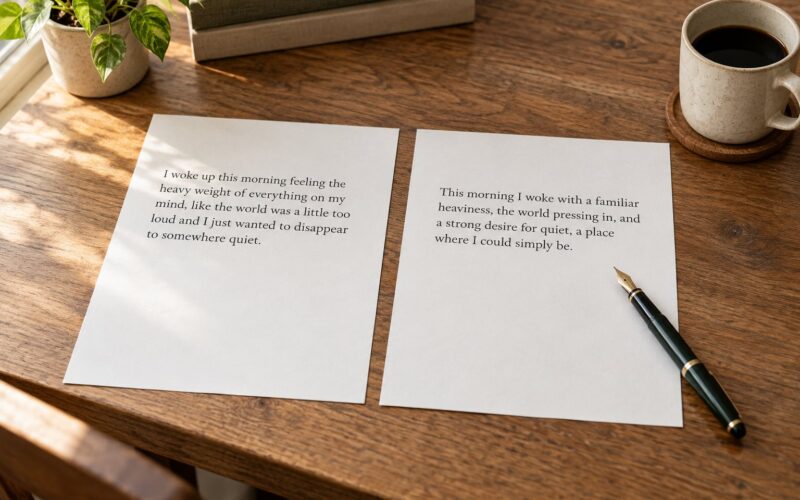
Take one idea. Plain register: “We were hungry, so we went to the fields and worked.” Ornate register: “Hunger, our cruel taskmistress, drove us from our fireside to labour in the fields beneath a pitiless sky.” The second sentence is not worse writing. It is just doing a different job, and it is doing a job many Puritan writers thought should not be done in sacred or civic prose.
That is also why plain style is not the same as careless writing or emotionless writing. Anne Bradstreet’s plain verse is full of feeling. What it withholds is the ornament, not the feeling.
How Do Imagery and Rhythm Shape the Puritan Plain Style?
Imagery survives in plain style, but it narrows. Instead of a developed figure that runs for twenty lines, you get one concrete object doing one job: the cold, the ship, the child, the bread. Short, heavy nouns carry weight that adjectives would only dilute.
Rhythm does similar quiet work. Puritan sentences tend to be measured rather than stirring, and the steadiness is part of the authority: a writer who is not trying to impress you sounds more trustworthy. Repetition of a phrase at a key moment, a series of parallel clauses, a question aimed straight at the reader, these give plain prose a cadence without decoration.
The result can be genuinely moving. Restraint concentrates feeling rather than draining it away, and readers often remember plain lines longer than flowery ones.
Which Authors Commonly Show the Puritan Plain Style?
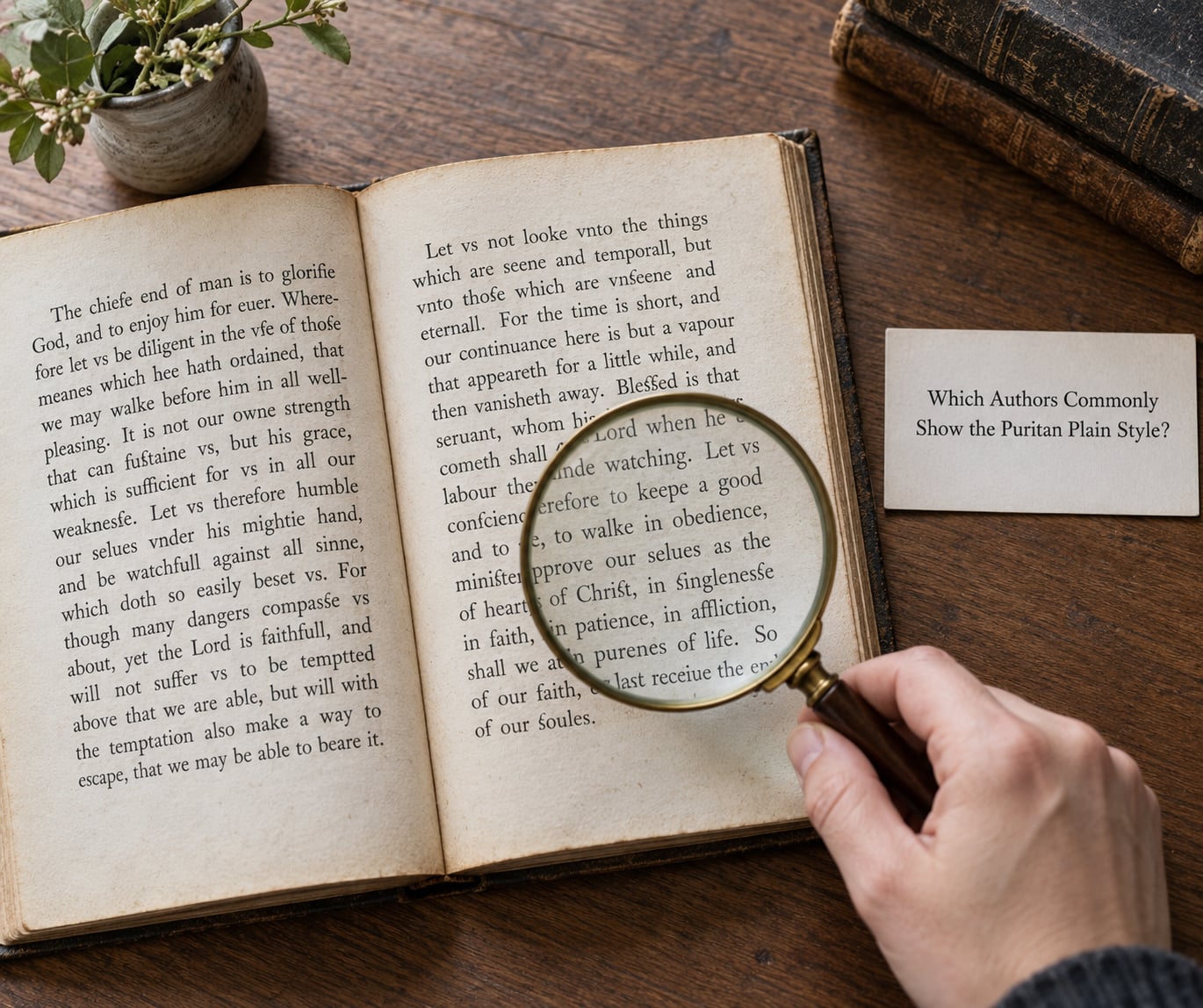
Anne Bradstreet is the first place most readers should look, because her poems are didactically framed and unusually clear about their own plainness. She also uses rhyme schemes inherited from English tradition, which makes her a good test case: the form is conventional, the language is not ornate.
Edward Taylor, in his Metaphysical Physic-Medicine poems, writes about bodily and spiritual illness in dense, urgent plainness. Jonathan Edwards pushes the style in Sinners in the Hands of an Angry God (1741) with direct address and rhetorical questions. John Winthrop’s sermons and A Model of Christian Charity show the civic register. William Bradford’s Of Plymouth Plantation shows the chronicle register, and often gets called plain when it is really a mixture of plain narration and set-piece biblical echo.
Do not treat any of these as a perfect specimen. Individual works vary, and not every religious writer of the period wrote plainly at all. Samuel Taylor Coleridge’s and Ralph Waldo Emerson’s nineteenth-century transcendental prose, for instance, grew out of Puritan print culture but rejects the restraint.
How Can You Analyze the Puritan Plain Style in a Passage?
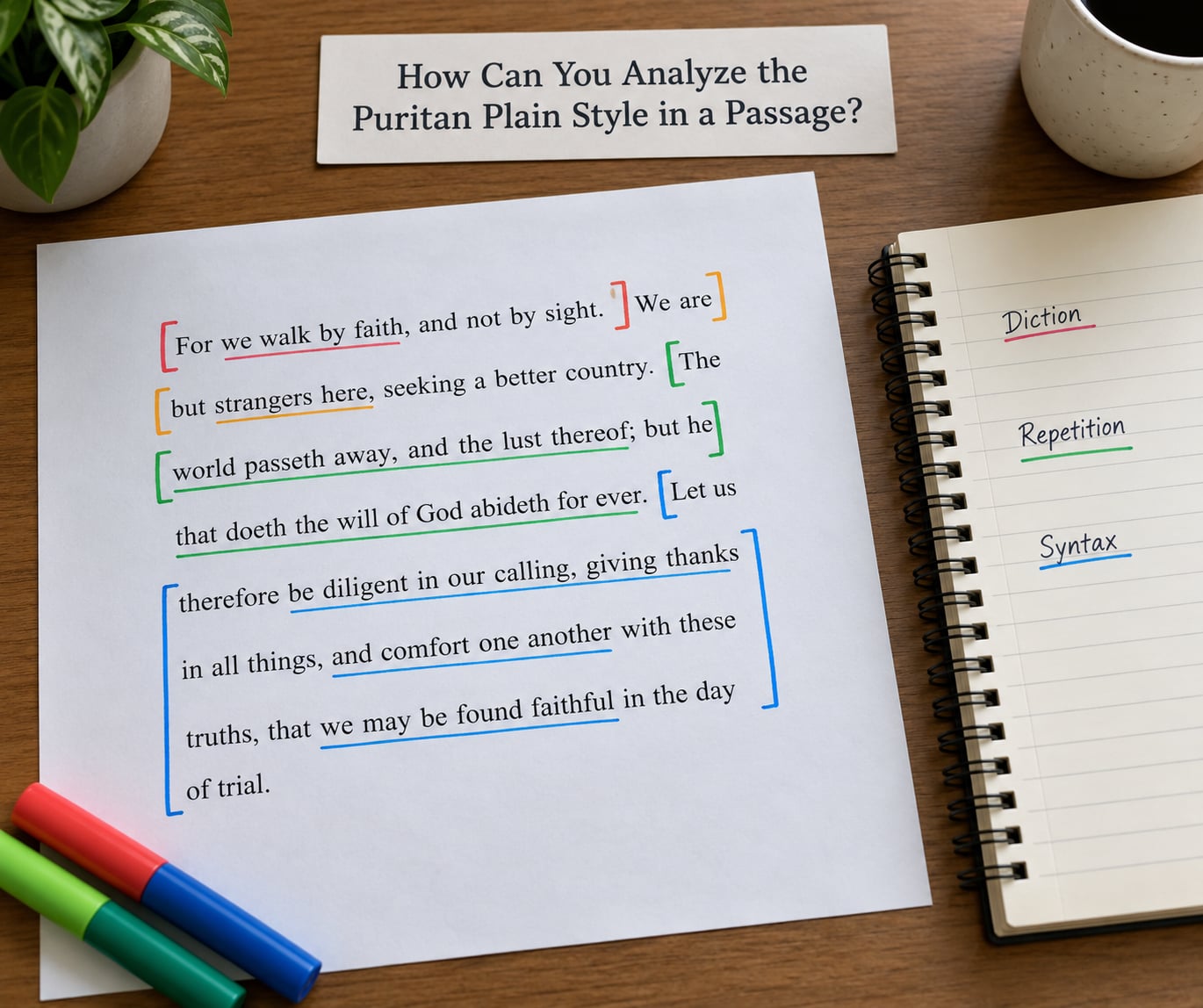
A five-step pass works on any passage, including an unseen one in an exam.
First, name the claim. One sentence, in your own words, saying what the writer is arguing for. If you cannot do this, you do not yet understand the passage, whatever style it is in.
Second, mark the diction. Underline every word that is doing precise work and circle every word that is merely ordinary. Both matter: the plain words carry the meaning, and one unusually concrete word may carry more than all of them.
Third, trace the syntax. Mark each clause boundary. Ask where the sentence starts, where the verb is, and where the emphasis lands at the end. Plain-style sentences usually put their weight in a final short clause.
Fourth, test for biblical echo. Look for words like providence, election, covenant, visitation, calling. Ask whether the phrasing is doing scriptural work or is simply period vocabulary.
Fifth, explain the effect. This is the step that separates a label from an analysis. For every choice you have marked, write one sentence on what it does for the writer’s purpose. If you can only say “it is simple,” you have described the surface, not the style.
What Are the Most Common Misunderstandings?
First misconception: the plain style was simply bad or lazy writing. It was a considered theological position about how truth should be delivered, and it took more control than ornament does.
Second: every Puritan wrote this way. Puritanism was a broad movement and its literature is varied. Anne Bradstreet’s “The Flesh and the Spirit” is tightly patterned and formal, and not plain in the sense we have been describing.
Third: every short sentence is plain style. Length alone means nothing. What matters is diction, syntax, tone and purpose working together.
Fourth: plain style means emotionless. Some of the most moving writing in the period is plain, because the restraint is what makes the feeling land.
Fifth: plain style means plainness in the modern sense, the way a workplace memo is plain. Those writers value brevity and clarity for practical reasons. Puritan writers valued plainness because of what they thought ornament did to a reader’s soul. The overlap is real, the motive is not the same.
Frequently Asked Questions
Is the Puritan plain style the same as plain modern writing?
They overlap more than most people expect, and the motive is different. Modern plain language aims for speed and clarity for a busy reader. The Puritan plain style aimed at truth and humility, because writers believed ornament obscured meaning and fed pride. The habits look alike: common words, short sentences, no classical allusion. The reasons behind them are not alike at all.
Which Puritan authors are best known for the plain style?
Anne Bradstreet, Edward Taylor, Jonathan Edwards and John Winthrop are the four most frequently cited. Anne Bradstreet’s poems are the clearest case, since she pairs didactically serious subjects with restrained language. Edwards uses direct address and rhetorical questions, Winthrop writes the civic register, and Taylor handles illness and sin with dense urgency. William Bradford’s chronicle prose is often included too, though it mixes registers.
Does the Puritan plain style avoid imagery and emotion altogether?
No. It avoids extended metaphor and ornamental description, but concrete imagery stays, usually one plain object doing one job: the cold, the ship, the child. Feeling stays too. Restraint concentrates emotion rather than removing it, which is why plain lines from the period often land harder than flowery ones. What the style suppresses is decoration, not depth.
How can a student recognize the plain style in a poem?
Check four things: the vocabulary is everyday rather than classical, the syntax runs subject-verb-object without inversion for effect, sentences are short and balanced, and the tone stays grave. Then look for purposeful repetition, since a repeated word or cadence is a plain-style tool rather than a flaw. Poetry complicates matters, because rhyme and metre come from English tradition while the diction comes from the plain style. Both can be present at once.
What is the difference between the Puritan plain style and Puritanism?
Puritanism was a religious movement, a theology and a community, formed in England and New England during the seventeenth century. The plain style was a habit of writing that many within that movement adopted. So one is a world of belief and the other is a way of using language. A Puritan could write ornately, and plenty of plain-style traits appear outside Puritanism entirely.
How should a teacher introduce the Puritan plain style to students?
Start with the reason before the traits. Students who understand that plainness was a theological choice stop treating it as a lack of polish. Then give them one short primary passage, have them underline the ordinary words, and ask what each one is doing. Finish by pairing a plain sentence with an ornate version of the same idea so they can feel the difference rather than only being told about it.
Conclusion
The Puritan plain style is a mode of writing that uses direct, unadorned, everyday language because its writers believed ornament obscured truth and encouraged pride. It shows up as plain diction, direct syntax, restrained imagery, a serious tone, logical order, biblical echoes and repetition used on purpose.
When you open a passage, start with four moves: name the claim, underline the plain words, mark the clause boundaries, and find the repetition. Then say what each choice does. That is usually the whole difference between labelling a style and analysing one.