The difference between a novel and a novella is mostly a question of length and scope: a novella is a work of narrative fiction usually running 17,500 to 40,000 words around one main plot, while a novel starts near 40,000 words and can stretch past 120,000 with subplots and multiple narrators. Word count gets you close. Structure tells you the truth.
I read across both forms constantly, and the honest answer is that no single number settles it. A 40,000-word book with three interwoven storylines reads as a novel. A 55,000-word book with a single arc and one devastating turn reads as a novella to almost everyone who finishes it.
This guide breaks the distinction down into numbers you can actually use, structure you can actually check, and real books that get labelled wrong all the time. It is written for readers picking something for a weekend, students working on literary form, and writers trying to name a manuscript.
Table of Contents
- Novel vs Novella What’s the Difference at a Glance
- How Do Length and Word Count Differ?
- Word Counts by Genre
- A Reader’s Shortcut: How Many Pages Is a Novella?
- How Much Story Development Does Each Form Allow?
- Character arcs
- Subplots, settings and symbols
- Which One Has the Faster Pacing?
- How Are Novellas and Novels Published?
- What Examples Help Show the Difference?
- Which Should You Choose?
- Frequently Asked Questions
- Does a novella need chapter breaks?
- Can a novella be part of a book series?
- Is a 30,000-word book always a novella?
- What is the difference between a novella, a novelette, and a short story?
- Should teachers classify a work by word count alone?
- Conclusion
Novel vs Novella What’s the Difference at a Glance
A novella is a piece of narrative fiction of roughly 17,500 to 40,000 words centred on one main plot, while a novel runs from about 40,000 to 120,000 words or more and can carry subplots, several narrators and a longer narrative arc. These are guidelines, not rules with enforcement.
| Criterion | Novella | Novel |
|---|---|---|
| Typical word count | 17,500 to 40,000 | 40,000 to 120,000 or more |
| Approximate page count | 70 to 180 | 180 to 500+ |
| Number of main plots | One, usually | One plus subplots, often several |
| Points of view | One or two, tightly limited | Several, sometimes alternating chapters |
| Character development | One or two arcs, compressed | Full ensemble arcs across acts |
| World and setting | One place, lightly sketched | Fully built, sometimes researched |
| Chapter breaks | Optional, often absent | Standard |
| Typical reading time | Two to five hours | Ten hours and up |
| Common examples | The Old Man and the Sea, Animal Farm | The Great Gatsby, The War of the Worlds |
Two things stand out in that table. Page counts shift wildly between editions, so treat them as a rough guide. And the structural rows matter more than the numeric ones, which is why the rest of this guide spends as much time on shape as on length.
The literary meaning of both words is old and stable. The commercial meaning drifts. Publishers, contests, genre conventions and reading platforms each draw the line in a slightly different place, and they change the line over time.
How Do Length and Word Count Differ?
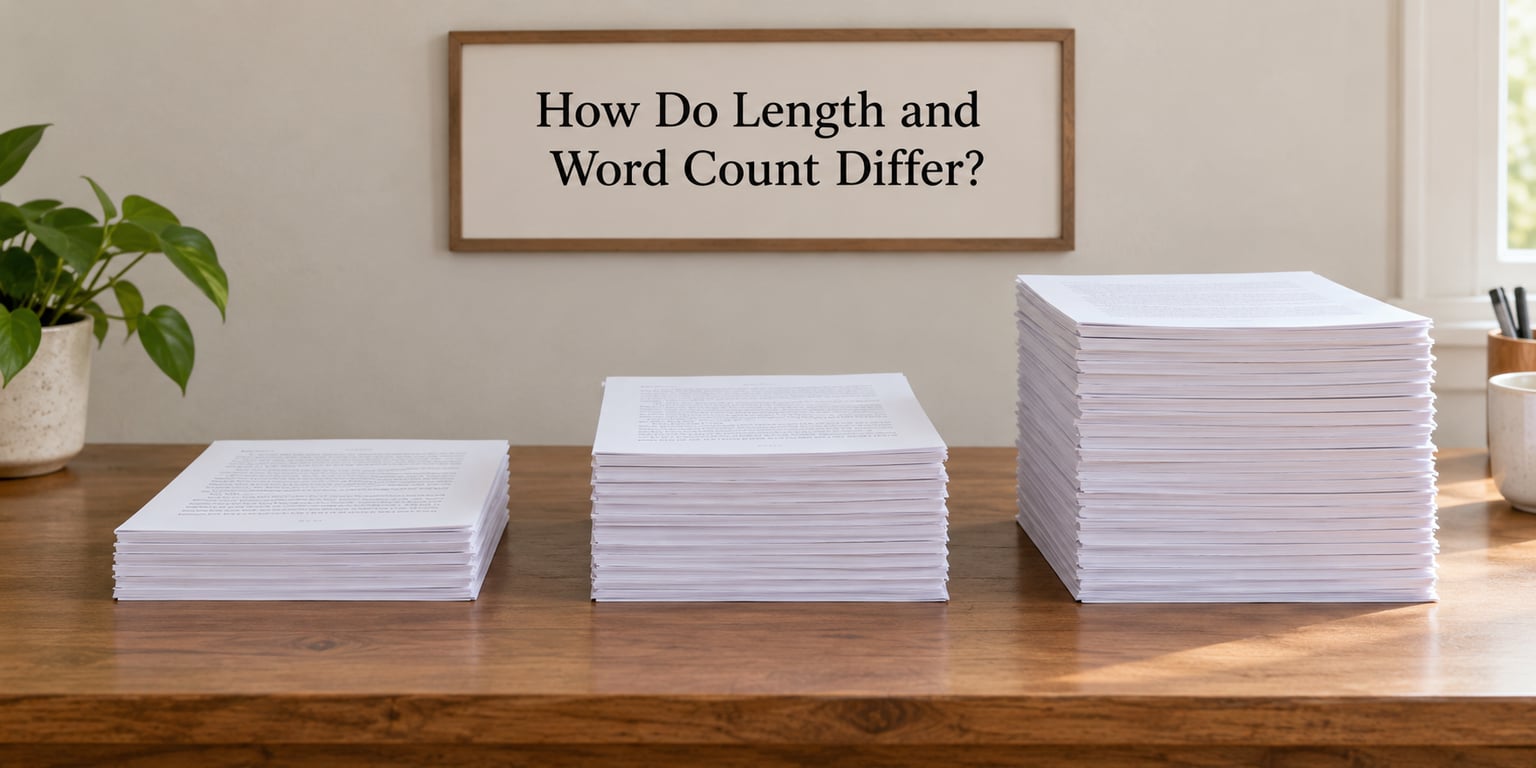
Novels generally run from about 40,000 words upward, while novellas commonly sit between 17,500 and 40,000 words. Some sources widen the novella ceiling to 50,000, and the Science Fiction and Fantasy Writers Association uses 40,000 words as its threshold for novel-length work.
Here are the specific numbers people search for most:
20,000 words lands squarely in novella territory. It is short enough that most readers finish it in a single sitting and long enough to carry a complete arc.
30,000 words is enough for a novella. Plenty of published novellas land there, including several award winners.
50,000 words is where the argument starts. It is past the traditional novella ceiling and inside territory most agents and publishers treat as a short novel. Genre matters more here than anywhere else.
The full ladder below shows where each form sits. The page estimates assume roughly 280 to 300 words per printed page, which is normal for trade fiction with standard type size.
| Form | Word count | Page equivalent | Defining feature |
|---|---|---|---|
| Flash fiction | Under 1,000 | 1 to 5 | A single image or turn |
| Short story | 1,000 to 7,500 | 4 to 30 | One scene, one change |
| Novelette | 7,500 to 17,500 | 30 to 70 | One suspenseful event, thin context |
| Novella | 17,500 to 40,000 | 70 to 180 | One main plot, one turning point |
| Novel | 40,000 to 120,000+ | 180 to 500+ | Subplots, several arcs, full structure |
Word Counts by Genre
Genre conventions move the numbers more than most guides admit. If you want to know how many words is a novel, the useful answer depends on what you are writing or reading.
| Genre | Typical novel range | Typical novella range |
|---|---|---|
| Romance | 50,000 to 90,000 | 20,000 to 50,000 |
| Fantasy | 90,000 to 140,000 | 25,000 to 50,000 |
| Science fiction | 80,000 to 120,000 | 25,000 to 45,000 |
| Literary fiction | 60,000 to 100,000 | 20,000 to 40,000 |
| Thriller and crime | 70,000 to 100,000 | 20,000 to 40,000 |
| Young adult | 55,000 to 90,000 | 20,000 to 45,000 |
Romance is the outlier. Its conventions push novella-length work toward 50,000 words, which is why so many romance novellas confuse readers who learned their expectations from other genres. Fantasy pushes the other way, where a 100,000-word book barely registers as long.
A Reader’s Shortcut: How Many Pages Is a Novella?
Under 200 pages is a novella for most readers. Between 200 and 260 pages is a very short novel, and 300 pages or more signals a full novel without much argument.
Use pages carefully. Paper size, type size and layout change everything, so the same 90,000-word novel can be 280 pages in one edition and 360 in another. A writer on one author forum reported a title listed at 170 pages and later showing 250 in a different listing, which is the kind of error that makes page counts feel unreliable for good reason.
Reading time is a more honest proxy. Most readers manage about 250 words a minute, which puts a 30,000-word novella at roughly two hours and a 90,000-word novel at six.
How Much Story Development Does Each Form Allow?
A novella gives one or two characters a complete arc inside a single pressure chamber, while a novel has room to develop an ensemble, layer subplots and explore a setting properly. Neither is better. They solve different problems, and a lot of famous works sit in the awkward middle.
Character arcs
The novella usually carries a single transformation. Santiago in Ernest Hemingway’s The Old Man and the Sea changes once, hard, and the book ends. There is no room for a second arc because there is no second engine.
A novel can hold several arcs at once and let them intersect. The Great Gatsby by F. Scott Fitzgerald tracks Nick Carraway, Gatsby and Daisy across the same summer, each with a separate trajectory, plus the narration itself doing work the plot does not.
Subplots, settings and symbols
The traditional novella, following the German Novellen tradition, is defined less by length than by design: one suspenseful event, an indeterminate length, a turning point sometimes called the Wendepunkt, and usually a concrete symbol carrying the meaning. That structure is why short novellas still feel complete.
Novels can hold subplots, multiple points of view and layered symbolism because they have the space for each thread to breathe. A subplot that earns 40 pages in a novel would eat a third of a novella.
Here is the part most guides skip: a novel can absolutely contain a novella-sized plot. Several books classified as novels are structurally single-arc stories. The label follows the market, not the architecture.
Which One Has the Faster Pacing?
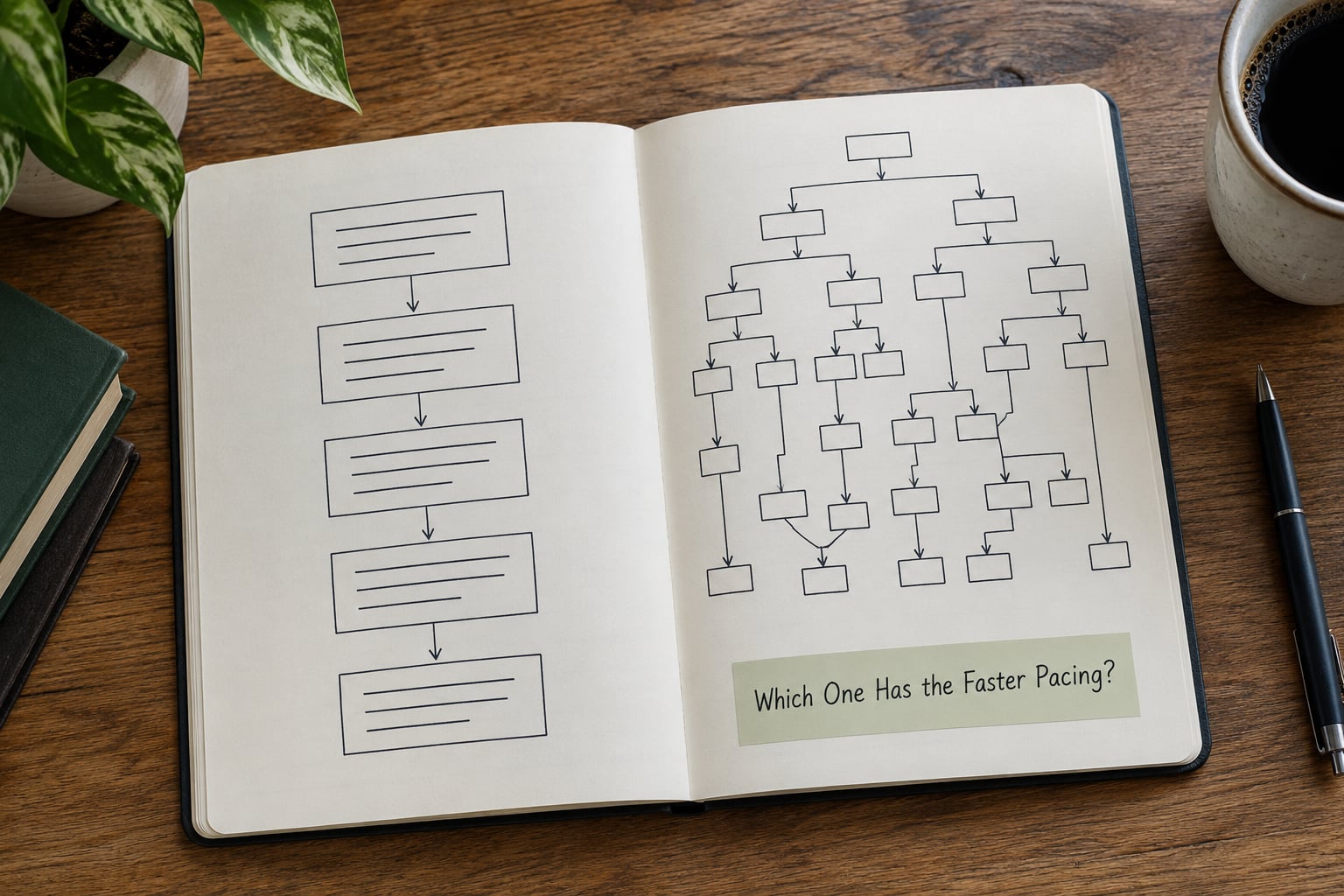
Novellas often feel faster because there is less space between events, not because novellas are inherently more action-driven. A compressed story has no room for a slow middle, so the prose carries less description and the plot moves on more quickly.
Concentration is the better word than speed. A quiet novella about grief can sit still for forty pages while something enormous happens underneath, and it will still read as tight. Length is not the same thing as pace.
Novels buy something with their length: they can slow down. A long descriptive passage in a novel is a pressure release, a place where a reader learns to trust the voice before the next storm lands. That luxury does not exist in a short form.
What you lose with a novella is breadth. What you lose with a novel is the sense of inevitability. Those are different costs, and plenty of readers honestly prefer one over the other.
How Are Novellas and Novels Published?
Novellas are commonly released as standalone short books, while novels usually appear as full-length books, though both formats now sit comfortably in print and ebook editions. The modern distinction is as much about packaging as about pages.
Three practical thresholds shape what happens next. The Science Fiction and Fantasy Writers Association treats 40,000 words as novel length for its award categories. BookBub requires a 50,000-word minimum for promotional campaigns, and Amazon Scout draws its novel line at roughly 50,000 words as well.
Those numbers create real friction. A 45,000-word book with one main plot is a novella by structure and a novel by platform requirement, which is why some writers market it as a short novel instead. Several authors on writing forums have described exactly this: dropping the novella label from the subtitle and selling the book by genre, on the reasoning that readers treat them all as books anyway.
Longer works have their own publication path. Many appeared first in serial form, in magazines or in instalments, before book publication. Serialisation is about delivery, not length, and a serialised novel is still a novel.
The distinction that confuses readers most is between a novella and an excerpt. An excerpt is a slice of a longer work designed to lead you to it. A novella is a whole story with a beginning, a turn and an ending, whatever its length.
One more term gets used loosely and rarely correctly. A novelette sits between the short story and the novella at around 7,500 to 17,500 words. Marketing use of the word has faded badly, and writers have noted they cannot recall seeing a book marketed as a novelette in years. If you have seen one recently, you are rare.
What Examples Help Show the Difference?
Well-known works classified as novellas include The Old Man and the Sea by Ernest Hemingway, Animal Farm by George Orwell, The Metamorphosis by Franz Kafka, A Christmas Carol by Charles Dickens and Heart of Darkness by Joseph Conrad.
Well-known works classified as novels include Jane Eyre by Charlotte Brontë, The Great Gatsby by F. Scott Fitzgerald, The War of the Worlds by H. G. Wells, and J. K. Rowling’s Harry Potter and the Philosopher’s Stone.
The Harry Potter question comes up constantly, so here is the plain answer. Harry Potter and the Philosopher’s Stone runs roughly 77,000 to 80,000 words in English editions. That is novel length by any measure, structurally and numerically.
A couple of the labels above are genuinely disputed. Heart of Darkness is frequently called a novella and sometimes a short novel, and The Metamorphosis sits somewhere between novella and long short story depending on whose definition you follow. Treat these as arguments, not errors.
The form has old roots. Boccaccio’s The Decameron and Geoffrey Chaucer’s The Canterbury Tales both worked in the space between story and novel long before the words meant what they mean now, with framed narratives and a set of narrators rather than one continuous arc. The split between novel and novella only hardened as a category in the 18th century, when long prose fiction became a marketable form in its own right.
Which Should You Choose?
Choose a novella when you want one concentrated story you can finish in a weekend, or when your story has a single arc and a single turning point that would only lose weight if you added more. Choose a novel when you have several characters to develop, multiple subplots that genuinely intersect, or a world that needs room to be built.
For readers: a novella suits a long evening or a flight. A novel suits a holiday. If you tend to abandon books around the hundred-page mark, novellas and novelettes will serve you better than starting another 400-page epic.
For writers: count the arcs before you count the words. If your story has one protagonist, one central problem and one ending, write the novella and stop when the ending arrives. If it has a second storyline that changes how the first one reads, you are writing a novel.
If you are still unsure, write the book the story needs and choose the label afterwards. That is the advice that keeps showing up in author forums, and it has never been wrong.
Frequently Asked Questions
Does a novella need chapter breaks?
No. Chapter breaks are a publishing convention, not a requirement. Many novellas run as continuous prose with a few scene breaks and no chapter headings at all, while some novellas do use short chapters. What matters is whether the story reads clearly. If your scenes shift in time or place, break them. If the narrative never stops, chapters can add nothing.
Can a novella be part of a book series?
Yes, and writers use the form deliberately for it. A novella is a natural fit for a spin-off set in an established world, a standalone flashback to an earlier generation, or one episode in a series built like a television season. It also works as a bridge between two longer books, giving a familiar character a story of their own without restarting a full novel.
Is a 30,000-word book always a novella?
Not always. 30,000 words sits inside the usual novella range of 17,500 to 40,000 words, but length alone does not decide the form. If the story carries several subplots, multiple narrators and a fully developed world, it reads as a short novel even at that length. If it holds one arc and one turn, it is a novella.
What is the difference between a novella, a novelette, and a short story?
Size is the main difference. A short story runs roughly 1,000 to 7,500 words and usually stays inside one scene. A novelette runs about 7,500 to 17,500 words and adds a little more context around a single suspenseful event. A novella runs about 17,500 to 40,000 words and carries a complete arc with room for character development. All three are narrative fiction.
Should teachers classify a work by word count alone?
No, and this is the most common flaw in literary-form exercises. Word count gives a first clue, but the structural test decides it: does the work follow one central arc to one ending, or several interwoven storylines and narrators? Works such as Heart of Darkness sit on the border precisely because length alone cannot classify them. Teach the structure test alongside the numbers.
Conclusion
The simplest distinction is scope. Novellas are shorter and more concentrated, usually holding one arc and one turning point, while novels are longer and generally broader, with room for subplots, several narrators and a world built at length.
Use word count as your first clue and then check the structure. Count the main storylines, ask whether the cast changes what the others do, and see how much of the setting the story actually needs. Those three questions settle almost every case.
If you are reading, let page count and reading time guide you. If you are writing, write the ending the story demands and label it afterwards.