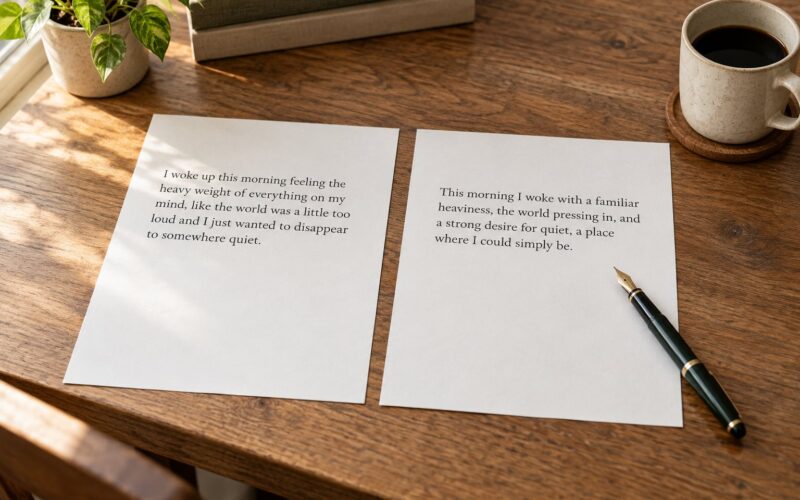
Satire uses humour, irony and exaggeration to expose and criticise vice, folly or abuse. Parody imitates the style, mannerisms or voice of an existing work for comic effect. Put simply: satire attacks something, parody borrows from something.
If you have been reading definitions without being able to apply them, the problem is not memory. It is that most definitions describe what each form looks like and skip the one question that settles the case: what is it pointing at? Get the target right and the label follows.
Table of Contents
- Satire vs Parody Explained at a Glance
- What Is the Difference Between Satire and Parody?
- What is satire?
- What is a parody?
- How Satire Uses Ridicule, Irony, and Exaggeration
- What are the three types of satire?
- What are the four main techniques used in satire?
- How Parody Uses Imitation and Recognition
- Tone, Intention, and Audience Effect
- Can a Parody Be Satirical?
- Is Scream a parody or satire?
- What if it is neither?
- Examples of Satire and Parody in Literature
- How to Identify Satire and Parody in a Text
- Which Should You Choose?
- The neighbouring terms worth separating first
- Frequently Asked Questions
- What is the difference between a satire and a parody?
- Is a parody always satire?
- What qualifies as a parody?
- What are the three types of satire?
- What are the four main techniques used in satire?
- Is Scream a parody or satire?
- Conclusion
Satire vs Parody Explained at a Glance
| Criterion | Satire | Parody |
|---|---|---|
| Main purpose | Criticise, expose, correct | Imitate and get a comic effect |
| Usual target | A person, institution, behaviour or idea | An existing work, author or genre |
| Does it need an original? | No. It usually invents its own material | Yes. Without the original, it is not a parody |
| Standard tone | Cool, mocking, occasionally venomous | Warm, affectionate, good-natured |
| Main technique | Ridicule, irony, exaggeration, inversion | Stylistic imitation, voice, catchphrases, plot shape |
| Effect on the reader | Laugh, then feel caught or implicated | Laugh because the original is instantly recognised |
| Typical home | Novels, poems, speeches, political cartoons, sketches | Sequel novels, sketch comedy, songs, films, memes |
One row does most of the work. If you can name the original being imitated, you are probably looking at parody. If you can name the flaw being attacked, you are probably looking at satire.
What Is the Difference Between Satire and Parody?
The difference between satire and parody is one of aim. Satire wants the audience to think differently about something after they finish laughing. Parody wants the audience to laugh once the resemblance clicks.
What is satire?
Satire is the use of humour, irony, exaggeration or ridicule to expose and criticise people’s vices and follies. The Oxford English Dictionary’s definition carries the key word expose, and it is doing real work there. A satirical work takes something that is usually taken seriously, presents it clearly, and lets the reader notice the absurdity on their own.
The Oxford definition of satirical adds that the criticism is expressed through humour and aimed at correcting behaviour. That correction impulse is what separates satire from plain mockery. Mockery can simply wound; satire usually leaves a target exposed and a verdict implied.
What is a parody?
Parody is an imitation of a work, author or genre, done for comic effect. The word comes from Greek roots meaning to attack by parodying, but modern usage is much gentler than that origin suggests. A parody depends on recognition: the audience has to know the source for the joke to land.
Readers on literary forums make this point repeatedly. A work with no source has no target, and a work with no target is not a parody. That is the single most useful thing to hold on to.
How Satire Uses Ridicule, Irony, and Exaggeration
Satire works by amplification. It takes a small flaw, enlarges it until the thing is unrecognisable but the logic still holds, and lets the audience see what the flaw looks like at full size. The exaggeration is not decoration. It is the argument.
Swift’s A Modest Proposal (1729) is the cleanest example: the speaker proposes a solution to Irish poverty with impeccable politeness and grotesque detail, and the reader arrives at the horror on their own. Nobody in the piece says the scheme is monstrous. The structure makes it undeniable.
What are the three types of satire?
Literary criticism traditionally names three kinds, and they are worth learning because teachers ask for them:
- Horatian satire named for Horace: tolerant, urban, aimed at folly rather than vice, and more amused than angry.
- Juvenalian satire named for Juvenal: savage, indignant, aimed at vice and corruption, closer to invective.
- Menippean satire named for Menippus: sprawling and chaotic, mixing voices, dialogue and digression to expose pretension.
Austen’s Pride and Prejudice is usually read as a fourth kind. It has Horatian manners and Juvenalian bite, aimed at class vanity and economic dependence rather than at a single politician.
What are the four main techniques used in satire?
The four techniques that show up again and again are:
- Exaggeration for effect: stretching a trait past credibility.
- Irony: saying one thing while meaning another, or setting an expectation and then breaking it.
- Ridicule and invective: mockery applied to a target.
- Inversion and incongruity: putting a serious treatment on a trivial subject, or a trivial subject in a serious key.
Voltaire’s Candide is built from all four. Animal Farm (1945) is built mainly from inversion and incongruity, which is why it still lands on readers who have never read a political essay.
How Parody Uses Imitation and Recognition
Parody works by borrowing a surface: a voice, a rhythm, a set of mannerisms, a plot shape, a handful of catchphrases. Then it reproduces that surface faithfully enough for the audience to recognise it and enjoy the mismatch.
Jane Austen’s Pride and Prejudice and Pride and Prejudice and Zombies are the same joke twenty-first century style, and the second book exists entirely on the surface its name promises. Mel Brooks’ Spaceballs (1987) does the same thing with the space western: the physics go wrong, the running gag is a lump of rubber, and the scene it quotes lands harder than the original scene did.
Notice what parody does not need. It does not need a target to hate, an argument to win, or an exposé to support. It needs a source. That is why parody tends to be affectionate where satire tends to be sharp: you have to like the original well enough to imitate it precisely, and an imitator who dislikes the original usually ends up doing satire instead.
The result is still often critical. A parody of a corporate press release, or of a recruitment advert, or of a university mission statement, criticises the very thing it copies. The imitation is the vehicle; the criticism rides on top.
Tone, Intention, and Audience Effect
Satire asks you to laugh and then feel uncomfortable. The laugh is the delivery mechanism and the exposure is the payload, so the last thing on screen is rarely funny. Wilde’s The Importance of Being Earnest ends with a pointless arrest because the play’s whole argument is that the society doing the arresting is ridiculous.
Parody asks you to laugh at the gap between the source and the copy. The recognition itself is the payoff, and once it lands the piece is finished. An affectionate parody of a classic children’s series lands because everyone in the room already knows the voice of the narrator.
Intention matters more here than most students expect. Two works can share every surface feature and still be different forms, because one was built to expose a flaw and the other was built to amuse. Ask what the author wanted the audience to do with the laughter, and the answer usually tells you which form you are holding.
The distinction matters online, where plenty of things called parody are neither parody nor satire but simple subversion: a trope played straight or reversed for effect with nothing imitated and nothing attacked.
Can a Parody Be Satirical?
Yes, and regularly. Parody is usually treated as a technique rather than a purpose, so a parody can serve a satirical aim without ceasing to be a parody. The useful model is two axes rather than two boxes: what is being imitated, and what is being attacked. A work can fill any combination of the two, or leave one of them empty.
Is Scream a parody or satire?
It is a parody of a specific film franchise, and it is also a satire of horror conventions. The Wes Craven films, the franchise merchandising and the haunted-house premise are all imitated deliberately, which makes it a parody. The film also stretches slasher logic past breaking point to expose how hollow the rules are, which makes it satire. Both labels are correct at once, which is why the question causes so much friction in classrooms.
What if it is neither?
Then say so. Subversion, pastiche and genre reversal each borrow something but attack nothing in particular, and calling every joke a parody flattens all three terms into one. Pastiche recreates an earlier style for its own sake, affectionately, without the laugh being pointed at anything.
Examples of Satire and Parody in Literature
| Work | Medium | Form | Why |
|---|---|---|---|
| A Modest Proposal (Swift) | Prose pamphlet | Satire | Attacks English policy toward Ireland through a deadpan proposal |
| Candide (Voltaire) | Novel | Satire | Exposes Optimism by relentless repetition of its failures |
| Pride and Prejudice (Austen) | Novel | Satire | Ridicules class vanity and economic dependence |
| The Importance of Being Earnest (Wilde) | Play | Satire | Turns triviality into a serious social system |
| Animal Farm (Orwell) | Novella | Satire | Inverts a fable to indict political authoritarianism |
| Pride and Prejudice and Zombies (Grahame-Smith) | Novel | Parody | Reproduces Austen’s voice over a mismatched genre |
| Spaceballs (Brooks) | Film | Parody with satire | Imitates space westerns while mocking genre formulas |
| Scream (Craven) | Film | Parody with satire | Imitates a franchise while stripping horror conventions bare |
Read across the Form column and the pattern holds: where an original exists, parody is available, and where a target exists, satire is available. Works with both do the most work, which is why the most memorable examples in the canon sit in the middle column.
How to Identify Satire and Parody in a Text
When a film, novel or meme is sitting in front of you and the label is unclear, work through four questions in order.
1. Is there an original being imitated? If yes, parody is in play. If no, parody is impossible, whatever the piece is doing. Look for reproduced mannerisms, catchphrases, plot shapes or a recognisable voice.
2. Is there a target? Name it. A named target means satire. A target that is a behaviour rather than a text is a strong signal that you are looking at satire built on imitation.
3. Does the work want anything changed? Satire usually carries an implied verdict, whether that is mockery, correction or exposure. Parody usually wants only the laugh, and leaves the reader to decide.
4. Is the tone affectionate or venomous? Not decisive on its own, since a loving parody of something hated exists, but it is a useful tiebreaker. Affection usually points to parody; venom usually points to satire.
If questions one and two both come back empty, you are not looking at either form. It is subversion, pastiche or plain comedy, and calling it satire because it sounds sharp will not survive a question from someone who knows the term.
Which Should You Choose?
Choose satire when the goal is to expose a problem, a person or an institution and you want the reader to leave with something other than a smile. Choose parody when the goal is to reproduce a recognisable style and let the contrast do the work. When both fit, build the parody first and let it carry the satire, which is the older and more reliable order.
The neighbouring terms worth separating first
- Spoof often used as a synonym for parody, though historically it means a parody aimed at something already absurd.
- Pastiche imitates an earlier style without mocking it, aiming to recreate a reading experience rather than a laugh.
- Caricature distorts one feature for comic effect, typically in drawing or portraiture rather than prose.
- Mockumentary is a film and television format that borrows documentary style, sometimes satirically, sometimes affectionately.
- Burlesque is a comic treatment of high material or a stage variety form, now mostly used for the comic intent rather than the format.
Copyright framing is worth a sentence, because it explains why the two are treated differently in courts and in ordinary speech: parody has to borrow from a copyrighted original and is generally understood as commentary, while satire usually invents its own material and points at conduct. That is context, not advice, and the specifics vary by country.
Frequently Asked Questions
What is the difference between a satire and a parody?
Satire uses humour, irony and exaggeration to expose and criticise vice or folly, usually pointing at a person, institution or behaviour. Parody imitates the style, voice or mannerisms of an existing work for comic effect, usually pointing at a text or author. Satire wants you to think differently afterwards; parody wants you to laugh at the resemblance.
Is a parody always satire?
No. Parody is usually treated as a technique rather than a purpose, so the two often overlap but do not always coincide. An affectionate parody of a classic series points at the work and nothing else, which makes it parody without satire. A parody of a corporate press release attacks the company, which makes it both.
What qualifies as a parody?
Three things qualify: an identifiable original, a deliberate reproduction of its style or mannerisms, and an audience expected to recognise the source. Without the original there is nothing to parody. Without the imitation of its surface there is no recognition, and without an audience familiar with it the joke does not land.
What are the three types of satire?
The three classical types are Horatian satire, Juvenalian satire and Menippean satire. Horatian is tolerant and aimed at folly. Juvenalian is savage and aimed at vice. Menippean is sprawling and mixed in form, using dialogue and digression to expose pretension. Critics sometimes add a fourth for mock-epic and mock-heroic treatments of grand subjects.
What are the four main techniques used in satire?
The four recurring techniques are exaggeration for effect, irony, ridicule or invective, and inversion or incongruity. Exaggeration stretches a trait past credibility. Irony sets an expectation and breaks it. Ridicule directs mockery at a target. Inversion puts a serious treatment on a trivial subject, or the reverse.
Is Scream a parody or satire?
It is both at once. The Wes Craven films, their merchandising and the standard haunted-house setup are imitated deliberately, which makes it a parody. The film also stretches slasher logic until it breaks, exposing how arbitrary the genre rules are, which makes it satire. The two labels describe different axes of the same film.
Conclusion
Satire attacks and parody borrows. That single sentence settles most cases, and the four-question checklist settles the rest. When you meet an unfamiliar text, start by naming what is being imitated and what is being attacked, then ask whether the author wanted you to laugh or wanted you to change your mind. If neither is there, it may be neither form, and saying so is a sharper answer than guessing.