
Modernism and postmodernism are the two labels you will meet most often in twentieth-century literature, and the whole difference turns on one question: can a text find a real, coherent truth, or is truth something language and culture invent? Modernists broke form in order to get closer to reality. Postmodernists broke form in order to show you that reality was never sitting there waiting to be found.
That single split shows up in period, tone, technique and the amount of authority a novel gives you. This guide works through both movements in plain terms, then gives you a method for sorting any passage you meet in class or in an exam.
Table of Contents
- Modernism vs Postmodernism in Literature at a Glance
- What Are Modernism and Postmodernism?
- Modernism is a broad cultural break that began in the 1890s
- Postmodernism is a later doubt about that project, dated from the 1950s and 1960s
- The same words also name historical periods, not just styles
- Core Ideas and Beliefs
- Modernism believes a real pattern exists beneath appearances
- Postmodernism holds that language and power decide what counts as reality
- Modernists treat history as damaged but factual, postmodernists treat it as a stock of stories
- Modernism keeps the author at the centre, postmodernism removes the authority
- Style, Structure, and Language
- How to Read Modernism vs Postmodernism in Literature
- 1. Find the claim the text makes about reality
- 2. Watch what the structure is doing, not just what it says
- 3. Test how far you trust the narrator
- 4. Place the text in its period before you place it in a label
- 5. Turn the observation into a thesis you can defend
- Major Works and Authors
- Modernist authors and the works that show it
- Postmodernist authors and the works that show it
- Grey-zone texts and how to sort them
- How the Two Movements Are Related
- Which Should You Choose?
- Frequently Asked Questions
- Is postmodernism the opposite of modernism?
- When did postmodernism begin in literature?
- Can a literary work be both modernist and postmodern?
- Why is fragmentation common in both modernist and postmodern literature?
- Which movement is more concerned with the reader’s interpretation?
- Is The Waste Land a modernist or postmodern work?
- Conclusion: What to Study First
Modernism vs Postmodernism in Literature at a Glance
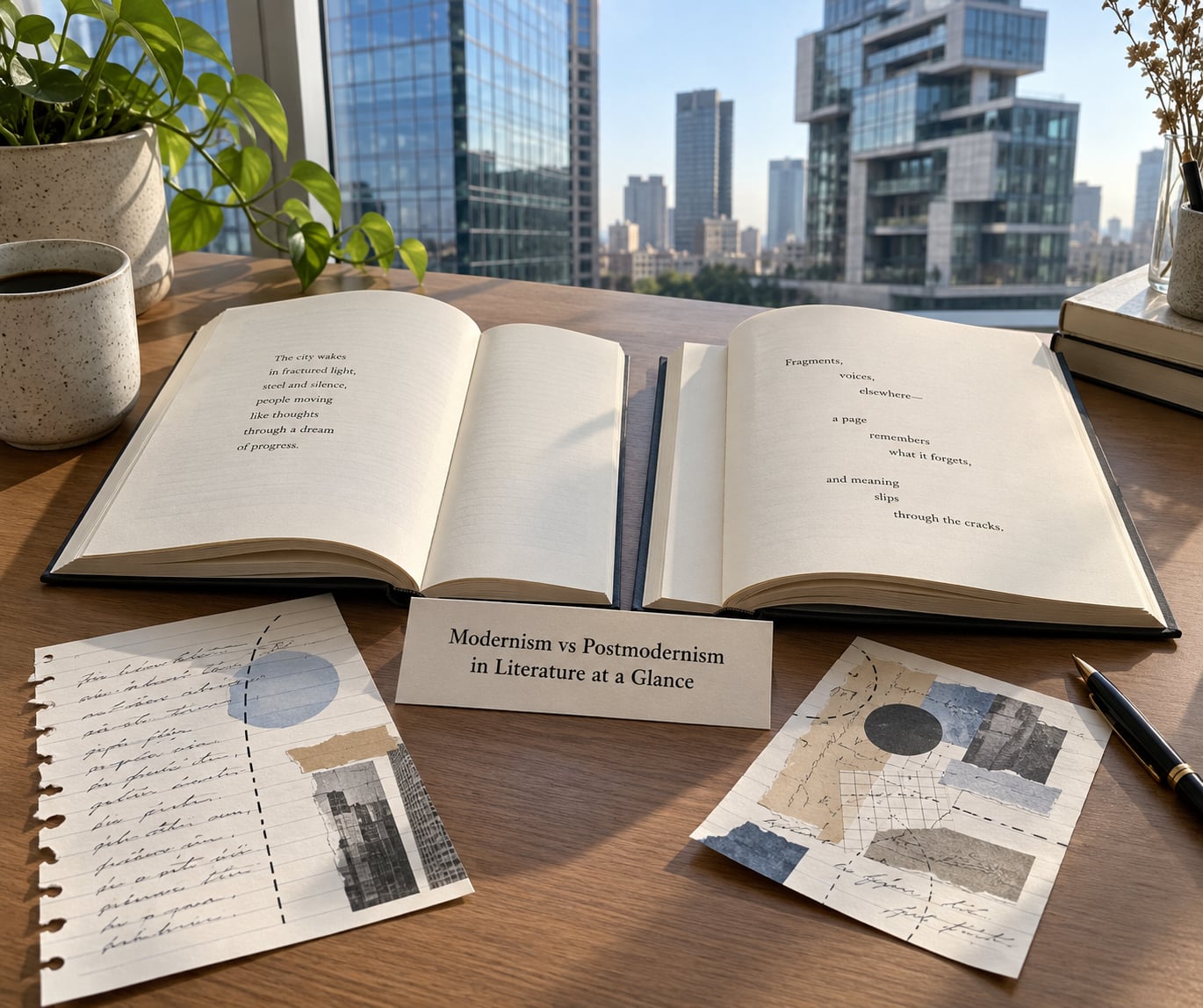
| Criterion | Modernism | Postmodernism |
|---|---|---|
| Main period | Late 19th century to roughly 1945 | Mid-20th century onward, from the 1950s to the 1990s and beyond |
| Central belief | A truthful form of experience exists, and art can approach it | Meaning is constructed, plural and permanently unstable |
| Tone | Urgent, earnest, elegiac, sometimes despairing | Ironic, playful, deadpan, self-aware |
| Typical techniques | Stream of consciousness, fragmentation, shifting point of view, temporal dislocation | Metafiction, pastiche, intertextuality, unreliable narration, parody |
| Culture | High art set against mass culture, difficulty treated as a value | High and popular culture deliberately mixed, purity of form mocked |
| Sense of time | Broken and disordered, but still hoping to be reassembled | Circular and recycled; the past is stock material, not record |
| Reader’s job | Reassemble the fragments and recover the pattern | Notice that the rules of reading are being played with |
| Signature works | Ulysses, Mrs Dalloway, The Waste Land | If on a Winter’s Night a Traveler, Catch-22, White Noise |
Read the table down the “central belief” row first, because every other row follows from it. Once you accept that the modernist is hunting a pattern and the postmodernist is undermining the hunt, tone and technique start to make sense on their own.
What Are Modernism and Postmodernism?
Modernism is a broad cultural break that began in the 1890s
Modernism names the period when industrial cities, mass newspapers, cheap rail travel and two world wars made older structures of belief feel suddenly too small. Writers responding to that shock tried to invent forms equal to a mind that had been split open by war, work and psychoanalysis.
It is a loose label, not a manifesto. Proust and Joyce barely overlapped in their reading habits, and nobody wrote a modernist manifesto that everyone signed. The shared thing is a mood: the conviction that inherited forms could no longer carry modern experience intact.
Postmodernism is a later doubt about that project, dated from the 1950s and 1960s
Postmodernism starts where modernism’s confidence starts to crack. In a consumer economy saturated with media, several critics asked a harder question: if every account of the world is produced by language, ideology and images, what exactly is left to be a stable truth?
Philosophers supplied most of the vocabulary, including structuralism, poststructuralism and the idea that reading is an act of construction rather than discovery. In fiction, that turns into self-conscious play with the book you are holding.
The same words also name historical periods, not just styles
Students often collapse two pairs of terms. Modernism as a style is the writing; modernity as a condition is the industrial, urban world that provoked it. Postmodernism as a style is the writing; postmodernity is the late-20th-century social world of consumer capitalism, media saturation and institutional distrust.
Keeping those apart solves a lot of confusion. A novel can be written in a modernist style in an era that is already thoroughly postmodern, and nothing breaks.
Core Ideas and Beliefs
Modernism believes a real pattern exists beneath appearances
For a modernist, the surface of ordinary life is thin and misleading. Beneath it sits a real order that art can approach, sometimes in fragments, sometimes as a pattern that becomes visible only from far away.
Woolf’s Mrs Dalloway moves between a single afternoon in London and the death of someone the characters barely remember, suggesting that moments separated by decades are connected underneath. That is modernist thinking: connect the fragments and something true appears.
Postmodernism holds that language and power decide what counts as reality
Postmodernism does not deny that events happen. It denies that the account of events is neutral. Every description, every archive and every “true” story is written by someone, in some vocabulary, for some audience.
Calvino’s If on a Winter’s Night a Traveler turns that idea into a plot. You begin reading a novel ten times over, and each opening is a promise the book immediately refuses to keep. The joke is not that the story is bad. It is that the contract between author and reader was always a fiction.
Modernists treat history as damaged but factual, postmodernists treat it as a stock of stories
A modernist war novel such as Hemingway’s A Farewell to Arms treats history as a catastrophe that wrecks individual lives. Truth here is painful and verifiable. A postmodern novel like Vonnegut’s Slaughterhouse-Five treats the bombing of Dresden as material the narrator can step in and out of at will, because no single version of it can settle the matter.
Modernism keeps the author at the centre, postmodernism removes the authority
High modernism still leans on the writer as a person with a claim on you. Joyce, Woolf and Eliot speak in voices that are complicated but unmistakably in charge. Postmodern fiction interrupts that voice, parodying the authorial tone, printing the writer’s own earlier sentences inside the novel, or letting a dead character address the reader directly.
That is not nihilism. It is a change in who gets to be believed.
Style, Structure, and Language
| Technique | Modernist use | Postmodernist use |
|---|---|---|
| Stream of consciousness | Dives inward to render felt thought and perception, as in Ulysses or The Sound and the Fury | Rarely used straight; more often parodied or quoted as a museum piece |
| Fragmentation | Parts of a whole that the reader should reassemble, as in The Waste Land | Parts that stay parts, because coherence was never the point |
| Narrative order | Time broken, memory layered over present, but with a recoverable shape | Non-linear, circular, recursive; characters recur, plots restart |
| Narrator | Limited but sincere, often strained by what they cannot say | Unreliable, splitting, or openly an invention |
| Language | Attention to the texture of words; music and rhythm carry meaning | Wordplay, pun, register clash, parody of someone else’s style |
| Length and scale | Long sentences, long novels, epic ambition with a broken frame | Both extremes: the vast systems novel and the very short oddity |
Five terms carry most postmodernist technique, and they are worth learning by definition. Metafiction is a novel that comments on itself as a novel. Pastiche imitates a dead or living style without comment. Intertextuality treats other texts as the raw material of any new one. Unreliable narration means the voice telling the story cannot be taken at face value. Irony holds two incompatible meanings at once and refuses to resolve them.
Modernism has its own small set of terms, and they are quieter. Interior monologue, temporal dislocation, free indirect style, the objective correlative and the symbol all show up in novels from 1910 to 1940. A student who can name the device in a paragraph earns marks quickly, but naming it is not the same as analysing what it does to the reader.
How to Read Modernism vs Postmodernism in Literature
1. Find the claim the text makes about reality
Ask whether the novel treats what it describes as solid, singular and true, or as produced by language, media and perspective. Woolf’s Orlando treats time as a real, patterned thing. Pynchon’s Gravity’s Rainbow treats facts about the Second World War as materials endlessly rearranged. One paragraph on this question anchors most essays.
2. Watch what the structure is doing, not just what it says
List the breaks: the shifts of time, the missing chapters, the abrupt change of voice, the interrupted sentence. Then ask what each break costs the reader. A modernist break slows you down so you feel something. A postmodern break reminds you that a break is available as a device.
3. Test how far you trust the narrator
Compare what the narrator says with what the narration reveals. When those two drift apart, you have found the engine of the book. In Nabokov’s Pale Fire a commentary on a poem gradually becomes an unnerving account of another person’s life. In Mrs Dalloway the narratorial sympathy shifts, and the same character looks different depending on whose mind you are inside.
4. Place the text in its period before you place it in a label
Publication date gives you a first hypothesis, not a verdict. A book written in the 1930s may carry techniques we now call postmodern, and a book from the 1990s may be doing modernist work in earnest. The forum consensus on literary study is more practical than it sounds: readers say these tags become meaningless when they are applied from memory instead of from the text.
5. Turn the observation into a thesis you can defend
A workable comparative thesis names the two texts, names the difference, and states your position. Try this shape: “Where The Waste Land breaks its fragments in the hope of a hidden order, Pynchon uses similar breaks to demonstrate that order was never available, and Eliot’s longing becomes Pynchon’s joke.”
Then give each text its own paragraph of evidence before you return to the comparison. A common marking complaint is a comparison essay that discusses one author properly and gestures at the other, so protect roughly equal space for both.
Major Works and Authors
Modernist authors and the works that show it
James Joyce, whose Ulysses makes a single day the most examined day in English literature and whose Finnegans Wake pushes language toward the edge of sense. Virginia Woolf, whose Mrs Dalloway uses free indirect style to move between minds, and whose To the Lighthouse makes memory itself the subject. T. S. Eliot, whose The Waste Land is the founding modernist poem, and W. B. Yeats, whose The Second Coming turns political collapse into a private apocalypse.
Also read Marcel Proust on memory as a structure, Joseph Conrad on imperial disillusionment in Heart of Darkness, William Faulkner on time collapsing inward in The Sound and the Fury, and Ernest Hemingway on a style of restraint that everyone imitates badly. Langston Hughes and Zora Neale Hurston widen the picture: the Harlem Renaissance was working with modernist technique in a racial and political context the London-based movements rarely acknowledged.
Postmodernist authors and the works that show it
Thomas Pynchon, whose Gravity’s Rainbow and The Crying of Lot 49 turn paranoia and plot-matching into comic systems. Kurt Vonnegut, whose Slaughterhouse-Five and Cat’s Cradle treat catastrophe as repeatable. Joseph Heller, whose Catch-22 locks a man inside a rule that cannot be satisfied.
Then Italo Calvino, John Barth, Don DeLillo, Umberto Eco, William Burroughs, Robert Coover, Salman Rushdie and David Foster Wallace. Borges deserves special mention, because his 1939 story “Pierre Menard, Author of the Quixote” performs the whole postmodern argument in a few pages: Menard rewrites Don Quixote word for word, and the identical text means something different because it is now produced by a different author.
Grey-zone texts and how to sort them
| Text | Closest fit | Where the label is contested |
|---|---|---|
| Waiting for Godot (Beckett) | Modernist | Almost no plot, and it influenced absurdist and postmodern theatre, yet the tone is austere and unguarded rather than ironic |
| “Pierre Menard” (Borges) | Postmodernist | Published in 1939, inside the modernist period, but its whole method attacks the modernist idea of originality |
| Pale Fire and Lolita (Nabokov) | Transitional | Published in the 1950s and 1960s, with modernist control of form plus a narrator whose delight in lying is openly performed |
| The Sound and the Fury (Faulkner) | Modernist | Multiple unstable narrators and dissolved time already do work later critics call postmodern |
| House of Leaves (Danielewski) | Post-postmodern | Uses postmodern apparatus, then pulls against it with horror and genuine feeling |
A simple rule handles most cases: ask what the fragmentation is doing. If the text implies a pattern behind the pieces, it leans modernist. If it shows you the pattern has been manufactured, it leans postmodern. If it does both at once, say so in the essay. Examiners reward a text that resists neat classification, provided you show the evidence.
How the Two Movements Are Related
Postmodernism grew out of modernism rather than replacing it, and the hinge quote is usually Eliot’s: “These fragments I have shored against my ruins.” The line can be read two ways. Read modernist, it says the pieces still lean against something true. Read retrospectively, it says the shoring was always doomed.
There was also a stream of precursors running through the middle. Dada and Surrealism attacked form in the 1910s and 1920s. The Beats made fragmented prose a lifestyle. Beckett and Borges pushed absurdity and self-reference to the edge, and Nabokov kept a modernist command of style while quietly dismantling the author’s authority.
Since the 1990s the question has been whether postmodernism is finished. David Foster Wallace argued that irony had become the default posture of a culture saturated in media, and his famous remark about a television with which we now have relationships is the standard citation. Later writers move between irony and sincerity, and the term metamodernism is used for the oscillation between the two.
There is also pressure on the canons themselves. Feminist criticism pointed out how many supposedly universal modernists treated women as interior decoration, and postcolonial criticism asked why literary history so often runs from Paris to New York while writers such as Chinua Achebe, Ngugi wa Thiong’o and Gabriel Garcia Marquez built against it. Any of this can be a strong essay topic for either movement.
Which Should You Choose?
Match the approach to what you are actually doing rather than to which movement sounds more impressive.
- Studying literary history: start with modernism, because the twentieth century stops making sense without it. Read the dates, the two wars and the industrial city, then add postmodernism as the response.
- Analysing language and form: modernism rewards close work on sentence rhythm, interior monologue and time. If your interest is voice, register and who is speaking, modernism is the easier and deeper place to start.
- Testing claims about truth and media: postmodern fiction gives you more to argue with. Its jokes are invitations, and it suits a confident argumentative essay.
- Writing a comparison: pair works with the same device and different aims, such as Mrs Dalloway against White Noise, or The Waste Land against Gravity’s Rainbow. Same technique, opposite reasons.
- Teaching it: keep the labels loose. Students remember the two beliefs far better than they remember the terminology.
Frequently Asked Questions
Is postmodernism the opposite of modernism?
No. It is a reaction, not an opposite. Modernism still believes a truthful way of seeing can be reached through art, even if the path runs through fragments. Postmodernism treats that belief as the thing to be questioned, so it inherits modernism’s subjects, authors and techniques before undermining them. Thinking of it as a reply to a question keeps the two movements connected instead of turning them into rival camps.
When did postmodernism begin in literature?
Most accounts place the start in the 1950s and 1960s, with the postwar years, the growth of consumer media and the arrival of structuralist and poststructuralist theory. Some critics reach further back to Borges and Joyce, and others to Dada. A safe date range for essays is mid-20th century onward, with the peak decade usually given as the 1960s and 1970s.
Can a literary work be both modernist and postmodern?
Yes, and several central texts sit in the overlap. Beckett’s Waiting for Godot strips plot almost to nothing but keeps an earnest tone, while Borges published his most postmodern fiction in the 1930s. The honest move in an essay is to state which features you are reading as modernist and which as postmodern, and to admit why the text resists a single label.
Why is fragmentation common in both modernist and postmodern literature?
Because both movements inherited the same twentieth-century pressures, including war, mass media and a crisis of trust in official accounts. Modernism fragments the text to push you toward a hidden order. Postmodernism fragments it to show that no order was there. The device looks similar on the page; the intention behind it is the useful point of difference.
Which movement is more concerned with the reader’s interpretation?
Postmodernism, by a clear margin. Modernist texts give the reader real work, but that work aims at recovering an intended pattern. Postmodern texts ask you to notice the construction itself, which makes your reaction part of the meaning rather than a route to someone else’s meaning. Some modernist novels are so open that you will still end up arguing with your tutor about what they intend.
Is The Waste Land a modernist or postmodern work?
The Waste Land is a modernist poem, published in 1922, and it is usually treated as one of the founding texts of the movement. Its fragments, its montage of voices and its despair after the First World War are modernist. It still influences postmodern writing, since Eliot’s line about shoring fragments against ruins reads equally well as a joke about ordering chaos.
Conclusion: What to Study First
Modernism broke form to find a truthful way of seeing; postmodernism used the same broken forms to question whether a stable truth was ever there. Once that difference is clear, the dates, the techniques and the authors line up behind it instead of floating separately.
Start with a short modernist text, which will be shorter and more readable than you expect: The Love Song of J. Alfred Prufrock, the opening of Mrs Dalloway, or the first section of The Sound and the Fury. Note one break in structure and what it makes you feel. Then open a postmodern fragment such as the start of If on a Winter’s Night a Traveler and ask the same question in reverse. That two-text exercise is short enough to revise the night before an exam and sharp enough to carry a whole essay.