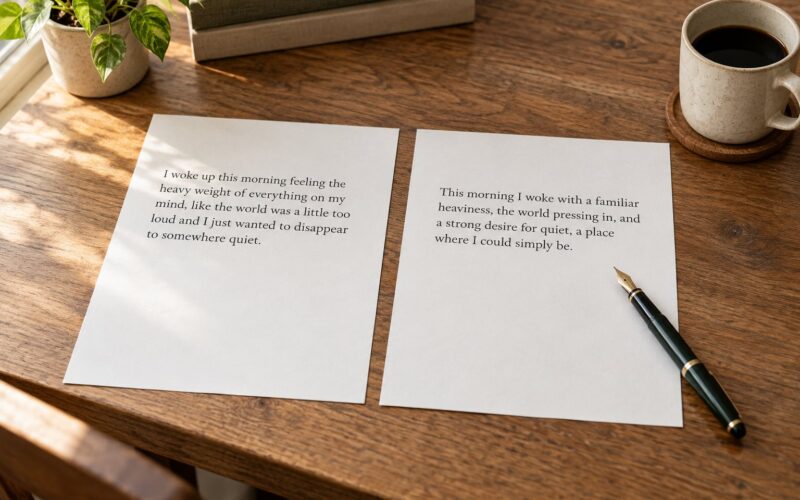
Plot vs story: what’s the difference in one line? Plot tells you what happens and in what order. Story tells you why it matters. Plot is the chain of events linked by cause and effect, while story is the meaning, characters, and emotional truth wrapped around those events. Get that one distinction straight and the rest of literary analysis gets much easier.
Students mix the two up constantly, and the confusion is not their fault. Textbooks use “story” loosely, sometimes meaning the plot, sometimes meaning the whole narrative. This guide fixes the terms, gives you worked examples, and shows you how to use the difference in an essay.
Table of Contents
- Plot vs Story What’s the Difference at a Glance
- What Is a Story?
- What Is a Plot?
- Why is it called a plot?
- Where does the plot sit in a story structure?
- Plot vs Story: How They Work Together
- How to Tell Plot and Story Apart in a Text or Film
- Step 1: List what happens, in bare sentences
- Step 2: Ask why each event matters
- Step 3: Separate the sequence from the significance
- Examples of Plot and Story in Literature and Film
- Which Should You Choose?
- How to answer plot vs story in a literature essay
- Frequently Asked Questions
- Is a plot the same as a story?
- What is an example of a plot?
- Why is it called a plot?
- How many plots are in a story?
- What is the difference between a plot and a theme?
- Can a story exist without a plot?
Plot vs Story What’s the Difference at a Glance
The difference between plot and story comes down to arrangement versus significance. Here is the short version side by side.
| Criterion | Plot | Story |
|---|---|---|
| Central question | What happens, and what causes it? | Why does it matter, and what does it change? |
| Definition | The author’s selection and ordering of events | The whole narrative meaning, including everything the events imply |
| Focus | Action, conflict, suspense, momentum | Character, theme, emotion, meaning |
| Time | Frequently breaks chronological order for effect | Holds the whole timeline, including what the reader learns later |
| Character | Characters act and are acted upon | Characters change, and the change is the point |
| Structure | Exposition, rising action, climax, falling action, resolution | Looser. A story can hold several plots and still be one story |
| Reader question | What happens next? | Why should I care? |
| Test | Remove a scene. If nothing breaks, it was not plot. | Remove a scene. If nothing is understood, it was not story. |
One line sums it up: plot is the skeleton, story is the person inside it. A skeleton with no person is not a novel, and a person with no skeleton is a diary entry.
What Is a Story?
A story is the full significance of a narrative. That includes the events, but also the characters, the setting, the point of view, the themes, and everything the author implies without stating outright.
Story is what a reader carries away after the last page. It answers the question of why the events were worth arranging in the first place, which is usually a question about human behaviour rather than action.
Writers on r/writingadvice put it neatly: want is plot, need is theme, story is why we care. The want pushes a character forward. The need explains why the pushing hurts.
Textbooks often list the elements of a story using five C’s. The most common version runs character, conflict, climax, context, and conclusion, though you will find variations that swap context for causality or conclusion for consequence. The labels change between classrooms; the underlying ideas do not.
- Character — who wants something, and what stands in the way.
- Conflict — internal, external, or both at once.
- Climax — the moment the conflict turns.
- Context — the world and history pressing on the character.
- Conclusion — what the outcome proves about the theme.
Notice that none of those five elements is really a sequence. Story works on interpretation, not order.
What Is a Plot?
A plot is the sequence of events an author selects and arranges so that each one causes the next. That causal chain is the whole definition. Without cause and effect you have a list of incidents, not a plot.
Plots move through recognisable stages: exposition sets up the situation, rising action builds pressure, the climax forces a decision, falling action shows consequences, and the resolution settles what remains. The stages are the same whether you are outlining a novel or analysing a film.
Why is it called a plot?
The word comes from an older sense of a plan, scheme, or piece of scheming. A plot in that sense is something laid out beforehand, a hidden arrangement of moves. Literary critics borrowed the word because that is exactly what a plot does: it is a plan for the reader’s expectations, built in advance by the author.
The same root gives us “conspiracy”. A plotting mind arranges events to reach an outcome, whether the arranger is a villain or a novelist.
Where does the plot sit in a story structure?
Plot is the part of the narrative you can diagram. Common frameworks include Freytag’s pyramid, the three-act structure, and the hero’s journey. They all describe the same movement at different resolutions: setup, escalation, turning point, aftermath, landing.
Other structures exist because different kinds of stories need different shapes. Kishotenketsu in Japanese fiction builds through small conflicts that accumulate rather than a single escalating crisis. Frame narratives wrap one story inside a second one told by someone else. Whatever the shape, the question is the same: what causes what.
Most novels carry one main plot and several subplots. The subplot is a smaller causal chain running alongside the main one, often handling a different character’s arc, and it intersects the main plot at one or two decisive points.
Plot vs Story: How They Work Together
They are not opposites. They are nested: plot sits inside story, story sits inside narrative. The containment does not reverse. Not every plot is a story, and not every story has a strong plot.
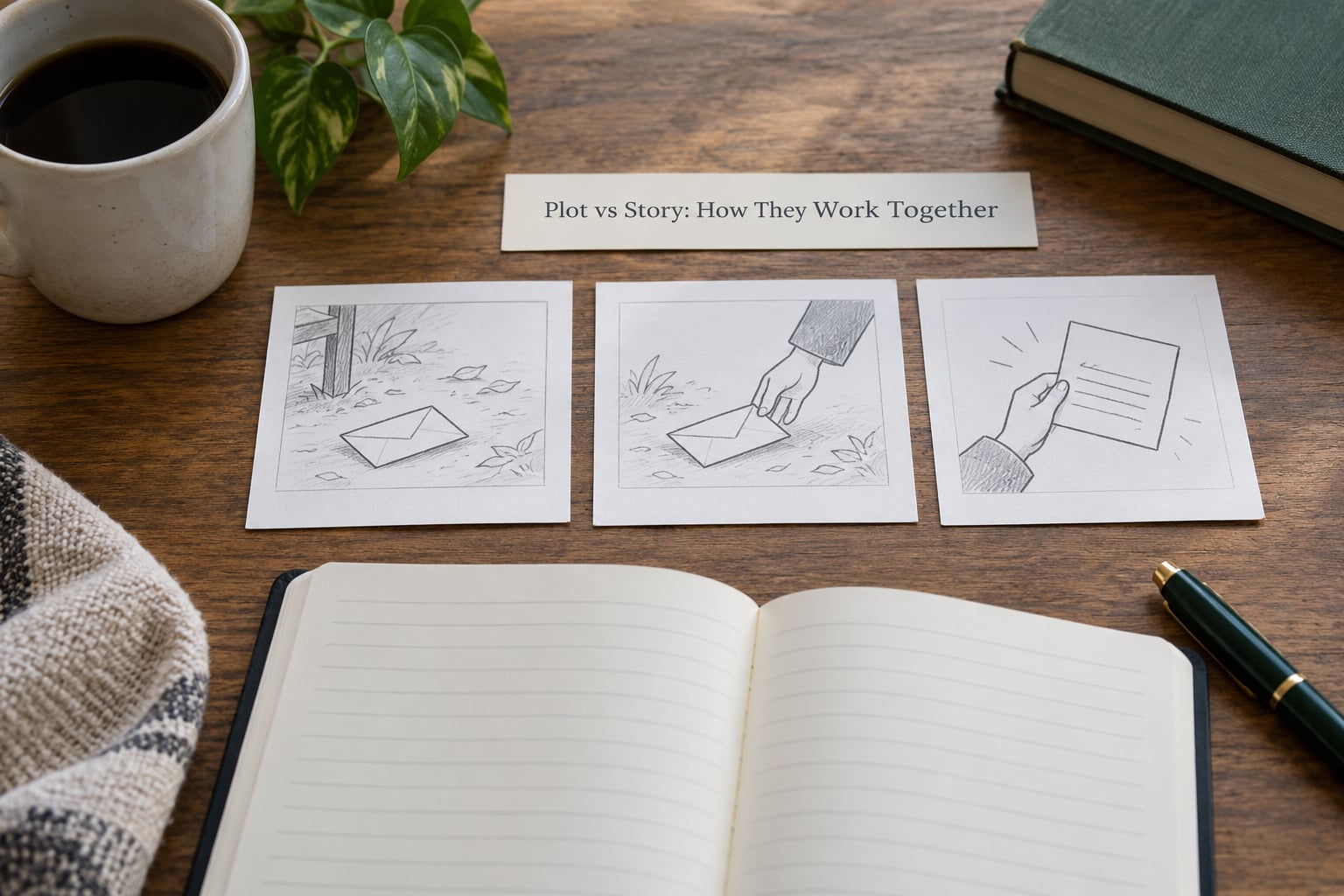
Because students often trip over the neighbouring terms too, here is how the five main words fit together.
| Term | What it is | Quick test |
|---|---|---|
| Narrative | The whole narrated account, including voice, perspective, and everything outside the central line | Does it include the framing and the narrator? |
| Story | The complete meaning of the events, character change included | Does it answer why it matters? |
| Plot | The ordered cause-and-effect chain of events | Does one event cause the next? |
| Storyline | The running thread of events, often used loosely as a synonym for plot | Is it just the sequence, without meaning? |
| Theme | The idea the story argues, stated as a claim about the world | Can you finish the sentence “this story suggests that…”? |
The practical version: plot builds tension, story resolves it into meaning, and theme is the sentence you could write at the end of an essay. Confusing theme with plot is the most common error after confusing story with plot, and it usually shows up as a student writing about symbolism where the question asked about structure.
How to Tell Plot and Story Apart in a Text or Film
Use three steps in order. They take about ten minutes on a short story and work just as well frame by frame on a film.
Step 1: List what happens, in bare sentences
Write events with no adjectives and no interpretation. “She finds the letter. She goes to the station. The train has left.” Keep going until you reach the end. This list is your plot skeleton.
Step 2: Ask why each event matters
For each item, finish this sentence: “This matters because…” The answers are the story. If an event produces only a shrug, it is a transition. If the answer points at fear, betrayal, loyalty, or loss, you have found meaning rather than mechanics.
Step 3: Separate the sequence from the significance
Now compare your two lists. Plot items can be reordered and retold in a different key. Story items cannot be removed without loss, because each one carries meaning that the next event depends on.
There is one test that settles most arguments in a discussion group: ask what happens next, then ask why you care. The first question belongs to plot. The second belongs to story. Whichever question a scene answers best is the layer that scene is doing the work on.
A scene-level version works for drafts. If a scene changes the situation, it carries plot. If it changes who the character is, it carries story. Strong scenes do both, and a novel made only of the first kind is exhausting to read.
Examples of Plot and Story in Literature and Film
The clearest example in the English-language tradition comes from E. M. Forster in Aspects of the Novel. A story goes: “The king died, and then the queen died of grief.” That is a sequence of events, but no cause connects them. A plot goes: “The king died, and the queen died of grief at the loss of the king.” One clause of causation turns a report into a story that pulls the reader forward.
Compare that with a fairy tale you know. The raw story: a girl loses her mother, travels alone, defeats a giant, and returns home. Written as plot, you open in media res on the walk into the forest, hint at the giant before she meets it, and delay the reason she was left until mid-way. Written as story, you spend the whole walk on her loneliness and end with her carrying her mother’s ring, which shows grief has been resolved rather than survived.
Now the film version. In most thrillers, plot drives: a deadline counts down, a betrayal narrows the options, and every scene either advances the plan or threatens it. The character work exists to feed the mechanism. A quiet family drama is the mirror image, where the external stakes stay small and almost all the weight sits on an internal conflict between two people who cannot say what they mean.
Most successful work sits in the middle, and writers on r/writing note that published fiction rarely commits fully to either pole. The practical question when you analyse a film is whether the events could have been arranged differently without changing what the film is about.
Which Should You Choose?
Choose plot when your task involves structure: pacing, suspense, causation, or why a particular scene is in chapter four. Choose story when your task involves theme, character arc, symbolism, or why the ending lands the way it does.
For readers and analysts, a clean split works. Ask what caused the climax and you are working on plot. Ask what the climax proves and you are working on story. Questions about flashback technique, foreshadowing, and pacing are plot questions. Questions about unreliable narrators, motifs, and the author’s attitude belong to story.
For writers, the choice is a workflow decision, and it depends on where you are. Outliners build plot first because plot is the visible checklist: scenes, turns, and consequences. Discovery writers build story first by chasing a character’s want until something breaks. The want and need framing is the bridge between the two, and it is a reasonable one to use at any stage.
How to answer plot vs story in a literature essay
Start with the distinction itself, then prove it with evidence from the text. A thesis that works:
While the plot of the novel arranges events into a rising sequence of confrontations, the story is carried by the narrator’s gradual admission of her own complicity, which is what gives those confrontations weight.
Then structure the body in two moves. The first paragraph gives the sequence of plot events, with cause and effect named. The second gives the story layer, with a quotation that carries the meaning. A short closing sentence can note where the two diverge, which is usually where the essay earns its best mark.
Two mistakes to avoid. Do not substitute summary for plot analysis, because retelling events is not analysing them. And do not claim a theme that the plot cannot support, which is the classic way an essay argues itself out of a conclusion.
Frequently Asked Questions
Is a plot the same as a story?
No. A plot is the author’s selection and ordering of events linked by cause and effect, and it is the layer that creates suspense. A story is the larger thing: the events plus the characters, setting, themes, and meaning. A plot can exist without story, as in a bare event list, but a story with no plot usually feels thin because nothing sets anything else in motion.
What is an example of a plot?
E. M. Forster’s standard example is the line about a king and a queen. As a story: the king died, and then the queen died of grief. As a plot: the king died, and the queen died of grief at the loss of the king. The second version adds one clause of causation, and that single clause turns a report into a narrative that makes a reader want to know what happens next.
Why is it called a plot?
The word originally meant a plan, a scheme, or a piece of secret scheming, which is where the related word conspiracy comes from. Literary usage borrowed that sense because a plot is an arrangement made in advance. An author lays out a sequence of moves to shape the reader’s expectations, much like a schemer lays out moves to reach a result. The word has carried that planned-arrangement meaning ever since.
How many plots are in a story?
Usually one main plot, and often several subplots running alongside it. A subplot is a smaller cause-and-effect chain, often tracking a different character, that eventually intersects the main plot at one or two decisive points. A novel can carry three or four subplots without becoming confusing, as long as each one delivers consequences that feed back into the central line.
What is the difference between a plot and a theme?
A plot is a sequence of events; a theme is the claim those events make. You can write a plot down as a list of sentences beginning with a character’s name. A theme you state as an argument, in the form this story suggests that. In an essay, plot analysis covers structure and causation, while theme analysis covers meaning, so mixing the two usually produces a summary with no argument attached.
Can a story exist without a plot?
Yes, though it is difficult to sustain for long. Stream-of-consciousness novels, diaries, and some experimental fiction rely almost entirely on character and consciousness with very little causal action. What usually happens is that the material still works as a story, and readers simply do not notice the missing plot until the ending arrives with no sense of arrival. Plot is what makes a narrative feel finished rather than simply stopped.
Start with the one-line test the next time a scene or a chapter leaves you cold. If removing it breaks nothing, you have plot with no story attached. If removing it changes what you understand, that is the story doing the work, and the plot is simply the rail it runs on. Getting clear on how plot vs story differ is still the fastest way to sharpen any analysis you write.