Voice is who you are on the page. Style is how you write. Voice is the personality, worldview, and sensibility that show up in your sentences; style is the set of choices you make with words — diction, syntax, sentence length, rhythm — that deliver that personality. You can change your style in an afternoon. Your voice takes years.
Most writing advice blurs those two, which is why “find your voice” feels like a puzzle with no pieces. Once you can name which one is missing from a draft, revision stops being guesswork.
Table of Contents
- Voice vs Style in Writing at a Glance
- What Is Voice in Writing?
- What voice looks like in practice
- Character voice is a different animal
- Voice is not grammatical voice
- What Is Style in Writing?
- The main style levers
- What Is the Difference Between Voice and Style?
- The same passage, two styles, one voice
- How Do Voice and Style Work Together?
- When editing flattens your voice
- Voice and writing assistance
- Which One Should You Choose?
- Focus on voice when…
- Focus on style when…
- Is this a style problem or a voice problem?
- Academic and technical writing needs both
- Does voice stay the same across genres?
- Frequently Asked Questions
- Is voice the same as tone in writing?
- How can I make my writing voice sound more authentic?
- Does style include word choice and sentence structure?
- Can a writer have a strong voice in academic writing?
- How do I revise voice without changing my personality?
- What is the fastest way to improve my writing style?
- Conclusion: Improve Voice First, Then Refine Style
Voice vs Style in Writing at a Glance
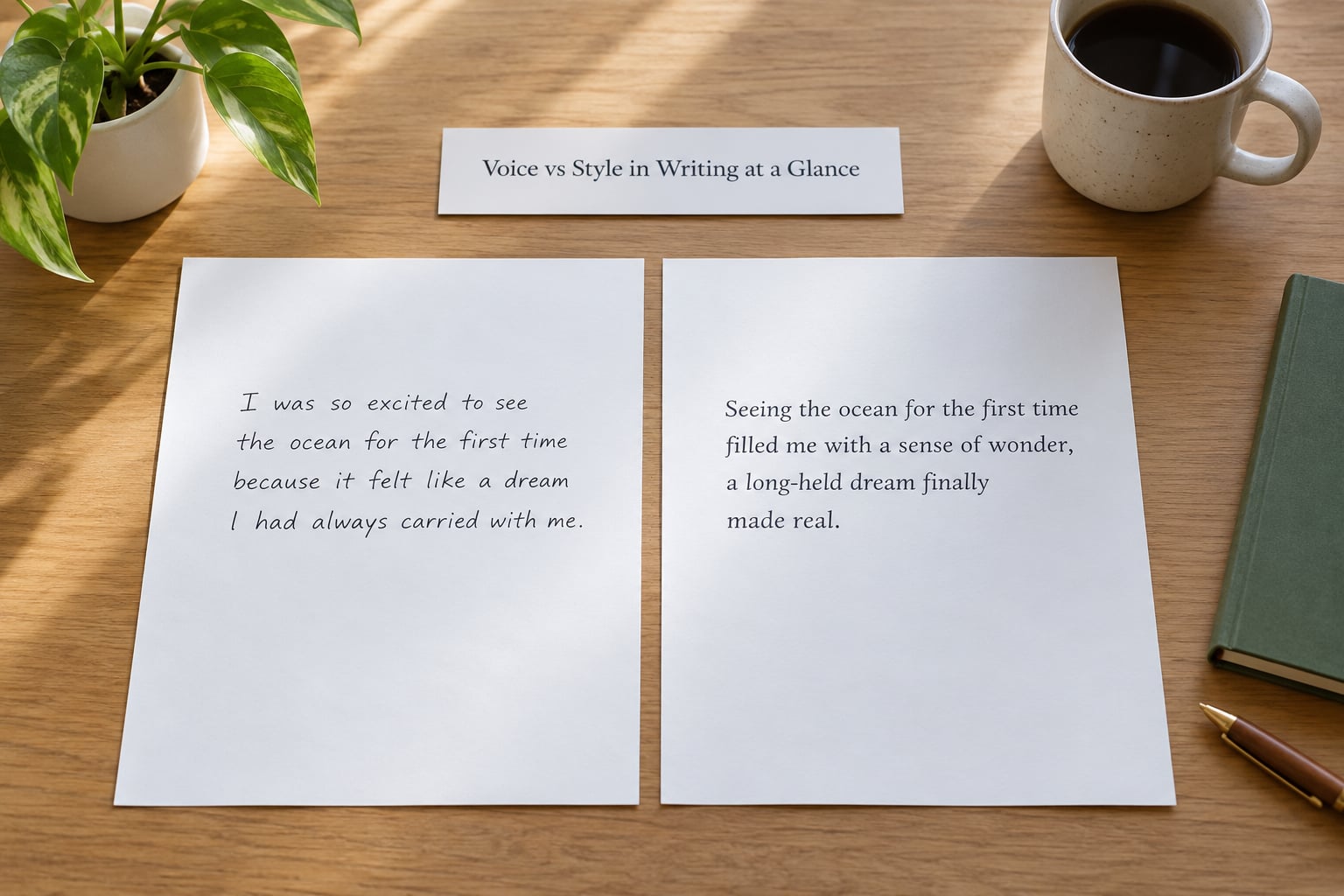
Here is the short version. Voice is the writer’s presence. Style is the machinery.
| Criterion | Voice | Style |
|---|---|---|
| What it is | The personality, worldview, and attitude a reader senses | The recurring set of language choices: diction, syntax, rhythm, pacing |
| Whose it is | The writer’s, though fiction also gives it to characters | The piece’s, and often a publication’s house conventions |
| Where it lives | Below the sentence — in what you choose to notice and how you report it | On the sentence — in how it is built |
| How fast it changes | Slowly, across years and books | Quickly, with a single revision pass |
| The tell | A reader can identify your work with the byline covered | A reader can describe your sentences but not their mood |
| Can it be borrowed? | Only faked, and readers sense it quickly | Yes — you can write in any style you study |
| Short example | “I have never trusted a map that admitted it was wrong.” | The same idea in six words, or thirty, or all one long breath |
The analogy writers use most often — voice as the fingerprint, style as the vehicle — comes from years of forum threads on r/writing and r/writingadvice, and it holds up because it explains why two writers can cover identical ground and leave you with completely different impressions.
What Is Voice in Writing?
Voice is the writer’s recognizable presence: the sum of personality, values, authority, and attention that a reader picks up whether or not you sign the work. In fiction it is the narrator’s sensibility. In nonfiction it is the angle of mind doing the reporting. In poetry it lives in attention and music. In academic writing it is the person doing the knowing.
Peter Levi described authorial voice as personal speech carrying a full personality in every ramification, and a Writer’s Digest essay on the craft put it more bluntly: voice is the controlling consciousness of the work. Neither writer was talking about word choice. Both were talking about who is running the piece.
What voice looks like in practice
Five things feed a writer’s voice:
- What you notice. Dave Barry’s humor lives in the specific absurd detail he selects; another writer covering the same event picks out the human cost.
- Your worldview. Tolstoy sees systems and coercion; a contemporary writer might see only the individuals inside them.
- Your authority. John Gardner argued that authorial authority is humanness plus the reader’s trust in your aesthetic judgment. Readers forgive a lot once they trust the person reporting.
- Your values. What you decline to describe says as much as what you describe.
- Your consistency. A reader who knows one of your books recognizes you in another, even when the genre has changed completely.
Character voice is a different animal
Fiction writers get asked this constantly: is the character’s voice the same as the author’s? No. Character voice is a set of diction, syntax, and habits belonging to one invented person — a dialect, an education level, a verbal tic. Authorial voice belongs to the consciousness choosing the words. A story can have a strong character voice and a lazy authorial voice, and readers will notice both.
Voice is not grammatical voice
One note before you go further. Search results for this question are polluted by grammar pages about active and passive voice. That “voice” is a syntactic construction. Everything on this page refers to authorial voice.
What Is Style in Writing?
Style is the observable fingerprint of your language choices: word choice, sentence structure, rhythm, pacing, figurative language, register, and the formatting habits around them. If voice is what you are, style is the bag of tools you reach for.
Style is fully visible to an editor. It can be described, taught, and swapped. That is why a house style exists at all: a magazine like Writer’s Digest publishes many different voices under one set of editorial conventions.
The main style levers
| Lever | What it changes | The move |
|---|---|---|
| Diction | Register and precision | “Deceased” and “dead” are the same fact in different clothes |
| Syntax | Emphasis and pace | Front-loading the verb makes a line urgent |
| Sentence length | Breath and rhythm | One nine-word sentence after three long ones hits harder |
| Rhythm | Musical continuity | Repeating a sentence’s opening makes a paragraph feel driven |
| Pacing | Reader attention | Cutting description lets action arrive sooner |
| Figurative language | The image system | Metaphor and simile build the writer’s default lens |
| Point of view and tense | Distance and intimacy | Third person limited sits closer than omniscient |
Compare two writers on one subject. Ernest Hemingway and Frank McCourt both write about hard lives under pressure. Hemingway’s style is spare, declarative, short paragraphs. McCourt’s is ornate, digressive, syntactically wild. John Irving’s runs long with clauses stacked mid-sentence and heavy recurring verbs. Those are three styles. Each one is a choice a writer made on purpose.
What Is the Difference Between Voice and Style?
Here is the distinction in one line: voice is who is speaking, style is how they speak. Everything else follows from that.
Two more terms get mixed in, and both are narrower than either voice or style.
| Term | Definition | Example of a shift |
|---|---|---|
| Voice | The writer’s personality and worldview on the page | Consistent across your whole body of work |
| Style | The technical choices: diction, syntax, rhythm, pacing | Shorter sentences in a draft meant to feel urgent |
| Tone | The attitude toward the subject or the reader | Confessional, skeptical, brisk, apologetic |
| Mood | The atmosphere the reader experiences | Uneasy, buoyant, elegiac |
A voice can hold steady across several tones, and one tone can be carried in more than one style. A Yale Poorvu Center workshop series on academic writing splits its own curriculum the same way: one half on American academic style (clarity, concision, flow), the other on developing your own voice through hedging and word choice.
The same passage, two styles, one voice
Here is the test that makes the difference obvious. The sentence to render is a small fact: the writer’s father repaired clocks.
Plain style. My father fixed clocks. He worked at the bench by the window and never once looked at the clock on the wall above him.
Ornate style. My father, whose hands knew the inside of a timepiece better than his own face knew the years, bent his unhurried attention over other people’s broken hours, and never once lifted his eyes to the wall above the bench where a second, official time kept its indifferent count.
The content is identical. The father is the same man with the same habit. In the first version he is spare and slightly stubborn. In the second he is grandiose and almost comic. That shift is style, and it happened entirely in word choice and sentence structure.
What did not change is the attitude underneath — the slight exasperation of a child watching a man refuse one specific clock. Push the style further and the voice starts to fray. Write three more ornate versions and the observer disappears, leaving only decoration.
How Do Voice and Style Work Together?

Voice sets the effect you want. Style is the set of language choices that produce it. That is the working relationship, and it explains the two failure modes writers hit constantly.
Weak voice, strong style. The sentences are clean, varied, and competently built, and nothing is there. This is the most common version of “my writing feels bland.” The technique is fine because it never had an effect to deliver. More style work will not fix it; the writer has to decide what they actually think about the subject.
Strong voice, inconsistent style. The writer clearly knows something, but the sentence lengths collapse into uniformity or the register jumps around. The voice gets muffled by its own mechanics. This is a style problem, and it responds fast to revision.
Mismatch. Someone tells a funny story in language borrowed from a grant application. Readers feel the seam. Voice and style should pull in the same direction, and when they don’t, one of them is out of place.
When editing flattens your voice
Writers complain about this constantly. A grammar checker or a well-meaning editor replaces a rhythmic line with a plainer one, and the piece stops sounding like them. Since style changes are cheap and fast, that is what automated tools reach for first — they flatten the surface, and the voice goes with it.
Defend it deliberately. Keep a small style sheet for yourself: which constructions you use on purpose, which words you never use, how you open. When an edit you did not ask for lands, decide whether it improves the style or erases the voice. Sometimes it does both.
Voice and writing assistance
If you use an AI tool to draft or revise, keep the voice question in front of you. Generated prose tends to converge on a smooth middle style — average sentence length, no tics, no strong attitudes. That is a style problem you can correct, but voice is the part you have to supply. Draft the argument, the observation, and the angle yourself, then let the tool handle transitions and cleanup.
Which One Should You Choose?
Choose based on the symptom, not on what sounds more important.
Focus on voice when…
Your writing is competent but interchangeable. You could swap in any author’s name and nobody would notice. Emotional distance creeps in, or you find yourself explaining feelings instead of reporting what happened. In a novel, your characters all speak the same. Pick one specific thing you genuinely noticed that nobody else in the room seemed to, and build the paragraph from it.
Focus on style when…
Sentences run the same length, paragraphs blur together, or the register keeps shifting without warning. You have something to say and the delivery is losing it. Style work is fast here: read the paragraph aloud, cut half the adverbs, vary two sentence lengths, replace three abstractions with concrete nouns.
Is this a style problem or a voice problem?
Work through these in order:
- Cover the byline. Would a reader still recognize your work? If not, voice.
- Read one paragraph aloud. Where you stumble or need breath, that is a style line to fix.
- Ask what you noticed that others left out. If the answer is nothing, voice.
- Count your sentence lengths in one paragraph. Little variation, style.
- Check whether your attitude toward the subject is stated or only implied. If it is absent, voice.
- Swap in a stranger’s byline mentally. If nothing changes, voice.
Academic and technical writing needs both
Students and professionals often hear that voice is a literary luxury and clarity is the only goal. That is a mistake. Academic and technical work has a house style — conventions of hedging, citation, structure — and inside it there is still room for a recognizable presence, usually carried by what you choose to emphasize, how much you hedge, and how you order your explanations. Write the plain style first so nothing is unclear, then push one or two choices until the writer is visible.
Does voice stay the same across genres?
No. Readers on r/writing ask whether their voice has to be identical in fiction, poetry, and marketing copy, and the honest answer is that the person stays recognizable while the surface changes completely. The voice persists; the style mutates to fit the audience.
Frequently Asked Questions
Is voice the same as tone in writing?
No. Voice is the writer’s whole presence on the page: personality, worldview, and the choices they keep making. Tone is narrower, meaning the attitude toward the subject or reader in one passage. A calm voice can carry an urgent tone, and a warm voice can carry a cool one, which is why an editor asking you to change tone may end up rewriting your voice.
How can I make my writing voice sound more authentic?
Write from what you actually observed rather than from a summary you expected to need. Forum writers who describe their work as sounding genuine usually share the same habit: one concrete detail that nobody else in the room bothered to record. Add that, cut the sentence explaining what you felt, and the presence tends to follow. Voice comes from volume and attention, not from a personality you are trying to perform.
Does style include word choice and sentence structure?
Yes, and those two are the most visible levers. Style also covers rhythm, pacing, figurative language, register, point of view, and tense consistency. The distinction matters during revision: if the ideas and the attitude are there but the sentences blur together, that is a style problem, and it responds quickly to line-level work.
Can a writer have a strong voice in academic writing?
Yes. A strong academic voice tends to come from emphasis, hedging, and ordering rather than from ornament. Say which finding matters most, hedge where the evidence is genuinely thin, and explain things in an order a reader can follow. Yale writing programs separate academic style from academic voice for this reason, teaching clarity and concision separately from developing a recognizable presence.
How do I revise voice without changing my personality?
Revise the reportable parts and leave the temperament alone. That means what you noticed, what you value, how much you trust the source, and the order in which you present things. You can change every sentence structure in a paragraph without touching any of those. Writers who keep a short style sheet of their own habits stop their editors and grammar checkers from sanding those habits off.
What is the fastest way to improve my writing style?
Read one paragraph aloud and fix only what your ear catches, keeping one variable steady at a time. On the first pass, vary sentence length. On the second, swap abstractions for concrete nouns. On the third, cut the transitions you added for comfort. Ear-led revision is faster than reading silently because it flags the lines your eye has already learned to skip.
Conclusion: Improve Voice First, Then Refine Style
Voice is who you are on the page. Style is how you write, and it is the layer you can rebuild in a single revision. When a draft feels flat, decide which one is missing before you touch the sentences.
One practical step: read a paragraph aloud, and say in your own words what attitude the writer is taking toward the subject. If you cannot answer that, you have a voice problem. If you can, and the paragraph still doesn’t carry it, take one style lever — diction or sentence rhythm — and revise around it. Work in that order and revision stops being a guessing game.