
The protagonist is the character whose choices drive the plot forward, the one whose goals the story follows. The antagonist is whoever or whatever opposes those goals and creates the central conflict. Neither word says anything about whether a character is good, so the difference is about function, not morality.
That single idea fixes most of the confusion students bring to these terms. My guess is you have heard someone call a character “the villain” and then watched a teacher mark it wrong, and you have never quite worked out why. The villain label judges behaviour. The antagonist label describes a job in the plot.
This guide covers both roles, the ways a story can split the protagonist role across two people, non-human antagonists, and a practical way to identify the pair in any text you pick up. It should take about ten minutes to read through and give you language for your next essay or class discussion.
Table of Contents
- Protagonist vs Antagonist Explained at a Glance
- What Is a Protagonist?
- What Is an Antagonist?
- What Is the Difference Between Them?
- How Do Protagonists and Antagonists Create Conflict?
- How to Identify the Protagonist and Antagonist in a Story
- Common Examples of Protagonists and Antagonists
- Common Misunderstandings About Main Characters
- A protagonist is not the same as the main character
- A protagonist is not automatically a hero
- An antagonist is not automatically a villain
- An antagonist is not always a person
- A narrator is not automatically the protagonist
- The first character mentioned is not automatically the protagonist
- Which Should You Choose?
- Frequently Asked Questions
- Must the protagonist be a good person?
- Can the antagonist be a group or something that is not a person?
- Can a story have more than one protagonist or more than one antagonist?
- How is a protagonist different from a narrator?
- Can the protagonist be the antagonist of their own story?
- What is the difference between a foil and an antagonist?
- Start With the Character Who Makes Decisions
Protagonist vs Antagonist Explained at a Glance
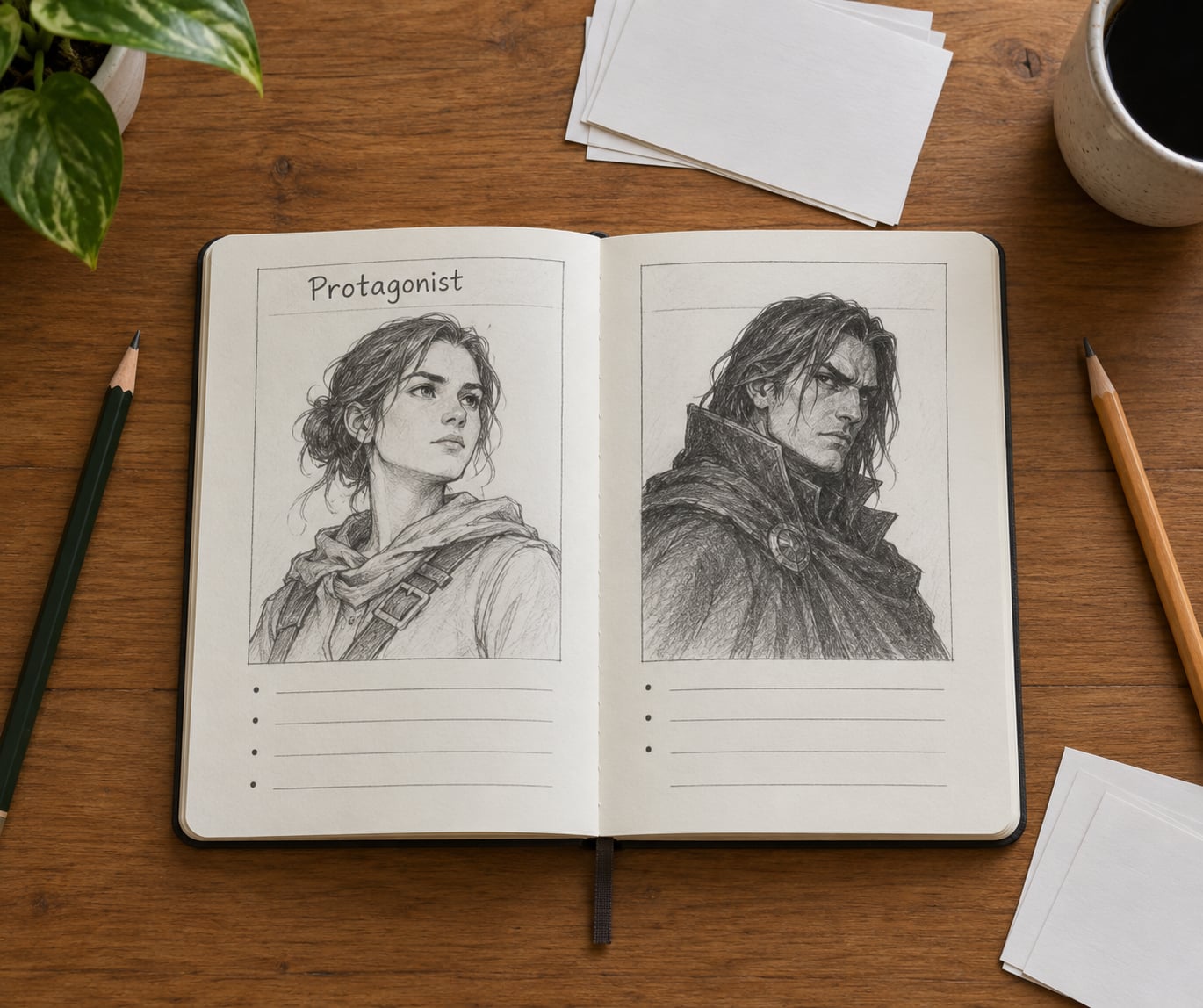
Here is the short version, criterion by criterion. Everything after this table unpacks one row at a time.
| Criterion | Protagonist | Antagonist |
|---|---|---|
| Role in the plot | Drives the story forward through choice | Pushes back, blocks, or redirects |
| Main objective | Something concrete they want to reach | An objective incompatible with the protagonist’s |
| Point of view | Usually the viewpoint the story follows | Usually external to that viewpoint |
| Time on the page | Most scenes, chapters, or screen time | Less, but concentrated at the turning points |
| Morality | Not part of the definition | Not part of the definition |
| Change over the arc | Usually adapts or breaks under pressure | May adapt, harden, or be defeated |
| Relationship to theme | Embodies the question the story asks | Forces the protagonist to answer it |
One row deserves a note before we go further. Moral columns are blank on purpose, and that is not an oversight. Plenty of the best-known antagonists in fiction are decent, even admirable people who happen to want something incompatible with the lead.
What Is a Protagonist?
A protagonist is the central character whose experiences, choices, and goals receive the greatest attention from the narrative. The plot is largely a record of what happens because this person does something.
The word comes from the Greek prôtos, meaning “first,” joined to agōnistḗs, meaning “actor” or “competitor.” The first competitor in the contest of the stage. Later usage narrowed it until it simply means the lead role.
Synonyms you will meet in criticism and classroom notes include main character, lead, central character, and hero, though hero carries an extra moral freight we will deal with below. The first three are near-exact; hero is not, which is where a lot of marking lost marks come from.
Two limits are worth stating. A protagonist is not automatically the hero, and the protagonist is not automatically the most important person in the story’s world. Plenty of novels hang on a minor figure while the most consequential character sits in the background.
What Is an Antagonist?
An antagonist is the character, group, or force that creates meaningful opposition for the protagonist. Writers often phrase it as the person, group, force, or idea that opposes the interests of the protagonist, and that phrasing is deliberate: the list is deliberately wide.
The prefix anti- means “against.” The antagonist is structurally the against of the protagonist.
Antagonists come in four broad shapes. A person who directly opposes the lead, like Iago. A group or institution, like the Board in The Circle or a school system in a story about a true believer. An idea or condition, like racism in Beloved or sexism in The Handmaid’s Tale. And a non-human force, like the ocean in Robinson Crusoe or time itself.
None of those require cruelty. An antagonist only has to want something that cannot coexist with what the protagonist wants.
What Is the Difference Between Them?
The core difference is direction of force. The protagonist pushes the plot toward an objective; the antagonist pushes it away from that objective. Everything else, screen time, sympathy, morality, follows from that one relationship.
Motives are the cleanest place to see it. In most stories the protagonist and antagonist each pursue a want, and the two wants cannot both come true. A detective wants the truth proven; a murderer wants it buried. Neither has to be good. The collision is the story.
Point of view separates them most of the time. The protagonist is usually the consciousness the reader lives inside, which is why their mistakes and surprises feel intimate. The antagonist is seen from outside, so we read their behaviour and infer the motive.
Change tends to run differently too. A protagonist is under pressure to adapt, and the arc measures what they learn or what costs them. An antagonist often stays fixed, which is exactly why they keep generating obstacles, though plenty of stories deliberately break that pattern.
Take a simple case. A protagonist wants to leave a small town; the antagonist wants the town to keep its reputation and quietly pressures them to stay. Add that the antagonist funds the protagonist’s education, and the opposition gets personal rather than institutional.
How Do Protagonists and Antagonists Create Conflict?
Conflict comes from incompatible objectives, and the mechanism is simple enough to trace in one sentence: the protagonist acts to get what they want, the antagonist acts to prevent it, and the results of those actions raise the cost each time.
Watch it work in four steps. The protagonist states an objective. The antagonist holds a competing objective. The antagonist places an obstacle in the protagonist’s path. The protagonist responds, and the response is what escalates the situation.
The escalation is where most stories fail, because writers repeat the same obstacle three times instead of changing it. A better version keeps raising the price. First a warning, then a lost job, then a relationship that cannot survive the next attempt.
Forum writers argue about this a lot, mostly over how much room the antagonist deserves. A recurring complaint is that antagonists get backstories so the reader can understand how and why they became who they are, while the protagonist is granted conventional motivation for free. That imbalance is worth noticing, because a well-motivated antagonist makes every setback land harder.
On the other side, a maxim that comes up repeatedly on writing forums is that every antagonist is the protagonist of their own story. Taken seriously, it means giving the antagonist a coherent interior life rather than a plan with no reason behind it.
How to Identify the Protagonist and Antagonist in a Story
Identify the protagonist by following choices, not by presence. Ask which character makes decisions that alter the situation, and notice who is still being acted upon when the chapter ends.

Then identify the antagonist by locating the main opposition. If removing a character would leave the plot with nothing left to push against, that character is doing the antagonist’s job. That test works for weather, a rumour, or a rule as well as for a person.
Four checks confirm your answer in most texts. Look at the title and the chapter headings, which often name or imply the protagonist. Read who the narration stays inside. Check the climax, where the two forces meet directly. Then read the resolution, because the protagonist’s choice at the end reveals what the story considered central.
If two characters fit the protagonist test equally well, the story has multiple protagonists or a close protagonist and deuteragonist pairing, where the second character carries substantial weight and sometimes narrates. Both are legitimate structures; you just name them accurately.
A useful classroom shortcut is to write the story’s plot as a chain of “because” statements and see whose name appears at the start of most of them.
Common Examples of Protagonists and Antagonists
The same pair behaves differently across genres because the roles are functional. Here are eight familiar works with the pair identified, and a note on what their conflict actually is about.
| Work | Protagonist | Antagonist | What the conflict is about |
|---|---|---|---|
| Hamlet | Hamlet | Claudius | Justice versus the public cost of revenge |
| Macbeth | Macbeth | Macbeth’s own ambition | Self-destruction driven by the protagonist’s own motive |
| Jane Eyre | Jane Eyre | Edward Rochester’s secret and the legal marriage | Whether love survives withheld truth |
| The Great Gatsby | Nick Carraway | Gatsby’s obsession with Daisy | The gap between a self-made image and the past |
| Beloved | Sethe | Slavery, and the past it left behind | Trauma that will not stay buried |
| Star Wars (1977) | Luke Skywalker | Darth Vader | A young man’s fear of loss versus duty |
| The Dark Knight | Batman | The Joker | Order and chaos as rival worldviews |
| Joker (2019) | Arthur Fleck | Arthur Fleck’s resentment | The protagonist turns against the world that made him |
The Batman and Joker pairing comes up constantly on film forums as the textbook case of two opposing figures with equal but separate screen time, and it is a good one to study because neither character changes for the other’s sake.
The last two rows show the pattern writers on character-development forums keep returning to: the protagonist becoming the antagonist of their own story. A bullied teenager transported into another world starts as a victim and ends up as the thing standing between the hero and an ordinary life. That arc only works if the earlier scenes showed a genuine wound rather than a plot device.
Common Misunderstandings About Main Characters
A protagonist is not the same as the main character
They usually coincide, which is exactly why the mix-up persists. A main character can carry the emotional weight of a story while making few choices, or a narrator can be prominent without being the driver of events. Use protagonist when you mean the plot follows that person’s choices.
A protagonist is not automatically a hero
Hero describes virtue and likability. A protagonist is defined by centrality. The narrator of Lolita is a protagonist; so is Michael Corleone in the later films, where his own decisions produce the catastrophe.
An antagonist is not automatically a villain
This is the most repeated misconception in student forums, and the correction is worth memorising. Villain is a moral judgement; antagonist is a structural one. A grandmother shielding her village, a doctor treating a plague, or an institution protecting its own survival can all be antagonists without being cruel for pleasure.
An antagonist is not always a person
A systemic or physical force can hold the opposing objective. Get in Your Car has nowhere to go in LA. In The Old Man and the Sea, weather and exhaustion work against Santiago without ever speaking. Antagonists like these often carry a theme more directly than a human opponent can.
A narrator is not automatically the protagonist
Narration describes who tells the story; the protagonist describes whose choices drive it. First-person narrators are frequently witnesses rather than agents, which is a deliberate technique for creating dramatic irony rather than a mistake.
The first character mentioned is not automatically the protagonist
Opening scenes often introduce a guide, a victim, or a dead relative. Settle the question by looking at the last scene instead: whoever is still making choices when the story ends has held the protagonist role throughout.
Which Should You Choose?
You do not choose between the roles. You identify each one and then use the term that matches the task in front of you.
In a class discussion, if someone asks who the story is about, say protagonist. If they ask who is causing the trouble, say antagonist. In a character analysis, focus on motivation and change for the protagonist, and on pressure tactics and objectives for the antagonist.
For a plot summary, use the pairing to describe the central conflict in one sentence, then let the events follow. In a literary essay, resist moral language entirely until the end, because writing that a character is evil and then trying to show function usually produces an argument that contradicts itself.
The most common mark I see on essays that define the protagonist as the hero is a comment pointing out that the essay never mentions what the character wants. Function first, judgement second.
Frequently Asked Questions
Must the protagonist be a good person?
No. Protagonist describes narrative centrality, not morality. The narrator of Lolita, Michael Corleone in the later Godfather films, and the title character in Moby-Dick all drive their plots while doing terrible things. What matters is that the story follows their choices and shows the consequences, not that readers approve of them.
Can the antagonist be a group or something that is not a person?
Yes, and most great ones are. The antagonist can be an organisation, a legal system, a disease, weather, or an idea such as racism. Toni Morrison uses slavery itself as the antagonist of Beloved, and Margaret Atwood uses the regime of the Republic in The Handmaid’s Tale. The test is whether it holds an objective incompatible with the protagonist’s.
Can a story have more than one protagonist or more than one antagonist?
Yes, and most memorable ones are. Ensemble novels that distribute plot weight evenly across a small group, such as the linked-story structures in Elizabeth Strout’s Olive Kitteridge, give equal narrative centrality to several characters who function as co-protagonists, while epic quest narratives usually stack several antagonists who arrive in sequence. A story can also pair a primary antagonist with a sub-antagonist whose pressure shapes the middle act.
How is a protagonist different from a narrator?
The narrator tells the story; the protagonist drives it. They are often the same person, but first-person narrators frequently function as witnesses rather than agents, and third-person narrators may be entirely outside the action. Check who makes the decisions that change the outcome, and that character is the protagonist regardless of who is speaking.
Can the protagonist be the antagonist of their own story?
Yes, and the device has a name: the self-antagonist or internal antagonist. Macbeth fights his own ambition, and Arthur Fleck in Joker (2019) gradually becomes the threat he originally fears. Writers on character-development forums frequently discuss these arcs, noting that they require genuine motivation early on so the turn feels earned rather than sudden.
What is the difference between a foil and an antagonist?
A foil contrasts with another character to highlight a trait, and that character may oppose, support, or simply mirror the protagonist. An antagonist specifically opposes the protagonist’s objectives and generates the central conflict. Dr Watson is a foil to Sherlock Holmes but never an antagonist, whereas Moriarty opposes Holmes in every way that matters to the plot.
Start With the Character Who Makes Decisions
If you take one habit from this guide, make it the decision test. Read a chapter and ask who chose what, then ask who stopped them. That test identifies the protagonist and antagonist in almost any story, and it keeps your analysis in the language of function instead of the language of moral judgement.
Updated for 2026.