A simile compares two things using the words like or as. A metaphor states directly that one thing is another. That single difference in structure changes how clearly a reader sees the image and how much work the writer has to do to build one.
If you have ever labelled something a metaphor and then found a stray “like” in the sentence, or argued about a line of poetry with a classmate, this page settles the argument. We walk through both devices, put them side by side, break down literary examples that get mislabelled online, and finish with a way to test any sentence you meet.
Table of Contents
- Simile vs Metaphor with Examples at a Glance
- What Is a Simile?
- What Is a Metaphor?
- Simile vs Metaphor: How the Comparisons Differ
- Signal words and grammar
- Distance from the reader
- Tone and strength
- Visual clarity
- The same idea, twice
- How to Identify a Simile or Metaphor in a Sentence
- Step 1: Find two unlike things
- Step 2: Check for like or as
- Step 3: Decide explicit or direct
- The as trap: comparison versus simultaneity
- The like trap: comparison versus preposition
- Simile vs Metaphor Examples from Literature
- When Writers Use a Simile
- When Writers Use a Metaphor
- Which Should You Choose?
- Frequently Asked Questions
- What are 5 examples of simile and metaphor?
- Is u0022I slept like a babyu0022 a simile or a metaphor?
- Is u0022You are my sunshineu0022 a metaphor?
- What are 5 examples of a metaphor?
- Are metaphors and similes figurative language?
- Can a sentence be both a simile and a metaphor?
- Conclusion: Choose the Comparison That Fits
Simile vs Metaphor with Examples at a Glance
The table below is the whole lesson in one view. Every row contrasts the same idea in both devices, so you can see the mechanism rather than memorise a list.
| Criterion | Simile | Metaphor |
|---|---|---|
| Signal words | like or as | None |
| Structure | A is like B, or A is as B | A is B |
| Literal reading | Still a comparison, so the reader can check the likeness | False on its face, so the reader has to interpret it |
| Reader’s job | Evaluate how close the likeness is | Work out what is being transferred |
| Typical effect | Clear, vivid, slightly distant | Denser, bolder, more immersive |
| Everyday example | Her voice was like gravel in a jar. | Her voice was gravel in a jar. |
| Literary example | Shall I compare thee to a summer’s day? | All the world’s a stage. |
One row deserves a note. “Shall I compare thee to a summer’s day?” from Sonnet 18 is a simile even though the word “like” is missing, because the verb “compare” announces the act of comparison. Teaching guides get this wrong constantly. Structure and purpose, not one keyword, decide the label.
What Is a Simile?
A simile is a figure of speech that compares two unlike things using the words like or as. The comparison is stated openly, so the reader can look at both items side by side and judge the resemblance.
Examples, with the signal word marked:
- His grin was like a cracked plate.
- The classroom went quiet as a library after the bell.
- She moved through the crowd like a stone through water.
- Their arguments were as brittle as wet kindling.
- Fog threaded the valley like a rope through a hand.
- He answered as promptly as a reflex.
Literary similes get much sharper. In Great Expectations, Pip describes Magwitch’s broken voice as a low, husky, growling sound that was “like a barrel organ grumbling out of tune.” The simile lets you hear the wrongness before Pip has words for it.
Similes stay popular in classrooms because they are forgiving. A simile stays near the literal meaning, so a reader who has not grasped the comparison yet still gets a foothold. That is also why writers reach for them when they want clarity over force.
What Is a Metaphor?
A metaphor is a figure of speech that states one thing is another, without like or as. Nothing announces the comparison, so the reader has to spot the transfer themselves and decide which qualities carry across.
Examples:
- Her memory is a house with the lights off.
- The city is a lung that never fully fills.
- Ambition is a staircase you build while climbing it.
- Truth is a bone that dogs bury in the yard.
- His patience is a coat he borrowed and never returned.
- The rumor crossed the room and struck someone down.
Metaphors hide inside verbs as well as nouns. Words like slithered or bellowed can carry a comparison without naming it, and readers who learn to spot implied metaphors tend to stop being able to read naive prose for a while.
That is the real difference in effect. A simile hands the reader a comparison to hold. A metaphor removes the scaffolding and expects the reader to build it.
Simile vs Metaphor: How the Comparisons Differ
Structure is the easy part. Tone, distance and scale are where the choice actually matters, and they are the reasons writers pick one over the other.
Signal words and grammar
A simile needs a comparative marker, most often “like” or “as.” A metaphor needs a linking verb, usually “is,” “was,” “became” or “seems.” When you see “is like,” you are looking at a simile. When you see “is” alone with an odd noun on the right, you are looking at a metaphor.
Distance from the reader
Writers often describe a simile as keeping a slight distance. The reader stays outside the image and evaluates it, which is comfortable but cooler. A metaphor collapses that distance and asserts identity, so the reader ends up inside the thing being described rather than comparing it to something else.
Tone and strength
Similes tend to read as precise and controlled. Metaphors tend to read as bolder and more emotional, which makes them more likely to feel political or committed. If a passage needs weight rather than accuracy, the metaphor usually wins. If a student needs to show their working, the simile is safer.
Visual clarity
Some comparisons cannot survive being stated directly. “Love is a red door” is odd, and that oddness is the point. “The door was a red panic in the wall” stays legible because the reader is still being pointed at two separate things.
The same idea, twice
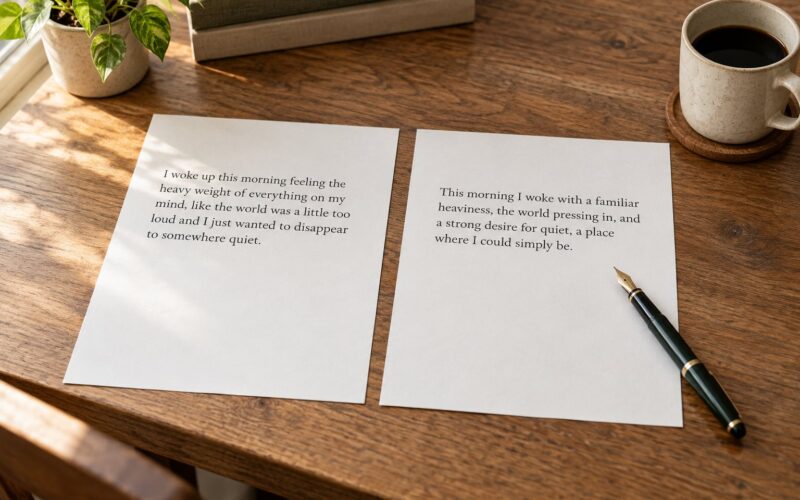
Here is the transformation in miniature. Simile: “The crowd moved like slow water down a slope.” Metaphor: “The crowd was slow water down a slope.” Nothing about the image changed. The distance did, and the second version reads as a claim rather than a suggestion.
How to Identify a Simile or Metaphor in a Sentence
Use three steps. It takes about fifteen seconds and works on anything, including lines with no obvious signal word.
Step 1: Find two unlike things
Ask whether the sentence puts two different categories of thing next to each other. A classroom next to a library, a memory next to a house, a voice next to gravel. If both nouns are literal and related in an ordinary way, you may not have figurative language at all.
Step 2: Check for like or as
If the comparison is marked by like or as in a comparative role, it is a simile. Then run the trap checks below, because not every “like” or “as” is doing that job.
Step 3: Decide explicit or direct
No marker and a strange identification means metaphor. Marker present means simile, unless the marker is decorative, as in “compare thee to.”
The as trap: comparison versus simultaneity
This is the most common false positive, and it is why “She ran as the rain fell” is not a simile. Here “as” means “while,” marking two actions happening at the same time. Nothing is being compared.
The test is grammatical. Ask whether you can replace “as” with “while” or “at the same time” without changing the meaning. If you can, you have simultaneity, not a figure of speech. If you cannot, and the sentence still says one thing resembles another, you have a simile.
The like trap: comparison versus preposition
“She swims like a fish” compares. “He looked at me like he had never seen me” is not comparing anything. “Like” there introduces an example of behaviour, not a resemblance between unlike things.
One more border case. “I slept like a baby” is a simile, full stop. The phrase is stock, but the structure is a marked comparison of sleep to infants. A cliché can still be a correctly built simile. Cliché is a taste problem, not a definition problem.
Simile vs Metaphor Examples from Literature
Famous lines get mislabelled online more than almost anything else in English class. These are correctly attributed and worth knowing.
- Simile: “Shall I compare thee to a summer’s day?” — Shakespeare, Sonnet 18. The verb does the work of “like.”
- Metaphor: “The slings and arrows of outrageous fortune” — Shakespeare, Hamlet. No marker word; injury is compressed into thrown objects, and the transfer is asserted rather than announced.
- Metaphor: “All the world’s a stage” — Shakespeare, As You Like It. Frequently mislabelled a simile. There is no marker word, and the identification is the point.
- Metaphor: “A house divided against itself” — Lincoln, from his 1858 House Divided speech. Identity, not likeness.
- Metaphor: “Time is a thief.” Borrowed so widely that most people can finish it, which is exactly why it reads as a metaphor rather than a comparison.
- Simile: “His smile was as stiff as a frozen fish.” A good exam question, because “as … as” appears twice in one phrase and the second “as” is easy to misread as an ordinary conjunction.
Here are original examples rather than quotations, so nothing gets miscited:
- Simile: Her patience wore thin like a shirt at the elbows.
- Simile: The lecture landed as softly as a coin in a fountain.
- Metaphor: His apology sat in the room like a fourth person nobody wanted to host.
- Metaphor: Grief is a room she keeps locked and keeps clean.
When Writers Use a Simile
Descriptive precision is the first case. When a reader needs to picture something specific, a simile supplies a reference point they already hold, which saves the writer from building the whole image from scratch.
Teaching abstract ideas is the second. Grief is hard to describe directly; comparing it to a locked, clean room gives a stranger something concrete to hold instead of a definition.
Emotional calibration is the third. A simile can hold a feeling at arm’s length and let a writer be precise about intensity without overcommitting. “Almost like drowning” and “exactly like drowning” are different claims, and the marker keeps them honest.
Classroom and craft work is the fourth. A simile shows the writer what is being compared, which makes revision easy. If the comparison does not clarify anything, cut it. Peer feedback in writing groups rejects worn comparisons like “as easy as pie” for exactly this reason: they add nothing a reader did not already have.
When Writers Use a Metaphor
Characterisation comes first. A metaphor reveals what a character believes, which is why the best ones carry the character’s point of view rather than the narrator’s judgement. A captain who thinks of his ship as a coffin is telling you everything about how he expects to die.
Theme comes next. A sustained metaphor can carry an argument across a whole poem or chapter, and the shape of that metaphor becomes the shape of the theme. An extended metaphor is one image run across several lines rather than dropped in and abandoned; when the same image recurs at intervals across a work, it becomes a motif.
To see how that works, read this stanza as a single frame:
The road unwound beneath us like a thread
pulled from the hem of a coat we had not noticed we were wearing,
and every mile took a stitch out of it,
until by morning we were carrying only the seam.
One idea, four lines, and the marker word appears once at the start and then vanishes. That is a metaphor doing work a line of simile could not do.
Conceptual explanation is the third case. Metaphors carry abstract ideas across unfamiliar ground, which is why economics borrows from breathing and physics borrows from food. Tone is the fourth: a metaphor can make a flat statement feel urgent, and few similes manage that.
Which Should You Choose?
Pick the simile when the reader is new to the idea, when you are teaching, when you are writing to be understood rather than felt, or when precision matters more than pressure. Pick the metaphor when the image is the argument, when you want a line to stay with someone, or when you are building a frame that runs across a passage.
Match the device to the audience. A classroom answer or a how-to guide reads better with similes. A poem opening, or a line of dialogue that should sting, reads better with a metaphor.
Sometimes the answer is neither. If the comparison says nothing the sentence was not already saying, it is decoration. Cutting a dull simile improves the paragraph faster than replacing it with a fresher one.
For your own drafting, try the substitution test: rewrite the sentence with the metaphor’s “is” restored. If the comparison survives as a coherent image, it works. If it collapses into confusion, go back to a simile.
Frequently Asked Questions
What are 5 examples of simile and metaphor?
Five similes: her smile was like sunrise; the hall was as quiet as a library; he argued like a prosecutor; smoke curled like a rope; the child clung like a barnacle. Five metaphors: time is a locked door; her memory is a dusty attic; the rumor was a snake in the grass; ambition is a staircase; the company is a ship in rough water.
Is u0022I slept like a babyu0022 a simile or a metaphor?
It is a simile. The sentence marks the comparison explicitly with u0022like,u0022 comparing the speaker’s sleep to the sleep of an infant. The fact that the phrase is a stock idiom does not change its structure or its classification. Cliché and figure of speech are separate concerns, and a stale simile is still a simile.
Is u0022You are my sunshineu0022 a metaphor?
Yes, it is a metaphor. There is no marker word like or as. The sentence asserts an identity directly, transferring warmth, brightness and cheerfulness from sunshine onto the person being addressed. Its popularity as a song title and greeting card line is exactly why students often meet it already detached from its literal sense.
What are 5 examples of a metaphor?
Five clear metaphors: her memory is a house with the lights off; the city is a lung that never fills; ambition is a staircase you build while climbing; the rumor was a stone dropped into still water; his patience is a coat he borrowed and never returned. In each one, the first thing is stated to be the second, with no marker word.
Are metaphors and similes figurative language?
Yes. Both are figures of speech, meaning language used in a non-literal way for effect rather than accuracy. They belong to figurative language alongside personification, hyperbole, irony and metonymy. What distinguishes them from plain description is that the meaning sits in the comparison rather than in the words alone.
Can a sentence be both a simile and a metaphor?
In everyday classroom terms, no. Most grammars treat simile and metaphor as two categories that do not overlap, separated by the presence of a marker word. Some literary theorists argue that a simile is a kind of metaphor, since both transfer qualities from one thing to another. For marking and quizzes, use the structural rule and commit to one label.
Conclusion: Choose the Comparison That Fits
A simile shows the comparison with “like” or “as” and keeps the reader at a slight distance. A metaphor drops the marker, asserts identity and pulls the reader inside. Start with one question: do you want the comparison stated openly, or do you want it to arrive as a claim? Tone, length and clarity all follow from that answer.