Confessional poetry is first-person poetry in which the speaker draws directly on their own life, especially mental illness, family relationships, trauma and sexuality, to explore private experience that had rarely been discussed openly in poetry before. This guide to confessional poetry explained for students covers where the movement came from, who wrote it, how to read it, and how to turn your reading into an essay that earns marks.
The genre has a bad reputation it does not deserve. Most students meet it as a vague label attached to Sylvia Plath, and then assume it means unfiltered diary writing with good line breaks. That reading misses almost everything interesting, including the fact that these poets were rigorous craftsmen who bent rhyme, meter and metaphor to difficult material.
Here is the short version: if you can identify who the speaker is and what they are doing with the form, you can analyse a confessional poem. Everything below builds toward that move.
Table of Contents
- What Is Confessional Poetry? A Student-Friendly Definition
- Where the name came from
- The five core poets
- How Is Confessional Poetry Different from Autobiographical Poetry?
- What Are the Main Features of Confessional Poetry?
- How Do You Read Confessional Poetry for Analysis?
- Confessional Poetry Explained for Students Through a Sample Analysis
- What the sample poem shows
- Which Literary Devices Commonly Appear in Confessional Poetry?
- How Do You Write About Confessional Poetry in an Essay?
- What Are Common Misconceptions About Confessional Poetry?
- Frequently Asked Questions
- What is confessional poetry in simple terms?
- Who are the most famous confessional poets?
- Who first used the term confessional poetry?
- Was Sylvia Plath a confessional poet?
- What are the criticisms of confessional poetry?
- What are the three R’s of poetry?
- Conclusion
What Is Confessional Poetry? A Student-Friendly Definition
Six characteristics define most poems in this mode. Keep this list in your notes; it is enough to identify the genre and enough to start an analysis.
- A first-person speaker using “I” who is closely tied to the poet’s own life.
- Subject matter that was private, stigmatised or simply unspeakable when the poems were written.
- Memory and the recovery of a past event, usually family history or illness.
- Family relationships, especially parent and child, and marriage.
- Mental illness, addiction and grief handled directly rather than displaced onto myth.
- Serious control of craft: rhyme, meter, stanza shape and figurative language.
Where the name came from
The term was coined by M. L. Rosenthal in 1959, in his review of Robert Lowell’s collection Life Studies. Rosenthal described the book as “confessional” because Lowell spoke as himself rather than through the classical masks that twentieth-century poets had been taught to wear. Plath, Anne Sexton and John Berryman all read that review and recognised what it described, which is why the label stuck to a whole movement.
The context matters. These poems appeared in postwar America, after the Holocaust and through the Cold War, when mental illness was still largely a private shame and psychiatry was unfamiliar to most readers. Writing about a psychiatric hospital, a father’s death or a suicide attempt was genuinely radical in that period.
The five core poets
| Poet | Key collection | Year | Defining personal subject | Poem to read first |
|---|---|---|---|---|
| Robert Lowell | Life Studies | 1959 | Mental hospitalisation, family history | Skunk Hour |
| W. D. Snodgrass | Heart’s Needle | 1959 | A father who died by suicide | The Truth the Dead Know |
| Anne Sexton | To Bedlam and Part Way Back | 1960 | Hospital treatment and depression | Lady Lazarus |
| Sylvia Plath | Colossus; Ariel | 1962; 1965 | An unreachable father, early death | Daddy |
| John Berryman | The Dream Songs | 1959 | Guilt over a father’s death, drinking | Dream Song 14 |
Anne Sexton was hospitalised and treated for severe depression from her early twenties, and she began writing seriously at her psychiatrist’s suggestion. Plath was treated with electroconvulsive therapy in the 1950s and wrote her most famous poems in England shortly before her death in 1963. Neither fact is the whole of a poem, but you cannot read Daddy or Lady Lazarus without knowing that context.
How Is Confessional Poetry Different from Autobiographical Poetry?
Every confessional poem draws on a real life, and plenty of autobiography is not confessional verse. The difference is what the poet does with the material once it is on the page. A diary records; a poem shapes, and shaping is the part students miss when they call this genre a diary.
| Point of comparison | Confessional poetry | Autobiographical poetry | Persona poetry |
|---|---|---|---|
| Who the “I” is | Closely the poet, though still a constructed speaker | May be the poet, or an ancestor, or a family member | A deliberately invented character |
| Typical subject | Illness, grief, family, sexuality, addiction | Whole-life narrative, often in sequence | Historical or fictional figure speaking in the first person |
| Emotional distance | Collapsed on purpose, then controlled by form | Varies widely | Maintained through character voice |
| Example | Plath’s Daddy | A sequence retracing a family | A Victorian speaker recounting a murder |
The persona column is the one worth learning properly, because students confuse it with confessional poetry constantly. When Robert Browning writes “How do I love thee? Let me count the ways,” the “I” is a character in a dramatic monologue, not the man at the desk. When Plath writes “I never could talk to you” in Daddy, the “I” is a speaker whose relationship to the poet is very close.
Test yourself with one question: could you find a biography, hospitalisation record or family document that this poem maps onto? If yes, you are probably looking at confessional verse. If the speaker exists only inside the poem, you are looking at a persona.
What Are the Main Features of Confessional Poetry?
Voice comes first. The poems speak as “I,” and that “I” carries an emotional pressure that impersonal verse usually avoids. Students often hear this as vulnerability, but the interesting part is control: the poet chooses exactly how much to show and how long to hold your attention.
Subject matter is the second feature, and it is where the genre broke with convention. Poems about psychiatric hospitals, sexual frustration, difficult mothers, alcoholic fathers and suicide had been written before, but usually disguised: a sparrow stood for the self, a winter scene stood for grief. The confessional poets removed the disguise and let the specific life stand there.
Craft is the third feature, and it is the one most often denied. Berryman’s Dream Songs are sonnets. Plath rhymes “Auschwitz” with the jaunty “chicken walk” and drops German-sounding syllables into the middle of nursery-rhyme rhythms. Sexton wrote in rhyme schemes and used puns. Free verse is the dominant surface of the movement, but it is not carelessness.
A fourth feature is the collapse of literary distance. The poet no longer stands beside the poem observing; the poet is inside it, and that changes what the poem asks of a reader. You are not analysing a scene. You are being handed an experience and asked to judge what the poet did with it.
The last feature is a tight, often obsessive subject. Confessional poets return to the same handful of images year after year: Plath and her father, Lowell and his marriage, Berryman and his father’s death. Repetition across a collection is part of the meaning.
How Do You Read Confessional Poetry for Analysis?
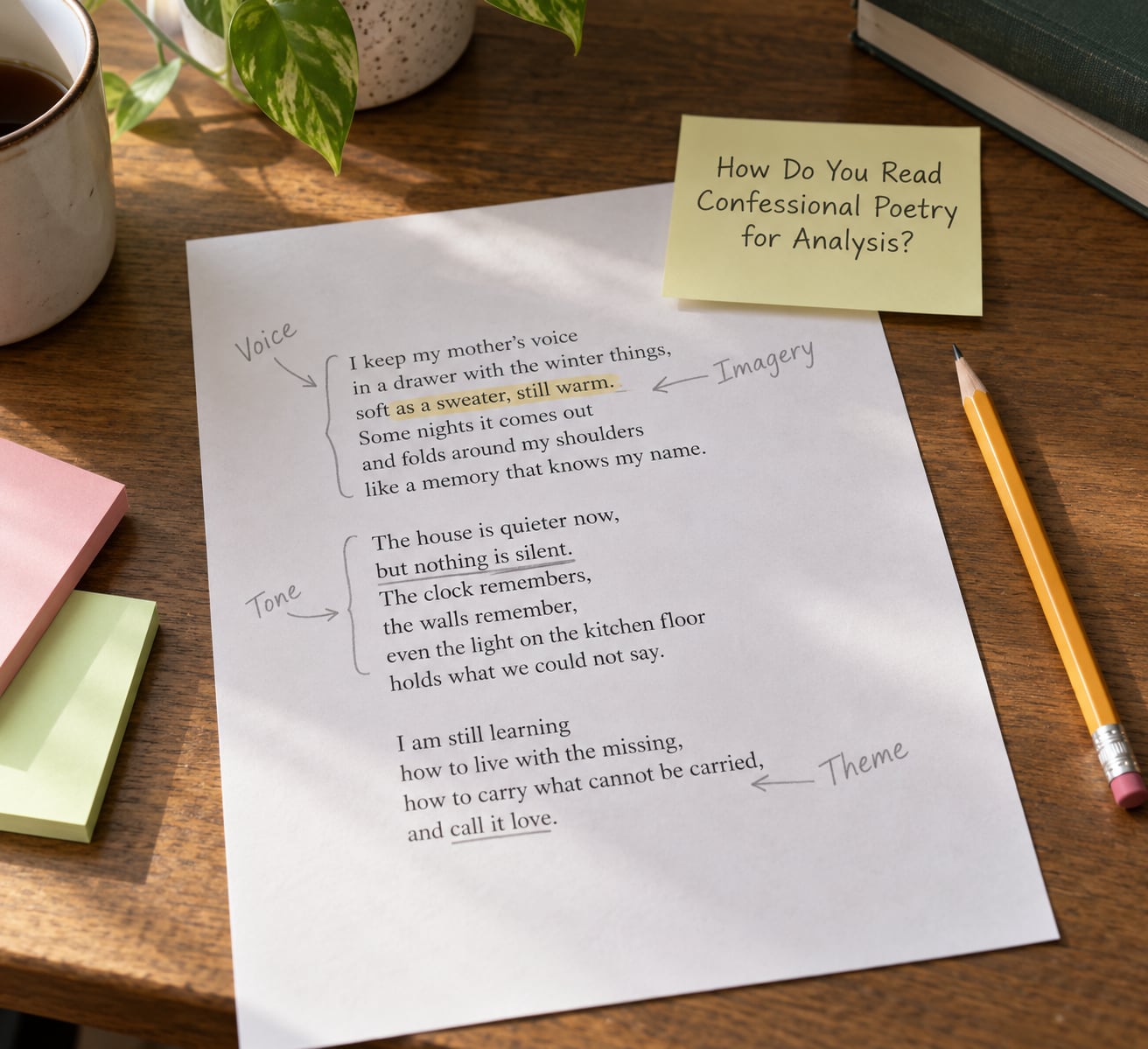
Read in this order and you will not run out of material before the essay deadline.
1. Read it straight through, twice, without annotating. The first read tells you the emotional weather. The second tells you what you actually remember. Underline the three or four lines that stayed with you, because those are usually where the craft is.
2. Write down what happens literally. In your own words, one sentence: what has the speaker done, lost, been told, or been unable to do? Plath’s “Daddy” is a woman addressing a dead father. “Skunk Hour” is a man driving at night who stops on a Massachusetts road to watch skunks. Literal summary first, interpretation second.
3. Find the words that are doing the most work. Circle images that mean more than they say. In “Daddy,” the man in black “with a Meinkampf look” is not a description of a German officer; it is a compressed collision of fascist imagery, family memory and blame, and “Ich” sits in the mouth like a language inherited rather than chosen.
4. Ask what the poem is doing formally. Note where lines break, where rhyme lands, where the stanza shape changes. Plath’s “Daddy” moves from tight, resentful short lines through a long dripping verse section built on rhyme, and ends on the exhausting repetition “I am through, I am through.” The structure enacts the suffocation the speaker is describing.
5. Build the interpretation from the evidence. Now write a claim that a marker could disagree with. Not “this poem is about a difficult father.” Try: Plath uses a first-person speaker who insists on keeping the past present, and the poem’s bluster is the only power she has left over a man who is dead.
Confessional Poetry Explained for Students Through a Sample Analysis
The poem below was written for this guide so you can watch the method work from the ground up. Content note for classrooms: it deals with grief and family silence, and there is nothing more graphic than that.
The Lamp We Left in the Hall
I took the lamp my grandfather wired
the summer the porch light quit.
Its cord is knotted. Its bulb is clouded glass.
I set it on the step, not knowing which
of us it was meant to guide.
The room it lit is bare now, bare like a sentence
someone started and decided against.
I tell myself the house let go of it first.
That is a story. It is warm. It fits.
Three lines and one to say it plainly:
nothing here is mine tonight.
What the sample poem shows
Literal layer: a speaker is leaving a lamp outside after someone has died or moved out. The childhood room is empty.
Evidence and technique: the fourth line ends on “which” and the next line starts “of us,” so the sentence breaks exactly at the point of doubt. The enjambment there makes the hesitation audible. In the opening line of the second stanza, “bare like a sentence” is a simile that turns an emptied room into an abandoned thought, and the echo of the bare room and the bare sentence turns description into self-assessment: the speaker feels unfinished.
The turn: line eight is a small confession inside the poem. The speaker admits to constructing a version of events that protects them, and line nine catches the excuse in three clipped fragments. Short syntax does what Plath-style flooding does in reverse; it sounds like someone repeating a comfortable lie in order not to break.
Theme: the last stanza abandons figurative language and states a claim flatly, then revokes it. That refusal to give the reader comfort is the confessional gesture, and it is a choice, not a symptom.
Tone: controlled, ironic, tired. Not raw emotion, but emotion under discipline.
Note what happened. You ended up discussing figurative language, syntax and tone, because the work of the poem pushed you there. If the piece had been a diary entry about the funeral, none of that analysis would have been available.
Which Literary Devices Commonly Appear in Confessional Poetry?
Allusion is the workhorse. Plath’s Daddy moves through German places of wartime atrocity in an English nursery-rhyme cadence, so the allusion carries two meanings at once: historical guilt and family history.
Metaphor and simile convert psychological states into physical ones. Lowell’s “I myself am hell” in “Skunk Hour” makes an internal state into a place, which is why the line is quotable out of context.
Rhyme, meter and repetition are used for pressure rather than music. Plath’s rhyme in “Daddy” is relentless and slightly grotesque, like a nursery rhyme sung by someone who is furious. Berryman’s fixed fourteen-line stanza in The Dream Songs creates a cage that the voice keeps breaking.
Enjambment and abrupt short lines control the reader’s breathing. A line that stops mid-thought creates suspense; a one-word stanza can feel like a slap.
Diction carries class and education. Plath’s vocabulary is educated, precise and Anglo; Berryman’s is learned, alcoholic and archaic. Diction is one of the fastest ways to characterise a confessional speaker in an exam.
The important point for students: heavy personal subject matter does not make technique predictable. Once you assume every confessional poem will be raw and shapeless, you stop looking, and the craft disappears from your analysis.
How Do You Write About Confessional Poetry in an Essay?
Use a claim-evidence-analysis structure where each stage points at the next.
Topic sentence: make a claim a reasonable person could dispute. “Plath uses nursery rhyme in ‘Daddy'” is an observation. “Plath’s use of nursery rhyme in ‘Daddy’ shows how memory can be kept under control only by being repeated” is a claim.
Evidence: quote two to four words, not a paragraph. Short quotation leaves room for analysis, which is where the marks are. Always give the line number or stanza.
Analysis: explain the effect of the device in this poem, for this speaker. Say what changes because of the choice.
Significance: connect it to the question you were asked. If the question asks about grief, explain how the rhyme stage carries the weight of the loss.
Conclusion: extend rather than repeat. A closing line about what the poem reveals about the relationship between a self and its past earns more than a summary.
A model thesis, if you want a starting point: “In ‘Daddy’, Plath builds the poem on the metre and vocabulary of a nursery rhyme so that the speaker’s most violent memories arrive dressed as play, and the only thing louder than that play is the exhaustion of the final repeated line.”
What Are Common Misconceptions About Confessional Poetry?
“It is just diary writing with line breaks.” This is the misconception that costs students marks. Diary entries record; poems select, compress and arrange. The moment you stop believing the form is deliberate, you stop noticing what it is doing, and you have nothing left to analyse.
“Every personal poem is confessional.” A poem can use a first-person voice and still be a persona or a performance. The test is whether the speaker’s life is the poem’s actual subject, and whether the poet is choosing to collapse the gap between self and speaker.
“It has to be completely literal.” The most quoted confessional poems are full of mythology, fairy tales and historical allusion. Plath’s “Daddy” ends with the speaker rising “Through the merciful fog” like a film of the Third Reich walking to the camps, and she was an exacting student of German and of folklore.
“It is untrained and self-pitying.” Online poetry forums split on this one, with readers defending the genre as the reason poetry feels honest and others dismissing it as a cry-baby diary. The critical version of that complaint is Richard Wilbur’s, who had admired Lowell early on and later argued that the turn to raw confession weakened the poetry, a charge Lowell answered in his Notebook. Robert Bly went further in 1961, accusing the confessional poets of offering no moral position at all and of treating the private self as an authority that needs no defence.
Those objections are worth knowing. New Formalist poets and language poets both reacted against confessionalism, arguing for craft, formal ambition and public political subject matter. An essay that mentions one counter-argument and answers it reads far better than one that only praises.
“It is only a mid-century American movement.” Sharon Olds and Mary Jean Chan carried it forward in a different register, and much of what now gets posted online as confessional writing descends from this tradition, which is why the term feels contemporary even though its peak was 1959 to 1965.
One caution for anyone writing their own. Beginners who imitate the form tend to produce self-pity, and the fix is restraint rather than more disclosure: cut the explanation, keep the image, and stop while the reader still wants more. If you are school-age, check the poem is one you are genuinely willing to share, because a teacher may ask to see it.
Frequently Asked Questions
What is confessional poetry in simple terms?
Confessional poetry is poetry that speaks as a first-person self drawn closely from the poet’s own life, usually about things once kept private, such as mental illness, family conflict, grief, sexuality or addiction. It became a movement in America in the late 1950s and early 1960s. What makes it poetry rather than diary writing is the craft: rhyme, meter, imagery and structure applied to painful material.
Who are the most famous confessional poets?
The five core poets are Robert Lowell, Sylvia Plath, Anne Sexton, John Berryman and W. D. Snodgrass, all of whom began publishing in the late 1950s. Key collections include Life Studies, Ariel, Colossus, To Bedlam and Part Way Back, The Dream Songs and Heart’s Needle. Sharon Olds is usually treated as a later inheritor of the mode rather than a member of the original group.
Who first used the term confessional poetry?
The critic M. L. Rosenthal coined it in 1959 in a review of Robert Lowell’s collection Life Studies. Rosenthal argued that Lowell had dropped the classical mask that earlier poets used and had begun to speak directly as himself. Plath, Sexton and Berryman were all writing work the description fitted, and they adopted it, which is how a review phrase became a movement name.
Was Sylvia Plath a confessional poet?
Yes, and she is usually the first name students should know. Plath’s Colossus (1962) and Ariel (1965) are built on personal material: her father’s death when she was a child, her sense of being unable to communicate with him, and her own treatment for depression. Daddy is the best starting poem because it compresses family history, wartime allusion and rhyme into fifteen short lines.
What are the criticisms of confessional poetry?
The main objections are that it turns private suffering into literary authority, that it makes the reader a spectator of pain, and that the poet’s emotional state is treated as self-justifying. Richard Wilbur argued the confession weakened Lowell’s poetry, and Robert Bly attacked the mode in 1961 for offering no moral position. New Formalist and language poets later reacted against its emphasis on self over craft and public argument.
What are the three R’s of poetry?
There is no single agreed definition, so check what your own teacher means by it. The version most commonly used in classrooms is read closely, reread for craft, and respond in writing. The first pass is for meaning, the second for technique such as rhyme, enjambment and imagery, and the third turns those observations into an argument. If your course names a different triad, follow that one.
Conclusion
Confessional poetry is first-person verse that draws on real experience, often painful and once private, and turns it into literature through deliberate craft. Your first step is simple: write one plain sentence about what literally happens in the poem, then find the two or three words doing the heaviest work and explain why the poet chose them.
Do that and the “it’s just a diary” objection collapses on its own, because you will have found choices where a diary would have had none.