Learning how to write free verse poetry takes about an hour for a first draft and a couple of revisions to make it sing. You pick one small thing you noticed, collect the honest details around it, and turn those details into lines you chose deliberately. No rhyme scheme, no meter, no template.
The part beginners find hardest is not rules. It is resisting the assumption that free verse means anything goes. Free verse has no external form to lean on, so the shape of the poem has to come from your word choices and your line breaks. That is a real skill, and it is learnable.
This guide walks through the whole process, from finding a subject to revising a draft you have already written.
Table of Contents
- What You Need
- How to Write Free Verse Poetry Step by Step
- 1. Find a Specific Subject or Feeling
- 2. Collect Images, Sounds, and Details
- 3. Choose a Central Idea or Tension
- 4. Decide Whether to Use Line Breaks
- 5. Shape the Poem with Sound and Rhythm
- 6. Write a First Draft Without Overthinking
- 7. Revise for Meaning, Order, and Compression
- A Worked Before-and-After Example
- Common Mistakes
- Frequently Asked Questions
- Does free verse poetry have any rules?
- What is a free verse poetry example?
- What is the structure of free verse poetry?
- What is the hardest type of poetry to write?
- How do I start writing free verse if I freeze on a blank page?
- Conclusion
What You Need
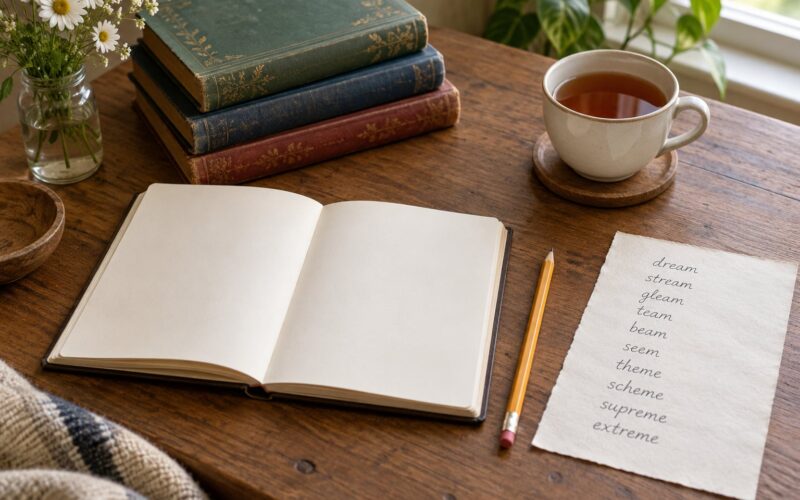
You need somewhere to write and about thirty uninterrupted minutes. That is genuinely all of it.
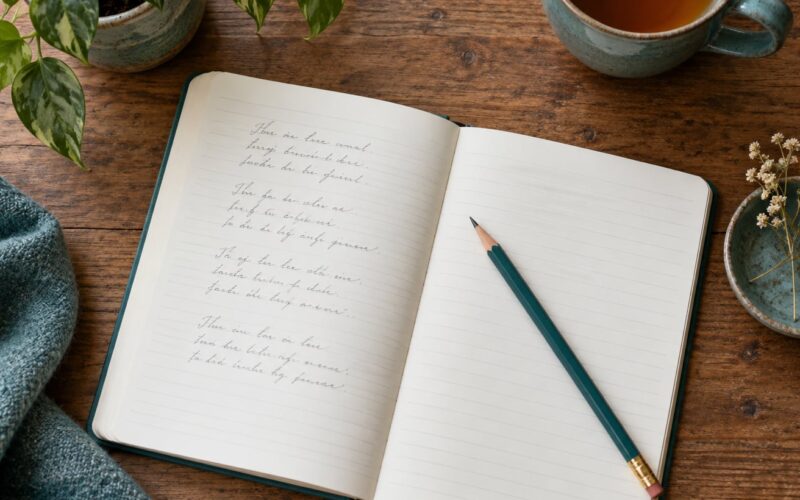
Paper works well for the first draft because handwriting slows you down, and the slowing down is the point. When your hand is slower than your editing brain, you get the honest version first. A notes app on your phone is fine too, especially if you are collecting details away from a desk. Many writers draft longhand and type the revision.
What you do not need is rhyme, meter, an outline, or a title in advance. What does help is attention. Free verse rewards three habits: looking closely at ordinary things, cutting words that do no work, and reading the draft out loud to hear where the poem stumbles.
One more thing worth having nearby is a notebook or a notes file you keep just for observations. Two weeks of noticing odd details gives you more material than an hour of staring at a blank screen.
How to Write Free Verse Poetry Step by Step
Free verse is defined less by the absence of structure than by the presence of deliberate choices. You choose the line lengths, the stanza breaks, the words that land at the ends of lines, and the silences between them. Once you see the steps as decisions rather than rules to obey, the form becomes much less frightening.
1. Find a Specific Subject or Feeling
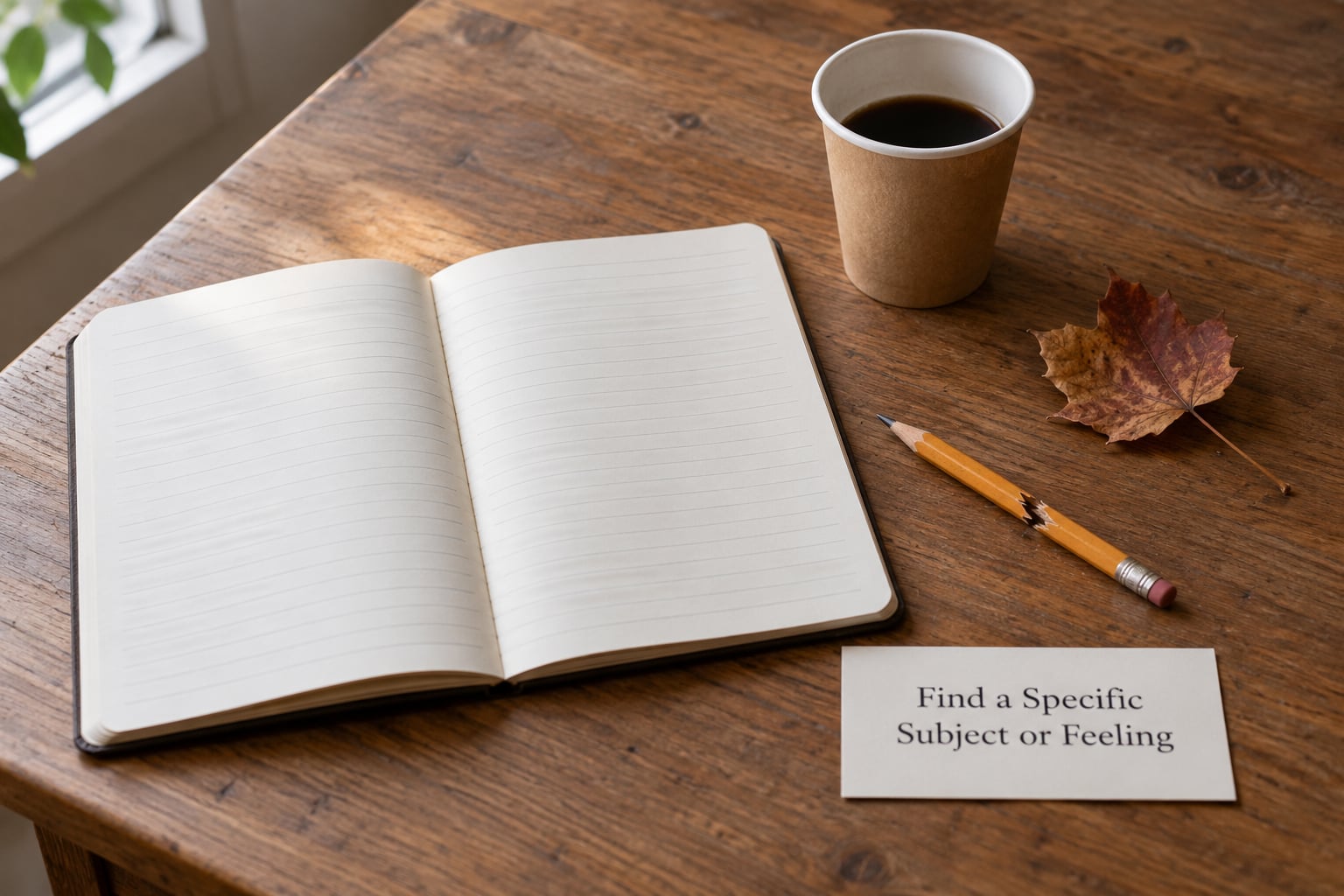
Start broad, then narrow until you can see it. Change is too big. Loneliness is too big. Missing my grandmother is closer, but it is still a theme rather than a thing.
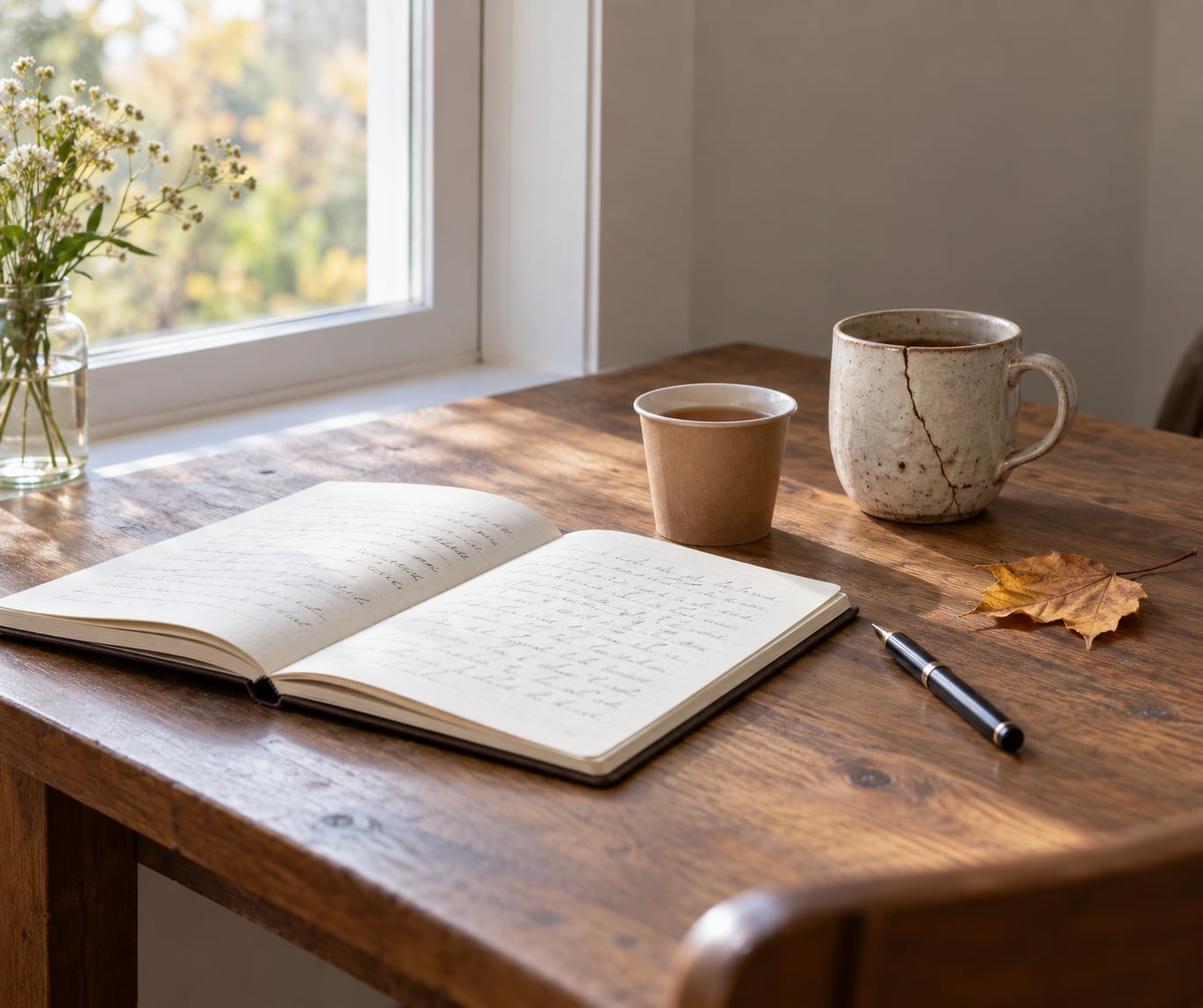
The version I would write is the mug she drank from, the one with the hairline crack she refused to throw out. Now I have a subject I can actually see. Specificity does the emotional work for you, which is one of the main reasons plain subjects make strong poems. A cracked mug carries more feeling than three paragraphs about grief, because the reader supplies the feeling.
Six prompts that reliably produce a workable subject: an object you have kept too long, a room you have not been in since childhood, a repeated gesture someone makes, a specific hour of a specific day, an object you threw away and thought about later, and a word you cannot spell but keep thinking about.
2. Collect Images, Sounds, and Details
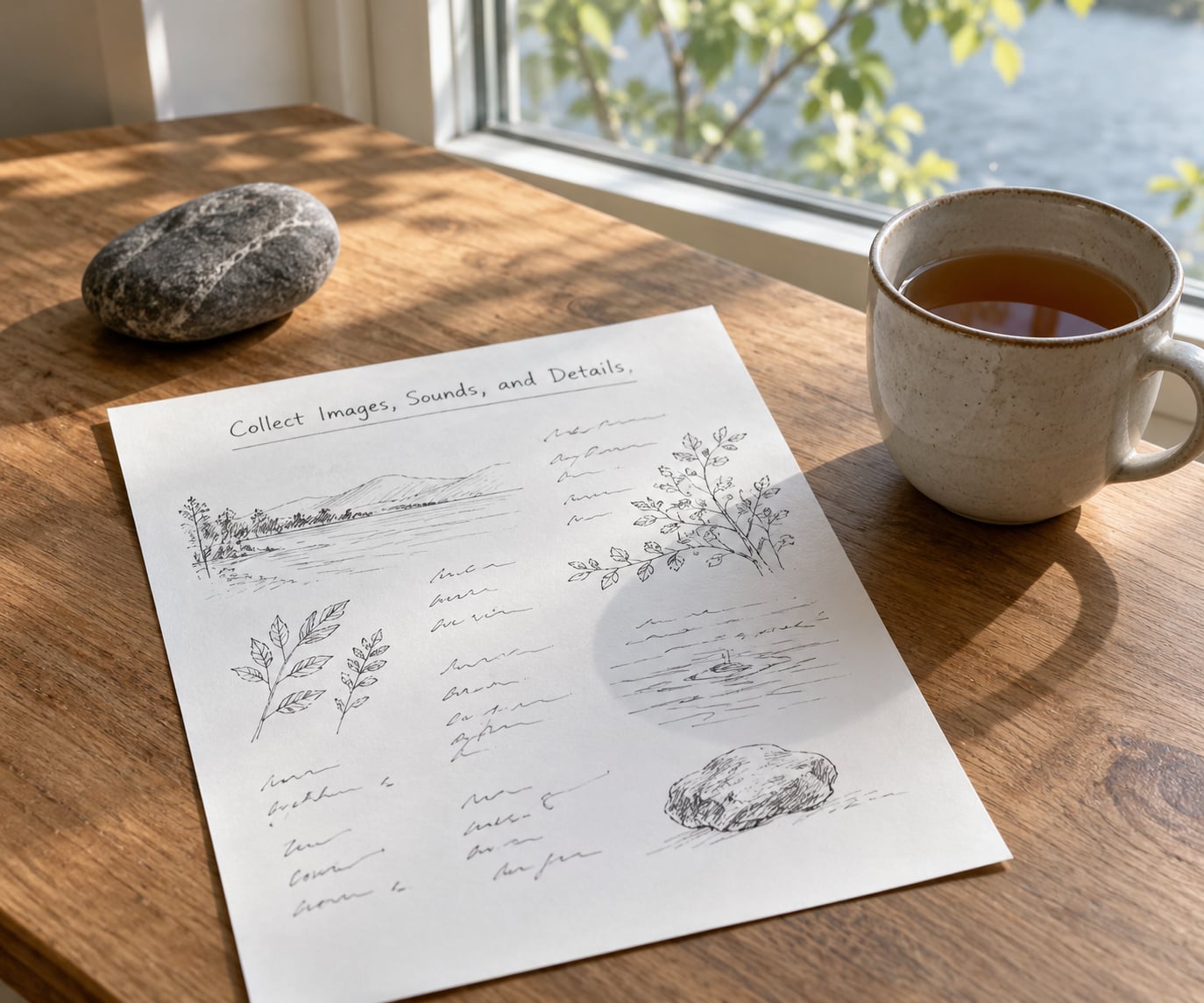
Freewrite for five to ten minutes without stopping and without deciding what any of it means. Write what you see, hear, smell, taste, and feel on your skin. Keep going even when the material gets boring, because the boring entries are often where the usable line is hiding.
For the cracked mug: cool ceramic against the lip, the smell of yesterday’s tea, the small clink it makes on the counter, the way the crack catches light, the weight of it in one hand. None of that has to end up in the poem. Most of it won’t. You are stocking a shelf, not writing.
Details beat adjectives. Instead of saying the kitchen felt lonely, write that the chair across the table stays pulled out. That single detail does the emotional work, and it lets the reader arrive at the feeling instead of being told about it.
The most-repeated advice in poetry writing communities is to read free verse poets while you gather material. Reading Elizabeth Bishop or William Carlos Williams trains your ear for the ordinary-detail-as-subject habit better than any prompt will.
3. Choose a Central Idea or Tension
Now look at your notes and find the thing that holds them together. It is usually not a statement but a tension: the mug is worthless and irreplaceable at the same time, or keeping it is loyalty while using it is a small betrayal.
A poem built on tension keeps moving, because each image pulls against the last one. A poem built only on a mood tends to repeat itself and then trail off. Ask yourself what question the poem keeps circling. If you can write that question in one sentence, you have your central idea.
Try writing that sentence before you write the poem. If the sentence feels like a description instead of a question, keep digging. Tension is usually a little uncomfortable, and that discomfort is a good sign.
4. Decide Whether to Use Line Breaks
This is the decision that changes a poem most, and the one beginners rush. A line break is a breath, a beat, and a unit of meaning. Where you break changes what the reader emphasises and how fast they move.
An end-stopped line finishes its thought, usually at a full stop or comma. It slows the reader down and lands the last word with weight. An enjambed line runs on into the next one, so the reader has to keep going to find out how the sentence resolves. Enjambment creates tension and momentum, which is why contemporary poets reach for it so often.
The same sentence can do very different things depending on where you break it. Take the plain sentence: she put the mug down and pushed it away from her. Break it as one line and it is a report. Break it after pushed and it away from her hangs. Break it so it ends on mug and the reader arrives at the object before the action, which puts the emphasis on the object instead of the gesture.
A few terms worth knowing, in plain English. Lineation is the whole pattern of where your lines begin and end. A caesura is a pause inside a line, usually marked with two dashes or a slash. A lacuna is a deliberate gap, a blank space or a missing beat that lets the reader supply something. Cadence is the rhythm your sentences make when read aloud. And in typesetting, a line break is simply the end of one typed line and the start of the next, unless you mark it with a slash.
The rule I would give you: every line should have a reason for ending where it does. If you cannot say what the break is doing, try a different position and listen to both versions.
5. Shape the Poem with Sound and Rhythm
Free verse has no fixed meter, but it is not silent. Sound is what keeps a poem from turning into a chopped-up paragraph.
Use repetition, alliteration, assonance and consonance to hold lines together, and vary line length to control the pace. Long lines carry you forward like current. Short ones stop you. Alternating them creates a pulse without counting a single syllable.
Also watch your line-end words. Lines that end on articles and prepositions, on the word and or the word of, feel like they are falling out of the poem rather than landing. Ending on a concrete noun or a strong verb gives the reader something to hold. Ending on an abstraction drains the energy out of the line.
Read two or three lines aloud. Your ear will find the sibilance or the heavy consonant cluster before your eye does, and it will tell you where the rhythm is dragging.
6. Write a First Draft Without Overthinking
Three rules for the unedited draft: do not edit, do not judge, and do not show it to anyone who is not a writer yet. That last rule is not vanity. Readers who do not write poems will tell you they liked it, which is useless information.
Write straight through the central tension you found in step three. Follow the image that wants the next line, and if a line feels confusing while you are drafting it, leave it alone and keep moving. Fixing mid-draft breaks the surprise that makes first drafts worth keeping.
You will write some bad lines. That is the point of a draft. The bad lines tell you what the poem is actually about, which is often not what you planned.
7. Revise for Meaning, Order, and Compression
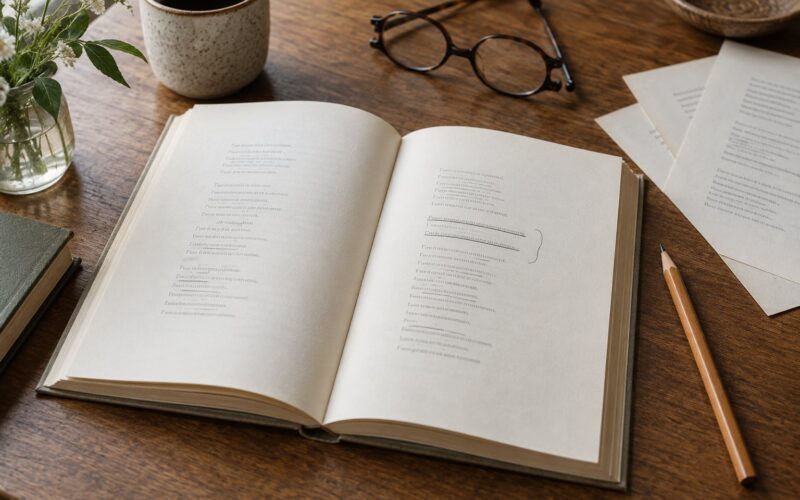
Run a seven-point self-edit on the draft. First, read it aloud and mark every place you ran out of breath or stumbled. Those marks are usually bad line breaks.
Second, cut 20 to 30 percent of the words. Writers report this as the single most reliable fix for a poem that sounds like prose. Look for filler phrases like in that moment or I began to realise, and for any line that explains what the previous line already showed.
Third, test every line break by moving it one position and comparing the two readings aloud.
Fourth, sharpen the images by replacing abstract nouns with concrete ones and weak verbs with strong ones. Fifth, check the order. Each stanza should move the central idea somewhere new, and if a stanza only restates the one before it, cut it.
Sixth, distinguish purposeful repetition from accidental repetition. If a word comes back and carries the same meaning both times, it is filler. If it comes back with a shifted meaning, keep it.
Seventh, read the whole poem once more. If the last line lands on a weak or abstract word, revise it.
A Worked Before-and-After Example
Here is a flat first draft, the kind almost everybody writes:
I miss my grandmother and I think about her a lot since she died. She had this mug that she used every day and it had a crack in it but she never threw it away. I kept it after she died and now I use it for tea.
It is honest and it is completely inert. Now the revised version:
cracked along the rim,
she would not put it down—
tea gone cold in it, most nights.
I still drink from it.
some mornings I catch myself
waiting for the small clink
of it on the counter, and looking up.
Notice what changed. The poem no longer explains grief. It hands the reader a cracked mug and a habitual sound, and the reader supplies the rest. Line breaks carry the rhythm: the long enjambed run in the second stanza breaks short on looking up, which stops the reader the way the memory stops.
Word count went from 52 to 47, but almost every word changed. The poem now ends on a verb instead of a noun, which leaves the emotion open rather than finished.
Common Mistakes
The first mistake is writing prose and slicing it into lines. This is the single most common beginner complaint in writing forums. If you can read your draft straight down as a paragraph, the line breaks are decoration. Fix it by reading it aloud and moving breaks until the reader has to slow down at least once.
The second mistake is forcing a rhyme scheme mid-draft. That is the moment a natural voice turns into a puzzle. If a rhyme keeps insisting, use it as an internal rhyme in a longer line rather than as an end word, or let it go entirely.
The third mistake is over-writing. Too many words, too much explanation, and lines that end on the words of or and. Fix: cut a quarter of the poem and read it again. If nothing breaks, you cut too little. If it falls apart, you can put some back.
The fourth mistake is mistaking short lines for good lines. Every stanza broken into three-word lines is not intensity, it is uniform choppiness. Vary the lengths. Let at least one line run long enough to make the reader lean in.
The fifth mistake is worrying that your poem is too simple. It is not. Plain language about a cracked mug is a legitimate poem, and the recurring fear that free verse does not count is the thing most worth putting down.
A few habits that help: keep a running notebook of observations, read one published free verse poem a week, and rewrite one old draft after a month away from it. Beginners improve fastest by making more poems badly before they polish a single one carefully.
Frequently Asked Questions
Does free verse poetry have any rules?
Free verse has no rules about meter, rhyme, length, or stanza structure. What it has instead are craft commitments: choose your line breaks deliberately, end lines on words that carry weight, use concrete detail, and cut anything that does no work. The form gives you freedom and asks you to supply all the structure yourself, which is why strong free verse feels deliberate rather than accidental.
What is a free verse poetry example?
One of the most quoted short examples is the opening of Walt Whitman’s Leaves of Grass, a long line with no rhyme and no fixed metre that builds through parallelism and repetition. For a compact example, William Carlos Williams’ The Red Wheelbarrow uses eight very short lines, plain nouns, and no metaphor at all. Read both and notice how different each one is from ordinary prose.
What is the structure of free verse poetry?
Free verse has no fixed structure imposed from outside, so its shape comes from four choices you make: how long each line runs, where lines end, where stanzas break, and how the white space is arranged. Short lines and frequent stanza breaks slow the reader down. Long enjambed lines and open spacing speed them up. That variable structure is the structure.
What is the hardest type of poetry to write?
Formal verse is often called the hardest because metre and rhyme leave no room for error. But free verse has its own difficulty: with nothing to hide behind, every line break and every word is exposed. Beginners struggle because a poem with no constraints can drift into being a paragraph with good words in it. Both forms fail differently.
How do I start writing free verse if I freeze on a blank page?
Do not start on a blank page. Start with an object and a set of details instead of a theme. Pick a mug, a key, a coat. Write five things you can see, three you can hear, and one you remember about it. Write for five minutes without stopping or editing. A specific subject removes the blank page problem entirely.
Conclusion
Free verse is a defined choice, not an absence of one: a small specific subject, honest sensory details, a tension to hold them together, deliberate line breaks, sound for rhythm, an unedited first draft, and a ruthless revision pass.
Start with one real moment and write what is actually in the room. Do not try to sound like a poet you admire, and do not judge the draft while you are making it.
Then read it out loud, cut about a quarter of the words, and move the line breaks until they do something. That is the whole method. It gets easier every time you run it.
Updated for 2026.