Proofreading means reading a finished draft closely enough to catch spelling, grammar, punctuation, and formatting errors before anyone else sees them. Most people who want to know how to proofread their own writing fail at the same point: they read too fast and their brain quietly fills in what they meant to say. The fix is a method, not more willpower.
Here is the short version. Set the draft aside, then return to it in five separate passes: structure and clarity first, then sentences and grammar, then a read-aloud pass, and finally a formatting check. Give each pass one job. That single change, more than any tool, is what makes self-editing work.
Table of Contents
- What You Need
- Step-by-Step: How to Proofread Your Own Writing
- Step 1: Take a Break and Reread the Draft
- Step 2: Check Structure, Clarity, and Organization
- Step 3: Proofread Sentences and Grammar
- Step 4: Read the Draft Aloud and Edit Word Choice
- Step 5: Check Formatting and Submit a Clean Copy
- Common Mistakes
- Frequently Asked Questions
- How long should it take to proofread an essay?
- Can spellcheck find all grammar mistakes?
- How can I proofread a paper written by someone else?
- Why do I miss obvious errors in my own writing?
- Should I use Grammarly or another proofreading tool?
- Conclusion
What You Need
You need four things, and none of them are expensive. The first is a saved draft you are not emotionally attached to yet. The second is the assignment guidelines, rubric, or style sheet, opened beside you rather than remembered.
Third, gather the reference materials your work is judged against: a dictionary, a handbook, the citation guide your course uses. Fourth, allow real time. Proofreading a 1,500-word paper properly takes 30 to 60 minutes, and a novel chapter takes far longer.
Tools help, but they do not do the work. Turn on spellcheck in whatever program you use. Most word processors also have a grammar and readability panel that costs nothing to open. If your course requires a particular citation style, keep the guide open in a second window rather than searching for it halfway through.
Change one thing about the setting too. Print the draft, switch to a different device, or change the font and size, because a familiar-looking page lets your eye skim straight past the mistake you are hunting for.
Step-by-Step: How to Proofread Your Own Writing
The five steps below run in a fixed order for a reason. Broad problems hide sentence-level problems, so you settle meaning first and polish last. Skipping ahead to comma fixes on a draft whose argument is a mess wastes the pass.
Step 1: Take a Break and Reread the Draft
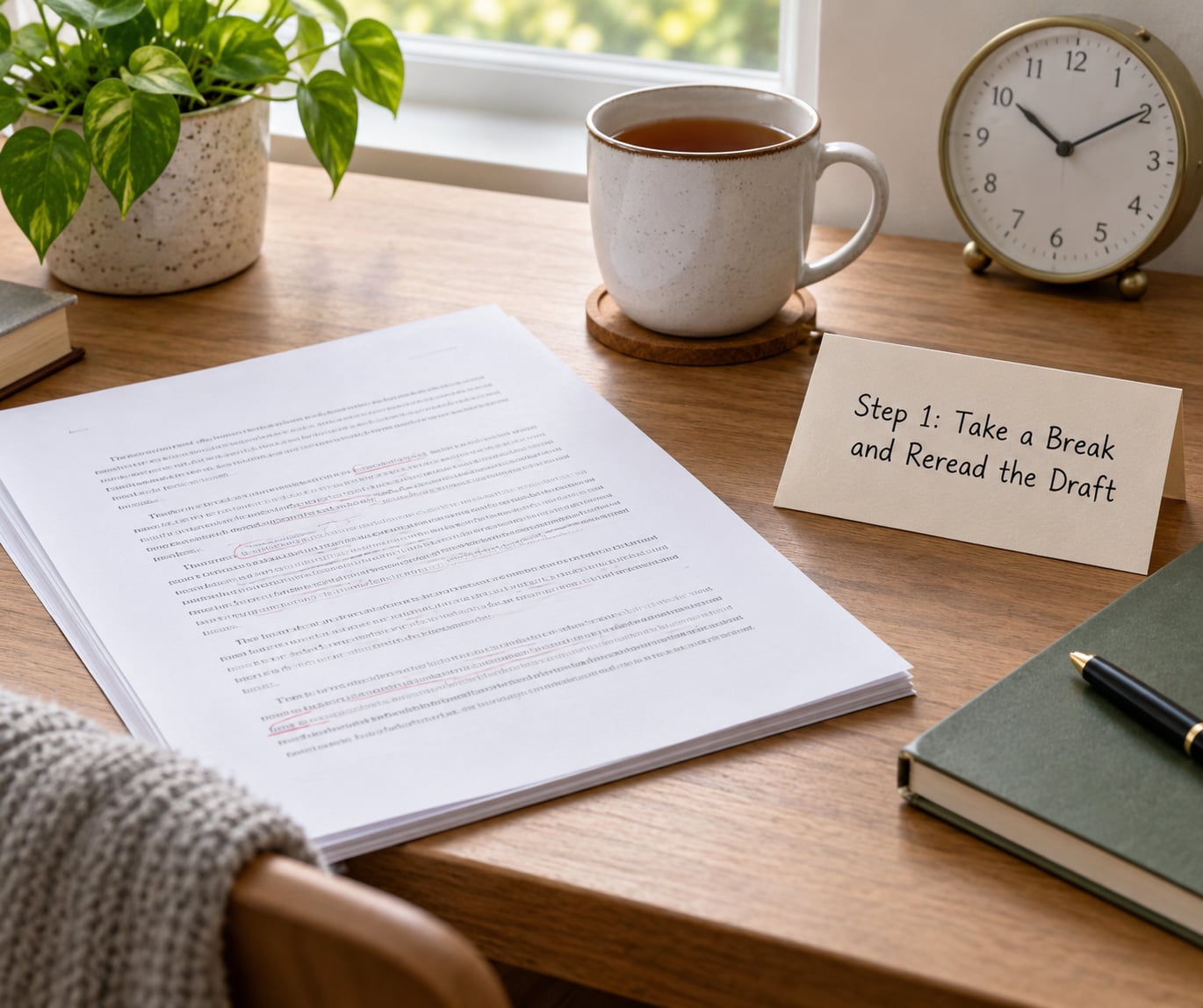
Walking away is the single most effective move, and it costs nothing. Writers who reread immediately catch almost nothing, because the sentences are still sounding in their ears. An overnight gap works for most pieces; a few hours is enough for a short email.
When you come back, do not fix errors yet. Read the draft against the assignment’s stated purpose and requirements, and ask three questions: does it do what was asked, does each paragraph earn its place, and would you recognise the topic from the first two sentences alone?
If a paragraph fails those tests, cut or move it now. Polishing a paragraph you are about to delete is the most common way people waste an evening.
Step 2: Check Structure, Clarity, and Organization
This is the editing stage, not proofreading. You are looking at argument and meaning rather than commas, and the goal is to fix problems you cannot see while you are focused on individual sentences.
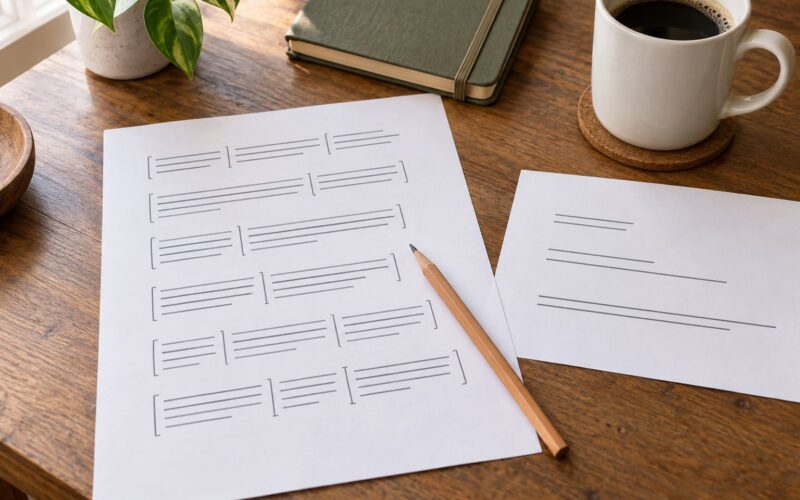
Work through the skeleton. Find your thesis and check that every paragraph connects to it. Write a reverse outline: one line per paragraph saying what that paragraph actually argues. Where two lines say the same thing, you have repetition; where the order jumps, you need a transition or a move.
Check the openings and closings too. A weak introduction and a conclusion that introduces a new point are the two failures readers notice first, and both are structural rather than grammatical.
Clarity problems usually show up as sentences that need three readings. Break them at the point where the subject changes, replace abstract nouns with plain ones, and cut every word that is not carrying weight.
Step 3: Proofread Sentences and Grammar
Now go after one error type at a time. Mixing grammar, spelling, and punctuation in a single pass splits your attention, and you catch far less of each. Work sentence by sentence, one full sweep per issue.
A practical pass order: sentence boundaries first, then subject-verb agreement, then tense, then modifiers, then punctuation. Boundaries first because a comma splice or a run-on hides every other problem inside it.
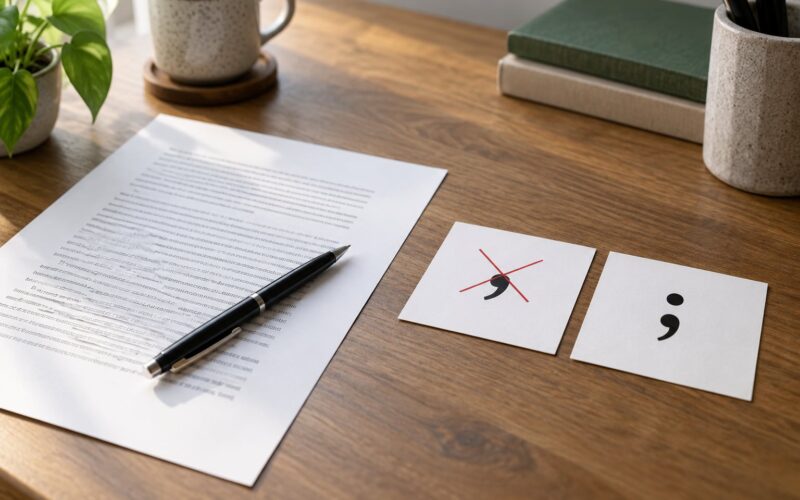
- Sentence boundaries. Two independent clauses joined by only a comma is a comma splice; join them with a semicolon, a coordinating conjunction, or a full stop.
- Agreement. The verb matches its subject in number, and a pronoun matches the noun it replaces in number and gender where it matters.
- Tense. Stay in one tense unless the shift is deliberate. The most common error is a stray past tense in an otherwise present-tense section.
- Modifiers. A modifier must attach to the noun it describes. “Walking to class, the umbrella was forgotten” leaves the reader guessing who is walking.
- Punctuation. Check commas after introductory clauses, quotation marks, and the apostrophes in its, you’re, and they’re. Those homophone errors survive spellcheck because every version is a real word.
Two habits speed this up. Put one sentence per line so your eye stops skipping, and use your finger or a pen to track across each line so the eye cannot race ahead of the attention. Reading backwards also works well here: start at the last sentence of the last paragraph and work toward the beginning, which prevents your brain from filling in what it expects to read.
Run one search before you finish the pass. Look for doubled words, which typing produces constantly and the eye filters out, and for double spaces left behind by editing.
Step 4: Read the Draft Aloud and Edit Word Choice
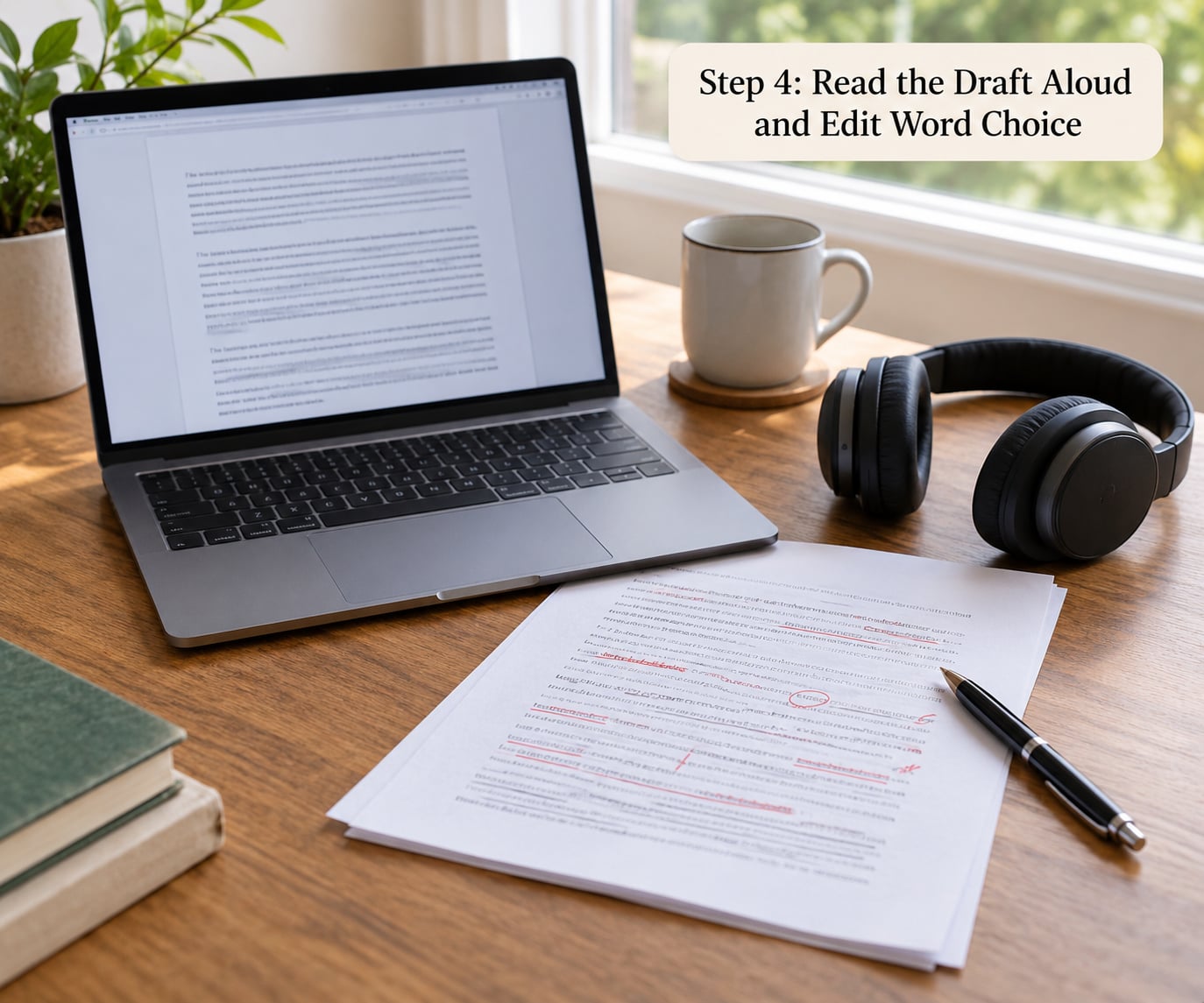
Your ear catches what your eye skips. Long sentences that look fine on screen sound like a car wreck when spoken, which is why reading aloud is the most recommended technique on writing pages and the one students skip first.
Read at a normal pace, out loud, and stop wherever you stumble, run out of breath, or run out of meaning. Every stumble is a real problem, and readers will hit it too. If you run out of breath before the end of a sentence, it is too long. If you cannot say it without repeating a word twice, it is badly shaped.
While you are reading, also listen for repeated words, filler, and thesaurus-inflated vocabulary. Long nouns stacked in a row hide simple verbs: “made a decision” is clearer than “conducted a decision-making process.”
If reading aloud is not practical, use text-to-speech. Most phones and desktops will read a document back, and hearing your own prose in a flat synthetic voice exposes weak pacing and missing words almost as well.
Step 5: Check Formatting and Submit a Clean Copy
The last pass is mechanical, and it is where marks are actually lost. Confirm the required margins, font, font size, line spacing, and page numbering, then check that headings, citations, and the reference list follow the style your teacher or editor asked for.
Check capitalisation at the start of sentences, proper nouns, and the spelling of names and titles you have mentioned more than once. Then run a search for double spaces, doubled words, and stray brackets, which the eye will not catch but a grader will.
Finally, confirm the file you are about to submit: the right document, the right name, no tracked changes left visible, no comments, and no notes-to-self pasted into the header. Export a PDF and read the PDF, since that is often what gets marked.
Common Mistakes
Proofreading too soon. The fix is a break, and it applies to emails as much as to dissertations. Thirty minutes away beats an hour of immediate rereading.
Changing everything at once. When a single pass tries to catch grammar, spelling, punctuation, and style, you catch roughly a quarter of what four separate passes would find.
Trusting spellcheck completely. It flags real words typed wrong, which is exactly why its, your, and there slip through. It also cannot tell whether you meant a word at all.
Leaving the rubric on the desk. Marking each requirement as you go takes two minutes and catches more lost points than any grammar fix.
Not verifying the final file. Submitting the wrong version, or one with tracked changes still showing, is common enough to be boring and it costs real marks.
Over-editing. Some drafts get weaker the more you revise them. If a paragraph reads clearly and supports your point, leave it alone and move on.
Two smaller habits are worth building. Keep a personal error log, a short list of the mistakes you make most often, and check it at the start of every proofread; it gets shorter over time because you are catching those errors faster. And when a piece matters enough that a wrong name or date would be genuinely costly, send it to one other reader, because some errors simply cannot be self-detected.
Frequently Asked Questions
How long should it take to proofread an essay?
For a 1,500-word essay, allow 30 to 60 minutes spread over at least two sittings. Ten minutes of quiet review per page is a reasonable rule of thumb. Short emails need five minutes at most, while a chapter of fiction can take a full afternoon because you are checking pacing and consistency as well as grammar.
Can spellcheck find all grammar mistakes?
No. Spellcheck only catches words that are not in its dictionary, so it misses every error made with a real word, including its and it’s, your and you’re, and there, their, and they’re. It also has no idea whether your argument works. A spellchecker is the floor of proofreading, not the whole job.
How can I proofread a paper written by someone else?
Read it twice for different purposes. The first pass is for meaning: does the argument hold together, is evidence used well, and does each paragraph earn its place. The second pass is mechanical: grammar, punctuation, spelling, citations, and formatting. Editing someone else’s work is much easier because you have no memory of what you intended.
Why do I miss obvious errors in my own writing?
Because you read what you meant to write, not what is on the page. Familiarity makes your brain predict each sentence and fill in missing words, wrong verbs, and punctuation automatically, so attention never lands on the error. Distance, reading aloud, reading backwards, and checking one error type per pass all break that prediction habit.
Should I use Grammarly or another proofreading tool?
Use it as a second reader, never as an authority. Paid tools are good at catching repeated words, passive voice, and basic agreement errors, and they are known for flagging correct sentences as awkward. Accept no change automatically: read the original, read the suggestion, and keep your own wording whenever it is doing the job.
Conclusion
Knowing how to proofread your own writing comes down to one habit: never do everything in one pass. Set the draft aside, check structure against the requirements, work through grammar one error type at a time, read it aloud, and finish with a mechanical formatting and file check.
Start tonight with the break, and keep a short list of the mistakes you make most often. After a few weeks of that, your proofreading will get faster than any tool can make it.