Writing a first poem takes about forty minutes. Pick one specific moment, turn it into a few concrete images, and put those images in lines. That is the whole machinery you need on day one, and if you have never tried it before, this is how to write a poem for beginners without stalling in front of a blank page. Rhyme and meter are optional extras rather than entry fees.
The hard part is never the writing. It is the twenty minutes before you start, spent waiting for a feeling to show up on schedule. This guide replaces that wait with a fixed process, and it includes a worked rewrite so you can see what actually changes between a flat line and a live one.
Table of Contents
- What You Need
- Step-by-Step: How to Write a Poem for Beginners
- Step 1: Choose a Small, Specific Focus
- Step 2: Pick Words That Bring Back the Moment
- Step 3: Draft Images Instead of Explaining
- Step 4: Build Around a Central Line
- Step 5: Add Sound Only Where It Helps
- Step 6: Read the Poem Aloud
- Step 7: Revise, Title, and Share
- Common Mistakes
- Frequently Asked Questions
- How do I write a poem for beginners if I feel blocked?
- Do beginners need to use rhyme or a fixed poem form?
- How long should a beginner’s first poem be?
- What is the easiest poetry form for a complete beginner?
- Is it normal for a first poem to need several revisions?
- How do I know when my poem is finished?
- Conclusion
What You Need
Four things, and three of them cost nothing.
- A blank page. Paper or a document both work. Paper has one small advantage: there is no backspace key, so the bad lines stay, and you will want them later.
- A pen or a keyboard. Whatever will not distract you. Some people write standing up, which also solves the sitting-down problem.
- Ten quiet minutes. Long enough to get past the first awkward minute, short enough that you will actually start.
- One concrete thing to look at. An object, a place, a memory, a person, or a sound you can hear right now.
Only the last one is a real requirement, and it is the one people skip. A poem is much easier to build from something you can see or hear than from an emotion you have been asked to summarize. “I am lonely” gives your hands nothing to do. The sound of a neighbour’s television through the wall at 2 a.m. gives you a poem.
Free verse needs no rhyme scheme, no syllable count and no rule about line length. If you would rather have a frame that tells you how many lines to write and when to stop, use one of these four. Every one of them has a beginner who can finish it in a single sitting.
| Form | Lines | Rhyme needed? | Meter | Why a beginner can finish it |
|---|---|---|---|---|
| Free verse | No fixed count | No | No | Nothing to get wrong. You stop when the thought stops. |
| Quatrain | 4 | Optional | No | Four lines is a small, finishable target, and any scheme works. |
| Haiku | 3 | No | Loose, often 3-5-3 syllables | The syllable count makes the cutting decisions for you. |
| Limerick | 5 | Yes, AABBA | Longer, bouncy lines | The bouncing rhyme walks you through the structure line by line. |
The sonnet is deliberately missing from that table. Fourteen lines of iambic pentameter is a good project for month two, not a first attempt.
Step-by-Step: How to Write a Poem for Beginners
Step 1: Choose a Small, Specific Focus
Beginners rarely get stuck because they lack ideas. They get stuck because their idea is a topic rather than a scene. “Love” is a topic. “The drive home after I said the thing I had been rehearsing for a year” is a scene, and it can be written.
Shrink the subject until it fits in one sitting. If you want to write about grief, try not grief in general but the twenty minutes after you hang up the phone. If you want to write about your grandmother, try her kitchen at six in the morning rather than her whole life.
A useful test: can you picture the moment? If you cannot, the focus is still too wide. When you have found yours, write three lines that begin with the same small phrase, such as “The morning my father” or “Everyone at the party”, and see which one produces a detail you did not plan.
You have the right focus when the first five lines arrive without effort. That is the check, not whether the subject feels important.
Step 2: Pick Words That Bring Back the Moment
Set a timer for ten minutes and write continuously about the focus from Step 1. No stopping, no deleting, no punctuation if it slows you down. Keep going past the point where it feels silly, because the useful material usually arrives about two minutes after that.
Alongside the freewriting, make a second list: every noun, sound, smell, texture and action the memory brings back. Do not judge the list. Include the kitchen tap going drip, drip, flour on a forearm, the specific word your uncle always used for the weather.
This is the step that answers “I have no ideas”. A memory that feels thin on the surface is usually rich underneath, and the only way to find out is to write fast enough that the editor in your head has no time to object. If you are working through how to write a poem for beginners from a book, this is the habit that book is really about.
You have enough material when your list has at least ten concrete entries and at least one sound.
Step 3: Draft Images Instead of Explaining
Now arrange some of that material into lines, and name the feeling by showing it rather than stating it. Concrete nouns, active verbs and sensory language do the work that “I was sad” cannot. Here is the same moment handled two ways.
| Weak line | Why it fails | Stronger line | What changed |
|---|---|---|---|
| I was heartbroken when she left. | Names the feeling instead of showing it | Her hair tie is still on the radiator / I keep moving it back to the middle. | An object and an action replace the label |
| He looked angry. | “Angry” is a label, not a picture | He pushed the door with his shoulder and did not look at me. | A verb with a body in it |
| I love my grandmother’s kitchen. | A warm fact with no sensory detail | Six a.m., the kettle before the light / flour on her forearm, the tap going drip, drip. | Time of day, temperature, sound |
The second version of each line is not better because it is fancier. It is better because the reader now has something to see, and the feeling arrives on its own. If you can touch it, hear it, or smell it, it belongs. If you cannot, it is probably an abstraction looking for an image.
Your draft passes this step when a friend could guess roughly what happened from the images alone, without being told.
Step 4: Build Around a Central Line
Nearly every good first poem has one line that holds the rest up. Find it, or write it deliberately, and let it be the one you protect while everything else gets trimmed. Here is a rough draft and the same material after the central line was identified and the rest rearranged around it.
Before
My dad has been gone for two years now.
It is strange without him here.
The house is different and quiet.
I think about him a lot.
I wish he could see me now.
I miss him and I remember.
Time moves on but I do not.
Anyway, things go on.
After
The porch light stays on and nobody is home.
His chair leans toward the arm that used to hold a mug.
I still buy two of everything, then eat both.
The porch light stays on and nobody is home.
The second version repeats one line and drops six. The repetition does the emotional work that seven sentences of explanation were failing at, and the last line landing as a repeat gives the poem a shape rather than a stop.
Line breaks are the cheapest tool you have. Ending a line early, with a full stop in the sense of a completed thought, slows the reader down. Running the sentence over the break, which has a name worth learning now, pushes them forward before they are ready. Move one break at a time and hear what each version does.
You have a structure when the poem can be read in order without a single line that could be lifted out and dropped in a different poem.
Step 5: Add Sound Only Where It Helps
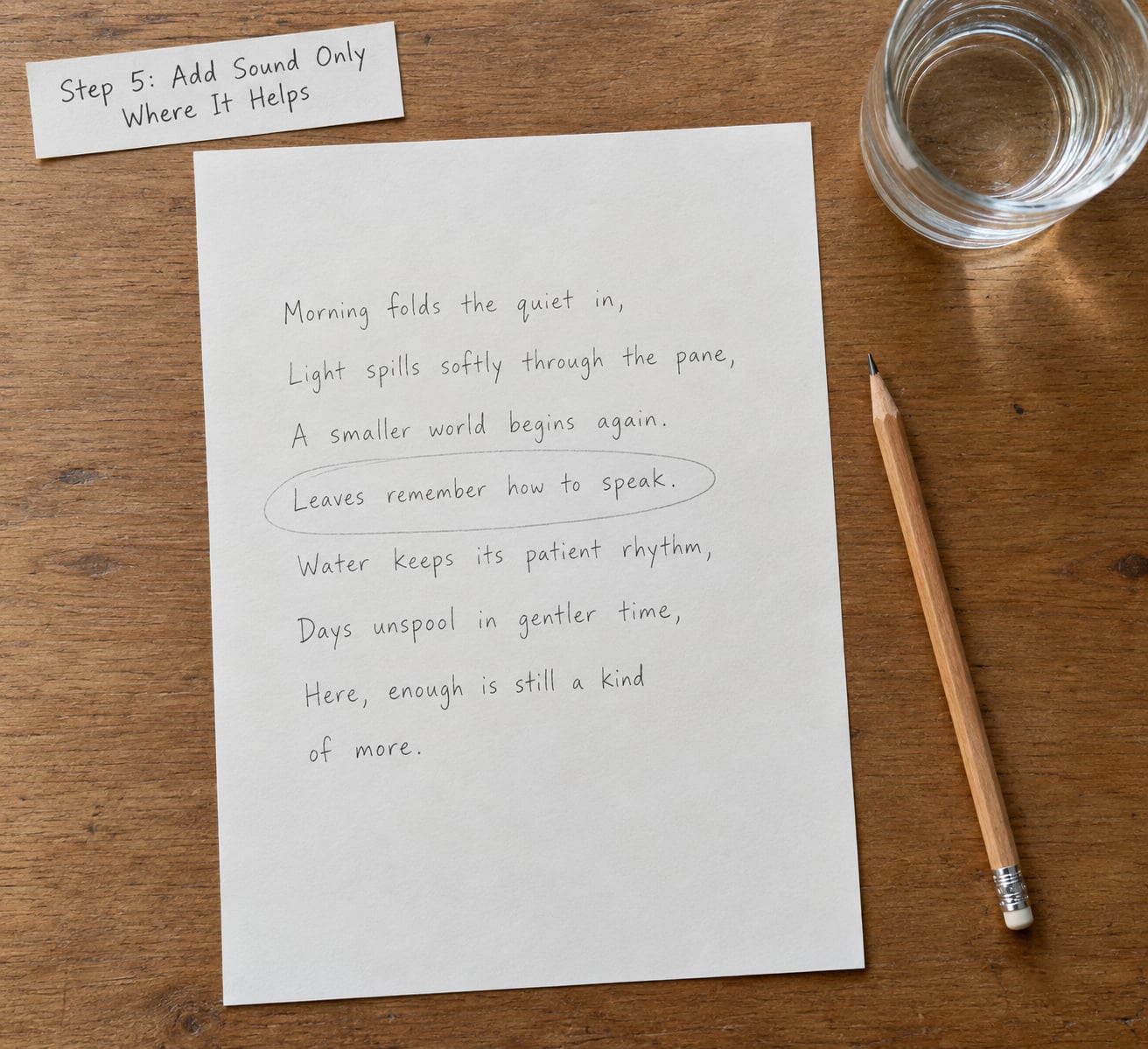
Sound is the part beginners get told about and then never use. Five things are worth knowing, and all five are simple.
Repetition gives a poem a pulse. Alliteration stacks the same consonant sound at the start of nearby words. Assonance repeats vowel sounds. Consonance repeats consonant sounds anywhere in the line. Rhyme is matching word endings.
Rhyme is the one most beginners reach for first and regret soonest, because it drags good phrasing into bad phrasing. A quatrain survives an imperfect rhyme far better than a free-verse poem survives a forced one.
If you rhyme, choose your rhymes second and let the first draft stay unrhymed, then come back to it in revision.
Use sound where it strengthens the meaning, not where it fills a gap. Here is a plain line and a revised one, both at ten syllables:
She moved out and the mailbox stayed
She moved out; the mailbox stayed.
The second version adds nothing but a semicolon and one stressed beat, and the sentence closes with a small turn instead of trailing off. That is what sound is for.
The check: read the line aloud. If it makes your mouth do something, the sound is doing work. If you have to explain why a line sounds good, it does not.
Step 6: Read the Poem Aloud
Read the whole poem out loud, at normal volume, standing up if it helps. This is the single highest-value habit in beginner poetry writing, because your ear catches things your eye scrolls past.
Listen for five things. Stumbles, where your mouth gets stuck on a word order, mean the line needs rearranging, and long pauses you did not intend mean the line break landed in the wrong place.
Rising inflection at the end of a line usually signals a weak verb. Lines you cannot say in one breath are usually two lines. Any line that produces no sound in you is a line that probably should go.
Breath is the practical guide. A line that is too long to say in one comfortable breath will usually be too long to read, however good it looks on the page. Split it at the natural pause, or cut the words before the pause.
You are close when the poem sounds like a person speaking rather than a person reciting.
Step 7: Revise, Title, and Share
Revision is a separate job from writing, so do it on a different pass. Put the draft away for a few hours or overnight, then print it or copy it out by hand, because rewriting by hand slows you down enough to expose weak words. The copying is not busywork; it is the reason you catch them.
Work in this order. Cut filler first, since every removed word is a gain: very, really, just, that, and the line “I began to”.
Then replace weak verbs with accurate ones, since “was” and “went” are the two most overused verbs in amateur poetry. Reorder lines and move breaks until the poem moves at the pace of the memory, and add one sound effect if the poem feels flat. Only then fix punctuation and spelling.
Preserve your voice through all of this. If revision turns your plain sentences into costume language, you have revised too far. The test is whether the finished poem sounds like something you would actually say out loud.
Give it a title last, and resist naming it after the feeling. Titles like “Sadness” and “My Heart” tell the reader what to feel before they have read anything. “Second Cup, Still Warm” or “What the Chair Kept” do more work in four words.
Then decide about sharing, which is its own decision. Some people read one trusted person and stop there, and some keep the poem in a notebook for years.
Some read it aloud, which is where a written poem becomes a performed one, and that is a different skill with different nerves. If you do share it more widely, decide first who should not read it, and send it to a person who will describe what they felt rather than judge your technique.
You are finished when you have read it aloud twice, changed nothing on the second read, and can say what the poem is about in a sentence. That sentence does not need to be profound.
Common Mistakes
Almost every beginner problem below is the same problem wearing a different hat: doing to a poem what a rule says instead of what the feeling wants.
Starting with an abstract statement. “Love is a beautiful thing” gives the reader nothing to picture. Open on the smallest thing in the scene, a mug, a radiator, a doorway, and let the feeling arrive from it.
Forcing every line to rhyme. Rhyming first makes you choose the word instead of the true word, and the result reads like a nursery rhyme with a grudge. Draft unrhymed, then add rhyme only if the lines survive the addition.
Explaining the image you just wrote. If the first stanza shows a garden after rain, the second stanza should not explain that the speaker feels renewed. Trust the reader, and delete the second stanza.
Copying a poet’s voice. Wearing another writer’s diction, archaic words included, produces a costume rather than a voice. Read widely for pleasure and instruction, then write in the only voice you actually have.
Punctuation that changes meaning. A comma can turn a flat list into an unexpected ending, and a semicolon can stop a line dead. Use the full stop and the comma confidently, and use the semicolon only where a real pause belongs.
Stopping at the first draft. The first draft is the raw material, not the poem. Almost no working poet has ever produced something finished on the first pass, and the ones who claim otherwise are selling something.
So set up a habit instead. Forty minutes on Sunday, one poem, any form, kept in the same notebook whether it was good or not. Twenty of those is more useful than a year of waiting to feel inspired, because the skill that improves is the one the schedule forces you to practise.
And expect the first three to be bad. Not bad as in unimportant, bad as in unfinished. Every poet you admire has a drawer of those, and the only difference between their early drafts and yours is that they kept going long enough to revise them.
Frequently Asked Questions
How do I write a poem for beginners if I feel blocked?
Blocked usually means you are starting from an idea instead of an image. Pick one object, sound or moment you can actually picture, set a ten-minute timer, and write whatever arrives without deleting anything. Freewriting for ten minutes straight defeats most blank-page panic, because the goal is words on the page, not good words. If ten minutes is too long, try two. The block lifts when the first line exists, not before.
Do beginners need to use rhyme or a fixed poem form?
No, and you are in good company. Most contemporary poetry is free verse, which has no rhyme scheme, no syllable count and no rule about line length. Fixed forms like quatrains and haikus are useful training wheels because they give you an ending, and limericks teach you rhythm, but neither is a requirement. Draft first without constraints, then choose a form in revision if you want one.
How long should a beginner’s first poem be?
Ten to twenty lines, or a single quatrain, is the right size. Long enough to have a beginning, a turn and an end, short enough that you can finish it in one sitting and feel that you did something. A poem does not need to be long to be complete. If your first attempt runs long, cutting the weakest third almost always improves it, and the cut lines are useful practice for the next draft.
What is the easiest poetry form for a complete beginner?
Free verse, because it has no rules to break, followed closely by the quatrain, which is simply four lines and gives you a clear finish line. A haiku is easy too, since the loose three-five-three syllable count makes the editing decisions for you. Limericks are more work because the AABBA rhyme forces you to pick words early. Avoid the sonnet for now; it is a second-month project.
Is it normal for a first poem to need several revisions?
Yes, and it is not a sign that you cannot do this. Most first drafts are a list of raw material rather than a poem, and the work of revision is finding the one line that holds the rest together, cutting the lines that only explain, and moving the breaks so the pace is right. Put the draft aside for a few hours before you start. Beginners often judge hardest right after writing, and that judgement is usually wrong.
How do I know when my poem is finished?
A useful beginner test: read the poem aloud twice, change nothing on the second read, and be able to say what it is about in one plain sentence. If you can do that, it is finished, even if you are not thrilled with it. Perfection is not the finish line, and poems do not improve by endless tinkering. Finish it, date it, put it in a notebook, and start the next one while the lessons are still fresh.
Conclusion
Choose one specific moment, write ten minutes without editing anything, then build the poem from the strongest image you find. Cut what only explains, move the line breaks until the pace feels right, read it aloud, and give it a title that names a thing rather than a feeling.
That is the whole process, and it is repeatable. The next poem is easier than the first one, and the twentieth is easier than the tenth.
Start with the ten minutes today rather than waiting for a feeling to arrive on a better day.