Poem analysis is the practice of taking a poem apart into its pieces — speaker, language, imagery, devices, structure — and then explaining how those pieces combine to produce meaning. Learning how to analyze a poem for the first time takes less than most people expect: the whole job fits into six passes over one poem. Give yourself forty minutes and a pen. No literary theory degree required.
One sentence first, because this is where most beginners get stuck: analysis explains how the poem works, while summary only restates what it says. If your paragraph could describe the poem to someone who never read it, you are summarizing. If it explains why the poet chose those words and that rhythm over others, you are analyzing.
The six passes below are sequenced deliberately. You start with what the poem literally presents, move to how it sounds, then to how its language is built, then to how it is shaped, and only at the end do you commit to a claim. Beginners who jump straight to theme end up arguing about a poem they have not actually read.
Table of Contents
What You Need
Less than you would guess. You need the poem itself and somewhere to write. That is the honest list.
- The poem, in full. Not an excerpt. Half a poem gives you half an argument, and you will spend your time guessing what came before.
- A pen and a blank page — or a text document with a notes column. Paper works better for your first attempt because underlining forces slower reading.
- A dictionary or a reader’s guide. You will hit one or two words you do not know in every poem. Looking them up is not cheating; skipping them without a note is.
- One or two facts of context, at most. Who wrote it, roughly when, and what was happening in their life or the world. That is enough for a first analysis.
On context, here is the honest limit most guides get wrong: biography is seasoning, not the meal. A paragraph of poet history that never touches a single image in the poem is padding, and it tells your reader you looked everything up except the text.
Students also ask whether they need to read other poetry first. You do not. Pick a short poem, twenty lines or fewer, and work through the passes. You build the skill by doing one poem properly, not by reading ten badly.
How to Analyze a Poem for the First Time: Step by Step
Work through these in order. Each pass gives you one action, one question to ask, and one sign that it worked.
Step 1: Read It Once Without Judging It
Read it straight through, once, without a pen. Do not decide whether you like it, do not look words up mid-read, and definitely do not try to solve it. You are collecting a first impression, which is data.
Then ask yourself four plain questions: Who is speaking? What is the subject? Where does it happen, if anywhere? What is happening on the surface?
You know this pass worked when you can describe the situation in one sentence without quoting the poem. “A speaker watches a procession pass and lets it go” is a reading. “This poem is about a carriage” is not.
Step 2: Read for Sound, Rhythm, and Emotional Effect
Now read it aloud, twice, at normal volume. Sound is the pass most beginners skip and the one that pays off fastest.
Listen for repetition, for places where the rhythm stumbles or pauses, for stressed syllables, for lines that are noticeably longer than the ones around them, and for any moment the voice changes register.
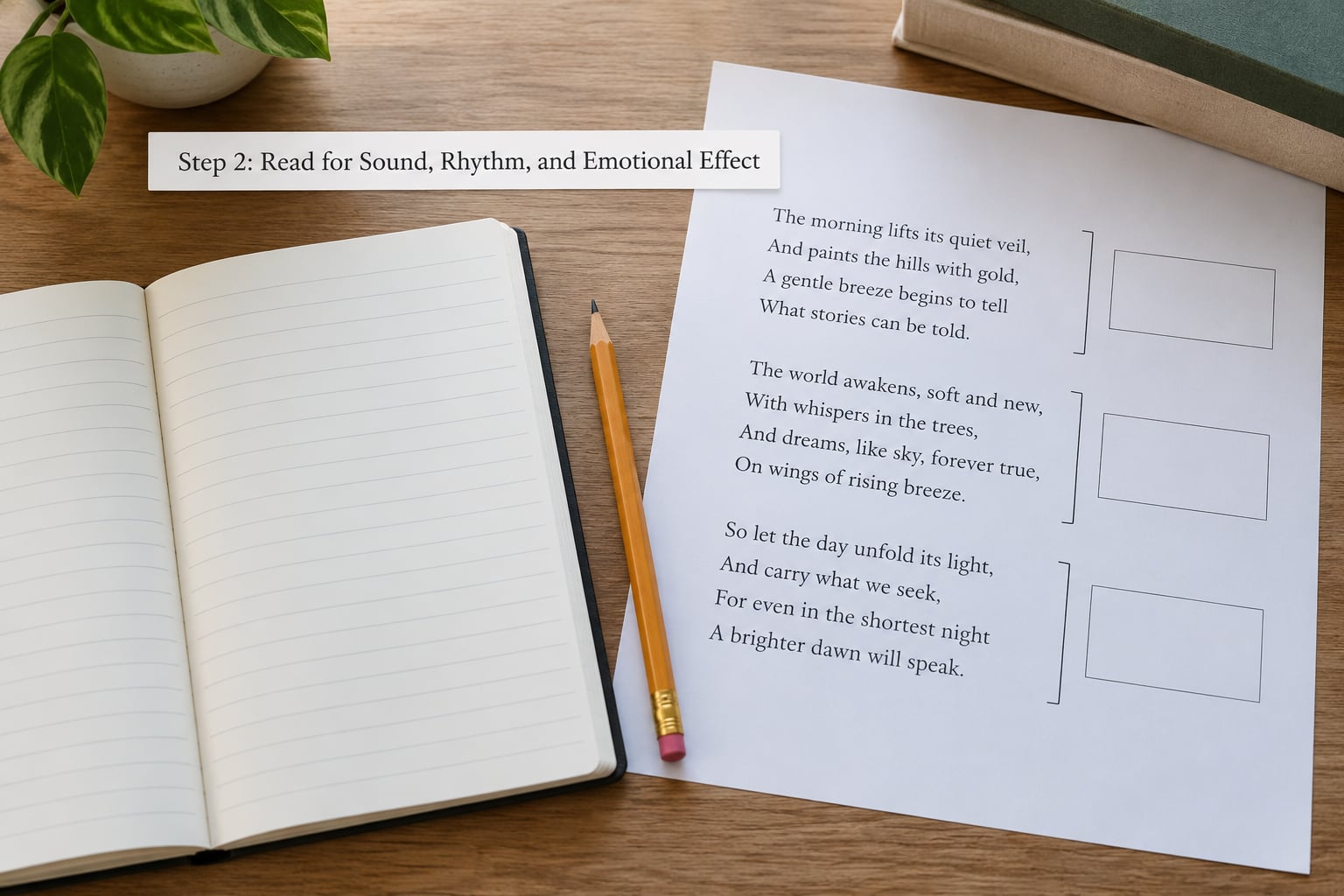
A hard line break before a word delays that word, and the delay makes it land harder. Repetition of a single word builds insistence. Long short-lines make a reader feel hurried; long slow ones make them feel heavy.
The test: read the poem aloud and note anywhere your own voice changed without you deciding to. Each of those spots is a place where the poet is shaping your feeling directly, before you reach meaning at all. That is your sign the pass worked.
Step 3: Annotate the Literal Details
Now go back through with a pen and mark the concrete things the poem actually gives you: images, actions, objects, gestures, conflicts. Underline the one image that struck you hardest and circle anything you cannot place.
Stay literal. If a line says someone stands in a doorway in the rain, write doorway, rain, standing. Do not write loneliness yet. You are describing the furniture of the poem before you decide what the room is for.
Finish this pass with a line-by-line paraphrase in your own words. This sounds tedious and it is the single most useful thing you will do, because it is the only reliable way to find out you misread something. When you paraphrase a line and the paraphrase makes no sense, the confusion is usually in the line — or in your assumption about who is speaking.
The sign this pass worked: you can summarize the poem’s action accurately and are now curious rather than lost.
Step 4: Investigate Diction and Imagery
Diction is word choice, and it is where meaning is won or lost. Look for two kinds of word: the unusually precise one (“sycamore” instead of “tree”) and the emotionally loaded one (“crawling,” “barely,” “still”). Both are choices the poet made over quieter alternatives.
Rank your images. Which single image carries the most weight? Write it at the top of your page. In a short poem it will usually be one that recurs, or one that appears at the turn.
The table below covers the twelve devices beginners actually need. Anything beyond this is a bonus, not a requirement.
| Device | What it means in plain English | What to look for | What it does |
|---|---|---|---|
| Simile | Comparison using like or as | “as still as” | Creates a familiar anchor for something unfamiliar |
| Metaphor | Comparison without like or as | One thing stated as another | Makes the abstract physically real |
| Personification | Giving human traits to a non-human thing | “the wind complained” | Turns background into character, usually threat or comfort |
| Imagery | Language that appeals to the senses | Colour, texture, sound, smell | Builds the poem’s world in the reader’s body |
| Symbol | A thing standing for something beyond itself | The same object recurring | Carries meaning the poem never states |
| Alliteration | Repeated starting consonant sounds | “soft silt” | Links words, slows the mouth, soothes or sharpens |
| Assonance | Repeated vowel sounds | “rain again” | Drags the line’s vowels together, often dreamily |
| Consonance | Repeated consonant sounds anywhere in the line | “blank and think” | Binds the line together internally |
| Onomatopoeia | Words that sound like their noise | “buzz,” “clatter” | Puts the reader inside the scene |
| Repetition | A word or line used again | Any deliberate echo | Insists, builds rhythm, or circles a thought |
| Enjambment | A sentence running past the line break | No punctuation at the break | Pushes the reader forward, creates momentum or surprise |
| Juxtaposition | Two things placed side by side | Unrelated images next to each other | Lets the reader draw the connection, which sticks harder |
One word or image often supports more than one reasonable reading, and that is not a failure of your analysis. It is the poem doing its job. Say both readings and say why you favor one.
Step 5: Map the Poem’s Structure and Devices
Now look at the shape. How many stanzas? How long are the lines? Does the poem rhyme, roughly or exactly? Where do the enjambments fall? How does the final line differ from the first?
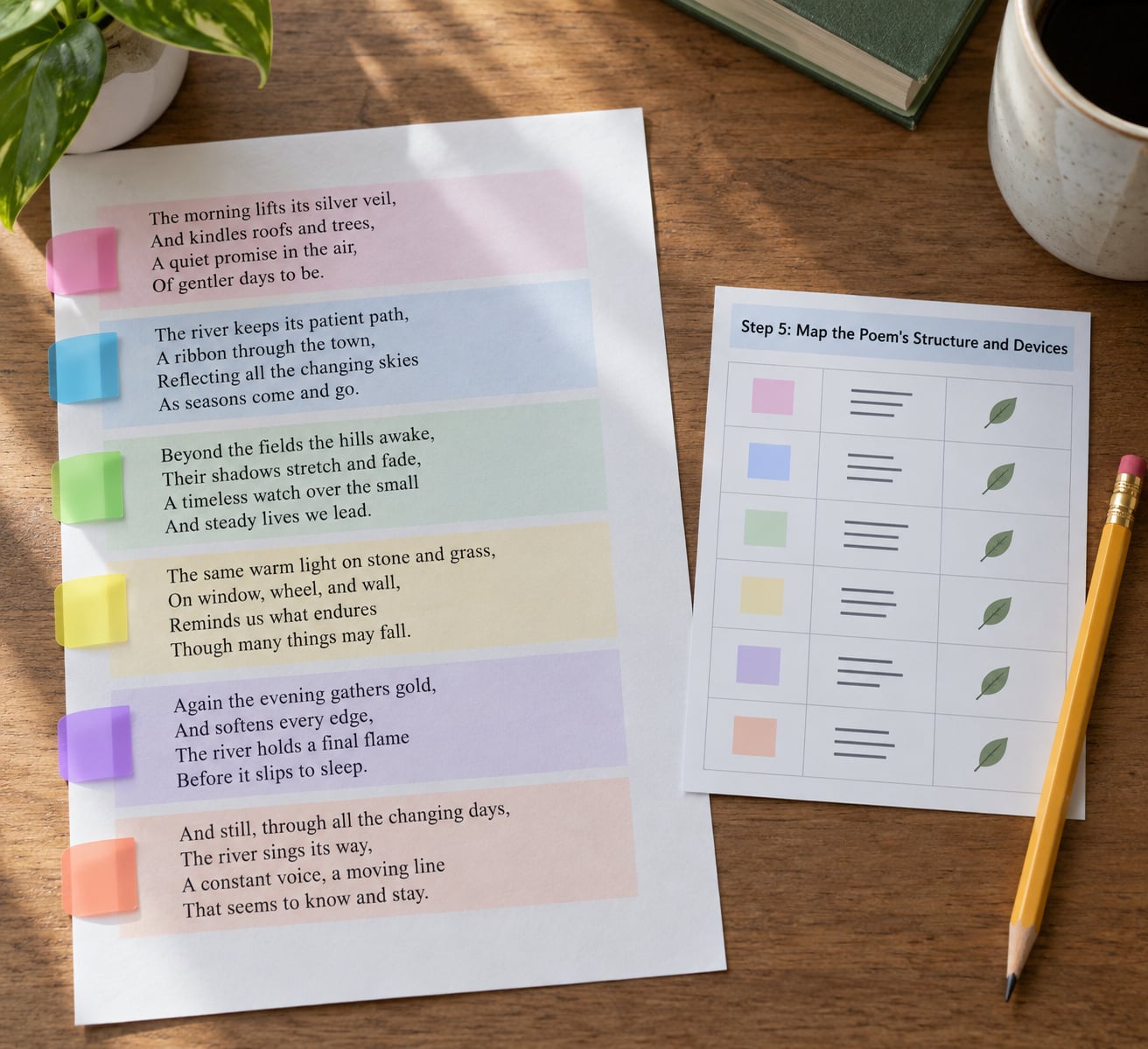
Map where the devices cluster. If nearly every line carries a figure of speech, that density is itself worth writing about — it means the poet is asking you to feel rather than to reason. If the device sits alone in an otherwise plain stanza, it is doing the emphasis work.
Here is the warning most classes never give you clearly enough: do not label a device without explaining its effect. “Line 4 contains a simile” is inventory. “Line 4 compares grief to something that ‘hangs,’ so the feeling gets weight and cannot be moved” is analysis. If you cannot say what the device does, leave it out.
The sign this pass worked: you can describe the poem’s architecture in three sentences and point to where its meaning shifts.
Step 6: Develop and Support an Interpretation
Now you have everything the poem gave you, which means the hard part of how to analyze a poem for the first time is behind you. Time to make a claim — one sentence about what the poem is doing, not what it is about.
“The poem is about death” is a topic. “The poem argues that refusing to grieve is a way of staying in control of how a life ends” is an interpretation. The second one can be wrong and still be worth reading.
Support it with at least two pieces of evidence, and explain each connection rather than quoting it and moving on. A workable paragraph skeleton:
In lines [x], the poet uses [device] to [effect]. Combined with [second observation from the structure or sound], this suggests [your claim]. The effect is [what that does to the reader].
One worked example, since seeing a real poem taken apart is worth more than any instruction. Take Emily Dickinson’s opening lines of “Because I could not stop for Death”:
Because I could not stop for Death –
He kindly stopped for me –
The Carriage held but just Ourselves –
And Immortality.
The speaker says she could not stop for Death, which puts her in the position of the pursued rather than the chooser, and the poem is about that loss of control. Then the grammar shifts in line two: Death is now the one doing the stopping, and he is “kindly.” One adverb turns a terror into a gentleman caller, and the unease moves into how politely he is being awful. Line three narrows the carriage to “just Ourselves,” excluding the audience entirely, so the reader is sealed into the scene with two people rather than three. Line four then closes with “And Immortality,” a word too large for the four-line frame it lands in, and it arrives as a companion rather than a destination — the dash before it reads almost like a shrug.
That is an analysis: a claim about control, two pieces of evidence, and an explanation of how each one works. Five sentences, and the poem has been genuinely taken apart.
Common Mistakes and How to Fix Them
Hunting for one correct answer. There isn’t one, and the search for it stops you reading. Fix: treat your interpretation as the most defensible reading you can build, not as a key with a hidden answer.
Collecting devices instead of using them. Listing every simile, every bit of alliteration, is a list, not an argument. Fix: keep the two devices that carry the most weight and explain each one.
Paraphrasing as analysis. Restating the poem in your own words is the summary trap. Fix: after any paraphrase sentence, add a sentence beginning “This matters because…”
Skipping sound and form. Rhythm, line length and stanza shape are meaning, not decoration. Fix: give your second pass real time. If you never read aloud, you are working half blind.
Quotations that do not support the claim. If you cannot finish the sentence “this line shows that my point is…”, pick a different line. Fix: choose evidence after you have written the claim, never before.
Biography bloat. Two facts about the poet’s life are enough. Fix: cut every sentence that does not mention something visible in the poem.
What if the poem seems to have no clear theme? Some of the most studied poems do not state one. That anxiety comes up constantly with beginners, and the honest answer is that a poem can be about a feeling, a tension, or an experience rather than a message. Frost’s “The Road Not Taken” is not really about a fork in a path; it is about how people tell themselves a story afterward. Let the poem stay unresolved if that is what it does, and analyze the effect of that uncertainty.
A few practical habits worth keeping: read the title again only after you have finished the poem, since a title that seemed plain often turns out to be ironic. Copy the poem into your notes so you can rearrange lines and see what the form is doing. And keep a running list of words you looked up, because half of them will turn out to matter.
Frequently Asked Questions
What should I do first when analyzing a poem?
Read the poem once, straight through, with no pen and no dictionary. While it is still fresh, jot down who is speaking, what the subject is, and what happens on the surface. That unfiltered first impression is your baseline, and every later pass is measured against it. Trying to understand the poem in that first read is the one thing to avoid, because the meaning has not surfaced yet and your guesses will get in the way.
How do you analyze a poem without summarizing it?
Never stop at restating. Every time you describe what happens, follow it with a sentence explaining why it was written that way. Instead of the speaker watches a carriage go by, write that the poet puts the speaker in the passenger seat to show how little choice she has. The difference is one sentence of mechanism on top of your summary, and once you are doing that reliably, you are analyzing.
How many literary devices should I identify?
Fewer than you think. In a twenty-line poem, two or three devices that genuinely shape the meaning beat a dozen listed without explanation. Name a device only when you can say what its effect is and quote the line it appears in. If a figure of speech does not change how you read the line or feel about it, leave it out and keep the poem clean.
How do you find the theme of a poem?
Look for the tension rather than the subject. Ask what the poem keeps circling, what stands in opposition to what, and what changes between the first and last lines. Theme is a full sentence about an insight, not a single word, and it should be something you could argue with. If you cannot find one, that is a valid finding too, and analyzing why the poem resists a theme is a legitimate interpretation.
How long should a poem analysis be?
Match the length to the poem and the task. A single short poem in class usually wants 300 to 500 words or roughly one page. An essay comparing several poems runs longer, because each poem needs only the evidence that matters. The useful rule is one paragraph per major movement in your argument, so if your analysis feels padded, the argument is probably thinner than the page.
If you only do one thing today, pick a twenty-line poem, read it out loud twice, and write down what happens before you decide what it means. The feeling you get on that first read is not a distraction from the analysis — it is the first piece of evidence in it. Come back with a claim, and keep two lines that support it.