Here is how to speed read without losing comprehension: you remove the mechanical waste in how your eyes and inner voice handle text — sounding out every word, drifting back to re-read phrases you already passed, and staring at one word at a time. That gain comes from reading more cleanly, not from skipping content, so your comprehension stays flat or improves while your pace climbs. Expect roughly 1.3x to 2x your baseline, not the 3x claims in most ads.
The distinction matters more than any trick. Speed from removing waste is free, because every word still gets processed. Speed from skipping is expensive, because you are trading understanding for pages finished. This guide is entirely about the first kind, and it costs nothing: a book, a finger, a timer, and about twenty minutes a day.
Table of Contents
What You Need
Five things, and only five things. None of them require money or software.
- A representative text. Something you genuinely need to read, at normal difficulty. A chapter of a textbook, a paper, a report. Practice on something too easy and your numbers will flatter you.
- A quiet setting and a distraction-free surface. Phone in another room. This matters more than any technique in the list.
- A timer for your phone, or a kitchen timer. You need it for the baseline test and for pacing.
- A pointer — your finger, a pen, a ruler. This is what keeps your eyes moving forward.
- Somewhere to write one sentence. Index card, notebook margin, the notes app. You cannot check comprehension without writing something down.
If you have those five, you have everything the system asks for.
Step-by-Step: How to Speed Read Without Losing Comprehension
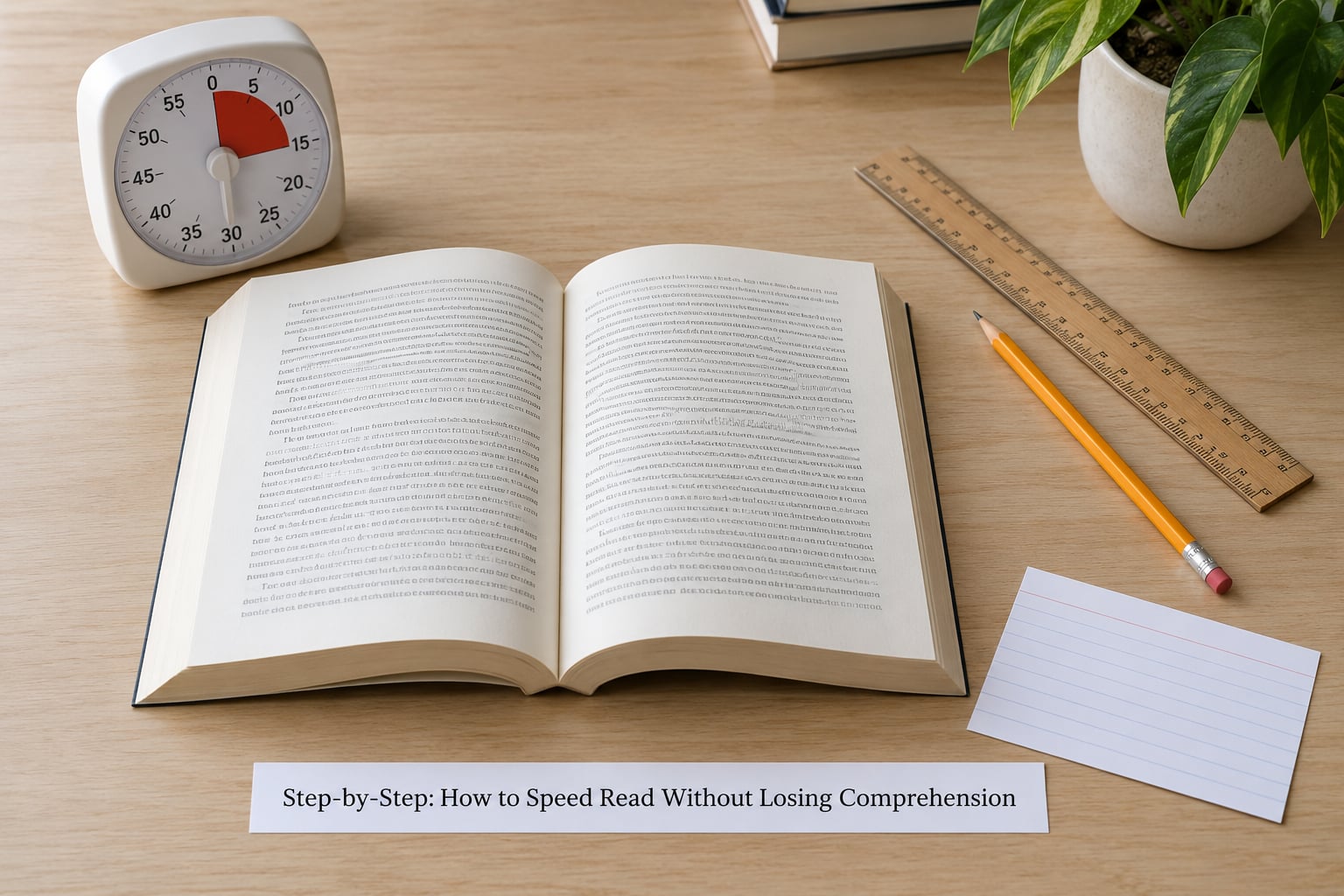
Six steps, in order, repeated across sessions. The first two slow you down on purpose, because a speed you cannot measure is a speed you cannot improve.
1. Establish Your Baseline Reading Speed
Pick a passage of 500 to 1000 words from the middle of a real text. Read it once at your normal pace and time it. Words divided by minutes gives your baseline in words per minute.
A 600-word passage finished in two and a half minutes is 240 WPM. That sits right in the range Brysbaert’s 2019 large-scale study found for average adult silent reading, roughly 200 to 260 WPM. If your number lands near 200, nothing is wrong with you. That is simply where most people start.
Then write one sentence about what the passage said. This is your comprehension baseline, and it is the half of the measurement people skip. Without it, faster and blank feel identical from the inside.
2. Preview the Text’s Structure
Previewing is the cheapest speed gain available and it costs nothing. Spend two minutes on it and the body of the text gets easier before you start.
Read the headings and subheadings. Read the first paragraph of each section and the last one. Look at captions, bold lines, boxed definitions, and anything set apart. Ask one question before you begin: what am I looking for here?
You are not reading the text twice. You are building a map, so your attention has somewhere to land when the body arrives. Readers who preview routinely report the same thing: fewer re-reads, because they expected the argument before it showed up.
3. Practice Purposeful Scanning
Scanning is reading with the eyes moving in deliberate sweeps instead of hopping word to word. Your eyes already work this way — they jump in saccades, and they gather no new visual information during the jump itself. Each stop, or fixation, lasts roughly 200 to 250 milliseconds.
Most slow reading is not slow because the eyes need more time per word. It is slow because there are a lot of very small fixations plus the ones you spend going backwards. Widening each fixation and cutting the backwards ones does more work than any other change you will make.
Run your pointer along the line just under the text and let your eyes stay one or two words ahead of it. Then, deliberately, take in three or four words at a time instead of one. Let “in spite of the” arrive as a single shape rather than four separate arrivals.
Here is what different approaches usually produce. Your own numbers will vary, and the comprehension column matters far more than the speed column.
- Untrained reading, one word at a time: 150 to 200 WPM. Comfortable, slow, plenty of backtracking.
- Paced reading, chunked, subvocalization reduced: 300 to 500 WPM. Comprehension stays high on familiar material. This is where the method lives.
- Heavy skimming of anything, including difficult material: 600 to 1000 WPM. You are sampling, not reading. Fine for triage, useless for arguments you need to defend later.
- RSVP, flashing one word at a time on screen: 300 to 700 WPM. Fast, and comprehension on dense text often drops. More on that below.
Quick sanity check on pages: 70 pages an hour of standard fiction works out to around 300 to 350 WPM. Twenty pages in forty minutes lands near 225 to 250 WPM, which is a normal, unhurried pace and not a sign of a problem.
4. Read With a Realistic Pacing Target
Pick a target about 20 percent above your baseline. Not double. Set it before you start and hold to it for a session. Anyone learning how to speed read without losing comprehension begins here, because an unmeasured target is only a guess.
Slow down deliberately for material that carries load: definitions, arguments with a chain of reasoning, math, anything you would have to defend in an exam. Speeding up is for connective tissue, not for the argument itself.
Match your pace to the material:
- Skimming for structure: 500 to 700 WPM is reasonable. You are looking for the shape of the argument, not the details.
- Easy narrative fiction: 350 to 500 WPM once the technique settles in.
- Non-fiction and reports you need to remember: 250 to 350 WPM.
- Textbooks and academic papers: 200 to 300 WPM. Slower than your narrative pace, and that is the point. Dense material is where the gains from removing waste show up most and skipping does the most damage.
- Poetry and close reading: your normal pace. See below on why.
5. Pause for Selective Comprehension Checks
Every few pages, stop. Close the book or turn the page over. Write one sentence: what just happened, and why did it matter?
That single sentence is the whole comprehension test. It is fast enough that you will actually do it, and it is brutal enough that you cannot fake it. If the sentence takes more than a few seconds to write, you did not understand the section, no matter how fast you moved through it.
Two habits make this easier. Margin notes: mark a single word or symbol where an idea begins, rather than highlighting whole passages. And a running question: decide what you want to be able to answer about the chapter, then read to find it.
For study material specifically, this connects to what evidence-based study practice already recommends. Close the book, write what you remember, then check. Retrieval practice beats re-reading every time, and it is the natural companion to faster reading rather than a rival to it.
6. Test How to Speed Read Without Losing Comprehension
After a week, repeat the baseline test. Same kind of passage, same timer, same one-sentence recall.
Work out the gain. 240 WPM to 300 WPM is a 25 percent improvement, which is a solid month of honest work. Then check the sentence: if you could write a specific, useful sentence and answer a question about detail you did not write down, the speed held comprehension. If you simply read faster and nothing is retrievable, the speed came from skipping and it was a bad trade.
Then raise the target by another 20 percent and repeat. That is the entire loop, and it is how to speed read without losing comprehension over months rather than in one overconfident afternoon.
Common Mistakes
Rushing every text equally. Applying one pace to everything is how people end up fast on fiction and lost on a paper. Match the pace to the material instead.
Skipping the difficult sections. The instinct to blow past hard paragraphs feels like progress and is usually the opposite. Slow down where the argument is, speed up through the connective tissue.
Measuring speed without comprehension. A timer alone will always flatter you. If you are not writing a sentence afterward, you have no data, only a feeling.
Reading in conditions that break concentration. A phone face down on the desk, music with lyrics, a tired evening. Many people blame their reading habits for what is really an attention problem.
Raising speed too fast. Jumping from 240 to 600 WPM in a week produces the famous reading torpor: you turn a page, hit a passage three times, and get nothing. Back off, hold the lower rate, rebuild.
Buying a course first. Rayner and colleagues’ 2016 review of speed reading evidence was sharply negative about programs promising dramatic gains, and readers in study forums tend to report the same. The techniques here need nothing but practice.
Tips for Building Speed Safely
Practice on easier material first. Build the mechanics on a book you find effortless, then move to the hard stuff.
Separate your reading purposes. Reading to enjoy, reading to decide whether to keep reading, and reading to be able to discuss an argument later are three different jobs. They deserve three different paces.
Do short daily sessions instead of one long weekend push. Twenty minutes most days beats two hours on Sunday, and the skill is motor as much as mental.
Take real breaks. Reading fatigue shows up as slowing down and drifting back. Standing up resets it faster than trying harder.
Know when not to do this. Poetry, rhetoric, dense mathematical proofs, and any text you are analyzing line by line belong at your normal pace. Speed reading a poem is reading past it. If a piece is worth slowing down for, that is not a failure of the method; it is the method working.
On ADHD and reading speed. People often ask whether slow reading with poor comprehension is an ADHD trait. It can be one of several reasons a reader struggles, but it is also common in readers with dyslexia, vision problems, or a text that is simply hard. If comprehension is the real problem, techniques that assume good comprehension transfer will disappoint. Getting the underlying issue assessed matters more than any pacing trick.
A note on RSVP apps, since they come up constantly: flashing words one at a time removes the very eye movements that carry comprehension, which is why readers complain in practice that they strip meaning out of serious text. They can work for light material and as a training tool. They are a poor substitute for reading anything you intend to think about.
Frequently Asked Questions
What is a good reading speed with high comprehension?
For most adults reading familiar material, 250 to 350 words per minute with steady recall is a strong place to sit. Beyond roughly 500 WPM, gains usually start coming from skipping rather than cleaner reading, and recall drops. The number matters far less than whether you can summarize what you read a few minutes later.
How many words per minute can an average person read?
Large-scale silent-reading research puts average adult reading at roughly 200 to 260 words per minute, which matches what most people measure at home with a timer. That is silent reading. Speaking aloud or muttering the words drops it to roughly 150 to 200, which is why cutting subvocalization alone often produces a noticeable jump.
Does speed reading work for dense academic texts?
Yes, with conditions. The techniques that matter for dense work are previewing the structure, cutting backtracking, and slowing down inside the argument itself. Those raise pace without cutting content. What does not work is pushing a fixed high rate through a journal article; comprehension falls off long before the pages get finished.
Should I use a speed-reading app or do it by hand?
Do it by hand to start. Chunking, a pointer, reduced backtracking, and a written recall sentence are the whole method, and all four work with a book and a pen. Apps that flash single words train eye movements away from the sweeping fixations comprehension depends on, so they are a poor primary tool for serious reading.
How can I stop rereading every sentence?
Use a pointer to keep your eyes moving forward, and treat a re-read as a signal rather than an automatic response. Most backtracking happens because the reader anticipates not understanding, so previewing the section first reduces the urge. When you do need to go back, mark the spot and reread once after the section ends instead of three times mid-sentence.
Conclusion
Start with one timed session: a representative passage, a stopwatch, and one written sentence about what you read. That single measurement is where the method begins, and most people find their real baseline is lower than they assumed and their comprehension higher than they feared.
Then raise the pace by twenty percent a week and keep the recall sentence every time. If you learn how to speed read without losing comprehension, that sentence will keep coming easily; if it starts costing you something, you have pushed too far and the answer is to slow down, not to try harder.