You find your writing voice by collecting evidence of how you already write when nobody is watching, then making deliberate choices about which of those habits to keep. Most writers spend months guessing at it. A few hours of honest analysis, some freewriting, and reading your drafts out loud gets you further than any amount of staring at a blank page wondering who you sound like.
Give this a week of short sessions rather than one long afternoon. The early steps feel dull because they are inventory work, and the payoff shows up in the last two.
Table of Contents
- What You Need
- Step-by-Step: How to Find Your Voice as a Writer
- Analyze Your Natural Writing Habits
- Define the Voice You Want to Create
- Collect Possibilities Through Freewriting
- Make Deliberate Choices About Language
- Read Your Draft Aloud
- Test and Refine Your Voice
- Common Mistakes
- Frequently Asked Questions
- How long does it take to find your writing voice?
- Can everyone find their writing voice?
- Is finding your voice the same as developing a style?
- Why do my stories all sound the same, and how do I fix it?
- Does my writing voice change depending on the genre I am writing in?
- How do I stop sounding like the author I just read?
- Conclusion
What You Need
Four things, and none of them cost anything.
An old writing sample. Two or three pieces you wrote without an audience watching. Old emails to friends, a class essay, a blog post from three years ago, journal entries. What matters is that nobody was grading them.
A notebook or a document. Paper slows you down in a way that helps some writers and hurts others. Either works. Pick one and use it for every exercise in this guide so you can compare like with like.
One quiet writing period a day. Twenty minutes, same time, phone in another room. Voice comes from accumulated output, not from a single inspired session.
A way to capture drafts. Scans, photos, voice memos, a folder with dates in the name. If you cannot look back at what you wrote six weeks ago, you have no record of your own patterns.
Step-by-Step: How to Find Your Voice as a Writer
Analyze Your Natural Writing Habits
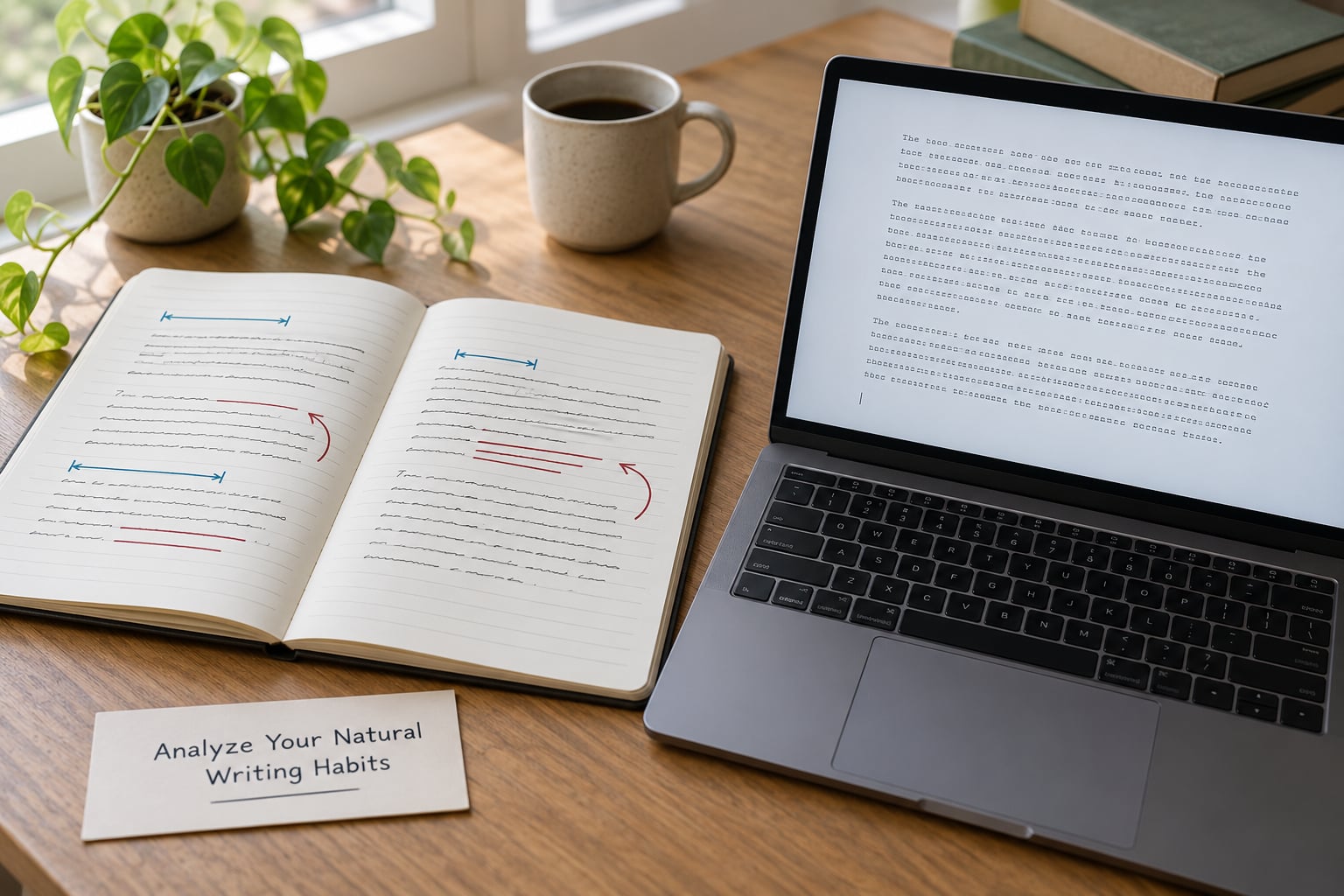
Pull out one old sample and read it as a stranger would. Mark the short sentences, the long ones, the places where you break a sentence in half with a dash, and the words you reach for repeatedly.
You are looking for five things: typical sentence length, vocabulary level, pacing, tone, and recurring verbal tics. Count roughly rather than precisely. If twenty of your sentences run under twelve words, you write short. If your sentences average around twenty-five and lean on clauses, you write long.
Mark the moments where the writing sounds like you talking and the moments where it sounds like you performing. Those two registers live in most drafts, and the gap between them is usually where your real voice is hiding.
Do this for two or three samples before drawing conclusions. One piece is an accident of mood. Three pieces is a pattern.
How to tell it worked: you can describe your own habits without hedging. “I write short when I’m excited and long when I’m explaining something” is a finding. “I think I’m kind of direct” is not.
Define the Voice You Want to Create
Knowing your habits is half the work. The other half is deciding which of them you want to keep.
Write down three adjectives for the writer you want to sound like. Direct and dry. Warm and unhurried. Precise and a little wry. Then add three concrete details:
- A reader. One person you are writing to. A friend who loves essays, a nine-year-old, a colleague who will read between meetings.
- A purpose. To explain, to persuade, to entertain, to remember.
- A genre. Blog post, short story, lecture notes, poem, email.
Now translate those adjectives into traits you could actually check in a draft. “Warm” becomes second person, contractions, and a sentence that never runs more than three lines. “Dry” becomes shorter clauses, no exclamation marks, and a habit of understating.
That translation is the step most guides skip. An adjective tells you nothing about a sentence. A rule about sentence length tells you exactly what to change.
Collect Possibilities Through Freewriting
Freewriting means writing continuously for a fixed period without stopping to fix anything. Fifteen minutes is enough. Set a timer, keep your hand moving, and let the sentences run long and stupid.
Do this most mornings for a week. Same prompt, same time. The point is not the content of any single session but what repeats across all seven.
Freewriting surfaces preferences your edited drafts hide. A cautious draft picks safe words. An unedited one tells you which words you reach for when you are not thinking about them. It also loosens the first-draft stiffness that makes many writers believe they have no voice at all.
After each session, underline every sentence you would defend as sounding like you. Keep a running list. By Friday you will have a vocabulary of your own, and it will not match the vocabulary in your old samples.
One warning: do not read these sessions back immediately. Read them a week later, when the freshness has worn off and only the voice remains.
Make Deliberate Choices About Language
Now revise a freewrite or an old draft with your adjectives and rules in view. Change one category at a time, and keep a note of what you changed and why.
Diction. Swap general words for exact ones. “Walked” versus “shuffled.” “Good” versus whatever the good thing actually was.
Syntax. If your sentences are uniformly medium-length, break some in half and let some run. Deliberate irregularity reads as a person rather than a template.
Rhythm. Mix long explanatory sentences with short hits. The short ones carry the emphasis.
Detail. Replace summary with the one specific that proves it.
Tone. Check the draft against your three adjectives. If “dry” is one of them, find every place you reached for warmth and decide whether that warmth belongs.
Change one category per pass. Editing word choice, rhythm, tone, and structure in a single sitting produces a draft that is nobody’s.
How to tell it worked: you can point to specific changes and say why each one fits the voice you described.
Read Your Draft Aloud
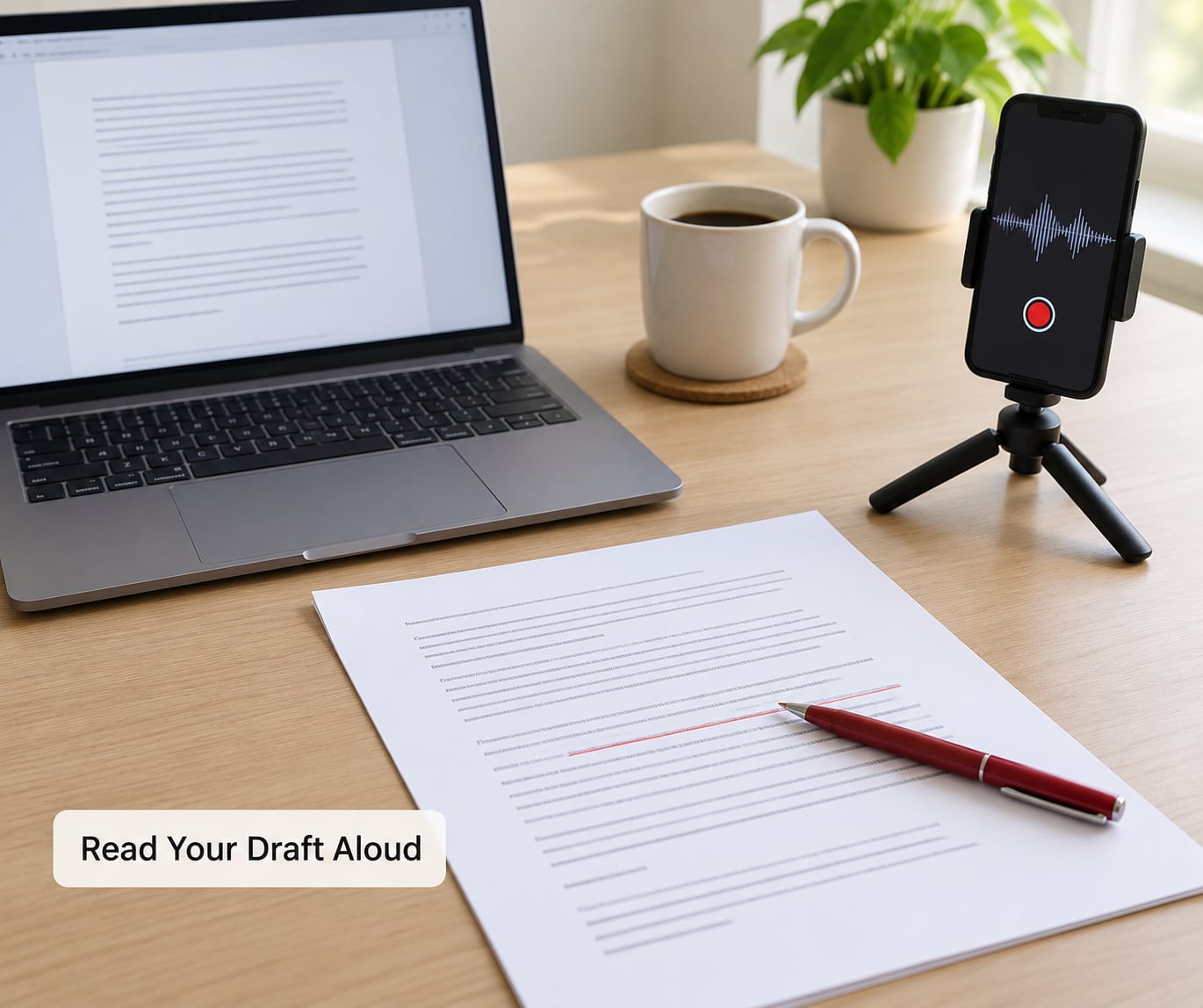
Read the whole thing out loud, at reading speed, and record yourself if you can. Your ear catches what your eye skips.
Four things to listen for: places where you run out of breath, places where a transition arrives without warning, places where the energy drops in the middle, and words that sound borrowed.
Breathing trouble means the sentence is too long for a human throat. Most writers cap out around 25 to 30 words. If you gasp, break it.
Flat patches usually mean you wrote that paragraph for yourself rather than for the reader you named in step two. Ask what that paragraph is doing for that reader.
Borrowed words are the hardest to catch. They sound slightly too polished, slightly more literary than the sentence around them. Mark them and test each one by reading it in your own speaking voice.
Reading aloud also catches voice drift after a heavy reading period. If a draft sounds like the last book you finished, that is step four’s problem, not your ear’s.
Test and Refine Your Voice
Voice is not a discovery you make once. It is a habit you keep testing.
Put two drafts side by side, an early one and a recent one, and read them without your name on them. Which sentences could only have been written by you? Which ones could have come from any published book? The second group is where work remains.
Then ask three specific readers rather than a general audience. Give them questions, not requests for compliments: which sentence sounds most like you, which one sounds borrowed, where did you stop caring. Vague questions produce polite answers, and polite answers teach you nothing.
Watch for the shape-shifting trap. After finishing a book with a strong authorial voice, many writers find their prose shifting toward it for weeks. If your voice changes every time you finish a good book, you have not settled into yours yet. The recovery is unglamorous: write daily in the notebook, not the book you just read, and reread your own samples from two months back.
Students often ask whether they need a degree or a workshop first. They do not. Ten pages a week kept honestly for six months will teach you more about your voice than a term of critique, because critique reacts to a draft while a notebook reveals a person.
Voice does shift by genre. Fiction, nonfiction, poetry, and academic writing ask for different sentence lengths, diction, and tenses, but the underlying habits, the attitude toward the reader, and the rhythm underneath stay recognizable. If a reader can tell you wrote all four, the voice is working.
Common Mistakes
Imitating someone you admire. Copying a writer’s habits is how craft gets learned, but it feels identical to stealing a voice and readers notice. Copy one element at a time, in a notebook that never reaches publication, and write everything else in your own hand.
Trying to sound sophisticated. Long words and passive constructions are the most common cover for a voice that has not been found yet. If you would not say the sentence out loud, delete it.
Changing everything at once. Rewriting word choice, structure, and tone in one pass flattens the draft into something generic. One category per session, with a short break between.
Confusing personality with voice. Personality is who you are at a dinner table. Voice is how that personality survives being arranged into sentences. Witty people write dull prose all the time when they edit the personality out.
Ignoring the reader. Voice that serves only the writer is a monologue. The ideal reader you named earlier decides how much personality is useful and how much needs cutting.
Two habits fix most of this quickly. Keep the dated notebook, and read your work aloud at least once per finished draft. Everything else is detail work on top of those two.
Frequently Asked Questions
How long does it take to find your writing voice?
Most writers notice a real shift within six to eight weeks of daily practice, and a settled, recognizable voice takes closer to a year of regular work. The timeline depends less on talent than on volume and honesty. Writers who keep dated drafts can see change at eight weeks because they have evidence. Writers who start fresh each time cannot tell progress from mood. Judge by accumulation, not by a single breakthrough moment.
Can everyone find their writing voice?
Yes, but the word find is misleading. Nobody locates a voice that was hidden and unlocks it. What people do is notice habits they already repeat and choose which ones to develop. That process works for beginners, for retirees picking up a first novel, and for published authors whose voice has shifted after reading a strong book. Talent affects speed, not availability.
Is finding your voice the same as developing a style?
They overlap but are not identical. Style is the collection of techniques you control: sentence length, structure, punctuation habits, typical formats. Voice is the personality and worldview underneath those techniques. A writer can have a strong style and no voice, which produces polished, interchangeable work. A writer can have a strong voice and weak style, which produces honest, rough drafts that read like a first attempt.
Why do my stories all sound the same, and how do I fix it?
Two usual causes. First, you may be reaching for the same generic sentences because you wrote them so often in school or online that they feel safe. Second, you may be over-editing, which strips the spontaneous word choices that make drafts sound like a person. Read an old piece aloud, underline what sounds borrowed, and replace those sentences with the plainest accurate version you can write today.
Does my writing voice change depending on the genre I am writing in?
Yes on the surface and no underneath. Fiction may use longer narrative sentences; academic work wants tighter ones; poetry breaks grammar rules; email is mostly fragments. Underneath, the attitude toward the reader and the rhythm you default to stay fairly constant. Write the same short scene in two genres and ask a reader to guess which one you wrote. If they can, the voice is real rather than borrowed from a template.
How do I stop sounding like the author I just read?
Expect it, because it is normal. Strong books alter your prose temporarily through attention and imitation. Recover by writing daily in a notebook away from that book, then rereading your own samples from a couple of months earlier. Reading your earlier work out loud restores your ear faster than anything else. The shift fades within a few weeks of consistent writing in your own hand.
Conclusion
Start tonight with the oldest piece of writing you can find. Read it once for sentence length, once for word choice, and once for tone, and write down what you notice before you decide what you like about it.
Then set a timer for fifteen minutes tomorrow morning and write without stopping. Underline the sentences that sound like you. That list is the raw material for everything else in this guide.