
To pick a book for a book report, work backwards from the assignment sheet: note every rule, find two or three books that satisfy them and that you genuinely want to read, then test each candidate for readability before you commit. Done in that order it takes about 20 minutes, and it saves the two outcomes students dread most, a book you cannot finish and a book with nothing to say.
The choice matters more than students expect. A report is a summary plus an analysis, so the book has to give you both a story you can retell and something you can argue about. A thin plot leaves you padding. Thirty pages of dense symbolism and you are stuck on page 40 with a due date in sight. Most of the students I see who panic at this stage skipped one simple step, which was writing the rules down before they started browsing.
A few honest words about the process. Teachers care far more about whether you can support your analysis than about whether the book won an award, and the title you pick is not the grade. Do check the sheet anyway, though, because a single missed rule, the wrong page count or an unapproved adaptation, is the cheapest way to lose marks on an assignment you did correctly.
Table of Contents
- What You Need
- How to Pick a Book for a Book Report Step by Step
- Review the Assignment Requirements
- Make a List of Topics You Already Enjoy
- Check the Reading Level and Length
- Preview the Book Before Committing
- Compare Your Top Choices
- Make the Final Choice
- Common Mistakes
- Frequently Asked Questions
- What is the 50-page rule for choosing a book?
- What is the 5-finger rule for books?
- How many pages should a book report book have?
- Can I do a book report on a book that was made into a movie?
- What is the best way to find book recommendations?
- What if I dislike the genre my teacher assigned?
- Conclusion
What You Need
Before you open a library catalogue or a recommendations list, gather six things. Ten minutes of setup prevents an afternoon of browsing books that were never going to work.
- The assignment prompt itself. The printed sheet, the email or the exact wording in the online class portal. Requirements hide in the small print more often than anywhere else.
- Teacher guidelines or a rubric. Many teachers post a separate handout covering format, length, citation style and what the assessment actually rewards. Find it before you pick anything.
- The due date. Not the date the assignment is handed out. Work backwards from it to get your real reading window.
- Your reading level. A current Lexile score, a recent reading assessment result, or a rough sense of what you read comfortably without a dictionary.
- A list of topics you already enjoy. Three or four subjects, sports, animals, a historical period, a type of story, anything you would read without being asked.
- An honest estimate of free study time. Count the real hours in a week you can read, not the hours you wish you had.
Access matters too. If you plan to borrow rather than buy, check that your school or public library holds the book and that one or two copies are free, since a class picking the same title can put a long hold on every copy. Many school libraries also keep a list of books already approved for reports, which cuts the work in half.
How to Pick a Book for a Book Report Step by Step
Review the Assignment Requirements
Read the prompt twice and pull out the constraints one at a time, in writing. A student who skips this step and picks first spends their energy negotiating with rules they never read.
What to look for, question by question:
- Genre. Some teachers insist on nonfiction, biography or a memoir; others want fiction from a named genre.
- Topic or subject. A unit on the American Civil War, on the environment or on a particular country narrows everything else out.
- Page count. Often a minimum rather than a maximum, sometimes a range. Treat a minimum as a real constraint.
- Point of view and structure. A few teachers want first person, or a book with a clear narrator, or a nonfiction text with chapters and an index.
- Citation format. MLA or APA, and whether the report needs a Works Cited or References page. That decides whether you want a book with a strong introduction, epilogue and section breaks.
- Adaptation rules. Some teachers rule out books with a movie version, on the grounds that you may end up summarising the film. Others do not care. If the sheet is silent, ask.
- Approval. If you have to submit your title for a signature before reading, your choice is provisional until the teacher replies. Pick a second option in the same message so a no costs you nothing.
Write these down in a single list. Everything after this is measured against it.
Make a List of Topics You Already Enjoy
Interest is not decoration here. It decides whether you finish the book, and finishing is the step most assignments quietly depend on.
Turn interests into search terms. Soccer, Minecraft, sharks, the Apollo program, sibling rivalry, a small town in winter, the Civil War, a lonely kid nobody notices, magic that costs something. Type the two or three that excite you into a library catalogue or a book recommendation site and read the summaries. The books that appear more than once across your searches are your shortlist.
Genre shapes how easy the writing will be. Some genres hand you material, and some make you work for every paragraph.
| Genre | What you get to analyse | Watch for |
|---|---|---|
| Realistic fiction | Clear protagonist, conflict and theme | A very quiet plot can leave little to argue about |
| Mystery and thriller | Structure, clues, how the author misdirects you | May be written for adults; check the age range |
| Historical fiction | Real events plus invented characters, easy theme work | Fact checking takes time if the prompt is strict |
| Memoir and biography | A life, a period, a person to characterise | Some teachers treat these as nonfiction, some do not |
| Science and nature writing | Concrete topics and accessible evidence | Can read like a textbook, so check the tone |
| Poetry and short story collections | Language and imagery to quote | No through-line plot, which many rubrics require |
The movie question comes up constantly, and students usually hear it as a prohibition when it is really a warning. If half your class reads the same popular adaptation, five of you may end up describing scenes rather than analysing the writing, and teachers notice. If your school has a list of books that became films, treat those as a soft avoid and pick around them. Plenty of bestselling books have no film at all, and the back catalogue is full of award winners that stayed on the shelf.
Two habits make this faster. First, ask for a book like one you already love, by author or by the exact feel you liked, since a similar book is usually a safe report choice too. Second, note the reporting angle as you browse: a book about a teenager concealing something gives you character analysis and theme, while a book that is mostly atmosphere gives you imagery and mood. Both are writable, but they are not equally easy.
Check the Reading Level and Length
Two numbers decide this: how hard the book is and how long it is. Ignore both and you either stall at page 40 or finish in two days with nothing to write.
Two rules from classroom reading programmes are worth knowing, because they give you a fast answer when a Lexile score is not available.
The 5-finger rule. Read a page, put a finger up for every word you did not understand, then read the next page. If you need more than five fingers, the book sits above your current level. Most readers can push through slightly too hard and still enjoy it, but a book that needs eight fingers is a fight you will lose in week two.
The 50-page rule. Give a new book 50 pages. If you are not still curious at the end of them, put it down and start something else. It saves the classic experience of forcing a book to 120 pages out of guilt, then discovering you remember none of it.
For a more precise reading level, look up the Lexile measure. It is a score for text complexity, and when a school publishes target ranges by grade band you can match a candidate against them in seconds. Publishers also list reading age and grade level on the back cover. Treat those as a guide rather than a rule: a book three years above your level can be a good report choice if the story pulls you forward, and a book below your level can leave you with nothing to analyse.
Now do the time arithmetic, because length is where good intentions go wrong. Reading runs roughly one page a minute for an average middle-grade or high-school novel, and slower for dense nonfiction, where a chapter of 20 pages can take an hour. A 300-page novel is therefore about five hours of reading, and a 400-page one closer to seven. Now count backwards from the due date, reserving the last quarter of your time for writing. Three weeks of solid reading time leaves room for a book of 300 to 400 pages. Ten days leaves room for something closer to 150.
If a teacher has set a minimum page count, apply it before anything else, since it overrides your preference. If not, aim for a book you can finish comfortably rather than the longest one on the shelf.
Preview the Book Before Committing
Ten minutes of previewing replaces a disappointing 200 pages. This is the step most students skip, and it is the cheapest insurance in the whole process.
Check these parts of the book, in this order:
- The copyright page. Publication date, and sometimes a reading level or an award line.
- The table of contents. Look for part titles that tell you where the story turns. A book with a prologue, dated sections and an epilogue is unusually easy to structure a report around.
- The first chapter. Ten pages is usually enough to hear the voice and judge the pace.
- The back cover and the first page of the ending. Publishers write these to sell, but they usually name the emotional territory of the book, which tells you what you will be writing about.
- Reviews and study guides. Look for reviews from readers in your grade band rather than adult critics. A publisher’s reading guide, if one exists, is a gift: it often lists discussion questions that double as report ideas.
- The library catalogue record. Subject headings tell you how librarians classified the book, and the summary tells you whether the tone is what you expected.
If you can, buy or borrow the book rather than choosing from a description alone. No blurb is as accurate as page 12.
Compare Your Top Choices
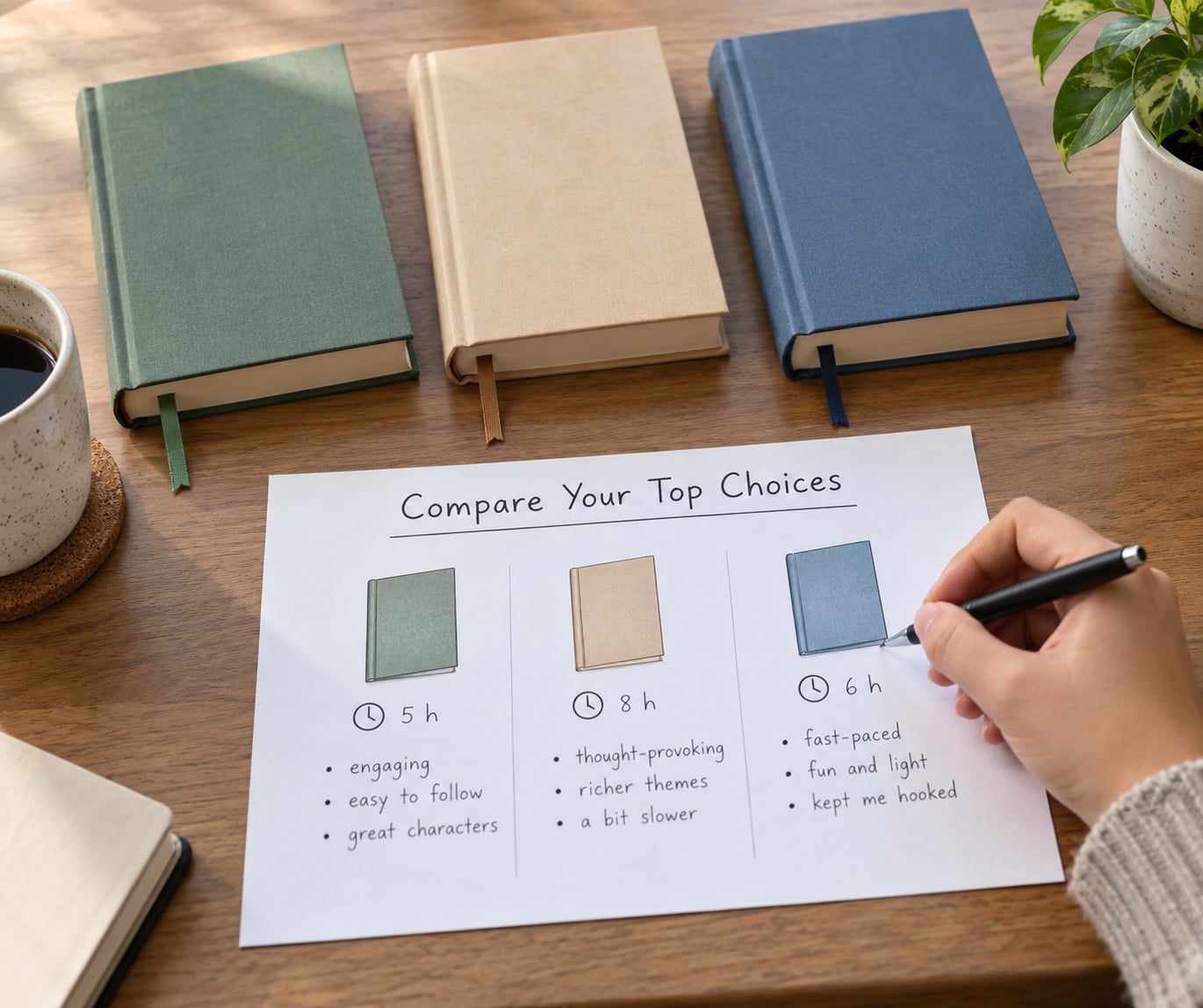
Put your two or three finalists side by side and score them against the same five criteria. A comparison table beats a memory test, because the book you liked most in the shop is often not the one you can write about best.
| Criterion | Book A | Book B | Book C |
|---|---|---|---|
| Interest: would I read this without being asked? | Yes / Maybe / No | Yes / Maybe / No | Yes / Maybe / No |
| Difficulty: readable with no more than the odd lookup? | Comfortable / Stretch / Too hard | Comfortable / Stretch / Too hard | Comfortable / Stretch / Too hard |
| Length: finishable before the due date? | Pages and estimated hours | Pages and estimated hours | Pages and estimated hours |
| Topic fit: matches genre, subject and viewpoint rules? | Meets all / Misses one / Misses two | Meets all / Misses one / Misses two | Meets all / Misses one / Misses two |
| Report potential: a clear conflict, theme or argument? | 3 ideas / 2 ideas / 1 idea | 3 ideas / 2 ideas / 1 idea | 3 ideas / 2 ideas / 1 idea |
The last row is the one that decides most ties. A book you can name three things to discuss, such as a protagonist whose choices drive the plot, a family that changes by the last chapter and a society that treats one group unfairly, is a book you will enjoy writing about. If you can only find one idea, the report will be one paragraph of summary padded to three.
Watch for candidates that lose on a single disqualifying point even while scoring well elsewhere. A book that is perfect on every line except the page count is out, whatever else it offers.
Make the Final Choice
Once one book leads on the sheet, commit. The urge to keep browsing is the most common way students lose a week on a decision worth twenty minutes.
Three finishing moves make the choice solid. If the prompt was vague on any point, genre, adaptations or approval, send your teacher the title and a one-line reason before you start; most reply within a day, and a short note also shows you read the instructions. Second, write down your reason in a sentence, for example a realistic story about a teenager whose first lie changes his family, and keep it, because it becomes the opening of your report. Third, note two quotations or a scene that struck you while previewing, since chasing those later costs an hour you may not have.
Then read for your report from the start, even though you already read 50 pages to test the water. The plot you skipped in the trial is usually the part your teacher expects you to summarise.
Common Mistakes
Almost every book report problem I see traces back to one of six habits, and each has a simple fix.
Choosing by popularity instead of by fit. The most-read book in your grade is popular because it is a good read, not because it is easy to analyse, and in most classes it already has a film. Fix: score your shortlist on the table above, and let a book with a strong central conflict beat a book that is merely well known.
Ignoring the prompt. Students read the title of the assignment and stop. A prompt that says choose a novel about family that is under 350 pages contains three separate rules. Fix: turn the prompt into a checklist and tick each item against every candidate before you commit.
Picking a book that is too hard. A book above your level is fine as a reading experience and a poor choice for a report, because the analysis suffers while you are still decoding the prose. Fix: run the 5-finger check on a random middle page, not the first one, and aim for a stretch rather than a wall.
Starting too late. The worst choices are made the night before submission, when anything readable will do. Fix: choose within 48 hours of getting the assignment, which is early enough to swap books at page 50 and late enough that the choice still fits your unit.
Picking something with no material to discuss. Very short books and heavily illustrated picture books leave a student with an introduction and nothing else. Fix: before choosing, say out loud two things you could argue about, then check that the book supports both.
Treating the choice as final and sacred. Reading 50 pages and putting a book down is a skill, not a failure. Fix: give every candidate a trial period, and switch without guilt if the voice bores you or the reading time will not fit your schedule.
A few selection habits pay off repeatedly. Read the last section first, since it tells you what the book is building toward. Keep a running list of books you finish and enjoyed, because next time the assignment will take you five minutes. Ask a librarian for recommendations in a specific genre rather than a general one, and say what you enjoyed last, as librarians are unusually good at this. And keep your first and second choices lined up, so a teacher saying no costs you one message rather than another week of searching.
Frequently Asked Questions
What is the 50-page rule for choosing a book?
The 50-page rule says to give a new book 50 pages before deciding whether to continue. Read to the end of page 50, then ask whether you are still curious about what will happen. If you are, keep going. If you are not, stop and start another book. It prevents students from forcing an unappealing book far past the point of enjoyment, and it is a good test of pacing before you commit.
What is the 5-finger rule for books?
The 5-finger rule checks whether a book is at your reading level. Read one page, then hold up a finger for every word you could not understand. Move to the next page and repeat. If you end up with more than five fingers, the book is above your level and will slow you down. A book that needs only one or two fingers is probably too easy for a report, since you will struggle to find themes worth writing about.
How many pages should a book report book have?
There is no standard number, so let the due date decide. Reading runs about one page a minute for most novels, so a 300-page book is roughly five hours of reading. With three weeks of solid reading time you can handle 300 to 400 pages; with ten days, stay nearer 150. If your teacher set a minimum page count, that overrides everything else and should be checked before you choose.
Can I do a book report on a book that was made into a movie?
Usually yes, but check the assignment sheet first, because some teachers rule out adaptations so that students analyse the writing rather than the film. If the rule exists, pick a book with no film version, which is easier than it sounds since most older and award-winning books have never been adapted. If the sheet is silent, choose anyway but write from the book itself, since a report built on film scenes tends to score poorly.
What is the best way to find book recommendations?
Start at your school or public library, where staff know what has been read and approved recently, and check whether the library already holds the title. Then use a recommendation site or an app and filter by reading level, genre and length rather than browsing popular lists, which return mostly adapted books. A librarian is the fastest option of all: say the genre, the page range and the last book you enjoyed.
What if I dislike the genre my teacher assigned?
Ask whether the requirement is the genre itself or a book on the unit list, because teachers sometimes accept a related genre with a note explaining the swap. A realistic novel can often stand in for memoir, and a historical account can stand in for historical fiction, if you explain the difference. If the genre is fixed, choose the book with the strongest central conflict and treat the unfamiliar style as something to analyse rather than a reason to quit.
Conclusion
Choosing a book for a book report is a filtering process, not a guessing game. You write down the rules, list the subjects you actually want to read about, test each candidate for difficulty and length, preview it, compare two or three finalists on the same criteria, and then commit to one with a sentence explaining why.
Start now rather than later, because the first action takes five minutes. Put the assignment prompt in front of you, list every rule it contains, and write down two or three titles that satisfy all of them. Everything after that is just deciding between good options.