
You get lost in Shakespeare for three separate reasons: the syntax is Early Modern English rather than modern English, most of the play is written in unrhymed verse with lines that break in the wrong places, and nobody describes the scenery because the actors had to imagine it. Fix those in order and the play stops feeling like a puzzle and starts feeling like a story with voices. Anyone can do this with about an hour of setup and one cheap paperback.
That last part matters, because the most common thing readers report is not confusion about vocabulary. It’s the sense that they must already know something before they are allowed to start. You don’t. A reader who has never opened a play can work through a comedy in an evening.
This guide is how to read Shakespeare without getting lost, and it is built for students with a Romeo and Juliet or Macbeth assignment, for adults picking Shakespeare up for pleasure, for book clubs, and for anyone returning to classics after decades. It works for every play in the canon, because the problems are structural rather than personal.
Table of Contents
- What You Need
- Step-by-Step: How to Read Shakespeare Without Getting Lost
- Step 1: Preview the Play and Get the Story First
- Step 2: Choose an Accessible Shakespeare Edition
- Step 3: Learn the Language Without Stopping at Every Word
- Step 4: Track Characters, Conflicts, and Relationships
- Step 5: Read Aloud, the Fastest Way to Follow the Text
- Step 6: Review the Whole Play Instead of Famous Lines
- Common Mistakes
- Frequently Asked Questions
- Conclusion
What You Need
Three things, and none of them complicated.
- A modern-spelling edition of one play. The text should be modernised in punctuation and spelling but still in Shakespeare’s words. If you have to ask whether the edition modernises the language, pick a different one.
- A way to mark up the text. A printed book with a pencil in the margin, or a document with a comment function. Two colours is plenty: one for “I don’t understand this” and one for “this matters to the plot.”
- A character list on one page. The dramatis personae list at the front of the play is a cast list, not a plot summary. Write it out in your own words before you read Act 1.
Optional but useful: a modern side-by-side translation for the plays or passages where you stall, and a full-text audio performance to listen to in the car.
That’s it. You do not need a literary dictionary open, a glossary crib sheet for every line, or any background at all.
Step-by-Step: How to Read Shakespeare Without Getting Lost
Each stage below has an action and a quick test that tells you it worked. Move on only when the test passes, because each stage removes one of the three things that trip readers up.
Step 1: Preview the Play and Get the Story First
Read the title, the source material note, and a plot summary before you touch the dialogue. Ten minutes with a summary of Macbeth, Hamlet, or whichever play you’re holding prevents forty minutes of confusion later.
This is not cheating, and it costs you nothing dramatic. Dramatic conventions mean you already know the ending of Hamlet from school, and nobody reads a Shakespeare play to find out who marries whom. You are reading to see how the language works, and you cannot do that while tracking thirty characters you met on page four.
Note three things from the preview: the genre, the setting, and the main source. The genre changes how you read. In a comedy, look for mistaken identity, doubled plots and a marriage at the end. In a history, track who claims what. In a tragedy, watch choices accumulate. In a romance, expect disguise, outlaws and a lost family.
Here is the part nobody warns you about. Shakespeare’s characters tell each other where they are, what time it is, and what just happened offstage, because there are no curtains, no sets and no screens. That constant narration is a convention called the theatre of the imagination, and once you recognise it you can stop mistaking it for a speech about scenery.
Also note the source material. Plays drawing on Plutarch come with a Roman military or political background. Plays drawing on the Bible arrive with references to Cain, Eden and the Flood that mean nothing to you unless you look them up once. Five minutes on the source, and the allusions start landing.
Your check: say out loud, in one sentence, who wants what. If you can, you’re ready to move on.
Step 2: Choose an Accessible Shakespeare Edition
Read the play in a modern-spelling edition, preferably lightly annotated, and treat modern translations as a support rather than a replacement. Editions differ far more in how much help they give you than in how good the text is.
There are four practical levels.
Modern-spelling, minimal notes. The Arden, Cambridge and Riverside Shakespeare series sit here. The text is complete, the language is untouched, and the notes sit at the bottom of the page or in an appendix where you can ignore them. These are the right choice once you’ve got through your first play, or if you already read comfortably in Early Modern English.
Modern-spelling, heavily annotated. Folger editions gloss unfamiliar words on the page itself and often come with free online texts. For a genuine beginner this is the friendliest option, because the note is next to the line where you tripped.
Simplified editions. These rewrite the lines in modern English, usually two lines printed against each other: Shakespeare on the left, plain modern prose on the right. Useful for a specific stubborn scene. Bad as a first and only read, because they remove the awkwardness that makes the plays interesting.
Study and unabridged editions. Heavier, with critical apparatus and variant readings. Save these until you want to argue with the text.
Two practical notes from readers who have been here. Beginners repeatedly pick the heavily annotated edition and get on with it, so the reputation for prestige that pushes people toward the hardest book is the wrong advice. And the full unabridged text is what you want, because the cuts in simplified editions remove exactly the comic and unsettling scenes that make the plays worth reading.
Your check: open the book, find the first page of dialogue, and identify who is speaking without difficulty. If the front matter confuses you, you’ve bought the wrong edition.
Step 3: Learn the Language Without Stopping at Every Word
Handle the language by marking uncertainty and moving on, not by decoding every word. Early Modern English is ordinary English with different habits, and once you know four or five of those habits you will understand most of what you read.
The pronoun system
Shakespeare uses thou, thee, thy, thine for the person you address, and you, your, yours for the people you address. Modern readers reverse it constantly. If a servant says “thou art welcome,” it’s the servant greeting you.
Word endings
The verb endings shift the way they do in Latin roots, not German ones. Art, hast and dost mean is, have and do. Wilt means will, canst means can, shalt means shall. A missing final e is also common: oft, prithee, holp.
Inverted word order
Poets reach for the rhythm of iambic pentameter, ten syllables arranged in five beats, and that means the verb sometimes arrives early. “Never man hadst a servant more faithful” is not broken English. It’s the meter pushing the sentence out of shape on purpose, and understanding Shakespeare means learning to unscramble that shape without noticing it.
The most common word that trips people up is wherefore. It means why, never where. Romeo’s “wherefore art thou Romeo” is asking why he is called Romeo, and knowing that one fact ends about a decade of schoolboy confusion.
The word you already know
Set every word you don’t recognise in a bracket and come back to it. Your reading speed will collapse if you stop every thirty words, and a full page of brackets teaches you less than moving through the scene and sorting it afterwards. Mark it, keep going, resolve it in your review pass in Step 6.
Your check: take one dense line and paraphrase it in plain words. If you can, your language handling is working, even if the dictionary is still open.
Step 4: Track Characters, Conflicts, and Relationships
Build a character map and a conflict log as you read, one line each, because most plot confusion is really bookkeeping confusion. Readers report knowing every word on the page and still being unable to say what just happened.
Start with the dramatis personae list at the front. Most editions print it, and many readers skip it, which is how you end forty pages in with five characters and no memory of who is related to whom. Then keep one line per character with three things: who they are, who they want, and what they lie about.
Watch the relationships move rather than staying fixed. In Hamlet, Claudius begins as a worried brother in mourning clothes and ends as the man who arranged the play-within-a-play to confirm his guilt. In Macbeth, the Macbethes are united against the world and then at odds about whether to keep going.
Conflicts come in three layers, and naming which one you are looking at makes the plot legible: a character against another character, a character against their own feelings, and a character against the social order around them. Most plays run all three at once, and scenes where a character’s internal conflict spikes are where the play is doing its real work.
One practical trap: speeches in a play are labelled with the speaker’s name, not introduced. After a speech ends, the next name is whoever responds. Nowhere to look up does the text say who is speaking, so the name does all the work, and you should pause at each new one to place the person.
Your check: for each main character, say who they are in three words and what they want. If you can do that for the leads, the plot is holding.
Step 5: Read Aloud, the Fastest Way to Follow the Text
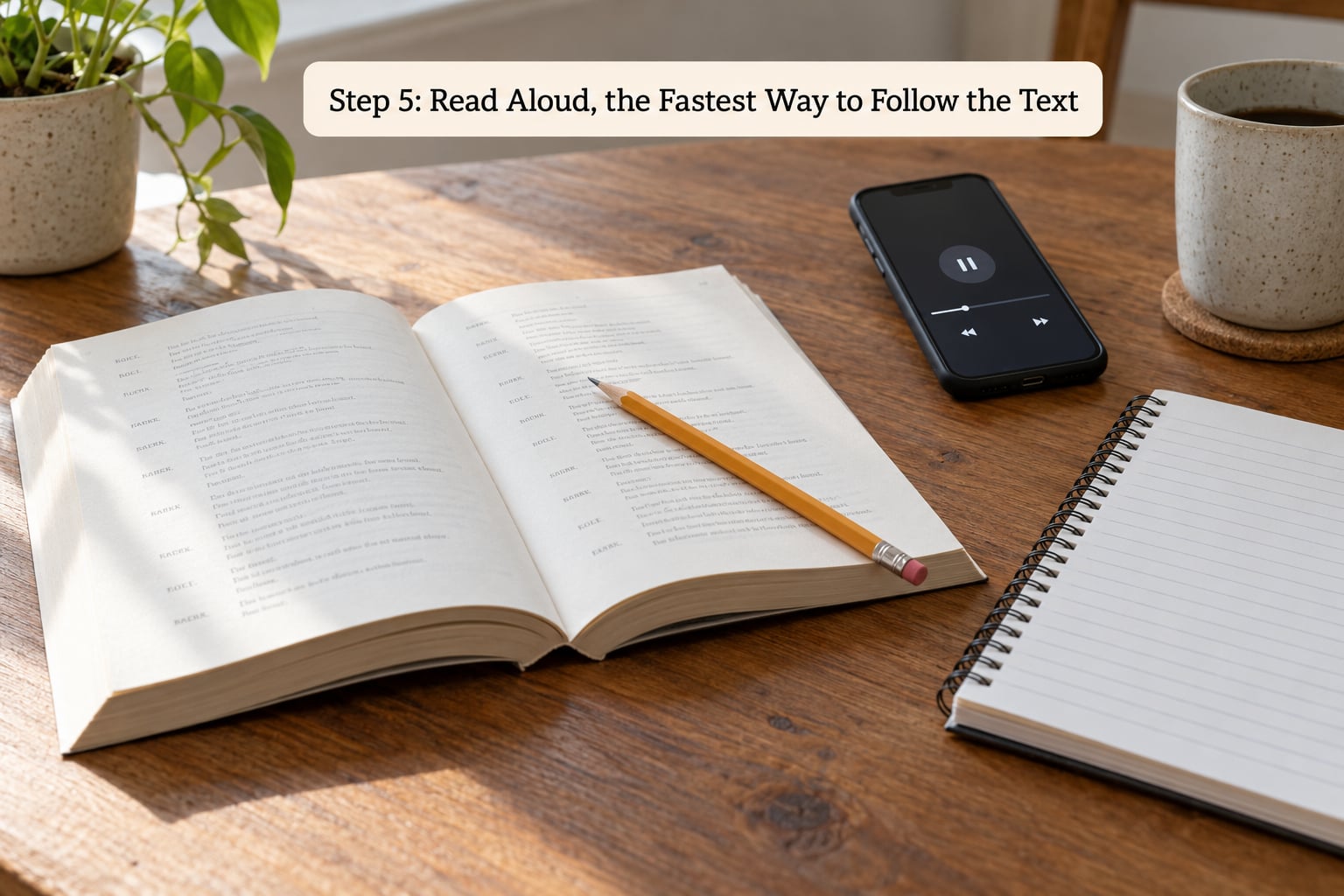
Read the play aloud. It is the single most effective technique for understanding Shakespeare, and it takes no equipment and no privacy beyond your own head.
The reason is mechanical. Prose lets your eyes run ahead of your ears. Verse makes you breathe, and breathing forces you to hear where the line ends, which is where the sense often ends too. A shared line printed as one row but spoken by two characters becomes obvious the moment you read both parts aloud, and so does the difference between a question, a command and an aside.
If reading aloud in a room feels ridiculous, do it in the car, walking, or washing up. Nobody is watching. Start with a speech you half understand and notice how much more arrives when you hear it.
Where a full-text audio performance exists, use it as a companion rather than a substitute. Listening in the car once is genuinely useful: it fixes the sound of the language, so that when you read the printed text you recognise a rhythm you’ve already heard. Readers stuck at stage conventions report that hearing a performance is what makes the imagined stage stop feeling imaginary.
Your check: say a speech you have just read in your own words. If you can, you understood it. If you can’t, you probably read it too fast rather than that the language defeated you.
Step 6: Review the Whole Play Instead of Famous Lines
Summarise each act or scene in one sentence, then connect the sentences with cause and effect. Reading a play is not about holding famous quotations in memory; it’s about seeing how choices lead to outcomes.
Write the act summaries on the first page of your notebook, in order. This takes ten minutes and does more for comprehension than any amount of highlighting, because it forces you to say what happened before you can say what it meant.
Then check the chain. Why did the friar give the potion? Because she asked for it and he thought it would clear her conscience. Why did she ask? Because the test was too slow. Keep pulling until each sentence explains the next, and you’ll find that a play you couldn’t follow scene by scene holds together perfectly well as a sequence of consequences.
Only after that do you look at themes. Ask what characters want and what the play suggests they’ll get. Ask which images repeat, and what they have in common. That last step is where the poetry gets interesting, and it works far better than trying to find meaning in a famous speech on the same page.
This is also when you clear your brackets. Every word you marked is worth looking up now that you know the scene it belongs to, and about two thirds of them will turn out to be inflections or pronouns you’d have worked out from context anyway.
Your check: retell the plot in five sentences from memory. If the sequence holds, you read the play.
Common Mistakes
Translating every line as you go. Stopping at each unfamiliar word turns a play into a dictionary exercise and kills momentum. Mark and move on.
Starting without knowing the story. Reading a comedy cold means spending your attention on who is who instead of why anyone is doing anything.
Treating every name at the top of a speech as the subject. The name before a speech is the speaker. The name after it is whoever replies.
Highlighting everything. If half the pages are marked, nothing is emphasised. Two colours, used sparingly, beat five colours used constantly.
Reading famous speeches as if they were the play. “To be or not to be” is about ninety words in a text of some three thousand. The scene around it explains it.
Starting with the fully modernised text and staying there. A side-by-side translation solves one difficult scene well and the whole play badly, because the plain modern version removes the awkward word order and the metaphor that give the lines their charge.
Frequently Asked Questions
What’s the best way to read Shakespeare?
That is the whole question, and the answer has an order. Get the plot first from a short summary, then experience the play through audio or a production, then read the original text aloud. Use a modern-spelling edition with light annotations, and keep a character list beside you. It removes the three things that trip beginners: unknown story, unfamiliar rhythm and unplaced characters.
Which Shakespeare book is the easiest to read for a beginner?
Comedies are the easiest entry point, and A Midsummer Night’s Dream is usually recommended first because the plot is simple, the language is playful, and mistakes about who is who get sorted out fast. Twelfth Night and Much Ado About Nothing follow. Romeo and Juliet is shorter but tracks two families and dated jokes, so it makes a better second read.
Is William Shakespeare easy to read?
No, and expecting it to be is the main reason readers give up. The language is about four hundred years old, most of it is unrhymed verse, and nobody describes the scenery. Every one of those is a solved technical problem rather than a sign you are slow. Readers who follow a set system finish plays; readers who read cold tend to abandon them in Act 1.
Should I read a modern translation first?
Read the original first and keep the translation nearby for when you stall. Starting with a side-by-side edition makes the play feel easy and removes the awkward word order and metaphor that give the lines their charge. If you read only the modern text you will understand the plot and miss most of the writing. Save it for the two or three scenes that stop you cold.
Do I need to read the footnotes?
No. Most beginners lose more time to footnotes than to Shakespeare, because each one interrupts a scene you have not understood yet. Read the text straight through first and clear your marked words in a second pass, when you know which ones mattered. Heavily annotated editions put glosses next to the line, which is far less disruptive than endnotes.
How do you say hi in Shakespearean?
There is no single greeting, because the language depends on who is speaking to whom. Common ones include good morrow for good morning, god save you for goodbye, and well met for hello. Pronouns carry much of the tone: thou and thee for the person you address, you and your for the person you are speaking about. Getting those two systems right solves most of the confusion early on.
Conclusion
Getting lost in Shakespeare is a predictable sequence of three problems rather than a verdict on your intelligence, and each one has a fix you can apply in a single sitting. That is what separates reading a play from abandoning it. Get the story before the text. Pick a modern-spelling edition that glosses unfamiliar words where you will actually see them. Mark what you don’t understand and keep moving. Read aloud. Summarise each scene and connect them with cause and effect.
Start tonight, not when the assignment is due. Read the title and a summary of one comedy, write out its cast list in your own words, and begin Act 1 with a pencil. One hour of setup is the whole investment, and it is enough to finish any play in the canon.