
A topic is the short, explicit subject a text is about, usually one or two words. A theme is the deeper, implied message about life or human nature that the text suggests, and it is always a complete sentence. If you can say it in two words, it is a topic. If it is a full thought with a verb, it is a theme.
That rule settles most cases, and learning how to tell the difference between theme and topic takes about ten minutes per text once you have four steps and a worked example. The cases that break the rule come later, because some subjects genuinely sit on both sides of the line.
| Question | Topic | Theme |
|---|---|---|
| What is it? | The subject a text deals with | The message the text implies about that subject |
| What form does it take? | A word or short phrase | A complete sentence |
| How does it appear? | Explicit, stated or easily summarized | Implicit, built from choices, conflicts and outcomes |
| Example | the Salem witch trials | Fear of the unfamiliar can turn a community into a mob. |
Table of Contents
What You Need
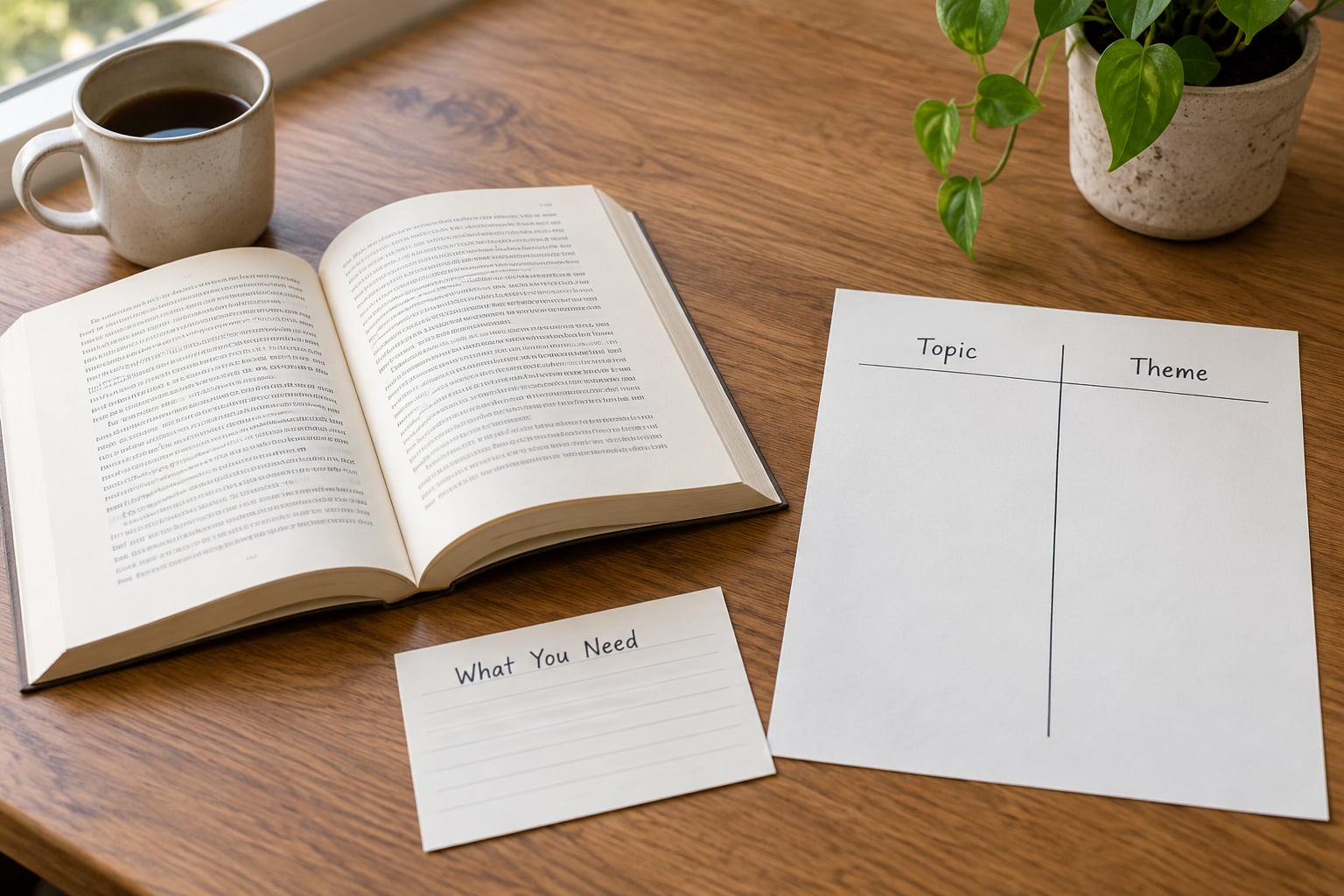
You need three things, and none of them are expensive. The title and back-cover blurb of the work, one substantial passage, and somewhere to write two columns.
The columns matter more than they sound. Put Topic in the left one and Theme in the right, then fill the left column first. Writing the theme before the topic is how students end up with a theme that is really a plot summary.
For a poem, the whole poem counts as the passage. For a novel, choose one scene that changes something, since a theme you can only see in the ending is usually a summary of the ending.
Step-by-Step: How to Tell the Difference Between Theme and Topic
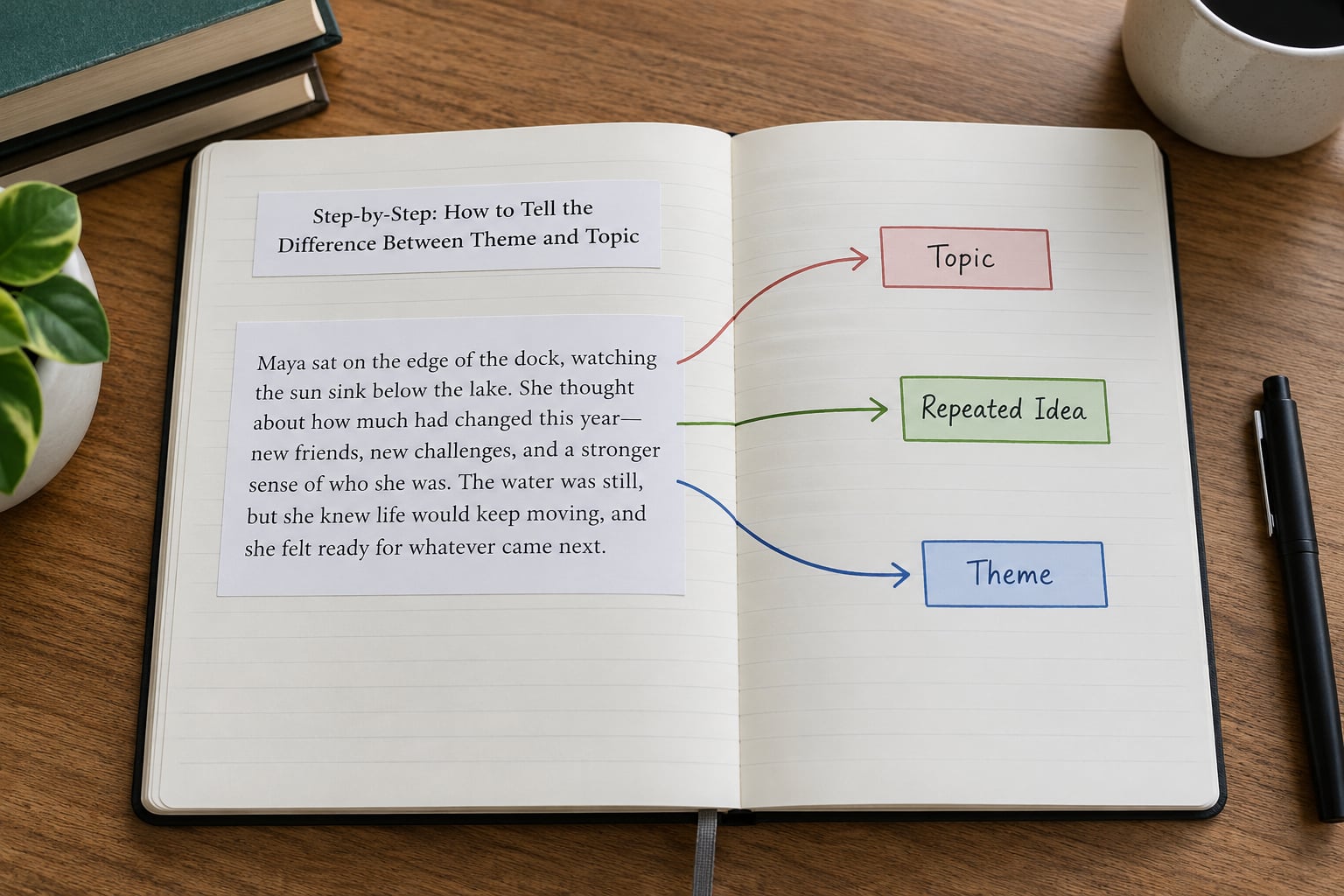
Step 1: Identify What the Work Is About
Read the back cover, then ask who, what, where and when. The answers give you the topic, and they usually arrive as nouns: a friendship, a disease, a war, a family leaving a country.
Keep the phrase narrow. “A family leaving a country” is a topic. “Family” is usually too vague, because you could attach it to almost any novel, and a topic that fits everything explains nothing.
Step 2: Look for Repeated Ideas and Contrasts
Now read the passage twice, hunting for patterns rather than events. What keeps coming back? Which two forces are set against each other? What do characters say, do or refuse to do more than once?
This is where theme comes from, not from the plot. A work about a coming-of-age that keeps returning to a parent who cannot say “I am proud” is not ultimately about growing up; it is about silence between people who love each other.
Step 3: Write the Theme as a Complete Statement
Turn the pattern into one sentence with a subject and a verb. If you cannot add “is,” “matters,” “can,” “leads to” or “shows us,” you still have a topic rather than a theme.
“Ritual violence” is a topic. “Blind obedience to community expectations can turn ordinary people into participants in cruelty” is a theme, and it can be supported with details from the text.
Step 4: Test Both Answers with Evidence
Go back to the passage and underline three moments that support your theme statement. If you cannot find three, your theme is probably too broad or borrowed from another text.
Then check the reverse direction: could your theme sentence apply to a different book without sounding odd? If it could describe any text at all, it is a platitude rather than a theme.
Here is the same four-step method run on a short text. For Frost’s “The Road Not Taken,” the topic is a speaker choosing between two paths. The repeated pattern is a speaker describing a choice as lonely and consequential, then admitting in the last stanza that the difference between the roads was really about how the speaker talked about them. A theme statement from that: people often build the meaning of a life around a single decision, and look back on it with a story they tell themselves.
That theme covers poetry and could sit over a dozen other texts, but the evidence stays with those three lines. The topic would not: you could not prove “two paths” from any passage other than this one.
One honest wrinkle. The line between the two is not always sharp, and a good answer admits that. Health care can be the topic of a policy article and the theme of an election campaign about who deserves care. A useful rule of thumb is scope: a theme has wider reach than a topic, so you can move from topic to topic while staying inside the same theme. Judge the label by what the writer is asking you to do with the subject, not by the word alone.
Common Mistakes and How to Fix Them
Most errors at this stage are reversed rather than random, which is good news, because each one has a clean fix.
A theme written as a single word. “Friendship” is a topic. Ask what the work says about friendship and finish the sentence. Students usually resist this because they think a theme should feel short, but a real theme is closer to a thesis in length.
A topic written as a full sentence. “This story is about a girl who fights her town’s rules” is a plot summary. Strip it back to “a girl defying authority” and you have a topic you can build on.
A moral dressed up as a theme. “Never trust strangers” tells the reader what to do. Themes describe what the text reveals about people, not instructions for behaviour, and a text with a moral often contradicts it.
A theme pulled from a different book. If your sentence would fit any title in the unit, it is not anchored here. Go back to the passage and rewrite it in words the text actually supplies.
A theme that is too narrow. A theme cannot be about one scene. It has to survive the whole work, so test it against the ending and the opening.
Only one theme allowed. Texts carry a major theme and often several minor ones. A major theme runs through the whole work and shapes the ending; a minor theme shows up in a few scenes and enriches the major one. Forcing a single answer is what makes the exercise feel false.
These five terms get swapped constantly, and sorting them out is the fastest way to stop the confusion. The short version: topic is the subject, main idea is what a piece of nonfiction argues in a paragraph, thesis is the claim an essay defends, theme is the implied insight about human nature, and moral is the lesson a reader might draw.
| Term | What it answers | Form | Example for The Lottery |
|---|---|---|---|
| Topic | What is this about? | Word or phrase | ritual violence in a small town |
| Main idea | What does this paragraph claim? | Sentence | not usually used for fiction |
| Thesis | What will this essay argue? | Sentence plus support | the village’s customs are indistinguishable from persecution |
| Theme | What does this work imply about people? | Complete sentence | Blind obedience to community expectations can make ordinary people participants in cruelty. |
| Moral | What should the reader do? | Imperative | resist group pressure, though the story argues no such thing plainly |
One more practical habit. Ask students to swap the two words in a sentence they have written. If “the topic of this poem is love conquers all” still reads oddly, it is a theme in disguise, and the swap will make that obvious faster than any explanation from you.
Frequently Asked Questions
Is a theme the same thing as a topic?
No. A topic is the explicit subject of a text, stated in a word or short phrase. A theme is the implied meaning about life or human nature that the text builds through characters, conflict and outcome, and it needs a full sentence. Two works can share a topic of war and reach completely different themes about courage, guilt or obedience.
Is there a difference between a theme and a topic?
Yes, and the difference is mostly about form and depth. A topic answers what the text is about and can be copied from the back cover. A theme answers what the work suggests about that subject, is never stated outright, and must be written as a complete sentence you can support with evidence from the text.
How do you identify a theme in a story?
Name the topic first, then look for what recurs. Track repeated conflicts, descriptions, decisions and turning points, and ask which two forces the work keeps setting against each other. Turn that pattern into one sentence about human nature, then underline three moments in the text that support it. If you cannot find supporting evidence, the sentence is too broad.
What are the four steps to identify the theme of a story?
The four steps are: name the topic in a narrow phrase; find the repeated ideas and contrasts that recur; write the theme as one complete sentence with a subject and a verb; then test it against the text by collecting supporting details and revising anything too broad or borrowed from another book.
Is death a theme or a topic?
It depends on the work. In a story where a character dies once, death is part of the topic, a plot event. When death keeps returning as a subject of reflection, a presence the work keeps measuring life against, it has become a theme, and your theme statement should say what the text claims about death rather than naming it.
How do you teach students to identify the theme of a story?
Separate the two tasks in class. Have students list topics from the back cover first, then require a full sentence with a verb for the theme, so form alone catches weak answers. Run the same four steps across several short texts in one sitting, and finish with the swap test: if their sentence still works after switching topic and theme, it needs work.
Conclusion: Start With the Topic, Then Find the Meaning
The distinction is simpler than most textbooks make it sound, and the four steps above are the whole method. A topic names the subject in a word or a phrase. A theme makes a claim about that subject in a full sentence, and the text has to prove it.
Do one thing first: take the text in front of you, write the topic in the left column, and keep asking what keeps recurring until a sentence appears on the right. The first attempt will usually be too broad, which is fine. The second one, with three moments of evidence underlined beneath it, is usually right.