A metaphor in a poem is a comparison that states one thing is another, without using “like” or “as” — so Emily Dickinson’s “‘Hope’ is the thing with feathers” turns an abstract feeling into a living bird that perches in the soul. To identify a metaphor in a poem, read literally first, flag any line that could not be true in real life, rule out similes, then explain what the comparison gives the reader. It takes about ten minutes per poem once you have the method.
The trouble is that most poems hide their comparisons. There is no “is” verb, no obvious signpost, and plenty of vivid description that looks figurative but is not. Here is the short version before the full method.
- Read the poem literally. Take every line at face value for one pass, so you catch the ordinary description before you start hunting.
- Flag lines that cannot be literally true. If a human being cannot do what the line says, you have found a comparison.
- Cross out anything using “like” or “as.” Those are similes, and calling them metaphors is the most common marking mistake.
- Scan for hidden verbs. Many metaphors work through the verb alone — “leaves blizzard down” needs no “is” at all.
- Say what the comparison reveals. If you cannot name the quality being borrowed, you may have only found a symbol.
Work through those five in order and you have a repeatable process that works on a poem you have never seen before, which is exactly the situation most students are in.
Table of Contents
What You Need
Very little. The poem itself, a pencil or pen, and about fifteen minutes. If you can print the poem or type it out with the line numbers visible, that helps more than any textbook, because a comparison often only becomes obvious when you can see it in the shape of the whole thing.
You also need a working definition, and it should be plain. A metaphor applies the name or description of one thing to something it is not literally true of. The thing being described is the tenor; the image being borrowed is the vehicle. In Dickinson’s line the tenor is hope and the vehicle is a bird with feathers.
That definition already excludes similes. A simile marks the comparison with a signal word — “like,” “as,” “so,” “as if” — and a metaphor does not. You can check any comparison you find against one question: is the poet explicitly telling me a comparison is happening? If yes, it is a simile. If no, it may be a metaphor.
Finally, know what you are not looking for. Not every strange image is a metaphor, and a poem can be full of figurative language without a single true metaphor in it. We come back to that below.
Step-by-Step: How to Identify a Metaphor in a Poem
Read the Poem and Note Its Main Subject
Before you interpret anything, write down in one sentence what the poem is mainly about. Not a summary — a subject. “A speaker addressing a departing lover,” “a house being taken apart,” “someone waiting for a doctor to arrive.”
This matters because it separates the poem’s central comparison from ordinary description. Annotation turns into guesswork when it starts at line one and reacts to whatever sounds prettiest. Starting from the subject gives every later decision a reference point: you can ask whether an image actually serves the thing the poem is about.
Read the poem twice. First pass, plain and unhurried, no marks. Second pass, underline anything that makes you picture something concrete. Do not label anything yet.
Look for Images That Compare Two Different Things
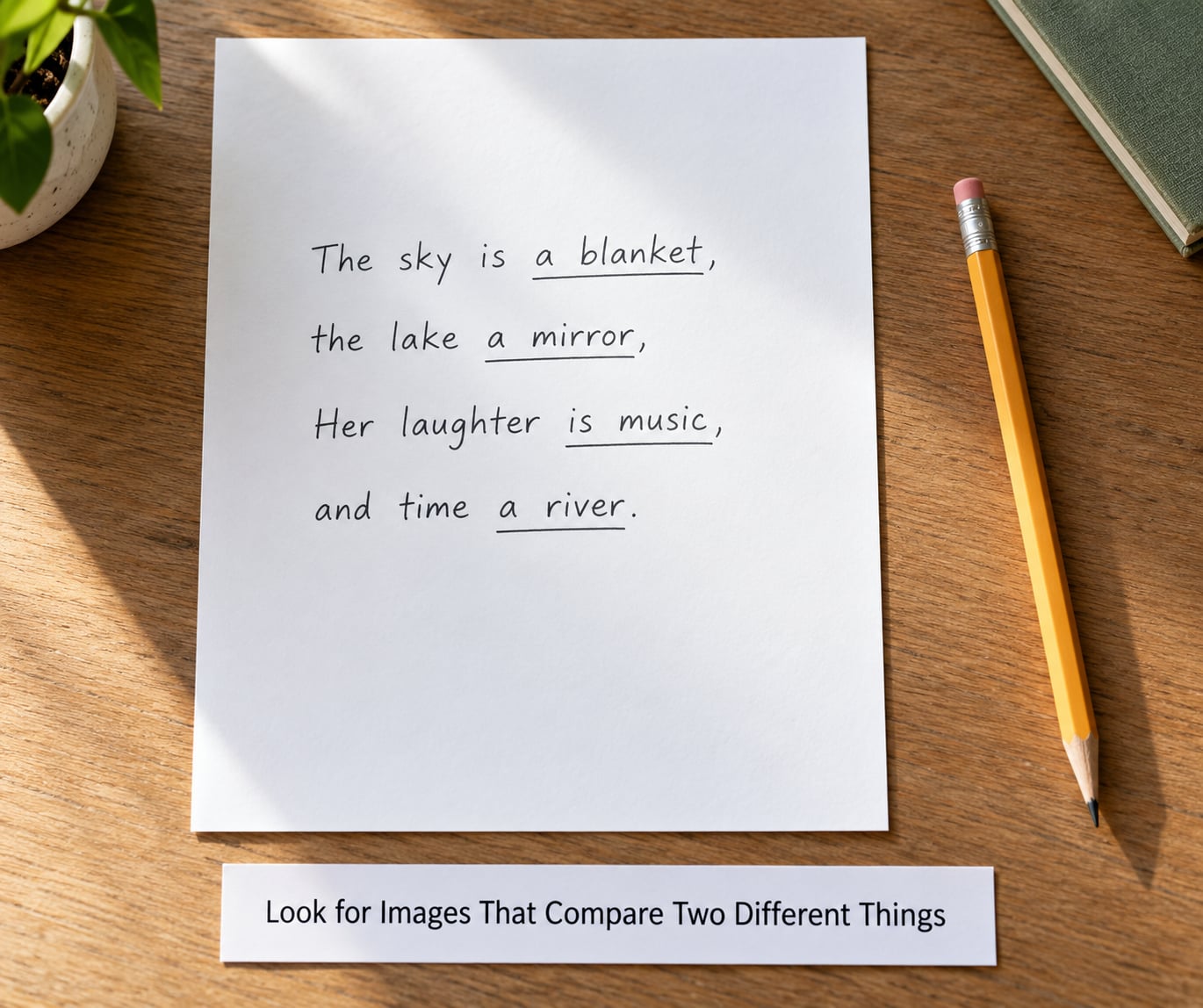
Now go back through what you underlined and apply a physical test: could this be true in the real world? A red sunset, a cold wind and a cracking branch can all happen to anyone, so they are description. But a heart made of stone, a voice of velvet, or a memory that devours cannot be literally true, so each one borrows qualities from something else.
Three shapes of comparison show up most often in poems:
- The stated form. “The world is a stage.” “My love is a red, red rose.” “Age is a thief.” The link is announced outright.
- The implied form. The comparison is complete in your head but never stated. Shakespeare, Sonnet 73: “That time of year thou mayst in me behold / When yellow leaves, or none, or few, do hang.” No “is” anywhere, but the speaker is plainly autumn at the end of something.
- The hidden verb. The comparison lives entirely in the action. In Hughes’s poem “Red,” the petals are described as if being opened by force — the image is carried by the verb rather than by any word like “like.” Look for verbs that seem wrong for the literal subject: swallowing, hunting, stalking, hoisting, drowning.
Underline the comparison, then label it in the margin with two words: what it is and what it is being compared to. “Hope = bird.” “Speaker = autumn.” That pairing is the raw material for the whole analysis.
Check for Comparison Words, but Do Not Stop There
Now cross out anything using “like,” “as,” “so” or “as if,” and set those comparisons aside as similes. This is the step most guides stop at, and it is where students lose marks. A simile is still a figurative comparison doing real work in a poem — you simply name it correctly.
Plath’s “Metaphors” runs on repeated similes: “I wanted you in my mind like a tree and its shadow, / like a load of sorrow with a thousand children.” Every mark is “like,” so none of those lines is a metaphor. What the poem does instead is repeat one comparison across many lines, which makes the simile function as an extended figure. Poetry is full of such hybrids, so grade your labels by accuracy rather than by picking one term and forcing everything into it.
The harder half of this step is the opposite one. Do not assume a metaphor must contain “is,” “was,” “became” or “seems.” Many of the strongest ones in poems are stated through a noun or a verb alone — “the mind is a knife,” “winter enters,” “the years unfolded.” And some arrive through possession rather than equation: “murder in the dark,” “the weight of years.”
Shakespeare’s Sonnet 18 keeps the same device running for fourteen lines. The comparison is announced in the first line — “Shall I compare thee to a summer’s day?” — which makes that line a simile — then sustained without any further signal word in “But thy eternal summer shall not fade.” Summer is no longer being compared to the beloved; it has been substituted for her.
Ask What the Comparison Reveals
This is where identification becomes analysis, and where most guides stop too early. Finding the metaphor is half the job; the other half is naming the specific quality being transferred and showing what it does to the poem.
Use this sentence frame: “The poet compares X to Y in order to suggest that X is [quality], which makes the poem feel [effect].”
Dickinson gives you “‘Hope’ is the thing with feathers – / That perches in the soul – / And sings the tune without the words – / And never stops – at all.” Borrow the qualities of a small singing bird — small, alive, persistent, wordless — and hope becomes something that survives without needing language. That is what the comparison is for.
Run the same test on a few more, and notice how different the effects are:
- Yeats, “The Second Coming”: “Turning and turning in the widening gyre / The falcon cannot hear the falconer.” History is a spiralling vortex, which turns a political poem into something centrifugal and out of control.
- Eliot, “The Love Song of J. Alfred Prufrock”: “I have measured out my life with coffee spoons.” A life becomes a sequence of tiny measured doses, so the speaker’s failure to act is in the measurement itself.
- Dickinson, “Tell all the truth but tell it slant”: “Tell all the truth but tell it slant – / Success in Circuit lies.” Truth is something you can succeed at only by failing to tell it directly.
- Bishop, “One Art”: “the art of losing isn’t hard to master.” Losing is treated as a craft to be practised, which is unsettling precisely because the skills involved are ordinary.
- Langston Hughes, “Harlem”: “Hold fast to dreams / For if dreams die.” Dreams are living things you can hold, so letting them go is a death rather than an inconvenience.
If you can complete the sentence frame for a comparison, you have a metaphor and an interpretation. If you cannot, you may have spotted a symbol instead — something concrete that stands for an idea without claiming to be it.
Use the Whole Poem to Confirm Your Interpretation
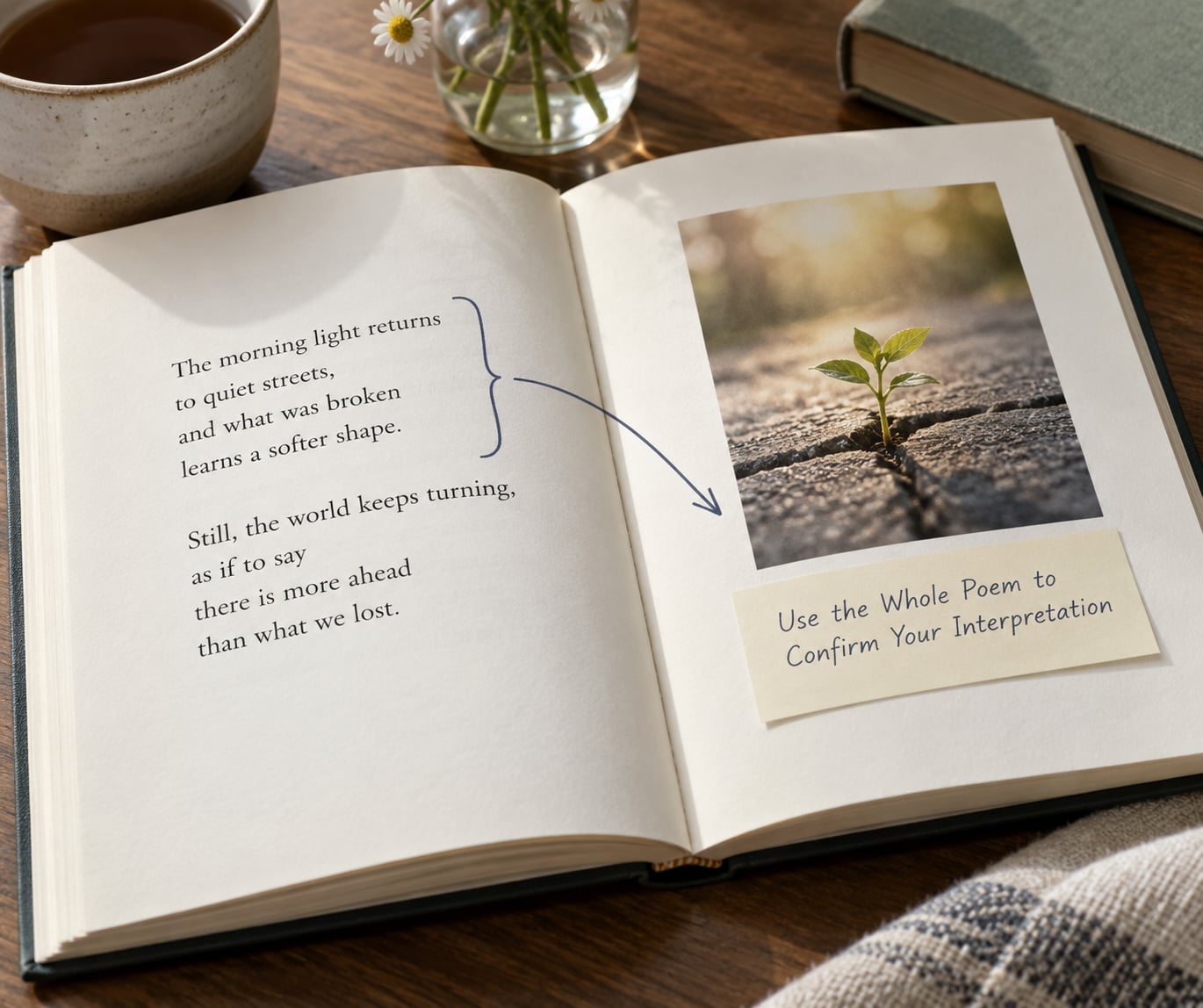
Surrounding lines are the test that keeps you honest. A metaphor that the poet never returns to, in a poem about something else entirely, is usually you seeing what you brought with you. Look for repetition, for a shift in tone around the image, and for the poem’s ending, which often tells you what the central comparison was really for.
Keats’s “When I Have Fears” carries one image across the whole poem. “Before High Words I always sit / And, till I make them, simply stare,” and then “Before High Words in a cold November when I write of death” run the experience of authorship as reaping and gleaning — the writer gathers what grows. Because the farming image returns stanza after stanza, it is an extended metaphor rather than a single line’s flourish.
To track one, bracket every line that carries the image, then read only the bracketed lines together. Three or four hits across separate stanzas confirms it. One isolated line is a local comparison, and saying so is a more accurate thing to write.
Metaphor, Simile, Personification, Symbol: Telling Them Apart
Confusion between these four is the most repeated stumbling block in classroom feedback, and it is easy to fix with a table. Read across each row and you can usually settle a case in a few seconds.
| Device | How it works | Signal words | Example |
|---|---|---|---|
| Metaphor | States one thing is another | is, was, becomes, or none at all | Age is a thief. |
| Simile | Compares using a signpost | like, as, so, as if | Her voice was like velvet. |
| Personification | Gives human qualities to a non-human thing | human actions or traits | Donne’s “Busy old fool,” addressing the sun in “The Sun Rising” |
| Symbol | Stands for an idea without claiming to be it | repeated object, not a stated comparison | A ring given in a poem about commitment |
| Analogy | Explains one thing by sustained comparison | prose, not usually verse | Comparing a poem’s structure to a musical score |
Personification overlaps with metaphor because it is a kind of one — but name it personification when the poet’s main move is giving human qualities to a non-human subject, and name it metaphor when the poet’s main move is substitution. “The wind whispered” is personification. “The wind was a gossip” is a metaphor, because the wind becomes a person rather than simply acting like one.
Common Mistakes and Quick Tips
Calling a simile a metaphor. The fix is mechanical: find the signal word and change your label. “Her eyes were like diamonds” is a simile, full stop.
Calling personification a metaphor. Both are figurative, but if your evidence is a human action applied to a non-human thing, the specific term is personification.
Labelling every vivid image a metaphor. “The window shattered” is a description. A metaphor needs a comparison that transfers qualities between two unlike things, and the test is whether the image is literally applicable.
Treating an idiom as a metaphor. Idioms like “break the ice” have worn smooth through use. In a poem, ask whether the poet has deliberately reworked the phrase for imagery; if the expression is doing no figurative work in that poem, it is not your evidence.
Forgetting implied metaphors. Shakespeare gives you “Bare ruined choirs” in Sonnet 73 with no verb and no “as.” Students who only hunt for “is” conclude the poem has none. Scan verbs and nouns as well as links.
Over-reading. Free verse often stacks metaphor on metaphor until nothing stays solid. If you cannot find a pattern across lines, be suspicious of your own first find.
Stopping at the label. Finding the metaphor earns you the identification; naming the borrowed quality earns you the analysis. Always pair them in the same sentence.
Quoting with evidence. Write the quoted line, its line number or stanza position, and the poet’s name into your notes as you go. In an exam you will not remember the citation otherwise.
Practise on a short stanza. Here is the opening of Dickinson’s “Because I could not stop for Death”:
Because I could not stop for Death –
He kindly stopped for me –
The Carriage held but just Ourselves –
And Immortality.
Apply the five steps. The Carriage and Immortality are capitals in a short lyric where almost nothing else is capitalised, which flags them. Death stops for the speaker, so Death takes on the actions of a courteous visitor — and Immortality rides along in a seat that has “just Ourselves” in it. Is “kindly” personifying Death, or is the whole carriage an extended metaphor for the passage out of life? Both readings are defensible, and saying which you prefer, and why, is the actual exercise.
Frequently Asked Questions
What is a metaphor in a poem?
A metaphor in a poem is a comparison that states one thing is another, with no signal word like or as. Emily Dickinson’s u0022’Hope’ is the thing with feathersu0022 is the standard example: hope, an abstract feeling, is presented as a bird that perches in the soul and sings. The image borrows the bird’s qualities — small, alive, persistent, wordless — so the reader understands the feeling through the creature.
How can I tell the difference between a metaphor and a simile?
Check for a signal word. A simile marks its comparison explicitly with like, as, so or as if — u0022her voice was like velvet.u0022 A metaphor states or implies the comparison with no signpost at all — u0022age is a thief.u0022 Both are figurative comparisons doing real work in a poem; they are simply different in form. Read Plath’s u0022Metaphors,u0022 where every comparison uses like, and you can see a poem built entirely from similes.
Does every comparison in a poem count as a metaphor?
No. Comparisons split into several devices, and naming them accurately earns marks. If a signal word marks it, it is a simile. If a non-human thing is given human actions, it is personification — as when John Donne calls the sun a u0022busy old fool.u0022 If a concrete object simply recurs to stand for an idea without claiming to be it, it is a symbol. Metaphor is substitution: one thing is presented as being another.
What if I cannot explain what a metaphor means?
Work on the pairing before the meaning. Write the two sides out: the tenor is what the poet is describing, the vehicle is the image being borrowed. Then ask which single quality the vehicle lends the tenor — small, cold, greedy, brief. Dickinson’s bird makes hope wordless and tireless. If no quality transfers, you may have found a symbol instead, and that is a useful thing to say rather than a failure.
How do I write an analysis of a metaphor in a poem?
Quote the line, name both sides of the comparison, identify the quality being transferred, then link it to the poem’s tone or theme. A workable sentence is: u0022The poet compares X to Y, suggesting X is [quality], which makes the poem feel [effect].u0022 Support it with the lines around the image, since a comparison that repeats across stanzas carries more weight than one that appears once.
Can a metaphor be an entire line or a whole poem?
Yes, and the larger the scale the more it rewards analysis. A metaphor can occupy one line, one stanza, or an entire poem, in which case it is called an extended metaphor because a single image is sustained across stanzas. Keats’s u0022When I Have Fearsu0022 runs authorship as reaping and gleaning from line to line. To confirm one, bracket every line carrying the image and read only the bracketed lines together.
Take one poem you have been assigned and spend the first fifteen minutes on this, before you write anything. Write the subject in a single sentence, underline every line that cannot be literally true, cross out the similes, and bracket whatever image keeps coming back. If you can name the borrowed quality for one comparison, you have what you need — and the rest is just evidence.