How to build a daily reading habit? It comes down to three decisions: pick a short window you can protect every day, choose a text easy enough to enjoy, and start at a size small enough that you cannot fail. Ten pages or twenty minutes a day is enough. Ten pages a day works out to roughly 3,650 pages over a year, which is about a dozen books.
Below is the plan I would hand a beginner, updated for October 2026.
Table of Contents
- Start Small
- What You Need
- Why Starting Small Works
- Step-by-Step
- 1. Set a reading time that fits your day
- 2. Choose an easy starting point
- 3. Read a small, defined amount
- 4. Record the session immediately
- 5. Adjust the routine without abandoning it
- How Many Pages a Day Should You Read?
- What Prolific Readers Actually Do
- Change Your Environment So Starting Is Effortless
- Diagnose Why You Actually Do Not Read
- How to build a daily reading habit when your attention scatters
- Track Your Reading Without Letting Tracking Become the Point
- What to Do When You Miss a Day
- A 30-Day Reading Habit Plan
- Reading for People Who Hate Long Books
- Common Mistakes
- Frequently Asked Questions
- How do I start reading every day when I read nothing at all right now?
- How do I choose books I will actually finish?
- Can I read every day when I am tired?
- Do audiobooks count as reading when building a habit?
- Should I track my reading, and with what app?
- How do I get back into reading after a long break?
- Conclusion
Start Small
- Read five minutes a day, not an hour.
- Start with one page if that is all you can manage.
- Pick a book you would actually read for fun.
- Put the book where you will see it first.
- Add five more minutes every week.
That list is the whole method. Everything after it is detail.
What You Need
You need very little, which is why most people stall: they wait for a better setup that never arrives.
A text that is engaging but not intimidating. A novel you have heard about, an essay collection, a biography, a short story in a magazine, or a book of poems. Pick something you can finish in under a week, because finishing early is what gives you proof that you are a person who finishes things.
A specific time, written down. A reading lamp, a chair, or a corner of the kitchen table. Somewhere your phone does not want to be.
And one way to record sessions. A paper notebook works. A note on your phone works. A checkbox in a habit app works. The tool matters far less than having one.
Why Starting Small Works
James Clear, in Atomic Habits, describes a habit loop with three parts: a cue that starts it, a routine you repeat, and a reward that closes the loop. BJ Fogg’s Tiny Habits model makes the same point from the behavior side: shrink the behavior until the starting friction is nearly zero, then let repetition do the work.
The part most guides skip is timing. A behavior repeated daily tends to start demanding less conscious effort somewhere in the second month, and researchers commonly put the automaticity range at roughly 60 to 70 days. That is not a deadline. It is the reason to keep the target low for the first two months: you are not trying to finish a novel, you are paying an entry fee for a routine.
There is a second reason small wins. Research on learning retention points at spaced practice: the same total reading time spread across many days does more for memory than the same hours crammed into one weekend.
Write the routine as an if-then sentence. “After I pour my first coffee, I read five pages.” “After I brush my teeth at night, I read for ten minutes.” Implementation intentions of this shape are one of the more reliable tricks in behavior work, because the decision happens once, in advance, instead of every evening when you are tired.
Step-by-Step
1. Set a reading time that fits your day
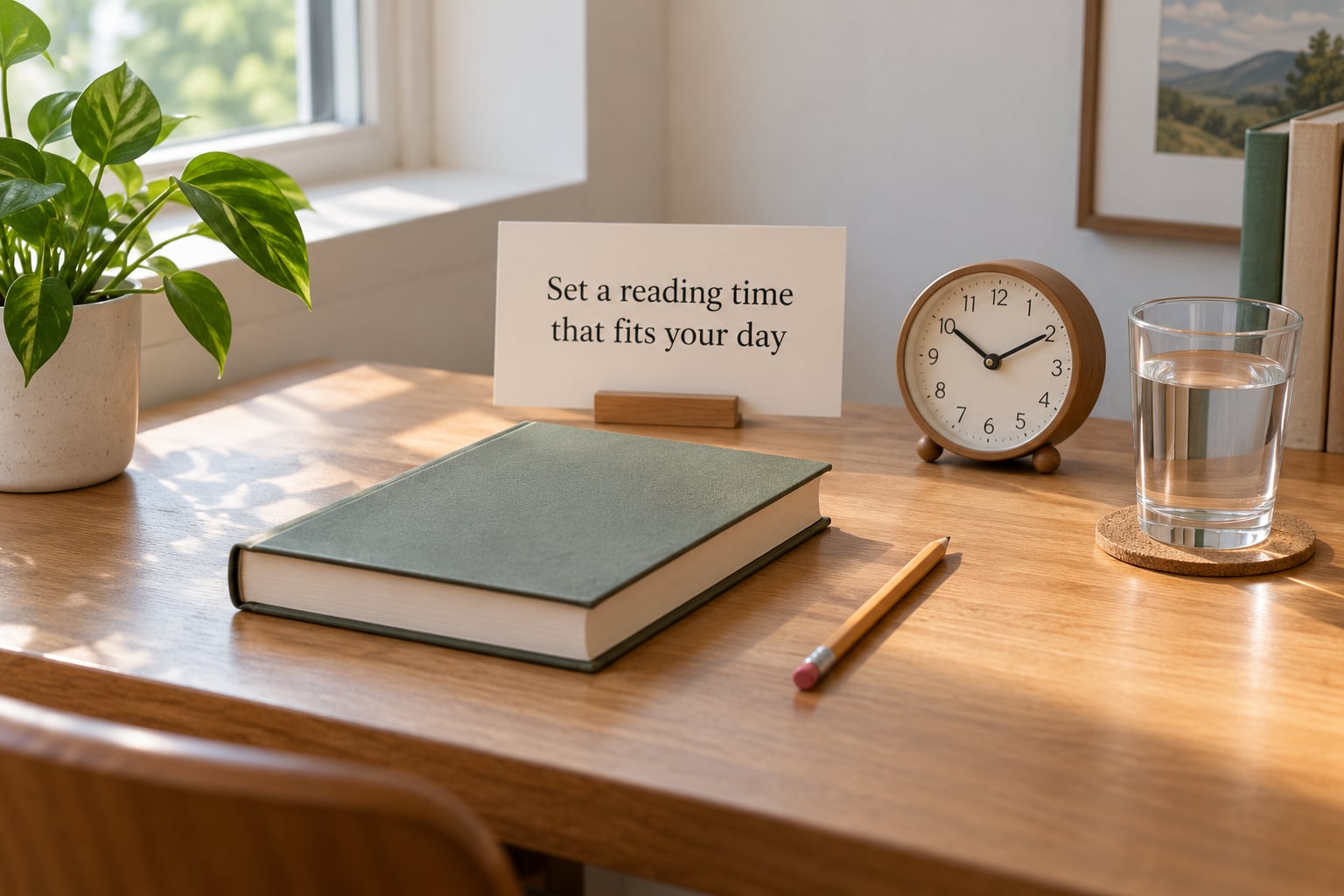
Choose one window and defend it. Twenty minutes after waking, the length of a bus ride, or the last twenty minutes before you switch off the light all work.
Morning slots tend to hold up better because nobody can interrupt you, and the reading is done before the day’s obligations stack up. Bedtime slots feel better and often die first, because a bad day pushes them off. A commute slot is the most interrupted but also the most replaceable, since you can do it on a train, in a car, or on a walk.
Write the time somewhere you will see it in the morning, not at night when you are deciding. If you tell yourself you will read “in the evening,” you have not chosen a time. You have named a phase of the day where you are tired.
You know it is working when three days pass and you have not once had to decide whether to read.
2. Choose an easy starting point
The book matters more than the schedule. A book you find boring at page 20 will not be rescued by discipline, and readers who abandon a book usually abandon the whole habit a month later.
Give yourself permission to quit. A book that has not moved you by the time you are about a fifth of the way in is usually telling you the truth. Put it in a “maybe later” box, not the bin, and start something else the same day.
Keep two backups. One is the book you are on. The other is a short piece, an essay, a few pages of poetry, because some days the full book feels like too much of a commitment.
If you genuinely do not know where to start, borrow a book about something you already care about rather than something you think you should read.
3. Read a small, defined amount
Decide the number before you sit down. Ten pages. Fifteen minutes. One chapter. A defined end is what makes this repeatable; an open-ended “read a bit” invites the session to collapse into either nothing or an entire evening.
Then lower the bar for starting, not for finishing. Open the book, read one page, and give yourself the option to stop. Most sessions continue past that point on their own.
For readers whose attention scatters, try shorter bursts rather than longer sessions. Four minutes, four times a day, adds up to more pages than one distracted hour, and the restarting cost is what kills most attempts.
It is working when you can finish a session before you would have said the time was up.
4. Record the session immediately
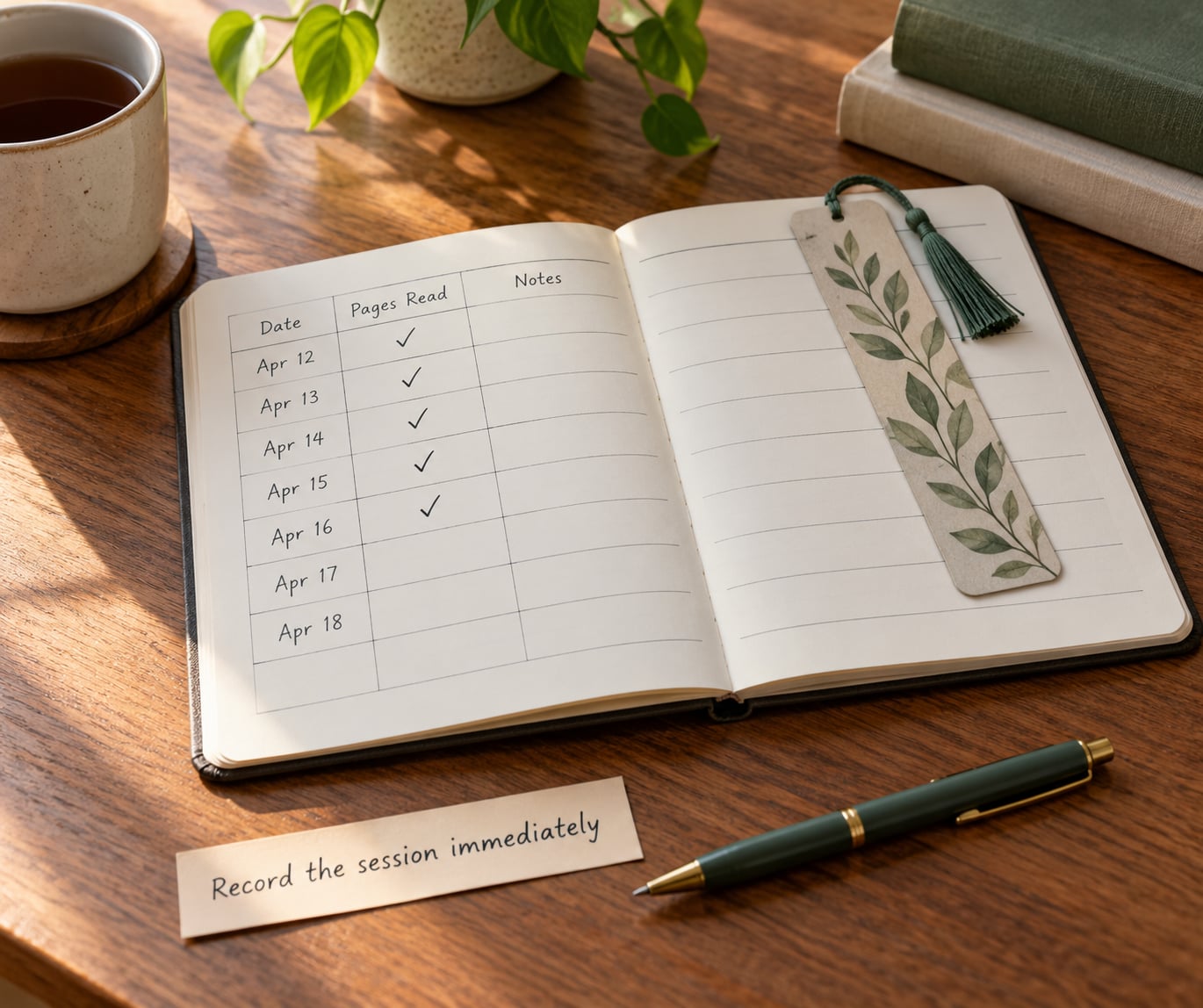
Mark it the moment you stop reading, not at night. Recording later means the recording becomes a task you can skip, and a skipped record is a session that did not happen.
A visible record builds momentum faster than any amount of good intention. A run of marks on a calendar is genuinely satisfying to look at, and people protect things they can see.
Keep the record simple: date, minutes or pages, maybe a half-sentence note on what stuck with you. The note is worth more than the number, because it is the part that turns reading from a task into a conversation you are having with a book.
Be careful that the tracker does not become the project. If a streak is making you anxious, count hours instead of pages, or drop the tracker for a month and keep the reading.
5. Adjust the routine without abandoning it
Expect a bad week, because a bad week is part of the plan rather than evidence the plan failed. Review what actually happened rather than what you meant to do.
If you missed because the time was wrong, move it. If you missed because the book was slow, change the book. If you missed because you forgot, the problem is the cue, not your character, so make the cue louder: leave the book on top of your shoes, put a bookmark in your wallet, or set a repeating alarm with a plain name like “read.”
Raise the target only after you have had a run of good days. Five minutes becomes ten becomes twenty, and each increase takes a week or two to feel ordinary.
And when you miss, come back the very next day at the smallest possible size. A two-page day still counts. On r/ADHD, one reader set a resolution of two pages a day and reported that the low floor was what made it stick; the number sounds silly and it is the point.
How Many Pages a Day Should You Read?
Use pages as a rough guide, not a grade. A page of dense nonfiction takes longer than a page of a thriller, so minutes are the fairer measure once you are past the first few weeks.
- 5 pages a day. About 1,825 pages a year, which is roughly six books at 300 pages each. Suits beginners, tired evenings, and anyone returning after years away.
- 10 pages a day. About 3,650 pages a year, roughly twelve books. This is the realistic minimum for an adult novel.
- 20 pages a day. About 7,300 pages a year, roughly 24 books, or one book a fortnight.
- 50 pages a day. About 18,250 pages a year, roughly 60 books. Suits readers with hours to spare, usually nonfiction or light fiction.
The 10-page rule is simply this: read ten pages every day, and you finish about a book a month. The 50-page rule is the same idea at double the effort, and it works well for people who read the way they listen to podcasts, in the background of a commute.
Readers keep asking whether 20 pages a day counts. It does, and it is roughly a book a fortnight, which is a genuinely large number of books over a year. One hundred pages a day is around 30 books a year and needs about three hours of daily reading; it is achievable for a student on break or a retiree, and unrealistic for a parent of young children. Two hundred pages a day is closer to 60 books and is a full-time job, not a habit.
Set a page target only if you enjoy numbers. A time target reads better with audiobooks and commutes, where pages are not the point.
What Prolific Readers Actually Do
The names people ask about are useful mainly for one lesson: volume comes from time protected, not from willpower.
Warren Buffett has said he reads five to six hours a day on a stack of books and trade journals, keeping a lifetime learning rate around 50 pages an hour by spending less time on the material he already knows. Elon Musk has described reading long stretches on a Saturday while his children were at a birthday party, working through history, science and fiction together.
Both describe a person who has already built the habit, so neither tells you where to begin. Begin with ten pages and let the volume arrive later.
Change Your Environment So Starting Is Effortless
Make the book the obvious choice in a room where you already spend time. The advice circulating widely, and the one most worth stealing, is to put a book on your pillow. In the morning you are already there.
Other low-effort placements: on the coffee machine, by the kettle, on the front seat of the car, next to the bathroom door. The cue does the work your memory keeps failing to do.
Remove the competing cue. Phone in another room, or face down and on Do Not Disturb. Several readers on r/books credit cutting off social feeds well before they pick up a book, then treating the reclaimed minutes as their reading budget. That is the environment half of the job done properly.
Make the sitting place easy too. Good light, something to lean on, a surface that holds the book. You do not need a reading nook. A comfortable chair you can find in ten seconds is better than a perfect corner you never use.
Diagnose Why You Actually Do Not Read
Before adding tactics, work out which of the four is the real blocker, because the fixes do not overlap.
No time. You finish most days without a gap. The answer is a shorter target in a more protected slot, not a longer one.
Attention scatters. You read three pages and pick up your phone. The answer is bursts and a separated device, not more willpower.
Book choice. You start books and quit around chapter four. The answer is a shorter list and permission to abandon.
Format mismatch. You commute daily, cook most evenings, or have a job that takes your eyes. The answer is audiobooks and ebooks, which turn dead time into reading time.
One reader on r/books described reading the same book for most of a year because they never found an uninterrupted window. That is a time problem, not a discipline problem.
How to build a daily reading habit when your attention scatters
Read where scrolling is not also possible: a paper book, on a train, in a library, or on a device with the apps removed. Then shrink the session and repeat it more often, since restarting is the expensive part, not the reading.
Generations of young adults read less than their parents did, and the usual explanation is not laziness but competition. A phone gives you something new every few seconds, so reading has to compete on a level playing field: short, frequent, and immediately rewarding.
Audiobooks help here more than most advice suggests. Walking, driving, folding laundry and cooking are attention-light tasks where a book is still a book.
Track Your Reading Without Letting Tracking Become the Point
Tracking helps because it makes the habit visible, and a visible habit is easier to protect. It helps less once the numbers start generating guilt, which is why a low-effort system beats a detailed one.
- A paper notebook. Zero friction, always works, private. Best for readers who want to think, not count.
- Goodreads. Best for a social reading life: lists, shelves, and friends whose reading you can see. Its interface has been the subject of endless complaints, and plenty of readers have moved elsewhere.
- StoryGraph. The most common destination for readers leaving Goodreads, with mood and pace filters and a calmer, more private feel.
- Kindle reading insights. Nothing extra to maintain. Several Kindle users report the built-in time and page counter alone is enough to keep them going.
- A general habit tracker. Useful for the streak and the calendar, wrong for cataloging books.
Pick one, use it for two months, then decide whether it helps. A tracker you resent is a reason to stop reading, and there is no virtue in maintaining one.
Some readers prefer not to quantify at all, and that is a reasonable position. A reader on r/books asked how to unquantify their reading habits, and the honest answer for that reader is a book journal with no numbers in it.
What to Do When You Miss a Day
The habit does not break when you miss a day. It breaks when a missed day becomes a missed week, because the story you tell yourself changes from “I slipped” to “I do not really read.”
So here is the recovery sequence. Do not try to make up the reading. Open the book at the smallest size you can manage, one page or two minutes, and stop there if you want. Keep the record unbroken by logging it honestly, even if it says one page. Get the cue back in place tonight, so tomorrow has something to attach to.
The widely repeated rule is never miss twice, and it works because it replaces a streak count with a single question: is today a miss or a reset?
If you have missed more than a week, shrink further rather than restarting at your old target. Two pages a day for a fortnight rebuilds the routine, and a rebuilt routine beats a perfect one you abandoned.
A 30-Day Reading Habit Plan
Week 1: five minutes a day. The goal is not reading. The goal is seven marks on a calendar and a cue you can find without thinking.
Week 2: ten minutes, same slot. Add the second backup book so a slow patch never means zero pages.
Week 3: fifteen minutes, and introduce a rule. You can go up to twenty on a weekend day, and you abandon anything you have not enjoyed by the one-fifth mark.
Week 4: twenty minutes, plus one extra slot. Add a second short session in the morning or the commute, and check whether the original slot is still the one that works.
After thirty days you have a routine and roughly 400 pages behind you. From here, raise the target by five minutes a week and leave the rest alone. If you want structure for the next stage, a monthly reading challenge works well, and a book club adds the one thing a private habit lacks, which is somebody who notices when you stop showing up.
Reading for People Who Hate Long Books
Some readers do not have a problem with reading. They have a problem with 300 pages, and no amount of discipline targets the right thing.
Novels run 80 to 140 pages, and a few good ones are under 200. Short story collections and essay collections deliver a different piece in every sitting, which suits burst readers better than a continuous narrative. Poetry fits into a waiting room. Essays on a single idea suit readers who like an argument.
Magazines and newspapers give you a few strong pieces a week with no commitment at all, and a good way to discover authors before committing to a whole book.
Children’s and young adult novels are genuinely well written and short. Nobody is being graded on what you read.
Common Mistakes
Choosing a book to improve yourself. Literary fiction chosen for the wrong reasons is the most common cause of a stalled habit. Pick something you would read on holiday.
Setting an aspirational target. A hundred pages a day framed as a starting goal usually fails within weeks and leaves you feeling bad. Start where you already are and raise it later.
Re-reading instead of moving forward. Rereading comfortable pages feels productive and stalls your sense of progress. Push on for two chapters before deciding the book is finished.
Treating a missed day as failure. One missed day is a missed day. The damage comes from the two days after it.
Reading on the phone with the phone in your hand. The device is the problem, not the format. Kindle, audiobooks, or any print book remove most of the friction.
Letting the tracker become the point. A streak you resent is a quota, and quotas get abandoned. Drop it before you drop the reading.
Waiting for a free afternoon. Free afternoons are rare. The habit has to fit inside a normal Tuesday, and if it does not, it is too big.
Two smaller habits fix most of these: use an audio book for the commute or the chores so dead time becomes reading time, and join a book club for the social pressure that keeps a private habit honest.
Frequently Asked Questions
How do I start reading every day when I read nothing at all right now?
Start with five minutes at a fixed time you already have, such as after your first coffee, and pick a book you would read for fun rather than one you feel you should read. Give yourself permission to stop after one page. The first week is about the cue, not the reading. Once seven days pass with a mark on a calendar, raise the target to ten pages.
How do I choose books I will actually finish?
Choose something short, familiar in shape, and interesting to you, and check whether it still interests you around the one-fifth mark. Most stalled habits come from quitting a dull book rather than from a lack of discipline. Keep a second easy option, such as a short story collection or a few pages of poetry, so a slow patch never means zero pages.
Can I read every day when I am tired?
Yes, if you drop the target on those days rather than the habit. Two pages or five minutes still counts, and keeping the record unbroken matters more than the number. Reading when exhausted is how the cue stays attached, and the small sessions are what hold the routine together through a hard week.
Do audiobooks count as reading when building a habit?
For habit purposes they do, because the cue and the routine are the same and the time is yours. Audiobooks also add reading hours that print books cannot, since walks, commutes and chores work fine. If a subject needs visual reference, such as a cookbook or an illustrated textbook, keep those in print.
Should I track my reading, and with what app?
Tracking helps early because it makes the habit visible, so pick the lowest-friction option available. A paper notebook suits reflective readers, Goodreads and StoryGraph suit people who like social features, and Kindle reading insights need no extra app at all. Review after two months: if the numbers make you anxious rather than steady, count hours or stop tracking.
How do I get back into reading after a long break?
Do not restart at your old level. Set the smallest target you would not be embarrassed by, such as two pages, and read it at the same time each day for two weeks. Rebuild the cue first, then the volume. A reader on r/ADHD reported that a two-page-a-day floor was what kept the habit alive through a difficult year.
Conclusion
Pick a time now, before you close this page. Choose a book short enough that you could finish it in a week, put it where you will see it tomorrow morning, and read ten pages. Record the ten pages. The rest is repetition, not willpower.
How to build a daily reading habit comes down to doing the same small thing on a day you would rather skip. Start with five pages, mark the calendar, and let the routine get louder than the excuse. That is the whole method, and it works because it is small enough that you will not stop.