
Knowing how to write a book report that gets an A is less about clever sentences than about what you decide before you type. An A-grade report is a short analytical essay, not a retelling: roughly 20-25% summary and 75-80% analysis, organized around one arguable thesis statement and supported by quotes with page numbers. Most students lose points not because they misread the book but because their reports are 80% plot recap. The fix is a repeatable process, and it takes about six to eight hours spread across a few days rather than one night.
The students I hear from most often don’t know what their teacher actually wants. They finish the book, open a blank document, type “In this report I will discuss,” and then stall. A rubric and thirty minutes of planning solve most of that.
Below is the process I give students, in the order they should do it. Each step tells you how to tell when you finished it.
Table of Contents
What You Need
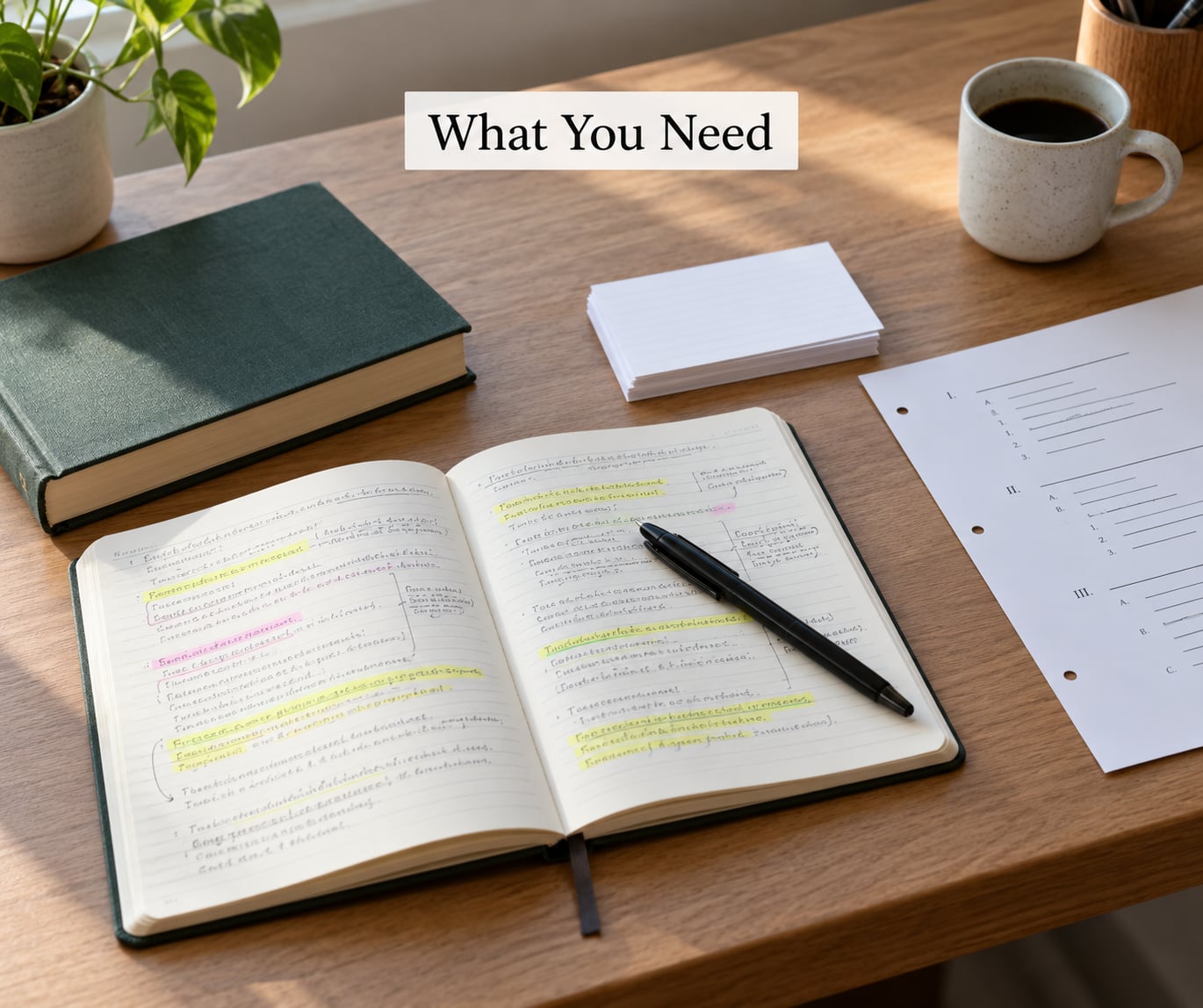
Gather these five things before you write a single sentence. The first two decide whether the report is the right assignment at all.
- The book itself, ideally the assigned edition so your page numbers match your teacher’s.
- The assignment prompt, read twice. Note the word count, the due date, the required sections, and the citation style.
- The teacher’s rubric, if one exists. This is the single highest-value document in the assignment and almost nobody opens it. A rubric tells you which criteria earn the A, whether a thesis is required, and how much of the grade is mechanics versus analysis.
- Your reading notes, organized into plot, character, theme, and quotes rather than one undifferentiated pile.
- Your citation guidelines, usually MLA 9 for English classes and APA 7 for some social studies and first-year seminar courses.
Also decide your tooling. A physical notebook for reading and a word processor for drafting works better than most students expect, because annotation in pen slows you down and forces you to decide what matters before you open the file.
Check the prompt for words like summary, response, reaction, review, analysis, or character analysis. They point to different assignments with different structures, and writing the wrong one is expensive.
Step-by-Step: How to Write a Book Report That Gets an A
1. Understand the Prompt and Rubric
Read the assignment sheet and turn it into a short list of requirements you can check off later: length, citation style, required sections, whether personal opinion is allowed, and how many sources beyond the book itself you need.
Then read the rubric row by row and note the criteria that carry the most weight. In most English rubrics, thesis and analysis carry roughly half the grade, evidence about a quarter, and organization and mechanics the rest.
You know this step worked when you can state the assignment in one sentence, including what grade level of thinking it expects. If you cannot, ask your teacher before drafting rather than after.
2. Read the Book and Take Notes
Read actively, in two passes if the book is long. The first pass is for plot and character; you are tracking what happens and how each main character changes.
The second pass is where the report gets built. Annotate passages you could not stop thinking about, and record for each one: page number, a short quotation, and two sentences on why it matters.
Separate your notes into three columns on paper or in a document: what the book does, what I think it means, and what I notice about how it does it. That third column is the analysis most students skip entirely, and it is where the highest marks live.
You know this step worked when you have at least ten quotable passages with page numbers and no whole chapters left blank.
3. Write a Focused Thesis Statement
A thesis is one arguable sentence about the book, not a topic sentence about a chapter. Compare the two:
- Weak: To Kill a Mockingbird is about racism and injustice in the South.
- Strong: Harper Lee uses Scout’s childlike narration in To Kill a Mockingbird to show that moral clarity, not social privilege, is what finally defeats a false accusation.
The weak version cannot be argued with, so there is nothing to prove. The strong version names a technique, a text, and an effect, and the whole report can be built on top of it.
A reliable formula: The author uses [technique or choice] to show [claim about meaning]. It works for fiction and nonfiction, and it takes about two minutes per draft.
You know this step worked when a skeptical reader could disagree with your thesis. If it is obviously true, it is probably too thin.
4. Select and Explain Evidence
Pick two to four quotes that actually prove your thesis rather than quotes that merely happened to be good. Two well-explained quotations beat six dropped-in lines every time.
Integrate them with a lead-in and a follow-up. The lead-in sets up why you are quoting; the follow-up explains what the quotation proves. Never end a paragraph on a quotation and hope the reader sees the point.
Do the arithmetic that keeps length under control: about one sentence of summary for every three or four sentences of analysis. If your draft breaks that ratio, you are retelling the book instead of analyzing it, and it is the most common reason a good reader earns a B.
Nonfiction and memoir follow the same rule with a shift in emphasis. Replace plot with the author’s argument, structure, and evidence, and look for what the author chooses to include or leave out.
5. Create an Organized Outline
Give every body paragraph one job: one claim, supported by at least one quote and page number, explained in two to four sentences of your own analysis. Build your outline and the report structure at the same time.
A workable outline for a five-paragraph report:
- Introduction (4-5 sentences): title, author, genre, context, thesis.
- Summary paragraph (4-6 sentences): the minimum a reader needs, no more.
- Body paragraph 1: first literary or argumentative point with evidence.
- Body paragraph 2: a second point, ideally a counterpoint or complication.
- Body paragraph 3: the point that ties back most directly to your thesis.
- Conclusion (3-4 sentences): what the book leaves the reader with, extending rather than repeating the thesis.
Use the whole back of an index card for this. Students who skip it tend to repeat themselves in the third body paragraph because they run out of distinct points and get vague instead of specific.
6. Draft the Book Report
Write the introduction last if you like, but write it first if drafting anxiety is the problem. Either way, it needs five things: title and author italicized, genre, a sentence of historical or literary context, your thesis, and a roadmap sentence.
Skip the filler openings. “This book is about…” and “In this report I will discuss…” tell a teacher nothing. Three moves that work better:
- Open with a detail from the text: one concrete image or line that the rest of the report explains.
- Open with a question about craft: why the author chose a particular form, voice, or ending.
- Open with a contrast: what the book suggests compared with what readers expect.
On the title page, most English teachers expect MLA 9 formatting with the works cited entry, and some first-year or social studies courses expect APA 7 instead. Follow the prompt, and if it names neither, check your rubric.
For conventions, default to present tense, third person, and an objective tone unless your teacher says otherwise. Students on writing forums ask constantly whether first person lowers a grade; the answer is usually yes for formal analysis, occasionally permitted for a reflective response. Ask rather than guess, because it is a one-message question and it protects a whole grade band.
7. Revise, Proofread, and Submit So It Gets an A
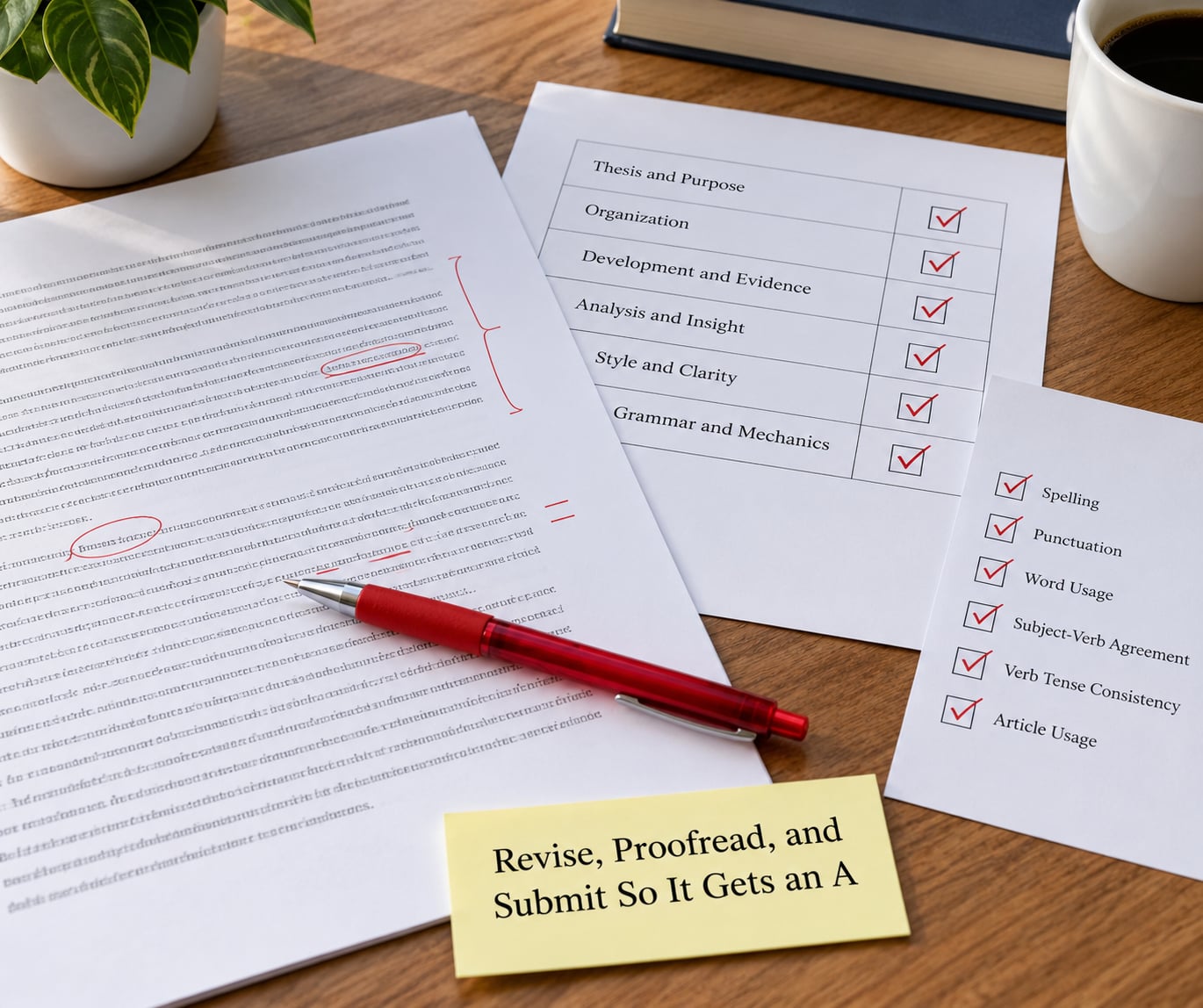
Revision is where grades are actually won. Read the draft out loud once, then work through it in three separate passes, because you cannot catch argument problems and comma problems in the same reading.
- Pass one, argument: does the thesis appear in the introduction, does every paragraph support it, and did you repeat yourself anywhere?
- Pass two, evidence: are quotes accurate, correctly punctuated, and followed by explanation rather than dropped at the end?
- Pass three, mechanics: subject-verb agreement, comma splices, citation format, works cited alphabetized, header and margins.
Then check the requirements list one final time. Word count, required sections, citation style, number of sources. Missing one of these is the cheapest kind of point to lose and the most common.
One last thing for 2026 students: keep the report your own. Teachers now read for voice, and a report that has never been rewritten by you reads wrong to anyone who has read student writing. Use outside tools for feedback or structure, then rebuild every sentence in your own words. A shorter report you actually read and revised beats a polished one you don’t recognize.
You know this step worked when you can match the finished report against every line of the rubric and confirm each item.
Common Mistakes
These six account for most lost points. Each has a specific fix you can apply in one pass.
1. Summarizing the whole book. The plot paragraph runs four paragraphs long and the analysis never starts. Fix: cut the summary to one paragraph of four to six sentences, then apply the one-to-three-or-four summary-to-analysis ratio to everything after it.
2. Opinions with no support. “I loved this book and it was really sad” is a reaction, not analysis. Fix: attach every opinion to a moment in the text, then rewrite the sentence to argue something about the book rather than about your feelings.
3. A topic instead of a thesis. You cannot prove “the book is about injustice.” Fix: use the author-uses-to-show formula and name a specific craft choice.
4. Weak evidence. The quote does not connect to the claim, or it was chosen because it was short. Fix: ask of each quotation, does this prove my sentence? If the answer is unclear, replace it.
5. Repeating the thesis in the conclusion. Ending with “In conclusion, this book shows…” adds nothing. Fix: answer the question your introduction raised, and say what a reader should carry out of the book.
6. Ignoring the rubric. The report was well written and still lost points on a required section or citation style. Fix: run the report against the rubric line by line before submitting, not after.
One practical habit that helps more than any other: leave at least one full day between the draft and the revision. Problems you cannot see at midnight are obvious at ten in the morning.
Frequently Asked Questions
How long should a book report be?
Length depends on grade level and the prompt, but most fall between 300 words in upper elementary school and 1,500 words in a college literary analysis course. Middle school usually runs 500 to 700 words and high school 750 to 1,000. If your teacher gives no number, the safer choice is the shorter end. A tight 600-word report with four well-explained quotations scores higher than a padded 1,200-word plot recap.
How many quotes should I include in a book report?
Two to four quotations per body paragraph group is plenty, and most strong reports use six to ten quotations overall. The number matters far less than the explanation after each one. A single quotation analyzed properly for four sentences beats six dropped in with a line of context. Cite the assigned edition so your page numbers match your teacher’s copies.
Can I give my opinion in a book report?
Usually, but only as evidence for an argument about the book rather than as a review of it. Saying the ending was predictable is not analysis. Saying the author’s foreshadowing in chapter three sets up that ending in a way you can trace is. For a reflective response or reaction assignment, personal opinion is the point. For a formal report or literary analysis, check the prompt before you write a single personal sentence.
How do I cite quotations from a book?
In MLA 9, put the author surname and page number in parentheses after the quote, such as (Lee 281), and add the page to a Works Cited entry that lists author, title in italics, publisher, year, and location. In APA 7, use the author and year in the in-text citation and place a page or paragraph number there when the wording matters. Always ask which style your course requires.
Should a book report include a summary?
Yes, but a short one. One paragraph of four to six sentences is enough to orient your reader, and the rest of the report should be analysis. Aim for roughly 20 to 25 percent summary and 75 to 80 percent analysis as a working ratio. If your teacher asked for a book review or a reader response instead, the balance shifts, since those assignments are built around your reaction rather than the text’s meaning.
Start With the Prompt, the Thesis, and Your Best Evidence
If you do only three things, do these: read the rubric first, write one arguable thesis sentence, and find two quotations you can explain properly. Everything else in the report is structure around those three decisions.
Then give yourself a full day before revising. That gap is where most of the difference between a B and an A happens.