
To quote dialogue in an essay, put a character’s spoken words in double quotation marks, keep the comma or period inside the closing mark, and place the parenthetical page citation after that closing mark. Anything longer than four lines of prose (or 40 words in APA) becomes an indented block quote with no quotation marks at all.
Those three moves cause most of the red ink on a dialogue essay. Once you have them down, the rest is a matter of choosing the right line, introducing it properly, and saying something about it afterward.
This guide walks through the whole process, including the parts style guides disagree about, like where the citation sits and what to do when a character quotes another character. Use the wrong-versus-correct table near the end to check your own draft before you submit it.
Table of Contents
- What You Need
- Step-by-Step: How to Quote Dialogue in an Essay
- Common Mistakes and Quick Fixes
- Frequently Asked Questions
- How do I quote dialogue in an essay without breaking the punctuation rules?
- Do you need quotation marks around dialogue quoted in an essay?
- How do you cite a quotation from a play in an essay?
- How long can a quotation be before it becomes a block quotation?
- Can you change a word inside a quotation from a book or play?
- Should a quotation be introduced before it appears in the essay?
What You Need
Quoting dialogue takes about ten minutes of preparation, but doing it with the wrong materials costs you an hour of rewriting.
- The source in a form with page numbers. A print book, a PDF with stable pagination, or an ebook reader that shows the location number. Literary analysis essays are cited by page, and a Kindle edition that repaginates will not match your professor’s copy.
- Your instructor’s required style. MLA, APA, and Chicago disagree about block quote length, indentation, and where the citation goes. Check the assignment sheet or ask. Do not mix two systems in one paper.
- The point the quotation has to prove. Write that point in your own sentence first. A quote with no job to do is the sentence most likely to get cut by a peer editor.
- An authoritative style reference. The MLA Handbook, Purdue’s Online Writing Lab, and your university’s writing center all cover dialogue punctuation in more detail than a summary blog can. When two sources disagree, those three win.
You do not need special software. A word processor with an indent setting is enough, and most style guides are free online.
Step-by-Step: How to Quote Dialogue in an Essay
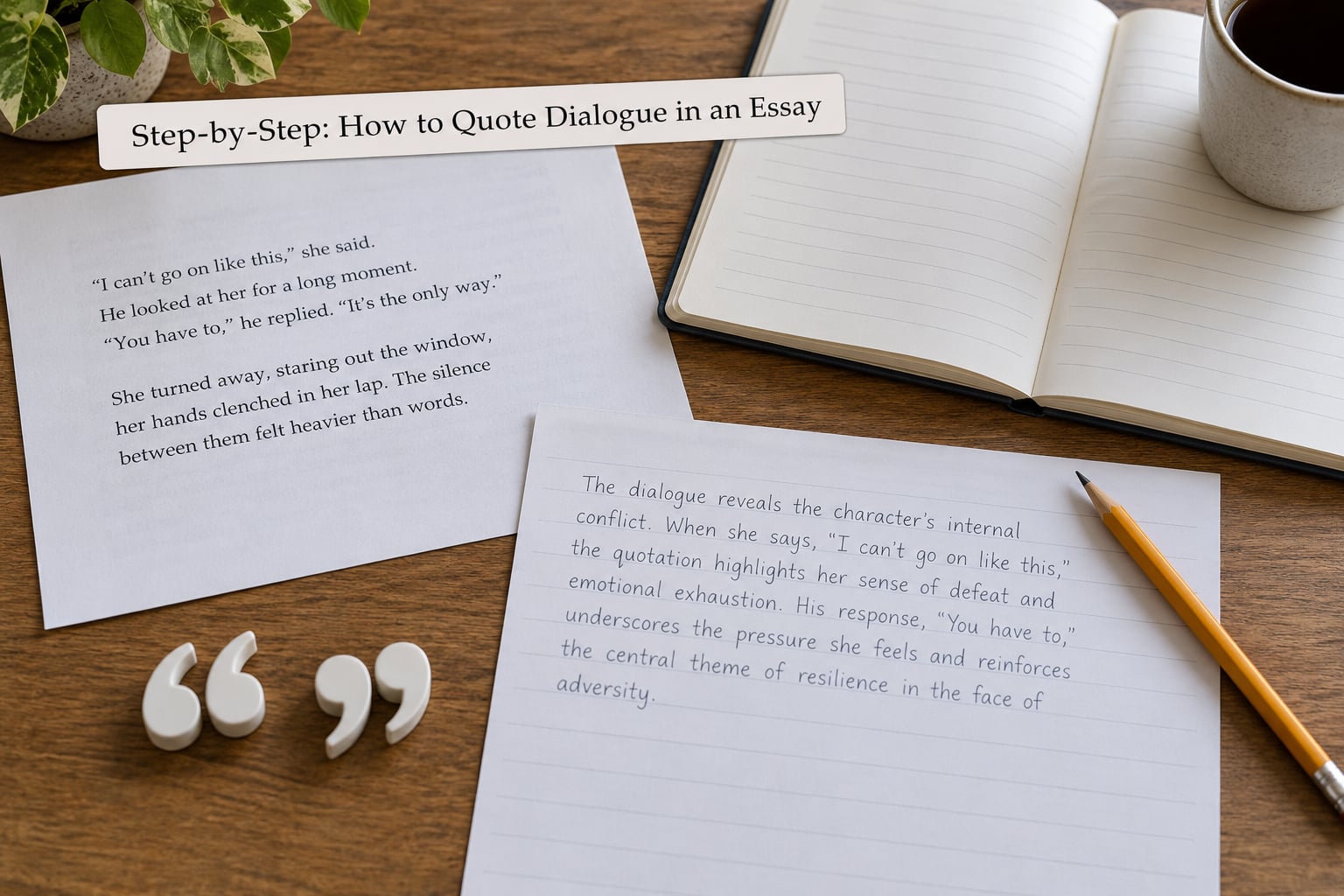
Step 1: Choose Dialogue That Supports Your Point
Pick the line that does the most argumentative work, not the line that sounds best. Read the passage twice: once for what is literally said, once for what the choice of words reveals about character, conflict, tone, theme, or historical context.
A good test is whether you can finish the sentence “This matters because…” without repeating the quotation. If you can’t, you have found a nice-sounding line that doesn’t yet belong in the essay.
Keep quotations short by default. Four lines is the MLA ceiling for a quote run into your sentence, and shorter quotes almost always look more confident than long ones.
Step 2: Introduce the Quotation
Give the reader three things before the quotation arrives: who is speaking, what is happening, and why this moment matters. A signal phrase is not optional in analytical writing, because a quotation with no lead-in forces the reader to stop and figure out whose voice they are hearing.
Change the tag verb where you can. “Says” is safe, but a mix of replied, muttered, insisted, and warned keeps the paragraph from going flat. The rule of thumb is one strong tag verb per paragraph, not per sentence.
Name the character or the scene, not just the work. “In the closing scene, Nora admits that…” beats “In the novel, she says…” every time.
Step 3: Format a Short Quotation
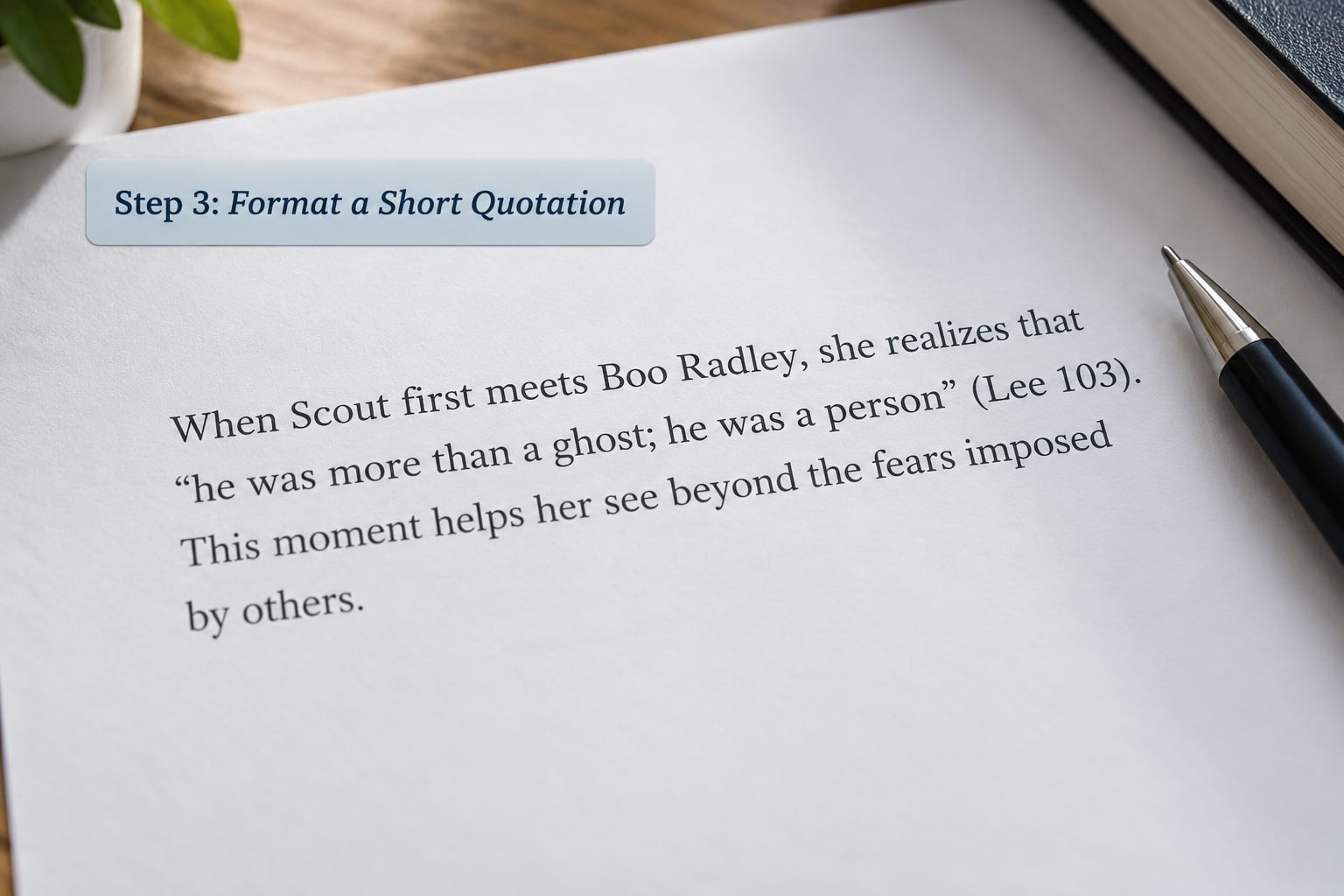
Put the spoken words in double quotation marks, capitalize the first word, and put the punctuation inside the closing mark. When a tag follows the quotation, add a comma before the closing mark unless the quotation already ends in a question mark or an exclamation point.
Capitalization follows the sentence, not the source. If you drop a quotation into the middle of your sentence, “I never lied” stays lowercase. If you start a new sentence with it, it becomes “I never lied.”
The tag can sit before, after, or in the middle of a short quotation, and each position carries a different emphasis. Putting the tag first slows the reader down before they reach the line, which is useful when the setting matters. Putting it last lands the emphasis on the words themselves.
Step 4: Set Up a Long Quotation
A quotation runs long when it exceeds four lines of prose or verse in MLA, or 40 words in APA. Chicago uses roughly 100 words as the point where a block quote begins. When you cross that line, the formatting changes completely.
Set the block quote on its own line, indented half an inch from the margin, with no quotation marks. Keep the original punctuation as it appears in the source, and place the parenthetical citation after the final period, as you would at the end of an unquoted sentence.
You do not need an ellipsis at the start of a block quote that begins where the excerpt begins. Skip the citation for a work already named in the sentence that introduces the block.
Step 5: Add Interruption or Omission Marks
Use an ellipsis to skip material inside a quotation and brackets to change it. Three dots (or three spaced periods, depending on your style guide) replace the words you removed; anything you add for clarity goes in square brackets so the reader knows the words are not the original author’s.
An em dash pair marks an interruption by another speaker: “I said the door was—” “You said nothing.” Without the dashes, two speakers’ words run together and the reader loses track of who said what.
Do not smooth out grammar or slang inside a quotation unless you mark the change. Character voice is evidence, and “cleaning up” it removes the evidence you quoted for.
Step 6: Cite the Quotation
The citation always comes after the closing punctuation, and in American style the period sits inside the quotation marks with the parenthetical following it. This is the placement students question most, usually because it reads like two closing marks in a row.
| Rule | MLA | APA | Chicago |
|---|---|---|---|
| Quote runs into your sentence up to | 4 lines | 39 words | about 100 words |
| Block quote threshold | More than 4 lines | 40 words or more | 100 words or more |
| Block quote indentation | Half inch from margin | Half inch from margin | Half inch from margin |
| Quotation marks on a block quote | None | None | None |
| Citation position | After the closing punctuation | After the closing punctuation | In a note, or after the punctuation |
| Citing a play | Act.scene.line | Act.scene.line | Act.scene.line |
A play gets numbers instead of page numbers because different editions paginate differently. For a line from Shakespeare, cite the act, scene, and line, then give the Works Cited entry by title, editor or translator, publisher, and year.
A personal interview or conversation is cited differently again, and it is the form students forget most. MLA wants the interviewee’s name, the words “personal interview” or “personal conversation,” and the date. APA wants the interviewee’s name, the medium in parentheses, and the date. There is no page number to hunt for.
When two quotations come from the same source, cite each one. A single citation at the end of a paragraph does not cover sentences spread across two pages.
Step 7: Analyze the Quotation
Dropping a quotation into an essay is not analysis. After the closing mark, write at least two sentences that explain the language, place it in context, and connect it to your thesis.
A four-sentence structure that works reliably: name the specific word or image you are examining, explain what that choice implies about the character or situation, connect it to the conflict or theme, and state what it proves about your argument. Skip the summary of the plot; the reader has the book.
Annotating in the margin while you draft makes this step faster. Jot a two-word note next to each quotation about what it proves, then turn those notes into sentences when you revise.
Common Mistakes
The errors listed next account for nearly every comment a writing instructor leaves on a dialogue essay. Read it, then run your draft against the table.
Common Mistakes and Quick Fixes
Each row shows the version that loses marks and the version that does not. The difference is often a single comma or a pair of quotation marks.
| What you wrote | What to write instead |
|---|---|
| He said, “I never lied.” | “I never lied,” he said. |
| Marcus said, “we should go.” | Marcus said, “We should go.” |
| She asked, “Are you coming?” | “Are you coming?” she asked. |
| “Leave now,” the captain shouted. | “Leave now!” the captain shouted. |
| Ella said, “Nate whispered ‘not here’.” | Ella said, “Nate whispered ‘not here.'” |
| A block quote wrapped in quotation marks | No quotation marks on a block quote |
| “I never lied” (Lee, 44) | “I never lied” (Lee 44) |
| He said “we should go.” | He said, “We should go.” |
Three habits catch most of the rest. Read your draft aloud, because spoken punctuation mistakes sound wrong before they look wrong. Then search for every opening quotation mark and confirm it has a partner and a closing mark in the correct position.
Check your style source once, not from memory. British style puts the citation outside and occasionally outside the quotation marks entirely, and publishers disagree with each other about it. Students who switch between sources sometimes end up with two systems in one paper, which is the one outcome every instructor marks down.
One more check: if the essay quotes speech you invented for your own narrative, that is dialogue. Speech you took from a book, play, interview, or website is direct quotation, and it needs a citation. Most lost points in this area come from treating invented dialogue like sourced evidence, or the other way around.
Frequently Asked Questions
How do I quote dialogue in an essay without breaking the punctuation rules?
Wrap spoken words in double quotation marks, keep the comma or period inside the closing mark, capitalize the first word, and add the parenthetical citation after the closing punctuation. Use a comma before the closing mark when a dialogue tag follows, unless the line already ends in a question mark or exclamation point.
Do you need quotation marks around dialogue quoted in an essay?
Yes, for any speech you take from a source, however short. The exception is a block quote of more than four lines in MLA or 40 words in APA, which takes no quotation marks and sits indented half an inch from the margin. Dialogue you wrote yourself in a narrative essay still uses quotation marks, but it carries no page citation.
How do you cite a quotation from a play in an essay?
Use act, scene, and line numbers instead of page numbers, because editions paginate differently. The parenthetical citation follows the closing punctuation, and the Works Cited entry gives the play’s title, the editor or translator, the publisher, and the year. For a poem, cite the line numbers of the version you actually used.
How long can a quotation be before it becomes a block quotation?
In MLA, a quotation of more than four lines of prose or verse becomes a block quote. In APA the threshold is 40 words, and in Chicago it is about 100 words. Block quotes are indented half an inch from the margin, carry no quotation marks, and take their citation after the closing punctuation just like an unquoted sentence.
Can you change a word inside a quotation from a book or play?
Not silently. Use an ellipsis to remove words and square brackets to mark anything you add, such as a pronoun you supply for clarity or a change in tense that makes the quote fit your sentence. If you shorten a quotation enough that it distorts the original meaning, paraphrase it instead and cite the page.
Should a quotation be introduced before it appears in the essay?
In analytical writing, yes. Name the speaker, give the situation, and vary the tag verb so the paragraph does not repeat u0022said.u0022 A quotation dropped in without a signal phrase forces the reader to stop and work out whose voice they are hearing, which weakens the evidence you chose it for.
Start with the shortest quote you can get away with and get its punctuation right: double marks, comma inside the closing mark, citation after the closing punctuation. Then introduce it with the speaker and a varied tag verb, and finish with two sentences that say what the line proves. Everything else, block quotes, nesting, plays, and interviews, sits on top of those three moves.