To cite a poem in MLA format, put the poet’s last name and the line numbers you quoted in parentheses, then list the poem title in quotation marks, the book or website holding it in italics, the publisher or site, the year, and the page range or URL. It takes about ten minutes once you have the six elements in front of you.
That single sentence covers both halves of the job, and students lose marks on the second half far more often than the first. In-text citations are usually fine. The Works Cited entry gets scrambled, because it mixes quotation marks, italics, an editor’s name, a publisher, a date, and a page range, and students rarely see a worked example of all six in one place. This guide shows the templates one at a time, then puts them together.
Everything here follows MLA 9th edition, the current MLA Handbook. Last checked October 2026 against the MLA Style Center and Purdue OWL.
Table of Contents
- What You Need
- How to Cite a Poem in MLA Format: Step-by-Step
- Common Mistakes
- Quick Tips for Citing Poetry in MLA
- Frequently Asked Questions
- How do I cite a direct quotation from a poem in MLA?
- Do I use a page number or line number when citing a poem in MLA?
- How do I cite a poem in MLA if I use it more than once?
- How do I cite a poem from an anthology in MLA format?
- How do I cite a poem found on a website in MLA format?
- What should I do if the poem does not have printed line numbers?
- Conclusion
What You Need
Gather these six elements before you type a single character. Missing one is the reason most citations come back marked up in red.
- The poet’s full name as printed. Middle names are optional, but a pen name needs a note if it differs from the author’s real name.
- The poem’s exact title. Check the capitalization in your source rather than retyping it from memory. Titles of shorter works go in quotation marks; a book of poems goes in italics.
- The container. The anthology, single-author collection, journal, magazine, or website where the poem appears.
- The editor’s name when the container is an anthology, plus the publisher and year of that container.
- The page range for a poem in a printed book. Without it you are pointing your reader at an entire volume.
- The URL for an online poem, typed without the http:// prefix, along with the date you accessed it.
Two more things help. Your instructor’s required edition comes first, because the same poem printed in two anthologies has two different page ranges and sometimes a different text. And know your source well enough to find the quoted lines again quickly, since almost every instructor asks for one spot check during the writing process.
How to Cite a Poem in MLA Format: Step-by-Step
Identify the Poet and Poem
Start by pinning down exactly what you are citing. If your assignment says to read Frost’s “Mending Wall” and your anthology prints it from North of Boston (1914), then that anthology, not the standalone volume, is your source. Cite where you actually read the poem.
Read the title page and the copyright page of your source. Most anthologies print an editor or a small editorial board, and the poem may carry a translator’s credit or a footnote explaining that the text is a reprint from an earlier magazine. Those credits belong in your citation because your reader might need to trace the poem back further.
Write down the container’s full title and the year on its copyright page, not the year printed on the poem’s first page. Old magazines reprint poems years after they first appeared, and the container year is what MLA wants.
For example, Elizabeth Bishop’s “One Art” first appeared in Questions of Travel (1965), while “Mending Wall” sits in North of Boston (1914). Write the version you hold, with the version’s year.
Add Line Numbers for a Direct Quotation
Poetry is cited by line, not by page. That single rule explains most of what follows.
Line numbers come from the text you are using, counted from the first line of the poem. If you quote Frost’s “Mending Wall” in the print anthology and its numbering starts at 1, your citation uses those numbers. Line numbering restarts at 1 for each poem, and a new copy of the same poem may renumber it if line breaks differ.
Three in-text patterns cover almost every poem:
- First quotation from a poem with line numbers: (Frost, lines 9-12). You may write (Frost lines 9-12) too; the comma is optional in MLA 9.
- Later quotations from that same poem: (Frost 21). After the first mention of line or lines, use the number alone for the rest of the poem.
- Poems numbered by stanza and line: use stanza.line, so (Whitman 32.3) points to section 32, line 3.
If the poem has no printed line numbers, do not invent them. Cite the author’s surname only, as in (Bishop), and let the quotation mark the spot.
The word line or lines appears the first time you quote from a given poem, then drops away. It resets for every new poem, even one by a different poet, which trips up people quoting Frost and Shelley back to back. So: (Frost, lines 5-7) and (Shelley, lines 1-4), then (Frost 12) and (Shelley 14).
How to Cite a Poem in MLA: Format the Works Cited Entry
The Works Cited template for a poem in a printed anthology looks like this:
Author Last Name, First Name. “Title of Poem.” Title of Anthology, edited by Editor Name, Publisher, Year, pp. Start-End.
Here it is filled in. The editor is required when the anthology has one, which is most of them:
Frost, Robert. “Mending Wall.” The Poetry of Robert Frost, edited by Edward Connery Lathem, Henry Holt, 1969, pp. 39-45.
When the anthology names several editors, use the first one followed by et al., and when the anthology has no editor at all, drop straight from the italicized title to the publisher:
Williams, William Carlos. “The Red Wheelbarrow.” Poems 1910-1934, New Directions, 1958, p. 331.
An instructor-assigned course reader has no publisher, so describe it instead:
Oliver, Mary. “The Summer Day.” English 212: American Nature Poetry Reader, Dept. of English, Northern State University, 2026, p. 14.
For an online poem, the container becomes the website. Every element stays in the same order, with the URL and access date at the end and no page range:
Shelley, Percy Bysshe. “Ozymandias.” Poetry Foundation, 2017, www.poetryfoundation.org/poems/45165/ozymandias. Accessed 3 October 2026.
A translated poem credits the translator and names the translator’s edition, not the original language edition you read in a school anthology:
Rilke, Rainer Maria. “The Panther.” The Selected Poetry of Rainer Maria Rilke, translated by Stephen Mitchell, Random House, 1984, p. 251.
Here is the whole map in one place. Replace the bracketed parts with your own details, including the real page numbers.
| Source type | Works Cited template | Model entry |
|---|---|---|
| Poem in an anthology with an editor | Last, First. “Poem.” Anthology, edited by Name, Publisher, Year, pp. X-Y. | Whitman, Walt. “Song of Myself.” Norton Anthology of American Literature, edited by Robert M. Perkins, 6th ed., vol. 1, W. W. Norton, 2013, pp. 1893-1912. |
| Poem in a single-author collection | Last, First. “Poem.” Collection, Publisher, Year, pp. X-Y. | Bishop, Elizabeth. “One Art.” Questions of Travel, Houghton Mifflin, 1965, pp. 90-91. |
| Anthology with no named editor | Last, First. “Poem.” Anthology, Publisher, Year, pp. X-Y. | Dickinson, Emily. “I heard a Fly buzz – when I died.” Representative American Poetry, Houghton Mifflin, 1963, p. 112. |
| Poem on a website | Last, First. “Poem.” Website, Date, URL. Accessed Day Month Year. | Shelley, Percy Bysshe. “Ozymandias.” Poetry Foundation, 2017, www.poetryfoundation.org/poems/45165/ozymandias. Accessed 3 October 2026. |
| Poem in a journal or magazine | Last, First. “Poem.” Magazine, vol. #, no. #, Date, pp. X-Y. | Ginsberg, Allen. “Sunflower Sutra.” City Lights, vol. 2, no. 1, 1955, pp. 26-27. |
| Translated poem | Last, First. “Poem.” Selected Poems, translated by Name, Publisher, Year, p. X. | Rilke, Rainer Maria. “The Panther.” The Selected Poetry of Rainer Maria Rilke, translated by Stephen Mitchell, Random House, 1984, p. 251. |
| Manuscript in an archive | Last, First. “Title.” Collection Name, Box #, Folder #, Repository Name, Year. | Frost, Robert. “Draft of ‘Mending Wall.'” Frost Collection, box 14, folder 3, Dartmouth College Library, 1959. |
Use MLA Containerization
MLA 9th edition treats every source as a set of core elements sitting inside a container. A poem is the work; the anthology, journal, or website is the container; everything between them, publisher, editor, date, and page range, belongs to the container.
Ask one question: where did I find this poem? Whatever that place is, it is your container. If a classmate handed you a printed PDF of course readings, the container is that reader. If the poem appears inside someone else’s book, then your container is that book, and you are citing a version of the poem rather than the poet’s own collection.
That secondary case comes up more than students expect. You read Bishop’s “One Art” quoted in a critic’s essay, so you need both citations: the critic’s book for the quotation you actually saw, and Bishop’s own collection for where the poem lives. MLA handles this with qtd. in, short for “quoted in,” placed after the poet’s name in Works Cited:
Bishop, Elizabeth. “One Art.” Complete Poems 1927-1979, qtd. in The Poetry of Perception, by Robert Polito, Houghton Mifflin, 2004, p. 63.
In your text, name the critic, since that is the source you read: (Polito 63).
Two details keep an entry clean. Titles of shorter works, poems included, use quotation marks with a capital first word and a capital first word after a colon. Book, journal, and website titles go in italics with every major word capitalized. Alphabetize the list by the poet’s last name, and if you cited several poems by one poet, use three hyphens in place of the repeated name in later entries.
Common Mistakes
Nearly every lost point on a poem citation comes from one of a short list of errors. Here they are, with the fix.
| Mistake | Why it costs you | Fix |
|---|---|---|
| Reversing the author and title | The entry reads as a title-first citation, which is what you do for an anonymous work. | Poet first: Bishop, Elizabeth. “One Art.” |
| Using a page number for a quotation | Page numbers are for prose; poems are located by line. | Give the line range in text, (Bishop, lines 1-3), and keep the page range in Works Cited only. |
| Dropping line or lines on the first quotation | Your reader cannot tell whether 5-7 means lines or pages. | Write (Frost, lines 5-7) the first time, then (Frost 12) after that. |
| Reusing the number-only form for a second poem | The number-only shortcut applies to one poem at a time. | Repeat line or lines for each new poem, even a different poet’s. |
| Italicizing the poem title | Only longer works get italics. A poem is a short work. | Poem title in quotation marks, book or website title in italics. |
| Leaving out the anthology editor or page range | The container becomes untraceable. | Add edited by Name and the pp. range from your own copy. |
| Numbering a poem that has none | Invented line numbers cannot be verified by anyone. | Cite (Author) only, or note that the source provides no numbering. |
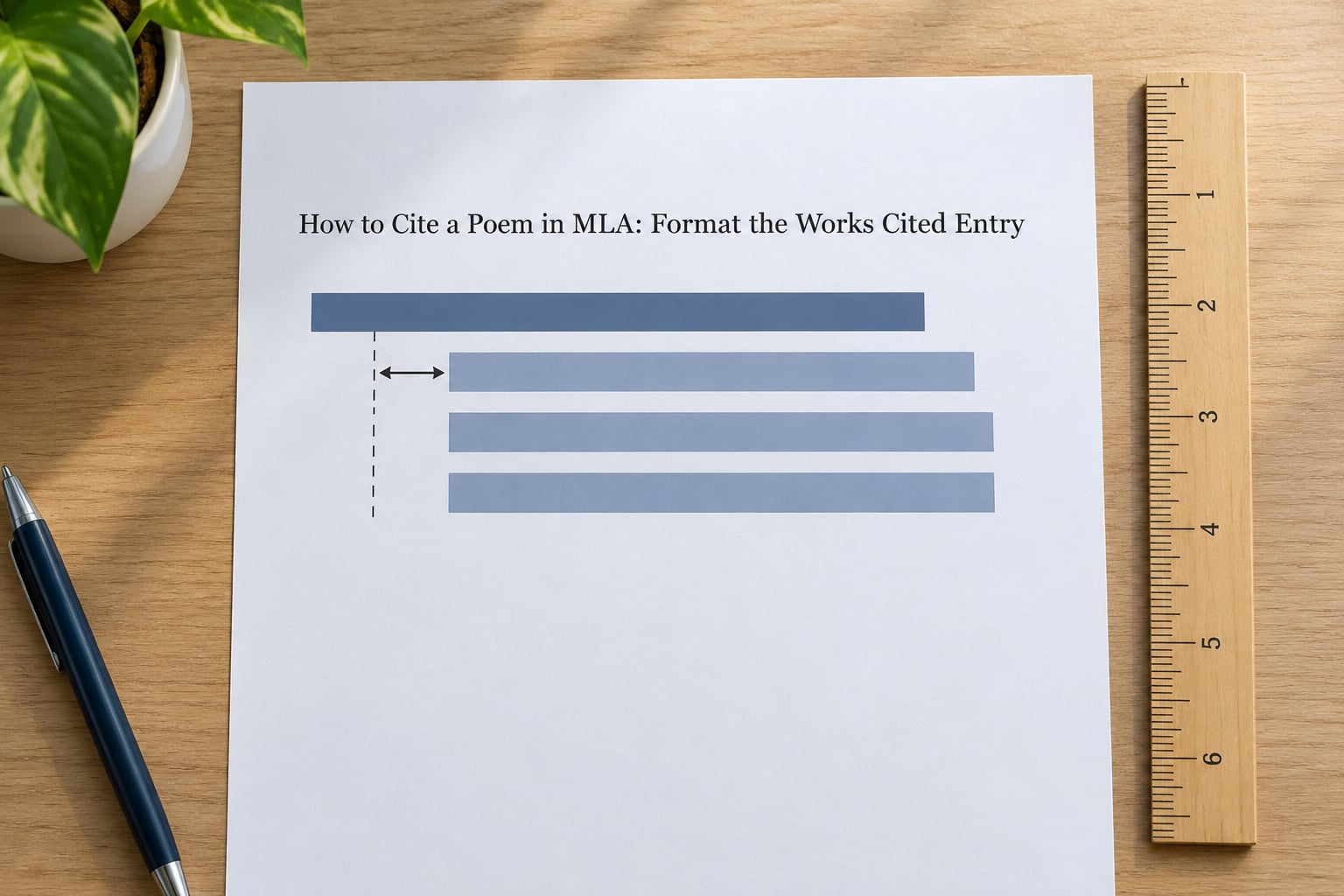
| Forgetting the hanging indent | Every line after the first needs a half-inch indent. | Set a 0.5 inch hanging indent and leave the first line flush. |
| Citing the wrong edition’s year | Reprints print the original date, which confuses readers. | Use the copyright-page year of the container you actually used. |
One more deserves its own note, because it shows up constantly in drafts. A shortened title in the parenthetical citation is only necessary when you quote more than one work by the same poet. Mention the title in your sentence instead of stuffing it into the parenthesis: Williams claims the poem’s form is “scarcely intelligible” in his essay “The Poem as a Container” (241). Students often write (Williams, “The Red Wheelbarrow” lines 1-4), which is wrong on two counts.
Quick Tips for Citing Poetry in MLA
Run this list before you submit. It catches most errors in under a minute.
- Check the word line first. Open every citation and confirm the first reference to each poem says lines, the rest say nothing.
- Read line numbers off the page, not off your memory. Count again if your range spans a stanza break.
- Format quotations to match the poem. Quote three or more lines as an indented block that preserves the original line breaks, with the citation after the last line. Keep shorter quotations inside your paragraph and separate lines with a forward slash, with no spaces around it.
- Keep the same capitalization as the source. Poem titles take a capital first word, a capital first word after a colon, and any other words the source capitalizes.
- Alphabetize, then use three hyphens for a poet’s second and later poems, keeping the list in one piece of the alphabet for that poet.
- Type the URL without http:// and add the access date only when the page has no visible publication date.
- Format your Works Cited page with a 0.5 inch hanging indent, double spacing, and the heading centered, never underlined or in quotation marks.
- Confirm the assigned edition once more against your instructor’s syllabus. When a course specifies a reader, the reader wins over any other edition you find online.
Frequently Asked Questions
How do I cite a direct quotation from a poem in MLA?
Give the poet’s last name and the line numbers, with line or lines spelled out the first time you quote from that poem: (Frost, lines 9-12). Write (Frost 21) for every later quotation from the same poem. If the poem is printed without line numbers, cite the surname alone, as in (Bishop), rather than inventing numbers.
Do I use a page number or line number when citing a poem in MLA?
Line numbers in your text, page numbers in Works Cited. Poems are located by line because they are built line by line, so a reader can find your quotation exactly. The page range in Works Cited points to where the poem sits inside the anthology or collection. Using a page number in the parenthetical citation is the most common poetry citation error.
How do I cite a poem in MLA if I use it more than once?
The first parenthetical citation includes the word line or lines, like (Frost, lines 5-7). After that, drop the word and give the number alone, such as (Frost 12). You only add a shortened title if you quote several poems by the same poet, as in (Frost, lines 1-4) and (Bishop, lines 1-4).
How do I cite a poem from an anthology in MLA format?
Start with the poet’s name and the poem title in quotation marks, then give the anthology title in italics, the editor if there is one, the publisher, the year, and the page range. Example: Frost, Robert. u0022Mending Wall.u0022 u003cemu003eThe Poetry of Robert Frostu003c/emu003e, edited by Edward Connery Lathem, Henry Holt, 1969, pp. 39-45. If no editor is named, go straight from the anthology title to the publisher.
How do I cite a poem found on a website in MLA format?
Use the website as the container in place of a book. Include the poet’s name, poem title in quotation marks, website title in italics, the publication date if one appears, the URL without http://, and an access date. Cite Poetry Foundation poems exactly as: Shelley, Percy Bysshe. u0022Ozymandias.u0022 u003cemu003ePoetry Foundationu003c/emu003e, 2017, www.poetryfoundation.org/poems/45165/ozymandias. Accessed 3 October 2026.
What should I do if the poem does not have printed line numbers?
Do not count and number the lines yourself in the citation. Cite the author’s surname only, as in (Bishop), and keep the quotation in your essay so the reader can see the passage. If your instructor expects more precision, a brief note in your paper explaining that the source provides no numbering is usually accepted.
Conclusion
Do these three things and the rest is bookkeeping. Find the container your poem actually lives in, note the line numbers of the lines you quoted, then fill the Works Cited template for that source type with the editor, publisher, year, and page range. Run the entry once more for the line or lines rule and the hanging indent, and it will hold up.