To cut words from an essay without losing meaning, work from the outside in: cut and merge whole paragraphs first, then tighten sentence by sentence, then trim individual words and phrases, and only then make micro-changes. Every claim, every piece of evidence and your own voice survive, because you are removing weight, not content.
Most students approach trimming the way they approach tidying a desk, grabbing whatever is nearest and shoving it aside. That is why so many finished essays come back from a teacher feeling shorter but no clearer, and why the same filler survives a fifth read. The fix is order of operations, not stubbornness.
Here is the method in full: what to set up before you start, six editing passes, two worked rewrites (one narrative, one academic), a list of what is off limits, and a check you run at the end to confirm the argument came through intact.
Table of Contents
- What You Need
- Step-by-Step: How to Cut Words From an Essay Without Losing Meaning
- 1. Read for the Essay’s Central Claim
- 2. Remove Repeated Ideas and Words
- 3. Cut Filler, Padding, and Empty Openers
- 4. Tighten Verbs, Nouns, and Sentences
- 5. Preserve Necessary Evidence and Qualification
- 6. Read the Revision Aloud and Check the Meaning
- Common Mistakes
- Frequently Asked Questions
- How do I cut 200 words out of an essay?
- What is the 10% rule in essay writing?
- Is it okay to go slightly over the word limit?
- How do I remove filler words without making my writing sound choppy?
- How can I make an essay longer without adding filler?
- Conclusion
What You Need
Five things, and none of them expensive. Without the first one, everything else gets slower.
- The draft itself, printed or pasted into something you can mark up. Editing on screen makes you three times more reluctant to delete, which defeats the whole exercise.
- The brief and the word limit, plus the rubric if there is one. Students on the admissions forums argue endlessly about whether going over is punished, and the honest answer is that it depends entirely on instructions nobody in the thread has read.
- Your central claim in one sentence. If you cannot write it, you cannot judge what is expendable, and that single sentence becomes your deletion filter.
- A word counter and a text-to-speech voice. The counter tracks the number. The voice finds the drag you have stopped hearing.
- A file per editing pass. Save every version separately. Writers in r/PhD describe cutting as painful largely because they assume the deleted material is gone forever; it is not, if you keep the draft.
Step-by-Step: How to Cut Words From an Essay Without Losing Meaning
The passes run in a fixed order because each one relies on the last. Cutting words first means you polish sentences you are about to delete. Start with the structure, end with the comma splices.
1. Read for the Essay’s Central Claim
Read the draft once without editing and write down what it argues in one sentence. Then go paragraph by paragraph and write a single word beside each one: keep, merge, or cut. A paragraph that fails the so-what test, the point of which is that nothing in it supports the claim, is a cut.
This triage step is the part students skip, and it is where most of the savings are. Most drafts that are 200 words over carry 150 words of that excess in whole paragraphs and only 50 words of actual wordiness. Do not hunt for bloated sentences when you have not yet checked whether a paragraph belongs.
2. Remove Repeated Ideas and Words
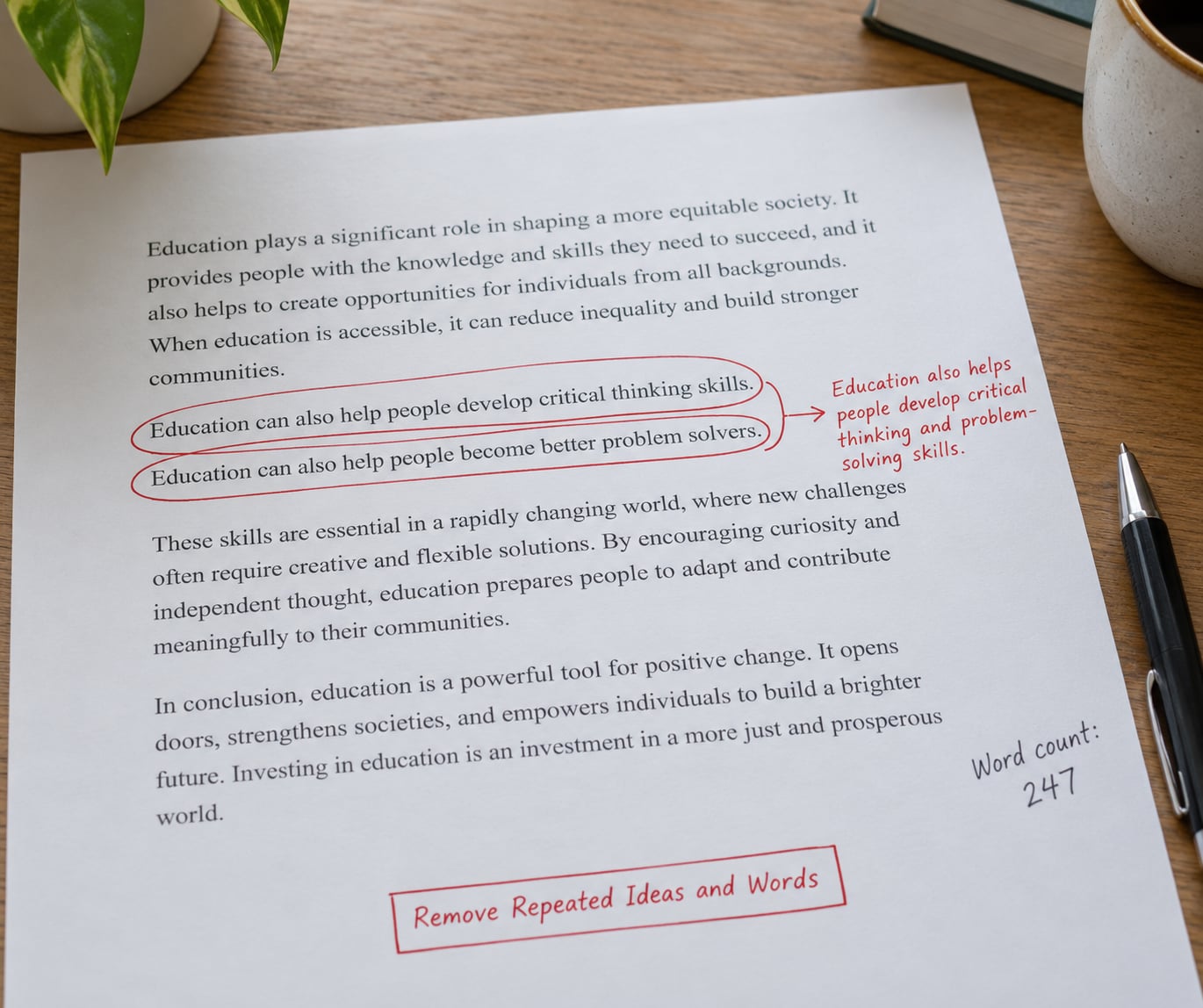
Repetition is not the same as redundancy. Deliberate repetition builds rhythm and emphasis, which is why a closing paragraph that echoes an opening one can be the strongest thing in the essay. Redundancy is a second statement of an idea you have already made, and it never earns its place.
Redundancy arrives in predictable forms. There are near-duplicate paragraphs, the same example used twice, synonyms that say one thing in three ways, and phrases that repeat a word they already contain, such as return back or final outcome.
Here is a narrative paragraph at 94 words, trimmed to 51:
Before: When I finally got the part at the bakery, I was so excited that I could barely contain myself. I had been applying for months, and every rejection had felt like proof that I was not good enough. When the offer finally came through, I cried in the parking lot, which sounds dramatic, but I was genuinely overwhelmed with relief and joy. I had spent so long doubting myself that the moment it happened I did not know what to do with it.
After: When the bakery finally offered me the job, I cried in the parking lot. Months of rejections had convinced me I was not good enough, and the moment that changed I did not know what to do with it.
Forty-three words gone. What survived is the scene, the emotional turn and the reflection, which are the three things a reader remembers. What went was the announcement, the throat-clearing and the restatement of the doubt, all of which appeared once and then said the same thing again.
3. Cut Filler, Padding, and Empty Openers
Filler words are words that carry grammar but no information. Someone on r/EnglishLearning asked for exactly this list, so here it is in the form people actually ask for:
It should be mentioned that, it can be seen that, it is clear that, obviously, in addition, furthermore, that being said, when all is said and done, at the end of the day, in recent years, in my opinion, I feel that, I think that, basically, actually, really, very, quite, somewhat, rather, fairly, in order to, due to the fact that, at this point in time, for the purpose of, in the event that, with regard to.
Two details on that list. First, hedges such as I think and in my opinion are sometimes the honest ones, and removing them can turn a careful student into a loud one; cut them when they add nothing, not as a rule. Second, adverbs ending in -ly can usually go, but not always: a precisely timed detail is doing work even though precisely is doing none.
Empty openers are the sentences before your real sentence. In many ways, this paragraph could have been shorter. There are three of them in most drafts, and each one costs eight to fifteen words. Delete the opener, start at the verb.
Watch also for pleonasm, pairs of words where one half is baked into the other: she returned back, past history, free gift, unexpected surprise, final result, close proximity, new innovation. These are pure wins, because removing them costs nothing at all.
4. Tighten Verbs, Nouns, and Sentences
Long English sentences usually lose to short replacements, almost without exception.
| Long phrase | Short replacement | Words saved |
|---|---|---|
| due to the fact that | because | 4 |
| in order to | to | 2 |
| was able to | could | 2 |
| at this point in time | now | 3 |
| for the purpose of | to, for | 3 |
| has the ability to | can | 3 |
| a large number of | many | 2 |
| in the event that | if | 3 |
| the reason why is that | because | 4 |
| as well as | and | 2 |
Then fix the verbs. A weak verb usually shows up as an -ed or -t form wrapped around a noun, and the noun doing the real work hides inside it: the making of a decision becomes decided, the performance of the analysis becomes analysed. Turn the noun back into a verb and two words collapse into one.
Passive voice is worth checking but not banning. “The results were analysed by three reviewers” is genuinely weaker than “Three reviewers analysed the results”, except when the actor is unknown or irrelevant, as in “The manuscript was submitted in March”, where naming the author adds nothing.
Now the sentence level. Merge two sentences when they make one point, which is the tactic students most often recommend to each other on r/CollegeEssays, and the one most often done badly. The line is simple: two sentences carrying one idea get joined with a semicolon, a coordinating conjunction or a participle; two sentences carrying different ideas stay apart. Join a claim and its evidence. Never join two claims.
An academic paragraph at 88 words, trimmed to 54:
Before: It has been widely argued by a number of critics that the language of the 1940s was shaped in large part by the experience of wartime scarcity. Many of these critics point out that rationing changed what people ate, and they have observed that new vocabulary entered the kitchen as a direct result of this. Because of this, ordinary recipes from that decade contain words that have largely disappeared from modern usage.
After: Critics have argued that wartime scarcity shaped 1940s language: rationing changed what people ate, and the new vocabulary entered the kitchen with it. Ordinary recipes from that decade still carry words now largely gone from use.
Thirty-four words saved, and the hedging, the attribution and the colon all stayed. Notice what did not happen: no citation was dropped, no qualifier was flattened, and the claim did not get louder. It got shorter.
5. Preserve Necessary Evidence and Qualification
Here is what is off limits, no matter how far over you are.
| Do not cut | Why it has to stay |
|---|---|
| Your thesis or main claim | It is the sentence the whole essay is answering. Cut it and you have a shorter essay with no argument. |
| Evidence and citations | Removing a source to save four words is the one shortcut that reads as misconduct rather than editing. |
| The qualifying clause | “The programme worked, though only in cities with existing transit” is a different claim from “the programme worked”. |
| One concrete detail | The bakery parking lot above is why that paragraph reads as lived rather than summarised. Keep one per essay. |
| Hedging that shows judgement | “The data suggests” and “this may reflect” are academic caution, not padding. A claim stated more strongly than the evidence supports is a new problem. |
| Transitions that carry logic | However, therefore and by contrast tell the reader how the paragraphs connect. They cost two words and save a paragraph of confusion. |
Academic work has its own cut order, and it is the reverse of the one most people use: never cut citation or qualification language before cutting description. Descriptive detail is the softest material in an essay, and it gives up its words quietly.
6. Read the Revision Aloud and Check the Meaning
Paste the revision into a text-to-speech tool and listen. Your ear catches run-ons, dangling qualifiers and repeated cadence faster than your eye, because your eye knows what the sentence used to say and skips over what it says now.
Then run the preservation check, four questions against the trimmed draft:
- Does the claim still appear, in your own words, and does every paragraph still support it?
- Is every citation from the original still present, and correctly placed?
- Has any qualifier vanished, turning a careful claim into a broader one?
- Does it still sound like you when you read the first and last paragraphs aloud?
If all four hold, the meaning survived. One number to keep in mind while you work: a pass that removes roughly 10 percent of the words is usually the most you can take out before the draft starts to feel thin. On a 2,000-word essay that is about 200 words, which is often exactly what students need.
Common Mistakes
Cutting before you have decided what the essay argues. This produces a tight draft with a loose centre. Fix: write the one-sentence claim and label paragraphs before you delete anything.
Merging sentences into a run-on. The fix is the join test. If the two sentences would still be two separate claims joined by and, leave them apart.
Making every sentence the same length. Strip out every hedge and adverb in a chapter and the prose acquires a metronome. Vary your sentence length on purpose, and keep one longer sentence per paragraph to do the heavy lifting.
Cutting transitions because they are only one word. Transitions are load-bearing. Removing them costs nothing and confuses the reader immediately.
Treating word count as the goal. A 1,200-word essay does not answer a question set for 1,500 words; on the related searches, students ask whether 1,200 is enough, and the answer depends on whether you have three developed points or one. Build the argument the question asks for, then cut.
Trusting a paraphrasing tool with your argument. The frustration students report is accurate: generic AI paraphrasers change meaning and flatten voice, which is the exact opposite of what you want here. Use them to flag candidates, never to rewrite.
Deleting, then padding somewhere else to refill the count. Writers in r/PhD call this the version-control trap, and it wastes the trim entirely. Do the cut, close the file, and check the count the next day before you replace anything.
One last habit worth keeping: save each pass as its own file before you start the next. It costs nothing and it means the trim is reversible, which makes the whole job less painful than it sounds.
Frequently Asked Questions
How do I cut 200 words out of an essay?
Cut at the paragraph level first. Read through and label every paragraph keep, merge or cut, then delete the ones that fail the so-what test. Most drafts that are 200 words over carry most of that excess in whole paragraphs. Next merge sentences that make one point, then swap long phrases for short ones. A 10 percent trim per pass is a reasonable ceiling before the draft starts to feel thin.
What is the 10% rule in essay writing?
The 10 percent rule says that one editing pass should remove no more than about a tenth of your draft, roughly 200 words on a 2,000-word essay. Cutting more than that in a single pass tends to strip qualifiers, transitions and evidence along with the filler. The rule is a pacing guide, not a law. If you are badly over the limit, run several passes rather than one deep cut.
Is it okay to go slightly over the word limit?
It depends on the instructions you were given, so read the brief before you decide. Some limits are strict and counted automatically; others are guidance, and a few percent over with a stronger argument beats a padded essay trimmed to the number. The safest move is to cut everything that is not doing work, then check whether your marker or portal counts headings, citations and the title toward the total before you decide how much risk you are carrying.
How do I remove filler words without making my writing sound choppy?
Cut them in a separate pass, after the structure is settled, and never two in a row. Filler words such as it should be mentioned, basically, very and in order to can go almost anywhere, but hedges like I think and words like clearly sometimes carry the writer’s real position. Remove the filler, then read the paragraph aloud to check the rhythm. If two short sentences appear side by side, join one of them.
How can I make an essay longer without adding filler?
Do the opposite of cutting, in the same order. Add evidence rather than adjectives: one more concrete example, a counterargument and a reply to it, or a qualification that narrows your claim to something defensible. Cutting often exposes sentences that made a general point where you needed a specific one. Those sentences are where new material belongs, and the addition raises the count honestly instead of padding it.
Conclusion
Start with your claim in one sentence, then label every paragraph before you touch a word. Cut structure, then sentences, then words, and save the micro-tricks for last. Keep the thesis, the evidence, the qualifiers and one concrete detail, run the read-aloud check, and save each pass in its own file so nothing is lost. If you remember nothing else, remember that deleting filler is editing and deleting argument is not.