To work out how to write believable dialogue, start here: believable dialogue is speech that reads the way real people talk. Short, interrupted, sometimes ungrammatical, and usually aimed at something other than what it literally says. You get it by giving every character a private goal, cutting every line to what a person would actually say out loud, and revising the result with your ears rather than your eyes.
The whole job takes about an hour per scene once you have the method. Seven steps, and each one ends with a test you can run before you move on.
Table of Contents
- What You Need
- Step-by-Step: How to Write Believable Dialogue
- 1. Establish What Each Character Wants
- 2. Give Every Character a Distinct Voice
- 3. Mix Dialogue With Action and Body Language
- 4. Use Subtext Instead of Direct Explanation
- 5. Let the Scene Change Something
- 6. Read the Lines Aloud
- 7. Cut, Refine, and Check the Purpose of Each Line
- Common Mistakes
- Everyone sounds like the author
- The info dump
- Fancy speech tags standing in for voice
- Nobody interrupts
- Stiff, over-polished sentences
- Forced dialect
- The wrong relationship
- Frequently Asked Questions
- What are the 5 rules of writing dialogue?
- What is the best way to write believable dialogue?
- What is a good dialogue example?
- How do I make my characters sound different from each other?
- Why does my dialogue sound unnatural?
- How do I get AI to write realistic dialogue?
- Conclusion
What You Need

You need four things before you type a single line of dialogue, and none of them are adjectives.
- One objective for the scene. Why are these two people talking right now? If you cannot finish that sentence, the scene is not ready.
- A want for each character. Not a personality trait, an objective. Wants collide. That collision is the scene.
- The private context. What each person knows, suspects, and is wrong about. Believable dialogue lives in the gap between those three lists.
- A physical setting. Standing, sitting, driving, pouring coffee. The body in the room is what gives action beats something to interrupt.
Notice what is missing: plot notes. If you have to explain your backstory before the conversation starts, the conversation is carrying weight it was never built for.
Write the two wants on two separate lines, then find the sentence where they collide. That sentence is your scene.
Step-by-Step: How to Write Believable Dialogue
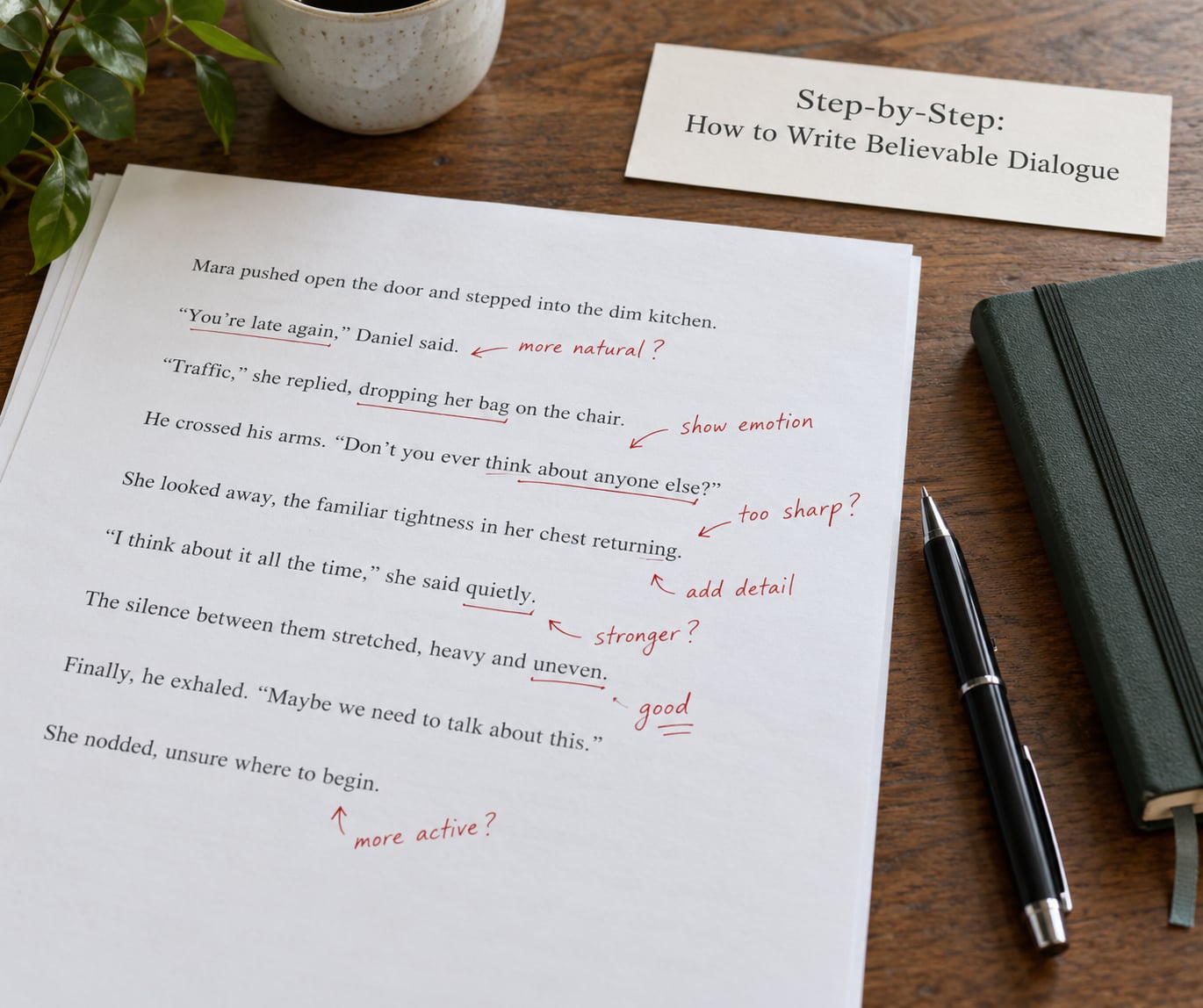
Seven steps, in order. Skipping ahead is why scenes end up sounding like two people reciting a briefing.
1. Establish What Each Character Wants
Give each speaker one thing they are trying to get in the next five minutes: ask for help, hide an invoice, delay a decision, intimidate somebody into leaving. Then write the scene so both wants are active at once.
Check: read only the dialogue lines with the tags removed. If a line could be swapped with any other line by any other character without anyone noticing, it is not doing work yet.
Example. Weak: “I need the report finished by tomorrow. I know you have been working hard on it.” Stronger: “Tomorrow,” Rosa said. “Not Friday.” The second version hides a whole history of missed deadlines in three words.
2. Give Every Character a Distinct Voice
Voice is not an accent. It is vocabulary, sentence length, how formal the person is, what they notice, and what they refuse to say. A mechanic and a lawyer argue about the same broken part and use completely different words for it.
Check: cover the character names and read only the lines aloud. If you cannot tell who is speaking, that is the answer.
Example. Generic: “I don’t think we should do that.” Revised: “Nah. Not doing that.” and “I would rather we did not proceed at this time.” Same information, two people, two rhythms.
Speech tags carry part of the voice too. Pick verbs that carry attitude, and save said and asked for the lines that need neutral delivery.
| Tag | Use it when | What it sounds like |
|---|---|---|
| said / asked | The tone is neutral or the moment is quiet | Flat, unobtrusive, lets the line lead |
| whispered | Volume genuinely matters, someone is nearby | Intimate, conspiratorial |
| muttered | A character half-admitting something | Reluctant, half to themselves |
| snapped | Short, angry, clipped | Fast, hard consonants |
| drawled | Amusement, drag, southern or lazy affect | Slow, amused, often condescending |
| clipped | Precision under pressure, military or clinical | Every word load-bearing |
Adverbs after tags are usually lazy. “He said quietly” can almost always become the line itself or an action beat.
3. Mix Dialogue With Action and Body Language
Nobody talks without moving. Gesture, eye contact, a hand going to a pocket, a door being held open, gives the reader the emotion you were too busy explaining.
Check: look for any run of dialogue longer than four lines with nothing between it. Break it.
Example. “I’m fine.” She set the mug down too hard. It did not break, but the water reached the rim. Now the reader knows what the line denies.
Two rules keep action beats from becoming clutter. The beat must be something the person would plausibly do, and it must reveal something the dialogue does not.
4. Use Subtext Instead of Direct Explanation
Subtext is the meaning sitting underneath the sentence. Real conversations rarely say the important thing out loud because saying it out loud costs something.
Check: mark every line that names an emotion outright (“I was angry,” “she was scared”). Rewrite the strongest one as an object, a topic change, or a silence.
Example. Weak: “I’m not angry that you went. I’m just disappointed.” Stronger: “The porch light’s still on. I left it on for you.” The subtext now carries both feelings and the reader supplies the emotion.
Writers worry that subtext confuses readers. It does not, as long as the reader gets one concrete thing to hold on to. The porch light is that thing. Strip out every concrete detail and the scene does turn into a riddle.
5. Let the Scene Change Something
Before you draft, write down where the scene ends. Not where the plot ends. Somebody decides, somebody lies, somebody finds out. If nothing shifts, the conversation is a briefing and you should cut it.
Check: complete this sentence without hedging: “Before the scene, A believed X. After it, A believes Y.”
Change can be tiny. A father who starts the scene certain his daughter made a mistake and ends the scene not sure is enough.
6. Read the Lines Aloud
Your eyes will forgive a sentence your mouth cannot say. That is why this test works so consistently, and why writers on craft forums keep coming back to it: nothing exposes a fake line faster than your own voice stumbling over it.
Read it standing up, at normal speed, with the tags. You are listening for four things.
- Breath. If you run out of air, cut a clause.
- Repetition. Three speakers in a row starting sentences the same way means you have written one voice three times.
- Clarity. If you had to reread a line to know who spoke, add a beat.
- Fit. If a line sounds unlike that person, cut it and let them react instead of explain.
Any sentence that takes an extra breath to say is more complicated than it should be. That rule catches more bad dialogue than any other single test I know.
7. Cut, Refine, and Check the Purpose of Each Line
Last pass, line by line. Read every line and ask which of four things it does: it advances character, it advances conflict, it changes the relationship, or it moves the plot. A line that does none of these is decoration, and decoration in dialogue is usually exposition wearing a coat.
Then run this checklist over the finished scene.
- Does every character want something specific in this scene?
- Could I tell the speakers apart with the names covered?
- Is there a run of more than four unbroken dialogue lines?
- Does any line explain something both characters already know?
- Is there at least one moment where the subtext differs from the words?
- Does the scene end in a different state than it began?
- Did I read it aloud and cut what my voice stumbled on?
Common Mistakes
These seven account for nearly every stiff scene I have read in a draft. Each one has a fix you can apply immediately.
Everyone sounds like the author
What the reader experiences: interchangeable speakers. Pick up any page and remove the names; the scene collapses into one person.
Fix: write two lines per character before the scene, each one something that character would say and nobody else would. Use them in the exchange even if it feels forced at first.
The info dump
What the reader experiences: the story stops. Characters explain shared history, define terms, and summarize past chapters for an audience that already knows.
Fix: delete any line beginning with “as you know,” “the thing is,” or “you have to understand.” Deliver that material through action, argument, or omission instead. If a fact must be stated, have one character get it wrong.
Fancy speech tags standing in for voice
What the reader experiences: stage directions masquerading as characterization. “He exclaimed darkly” tells us nothing a plain sentence would not.
Fix: keep tags to two or three words. If the tag needs an adverb to make sense, the line is doing nothing.
Nobody interrupts
What the reader experiences: turn-taking so polite it feels scripted. Real conversation overlaps, restarts, and drops.
Fix: cut a speaker off mid-sentence with a dash, and let the interrupted character come back to it later in the scene. Contradictions between what was said and what got heard generate free conflict.
Stiff, over-polished sentences
What the reader experiences: a narrator reciting, not a person talking. Nobody under stress uses complete grammatical sentences.
Fix: add contractions and fragments. “I don’t know what you want from me” and “Don’t. Just don’t” both beat their polished cousins. Keep fragments for the moments where precision would be wrong.
Forced dialect
What the reader experiences: a caricature. Dropped g’s and invented slang pull readers out of the story into an accent.
Fix: use grammar instead. A character who drops every g has a region, not a personality. Vary sentence structure and word order to place the reader geographically, and put the rest into the narration.
The wrong relationship
What the reader experiences: two characters who know each other well speaking like strangers meeting at a bus stop.
Fix: check what each one already knows and what neither will say. Familiarity shows up in skipped greetings, assumed context, and topics both avoid, not in backstory speeches.
Frequently Asked Questions
What are the 5 rules of writing dialogue?
The five that matter most: give every character a distinct want, keep lines short enough to say in one breath, cut exposition both speakers already share, interrupt long speeches with action beats, and put subtext under the literal meaning. Dialogue formatting and tag discipline support all five but do not carry them on their own.
What is the best way to write believable dialogue?
Decide what each character wants before you write a line, then draft only the words they would actually say out loud, not the words you would use to explain the scene. Finish by reading it aloud with the character names covered. If you cannot tell the speakers apart, their voices are not built yet.
What is a good dialogue example?
A weak one reads, I am not angry that you went, I am just disappointed. A stronger version says, the porch light is still on, I left it on for you. The second keeps the same feeling, drops the stated emotion, and gives the reader one concrete detail to read the subtext from.
How do I make my characters sound different from each other?
Change vocabulary, sentence length, formality, and what each person chooses to notice. Then run the cover test: read the lines aloud with the names hidden and see if you can still tell them apart. If you cannot, write two lines per character that nobody else would say and use them in the exchange.
Why does my dialogue sound unnatural?
Four usual causes: sentences nobody could say in one breath, characters explaining things they both already know, speech tags doing the work that voice should do, and dialogue that changes nothing. Read the scene aloud and cut whatever your voice stumbles over, then check that the scene ends in a different state than it started.
How do I get AI to write realistic dialogue?
Give it the scene objective, each character want, the private information each one holds, and a voice profile with vocabulary and sentence length for every speaker. Ask for interruptions, fragments, and action beats rather than complete exchanges, then rewrite the result yourself. Unedited model dialogue lands in one register, and your job is splitting it into separate people.
Conclusion
Believable dialogue comes down to four moves repeated: know what each character wants, let those wants collide, write only what someone would say out loud, and revise with your ears. Every step above exists to protect one of those.
Start with a single scene. Write the two wants on two lines, find where they clash, draft the exchange without stopping to explain anything, then read it standing up with the names covered. If you only keep one habit from this guide, keep that one. It teaches you more than any rule list, and you will hear exactly which lines to cut.