A document based question essay asks you to build an argument out of a set of sources you have never seen before. To answer one well, read the prompt twice before you touch the documents, annotate each source in about fifteen words, group sources by theme, and write a thesis that takes a position the evidence can actually defend.
Most students lose points in the same places. They summarize the documents instead of interpreting them, they quote too much and explain too little, and they save all their analysis for the last five minutes. None of that is a talent problem. It is a method problem, and the method is learnable in a week.
The method below works for AP US History, AP World History, AP European History, and any college seminar essay built around primary sources. The document examples are invented for teaching, but the moves are the same ones graders look for.
Table of Contents
- What You Need: How to Answer a Document Based Question Essay
- The prompt, printed and isolated
- Your assigned documents, plus one known fact
- A way to mark documents
- An evidence tracker
- A rough sense of the scoring
- Step-by-Step: Build a Clear, Evidence-Based Response
- Step 1: Read the Prompt and Identify the Task
- Step 2: Read and Annotate the Documents
- Step 3: Select and Organize the Strongest Evidence
- Step 4: Write the Introduction and Thesis
- Step 5: Draft Evidence-Based Body Paragraphs
- Step 6: Finish with a Conclusion That Answers the Question
- Common Mistakes and How to Fix Them
- Frequently Asked Questions
- How do I pick quotations from a document I barely understand?
- Do I have to use every document in the set?
- What actually counts as outside evidence?
- How do I start when the prompt is unfamiliar and I have no opinion?
- What is the 10 percent rule in essay writing?
- Is a DBQ hard?
- Conclusion: Start With the Prompt and Build From the Evidence
What You Need: How to Answer a Document Based Question Essay
Before you write a word, gather five things. Most failures trace back to skipping this list and starting with a blank page and a panic.
The prompt, printed and isolated
Read the question itself, not the documents, first. Underline the verb. Questions that ask to what extent want a graded answer where you say how far something went. Questions that ask evaluate or compare want a judgment. Questions that ask how or why want causation. The verb tells you what shape your answer has to be before you have read a single source.
Your assigned documents, plus one known fact
You also need at least one piece of information from outside the document set. That is your outside evidence, and it is the cheapest point on most history rubrics because it requires a sentence, not a paragraph. A date, a policy, a war, a trade route, a leader’s name — one concrete fact that helps explain the sources.
A way to mark documents
Highlighter and pencil work fine. A plain index card per document works fine too. What does not work is reading the whole set twice and hoping it sticks. Decide on one notation before the clock starts.
An evidence tracker
This is the piece most students skip. As you annotate, you need somewhere to record four things per document: what it says, who made it, who it was for, and how you will use it. That fourth column is the one that turns reading into writing.
A rough sense of the scoring
History document based essays are scored out of seven points on the AP rubrics, and the shape is consistent enough to plan against.
- Claim (1 point). Earns it: a thesis that answers the prompt’s verb, takes a side, and qualifies itself. Loses it: a statement of fact or a summary of the sources.
- Contextualization (1 point). Earns it: relevant background that explains why the sources emerged when they did. Loses it: unrelated background, or dates the sources already contain.
- Evidence (2 points). Earns it: accurate use of several documents plus at least one outside fact. Loses it: listing what each document says with no analytical use.
- Analysis and reasoning (3 points). Earns it: explaining how evidence supports a claim, sourcing moves, and engaging complexity. Loses it: citing without explaining, or explaining without claiming anything.
Look at where the points actually sit: three of the seven are in the last row. A student with a perfect summary of every document and no interpretation lands around a 3. A student who uses four documents loosely but analyzes each one deeply lands much higher.
Step-by-Step: Build a Clear, Evidence-Based Response
Step 1: Read the Prompt and Identify the Task
Mark up the prompt before any document. Circle the verb, box the time period, and underline the geographic scope. A question about nineteenth-century reform movements in Britain does not want a paragraph about nineteenth-century reform movements in Russia, no matter how good your evidence is.
Then write one sentence, off the top of your head, that answers the question in the plainest language you can manage. Do not make it elegant. This is not your thesis — it is a diagnostic. If you cannot answer the question after reading only the prompt, you do not yet understand the task, and no amount of annotation will fix it.
On the AP exams, the reading period is 15 minutes for the whole document set and the writing period is 40 minutes, so the clock is short. Knowing the exact split matters. Reserve the first two minutes of reading time for this step.
Step 2: Read and Annotate the Documents
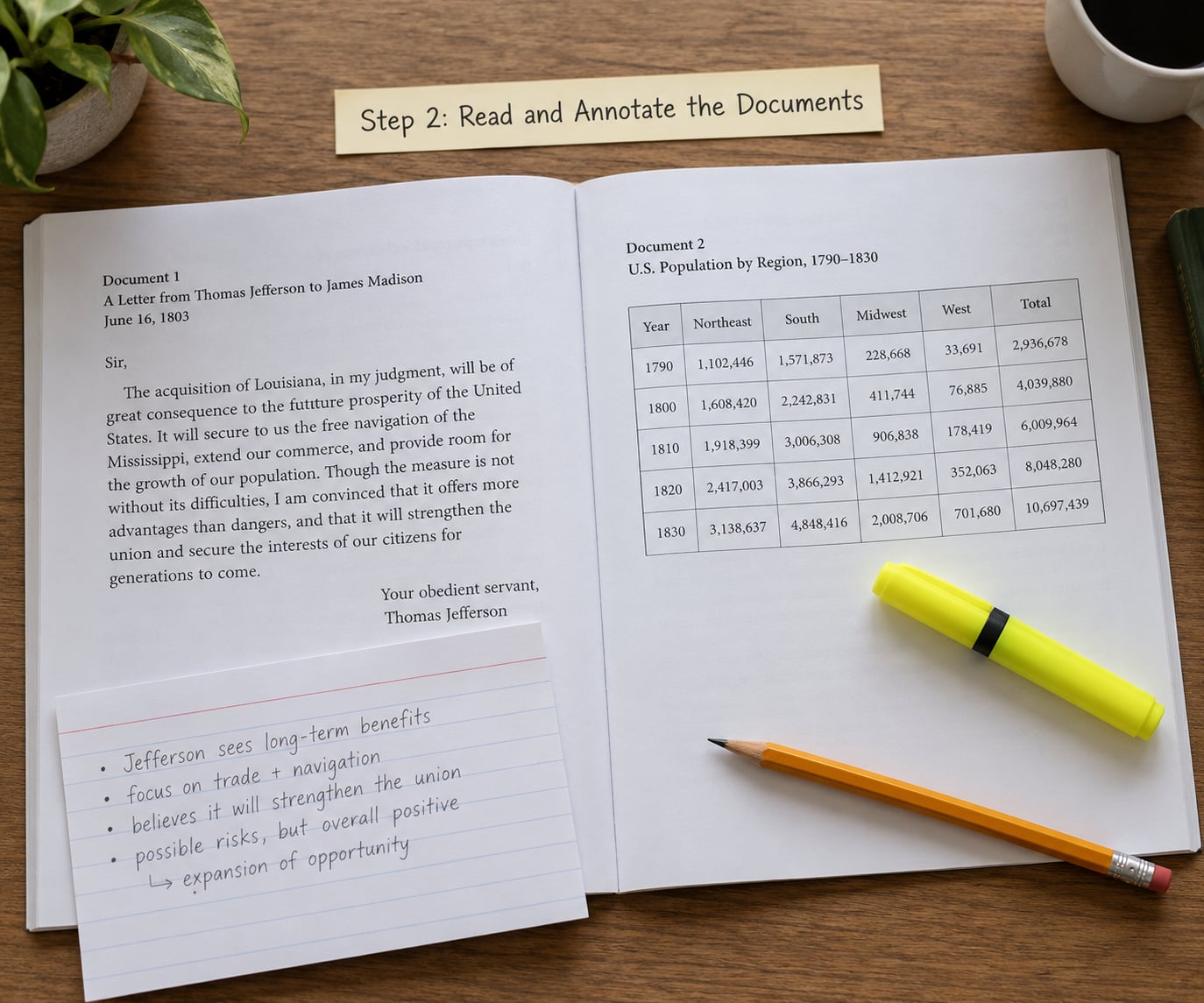
Annotate with a limit. Some teachers cap students at fifteen words per page because the point is not transcription, it is capture. Fifteen words is roughly one sentence, and it forces you to write down what the document does rather than everything it says.
For each document, capture four things. Who wrote or produced it, who it was aimed at, what it claims or shows, and why that producer had a reason to say it that way. A letter from a plantation owner in 1850 and a pamphlet from an abolitionist society in the same decade use the same facts for opposite purposes. Sourcing is the observation that the source is not a window, it is a position.
Read each document twice: once at normal speed for the gist, once for the language. Quotes worth keeping tend to sit in the second read, in the adverb, the loaded noun, the sentence that sounds like it was written to be quoted.
Mark the documents that speak directly to the prompt with a symbol, usually a star. On the AP rubrics, using four documents well beats using all seven badly, so you are hunting for four strong ones, not exhaustive coverage.
Step 3: Select and Organize the Strongest Evidence
Two kinds of evidence matter: evidence that supports your position and evidence that complicates it. Novice essays are one-sided and read as thin, because a reader who sees no tension assumes you have not looked hard. Find the document that argues against you before you start drafting.
Group your starred documents. Thematic grouping asks what argument they share, and it is the strongest default because it keeps one line of reasoning per paragraph. Chronological grouping asks what changed and when, which is required whenever the prompt involves change, continuity, or development over time. A hybrid of two chronological body paragraphs plus one thematic comparison paragraph is a common and reliable shape.
Skip documents with no useful point of view. A map with no title and no legend gives you nothing to analyze beyond geography. Leave it. Sacrificing one weak source is a better use of forty minutes than squeezing it in where it does nothing.
Before you write, sketch a one-line outline: your claim, the two or three groups that prove it, and the line each group runs. If a group cannot be named in one sentence, it is not a group yet.
Step 4: Write the Introduction and Thesis
Most document based question essays need three to five sentences of introduction, not a page. Historical background you earned the right to state because it explains your sources, then the answer to the question, then the thesis. Anything longer is padding that pushes you into a rushed body.
A defensible thesis names an argument, answers the verb, and does not pretend the evidence is unanimous. Templates with blanks work well for most students:
Although what the sources agree on, the evidence shows that your interpretation, largely because the factor you identified, even though the complication.
That final clause is not decoration. It is the difference between a thesis and a slogan, and it opens the door to the complexity point later. A thesis that says something was entirely one thing with no qualification gives you nowhere to go when a source disagrees.
Keep the thesis to two sentences at most. If it runs longer than that, it usually contains two claims, and two claims in forty minutes is one claim too many.
Step 5: Draft Evidence-Based Body Paragraphs
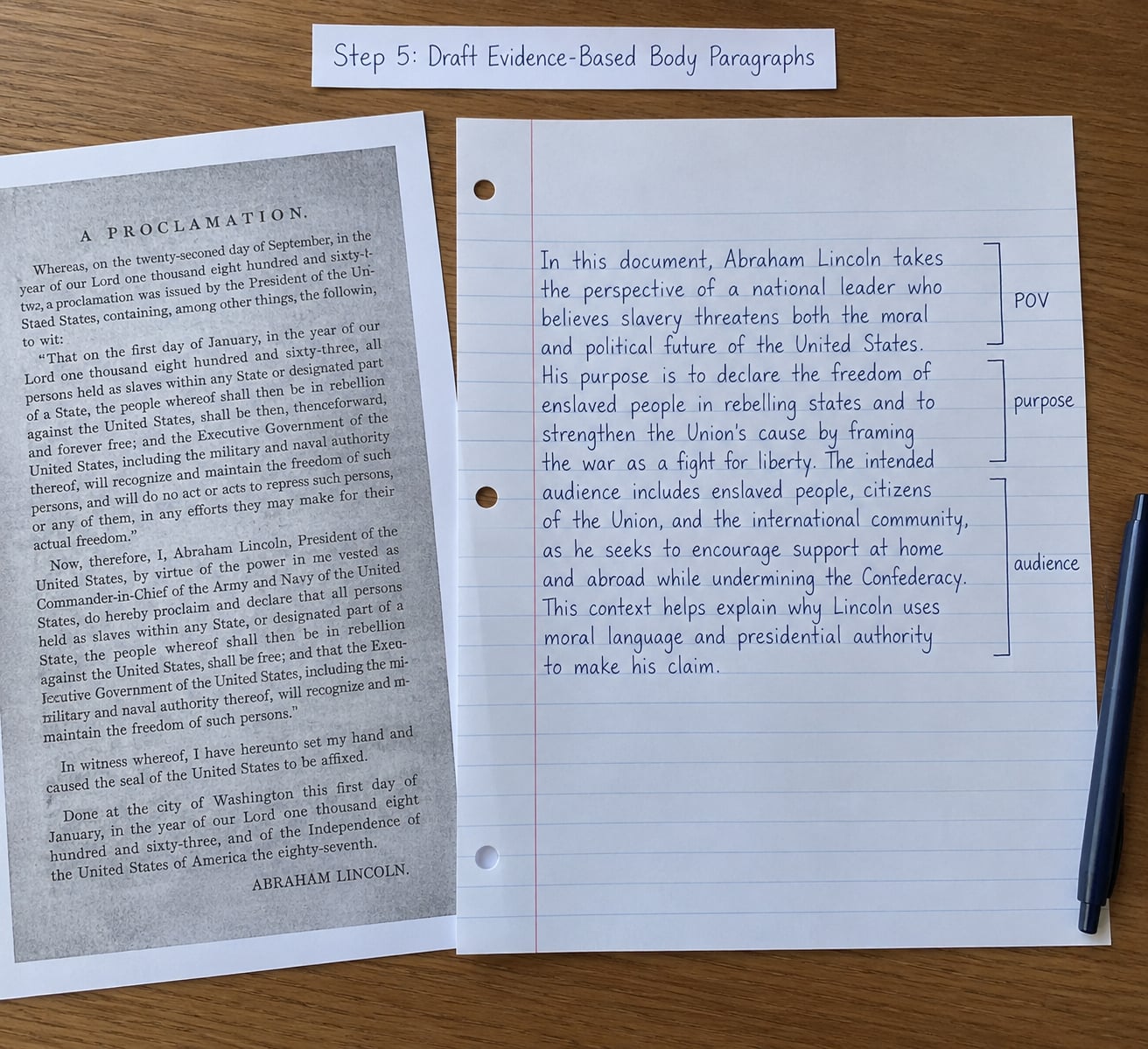
Every body paragraph follows the same five-part formula. Topic sentence that makes an analytical claim, explanation of why that claim holds, short quotation or paraphrase, analysis of what the source reveals about its author’s position, and a sentence linking back to the prompt. The analysis step is the one that carries points, and the one students shorten when the clock bites.
Here is the formula in practice, using an invented 1890 letter. A weak version says: Document 3 says that farmers were angry about the railroad rates. This shows that farmers were unhappy in the 1890s, which is relevant to the question. That is a summary with a bow on it. Nothing is argued and nothing is interpreted.
A stronger version: Document 3 reveals that railroad regulation was contested from within the farming economy itself. The author, a county grain merchant writing to a state senator, insists that “the rates we are charged are not rates at all, but tribute,” language that frames railroads as predators rather than partners. The recipient’s position as a legislator gives him a reason to inflate the grievance, and the merchant’s reliance on the phrase “the producer” shows he is writing for an audience that already shares the anger. That the complaint comes from a merchant rather than a laborer or a small farmer suggests the dispute was already being framed by those with political access, which matters for how far reform could realistically go.
Same source, roughly the same length, three more points. The difference is that the second version asked four sourcing questions — point of view, purpose, audience, historical situation — and answered them.
Weave outside evidence into the paragraph where it does work. One sentence in the middle of a paragraph is stronger than a stranded sentence at the end, because the reader sees why you brought it in. Slot it after the analysis and let it confirm your point.
When you reach the contradiction, keep the paragraph inside your own essay. Do not write a separate counterargument section; students who try it waste a paragraph on an argument they then abandon. Instead, take one sentence to grant the opposing source’s point and two or three to explain why it does not overturn yours.
Step 6: Finish with a Conclusion That Answers the Question
A conclusion on a timed document essay is two to four sentences. Restate the answer to the question in new words, show why it matters beyond the sources, and stop. Do not introduce a new document here. Nothing you add in the last two minutes is scored as evidence; it is read as rambling.
Signals that you are finished: you have restated the claim, you have named a consequence or tension, and you have not introduced anything you would need to defend. If you are still explaining a source in your conclusion, you have run out of room earlier than you thought.
Common Mistakes and How to Fix Them
Summarizing instead of interpreting. The fix is a rule: every sentence about a document must also say something about why that document was written or what it proves. If a sentence would still make sense with the document swapped for a different one, it is a summary. Rewrite it around point of view or purpose.
Quoting too much. A quotation longer than one line rarely does analytical work, because the reader is reading instead of reasoning. Fix: keep the quote to a phrase and spend twice as many words explaining it.
No thesis, or a thesis that hedges to nothing. “The documents show complexity” is not a claim. Fix: pick a side, then add one qualifying clause. Hedged sentences with no position cannot earn the claim point.
Evidence that never touches the prompt. You can be analytically brilliant about a source that does not answer the question asked. Fix: check each paragraph against the underlined verb. If it does not advance the answer, cut it.
Ignoring the source that disagrees. Students often treat contradiction as a problem to hide. Fix: name the conflict in one sentence and explain your reasoning. On the AP rubrics this is one of the recognized paths to the complexity point, and it costs one sentence.
Misusing outside evidence. A fact dropped in without a job to do is dead weight. Fix: write it so that it explains something — why a source emerged, why an argument took the shape it did.
Blanking out under time pressure. This is the one students mention most and prepare for least. If your mind goes empty mid-paragraph, stop mid-sentence and do this: write the strongest single claim you have already made about any document, then re-read the paragraph’s first line and write whatever argument follows from it. Partial credit is real credit. A blank paragraph earns nothing, and most of the blanking-out students describe is not a knowledge gap — it is the panic of staring at a blank half-page. Twenty minutes of timed practice on a real released prompt fixes more of this than any amount of re-reading notes.
Two more habits worth naming. Write topic sentences first, before the paragraph, because a paragraph built around an unclear claim is the one that turns into sentences about sentences. And let your weakest paragraph be the shortest; a short paragraph with a clear claim reads as deliberate, while a long vague one reads as padding.
Frequently Asked Questions
How do I pick quotations from a document I barely understand?
Read the first and last sentence of the document first. Those two sentences usually contain the author’s position, and the middle is support. Mark one phrase from each end, then read the passage around each mark out loud. If you cannot say in your own words why that phrase matters, it is not ready to use. Fifteen words of annotation per page keeps you from copying passages you never actually understood.
Do I have to use every document in the set?
No. On the AP rubrics, credit is tied to using a small number of documents well rather than covering the whole set. Four sources that you quote and analyze will score better than seven that you mention in passing. Skip anything with no clear point of view or no connection to the prompt, and spend the time you saved on explaining the sources you keep. A document set is a menu, not a checklist.
What actually counts as outside evidence?
Any specific fact that did not come from the document set: a date, a policy, a treaty, a leader’s name, a demographic figure, a preceding event. The test is whether it helps explain your sources. One well-placed sentence is enough, and it works best sitting inside a body paragraph right after your analysis, where the reader can see why you brought it in. Vague generalities do not count.
How do I start when the prompt is unfamiliar and I have no opinion?
Write a plain one-sentence answer from the prompt alone before reading anything, then test it against the documents. Starting with a wrong guess is useful, because the documents are what change it. If your answer survives every document you annotated, that is suspicious; a prompt complicated enough to be worth asking usually has at least one source that complicates your position.
What is the 10 percent rule in essay writing?
The 10 percent rule is a time-management guideline, not a scoring rule: roughly ten percent of your writing time should go to the introduction and conclusion, leaving the rest for body paragraphs. Nothing in the AP rubrics mentions it. Treat it as a rough guardrail against spending ten minutes on background and forty minutes panicking over a single source, and adjust when your teacher has told you something different.
Is a DBQ hard?
It is hard in one specific way: you cannot prepare the argument in advance, because the prompt and the sources are new. Students who treat it as a memory test struggle most. Students who treat it as an argument-building exercise do better, because the steps — read the prompt, annotate, group, argue — are the same on every prompt. Practicing timed, with released prompts, closes most of the gap.
Conclusion: Start With the Prompt and Build From the Evidence
Answering a document based question well comes down to three habits: take the prompt seriously before the sources, capture each source’s point of view in a handful of words, and spend your writing time explaining evidence instead of describing it. Everything else — grouping, thesis templates, sourcing moves — is a way of protecting those three habits when the clock gets tight.
So start with one small thing. Take a released practice set, set fifteen minutes, and do nothing but annotate. Do not write the essay. Just mark the documents and see whether your notes contain anything you could argue with. That is the foundation, and everything else sits on top of it.