If you have ever wondered how to write an AP literature essay that scores in the middle of the range instead of the bottom, the answer is not better vocabulary or more books. It is a defensible thesis, two to four pieces of specific textual evidence, and commentary that shows how each piece builds a line of reasoning, all inside a 40-minute window. Readers score every essay against the same 6-point rubric: one point for the thesis, four for evidence and commentary, one for sophistication. Nailing those three rows is worth more than any amount of general writing polish.
Section II of AP English Literature and Composition asks for three timed essays, and those three essays carry 55 percent of the exam score. One of them is usually weighted more heavily than the others, which means one good hour can move your composite more than a full practice exam.
The three question types are:
- Question 1, poetry analysis: usually two poems you have never seen before, and a prompt asking how one line of reasoning connects them. You cannot prepare the evidence in advance.
- Question 2, prose fiction analysis: one passage from a novel, short story, or play, and a prompt that usually asks you to account for the meaning of a moment within the work as a whole.
- Question 3, literary argument: an open question, and you choose the work. This is the only one where your preparation can pay off directly, and it is also where students panic when they cannot remember enough detail.
Here is the honest read on difficulty. Students call AP Lit the hardest AP exam, and the free-response section does ask for a skill that is genuinely under-taught: sustained analysis with a clock running. In r/ApplyingToCollege threads, the recurring advice is that preparation, not reading speed or innate writing talent, is what separates a 3 from a 5. That is good news if you have time to practise, and it is a warning if you plan to wing it in May.
Table of Contents
- What You Need
- Step-by-Step: How to Write an AP Literature Essay
- Step 1: Read and Analyze the Prompt
- Step 2: Build a Focused Thesis
- Step 3: Select and Explain Evidence
- Step 4: Outline the Argument
- Step 5: Draft Clear Literary Analysis
- Step 6: Revise and Proofread
- Common Mistakes
- Frequently Asked Questions
- How many paragraphs do you need for an AP Lit essay?
- How long should an AP Lit essay be?
- Do you need direct quotes, and can I use outside sources?
- How do I earn the sophistication point?
- Is AP Lit the hardest AP exam?
- How do I study AP Lit without a teacher?
- Conclusion
What You Need
Most students lose AP Lit points to a preparation problem, not a talent problem. They walk in with the book read but no argument, or with an argument and no evidence filed anywhere. What you need before you sit down to write is smaller than it sounds.
The prompt, read twice. Prompt parsing is a skill with its own steps, covered in Step 1 below. Read it once for the topic and once for the command verbs, which is where the actual instruction hides. Verbs like analyze, compare, account for, and discuss ask for different things.
The text, or texts, plus your annotations. Underlining nothing is the same as not having read the book for this exam. For prose fiction, mark the three or four moments the prompt might plausibly reach for. For poems, mark the two or three lines doing the most work, and note what each one is doing rather than what it feels like.
An evidence bank. A single page per work with scene or line references and a few words on why each one matters. This is the difference between picking evidence deliberately and scrolling through the book hoping something fits. Forum threads on this exam are full of students who picked a work for Question 3 and then froze, because nothing had been written down.
The rubric, in its own words. Go to the College Board scoring guidelines on AP Central and read Row A, Row B, and Row C. Do not paraphrase them from a study guide, including this one. The AI summaries of AP Lit grading all trace back to those same rows.
The released sample essays. AP Central publishes scored student essays with the actual reader comments attached. Reading three of them with a high score, then a low one, teaches you more about what readers reward than any amount of rules. The difference is almost never vocabulary.
A timer. Untimed writing teaches you to be slow. Every practice essay should be written in 40 minutes with no notes once the planning phase ends.
Step-by-Step: How to Write an AP Literature Essay
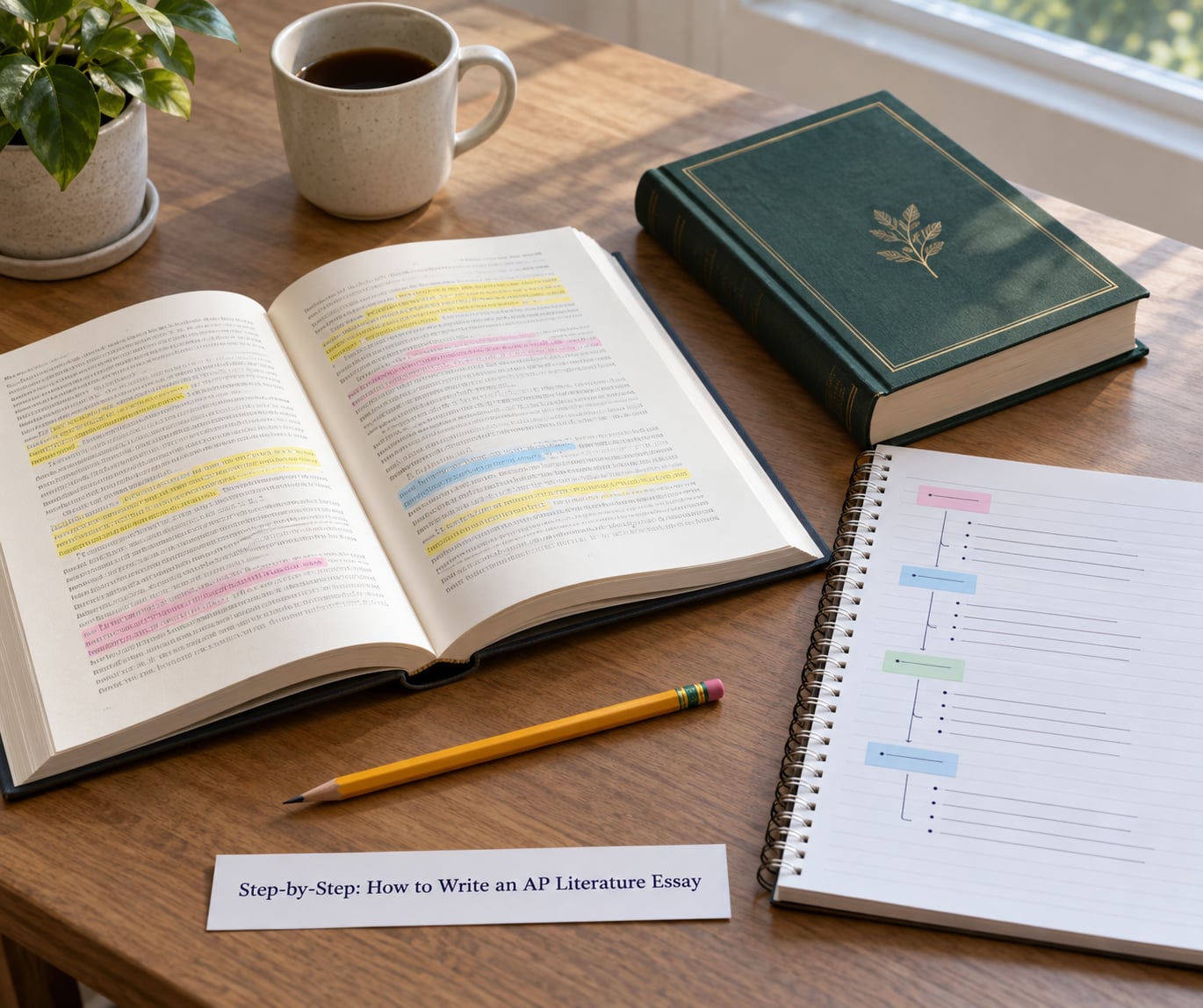
Six steps, in this order, each one short enough to finish while the clock runs. The sequence matters more than the individual moves, because most lost points come from skipping ahead to drafting before the argument exists.
Step 1: Read and Analyze the Prompt
Spend two to three minutes here, and resist the urge to start writing a formal introduction. The prompt tells you what kind of thinking is required, and reading it carelessly is the most expensive mistake in the whole exam.
Mark the command verb first, because it defines the shape of the essay. Then circle the words that narrow the field, usually a single word or short phrase that most candidates will ignore. A prompt about how one character responds to injustice in a novel you have not read is a much smaller job than a prompt about justice in general, and the narrower reading is the one readers reward.
Then decide what the essay is not allowed to be. If the prompt says analyze how a moment contributes to the meaning of the work as a whole, a plot summary of the novel is not analysis, and a biography of the author is not analysis either. The unit of analysis is the work, and the moment is your way in.
A workable 40-minute budget looks like this, and it holds for all three question types:
| Stage | Time | What happens |
|---|---|---|
| Prompt and planning | 8 minutes | Read the prompt, test a claim, pick evidence |
| Introduction | 3 minutes | Two or three sentences, thesis last |
| Body paragraphs | 22 minutes | Two or three paragraphs, roughly seven minutes each |
| Conclusion | 4 minutes | Extend the argument, do not restate it |
| Proofread | 3 minutes | Thesis present, names spelled, no stray sentences |
Step 2: Build a Focused Thesis
A defensible thesis is one that interprets the text and could be argued against. The College Board language is precise here: the thesis must state a defensible claim about the text and answer the prompt. Restating the prompt with a synonym swapped in is the most common zero in Row A, and readers see dozens of those in a single scoring session.
One formula carries most students through all three question types: the work uses a specific technique to create a specific effect, and that effect complicates or reveals something about the prompt’s central idea.
Weak thesis, for a prompt about how two poems treat memory: In these poems, the speakers talk about memory and how it affects them. That sentence could describe a hundred poems. It restates, so it scores zero.
Stronger version of the same claim: Both speakers treat memory as an unreliable archive, and because each poem undermines its speaker’s confidence in what is recalled, memory stops being a source of comfort and becomes a source of exposure. That sentence names a specific effect, takes a position, and gives you two to four devices to prove it.
For a prose fiction prompt, the same formula becomes: the passage’s point of view, diction, or structure creates an effect that shifts how the scene’s meaning functions inside the larger work. For Question 3, you get to pick the work, so write the thesis first and then check that you have enough evidence to defend it.
Step 3: Select and Explain Evidence
Two to four pieces of evidence, not ten. The habit of naming every device in the passage is the most reliable way to run out of time and produce shallow commentary, and shallow commentary is what caps your Row B score.
Choose evidence that proves different parts of your thesis. If three of your four pieces all show the same thing, you have one point of argument stretched thin, which is better handled as one paragraph with strong analysis than as four short ones.
Embed quotations properly: introduce the quote, weave it into your sentence, and follow it immediately with the sentence that does the work. The machinery looks like this.
Frame: the claim about what the choice does. Then evidence: the quoted line or the specific scene, in your own words where a summary is stronger than a quotation. Then commentary: the so-what sentence that links the evidence to the thesis. The failure mode is stopping after the frame and moving on, which leaves the reader with your reading and no proof.
Not all evidence is quotation. In prose fiction, naming a specific moment, a shift in narrative distance, or a repeated image can carry more analysis than any line of dialogue. Students often ask whether they need quotes at all, and the answer is that quotes are optional and reasoning is not.
Step 4: Outline the Argument
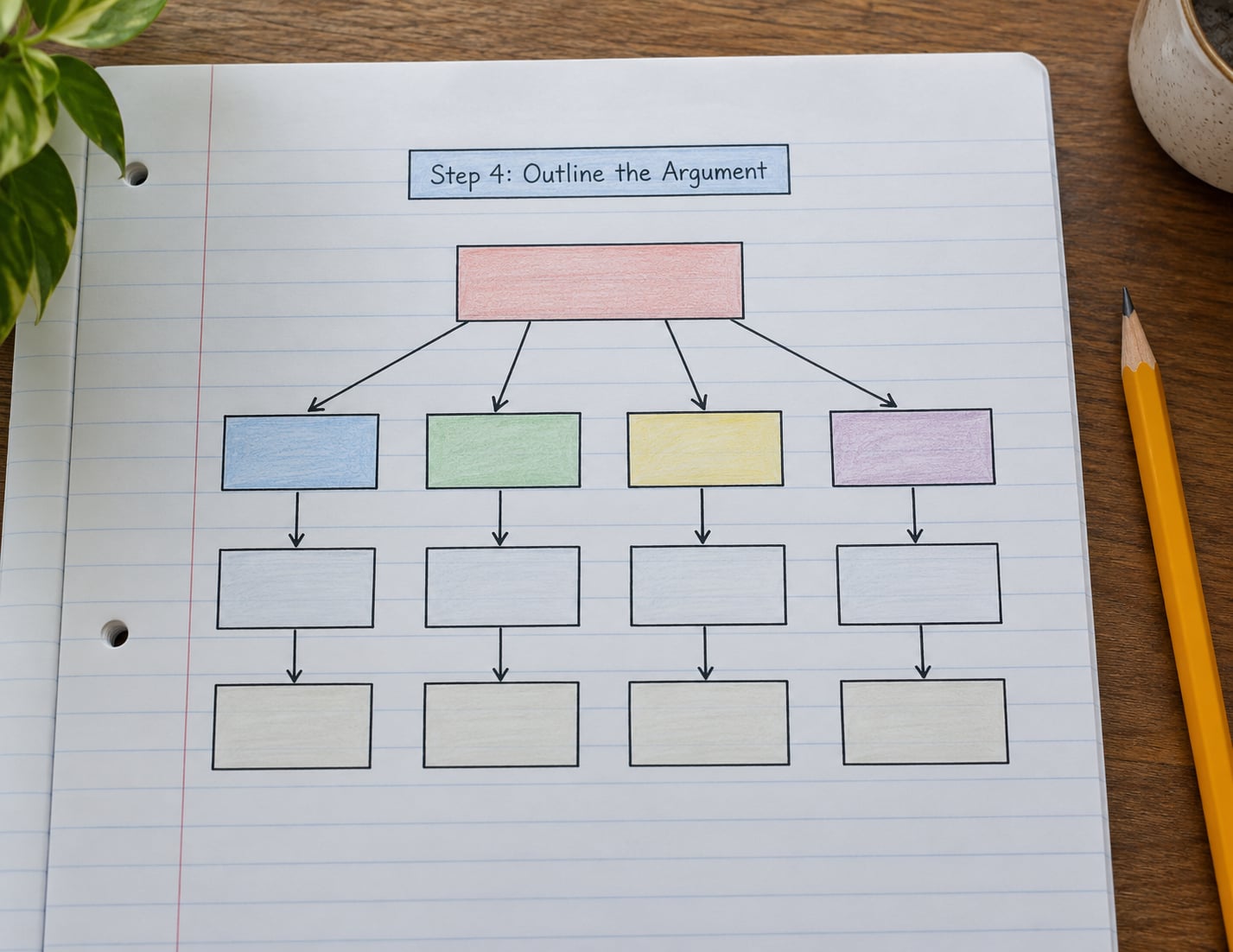
You have about three minutes. Write the thesis at the top, then one line per body paragraph containing a topic sentence and the evidence that supports it. That is the outline. Resist adding sentences to it.
Students ask on forums whether paragraphs should follow the order of the text or follow the ideas in the thesis. Both work, and the answer depends on the prompt and the work.
Use chronological or text-order organization when the prompt is about how meaning develops, how a character changes, or how structure builds an effect across a passage. Readers find the reasoning easy to follow, which matters when the reader is scoring four rows in a short time.
Use device-clustered organization when your thesis names two or three techniques, which is common in poetry analysis and in Question 3. Group everything that supports the first part of the claim into one paragraph, then the second, and so on. The risk is a thin paragraph, so only cluster when each group has at least two pieces of evidence or one piece rich enough to sustain several sentences of analysis.
Write the conclusion in the outline too, as a single sentence. Planning the ending stops the last two minutes from turning into a restatement of the introduction.
Step 5: Draft Clear Literary Analysis
Write the body paragraphs in the shape from Step 3, one idea per paragraph. If a paragraph cannot be summarized in a single sentence that starts with a claim, it is doing two jobs and both will suffer.
Keep the analysis visible in every paragraph. The most common way to lose Row B points in a timed essay is drifting back into description: telling readers what happens, in what order, with what weather. Description belongs in a clause inside your analysis, never as the paragraph’s main work.
Use literary terminology where it earns precision, and skip it where it is decoration. Naming a device tells readers nothing on its own. Explaining what the device does, and why the author chose it here instead of somewhere else, is the analysis readers are scoring.
Introductions should be short. Two or three sentences that name the text, orient the reader, and land a clear thesis is plenty. A sweeping historical opening, a summary of the plot, and a definition of a literary term are the three most common uses of wasted minutes in the first ninety seconds.
Step 6: Revise and Proofread
You will not have time for a real revision. You will have about three minutes, and you should spend them in a fixed order rather than reading the essay straight through hunting for whatever looks wrong.
Read the thesis first, then the first sentence of each body paragraph. That takes under a minute and catches the most expensive problem, which is a body paragraph that never connects back to the claim.
Second, check that every quotation is finished and correctly punctuated, that you named the author and the work in a way a reader can follow, and that no paragraph is only plot.
Third, cut. If you wrote a sentence that adds atmosphere without adding reasoning, it is the first thing to remove. Long essays lose sophistication points, not length points.
The conclusion should extend the argument, meaning it should say what the reading complicates, what remains unresolved, or what the moment reveals that the essay’s earlier claims did not reach. A conclusion that summarizes the three body paragraphs in order tells readers you ran out of ideas, and it is where a lot of otherwise competent essays get capped.
After the exam, score yourself honestly against the rubric rather than asking whether you feel you did well. Readers have been trained to look for specific things, and self-scoring with the scoring guidelines in hand is the fastest way to see which row you are actually losing.
Common Mistakes
Low scores on this exam trace back to a short list of repeated habits, and each one has a direct fix. I have organized them by the rubric row they cost you points in, so it is easy to see which habit to attack first.
A thesis that restates the prompt. If your thesis could be written without reading the book, it is not an interpretation. Fix: after drafting the thesis, ask what a reasonable reader could disagree with. If there is no disagreement, the sentence is still too vague.
Plot summary dressed as analysis. Long stretches of what happens, with devices named on top but not explained. Fix: cut every sentence that would survive if the quotation were deleted, then re-add only what the quotation needs.
Evidence dumping. A run of quotations or examples with no commentary between them. Fix: one piece of evidence per sentence-and-a-half, and no second piece until the first has been explained.
Hunting for the sophistication point with vocabulary. Unusual words do not earn Row C, and readers have seen the attempt enough times to recognize it. Fix: complicate the idea instead, by addressing a counter-reading or a limit in your own claim.
Weak or missing transitions between paragraphs. Paragraphs that read as unrelated entries, even when each one is individually good. Fix: end each paragraph with a sentence that hands off to the next part of the thesis, and spend the seconds to write it.
Ignoring the prompt’s specific terms. Writing a general essay about a general theme because the prompt felt familiar. Fix: underline the two or three most specific words in the prompt and check your thesis against them before you draft.
Running out of time before the conclusion. Fix: give the conclusion four minutes from the start of your outline, and if you are behind at minute thirty, cut commentary length rather than skipping the ending entirely.
Bringing in outside sources. A paragraph of historical background or a critic’s opinion is the easiest way to spend eight minutes writing about something that is not scored. Fix: keep context to one clause, only when it sharpens your reading of the text.
One more worth naming, because it is the most common complaint from self-studying students: having nowhere to get honest feedback. The workaround that seems to work best is scoring your own timed essays row by row with the College Board guidelines open, and marking every sentence that would not obviously earn a Row B point.
Frequently Asked Questions
How many paragraphs do you need for an AP Lit essay?
Four or five paragraphs is the working target: an introduction carrying your thesis, two or three body paragraphs built around specific evidence, and a conclusion that extends the argument. With 40 minutes on the clock, three body paragraphs is generous. Two paragraphs with real commentary score better than four thin ones, because readers reward depth of reasoning per paragraph rather than the number of paragraphs.
How long should an AP Lit essay be?
Aim for roughly 500 to 700 handwritten words, which is what fits comfortably into a 40-minute window. Length is not a scored criterion, so an extra page of plot summary gains nothing. If you are running long, cut background and restated transitions first. If you are running short, extend the commentary after your last piece of evidence rather than adding a new summary paragraph.
Do you need direct quotes, and can I use outside sources?
Quotations are optional and reasoning is not. One short embedded quote per body paragraph is plenty, and naming a specific scene, image, or shift in narrative distance often carries more analysis than a line of dialogue. Outside sources are a bad trade: a critic’s opinion or a page of history is unscored, and a sentence of context works only when it sharpens your reading of the text.
How do I earn the sophistication point?
The point goes to an essay that acknowledges complexity, nuance, or context, and the label is deliberately vague so that several moves qualify. Weaken your own claim, address a reasonable counter-reading, trace how the passage resists a single interpretation, or connect the moment to a relevant context or comparison. Sophisticated vocabulary by itself does not earn it, however impressive the vocabulary is.
Is AP Lit the hardest AP exam?
It gets called that constantly, and the free-response section does demand a skill many students have never practised: sustained analysis on a timer. Difficulty here is mostly about preparation rather than talent. Students on r/ApplyingToCollege keep landing on the same point. Write several timed practice essays from released College Board prompts and read the scoring guidelines closely, and the format stops feeling unfamiliar.
How do I study AP Lit without a teacher?
Build everything around the released prompts and scored sample essays on AP Central, write to those prompts on a timer, and score yourself row by row with the guidelines open. Read fewer works properly and keep an evidence notebook than many works superficially. Practise on both novels and poems so switching between prose fiction and poetry analysis does not cost you your first ten minutes.
Conclusion
Start with the prompt and spend the first eight minutes deciding what you are actually claiming. Write a thesis that could be argued against, pick two to four pieces of evidence that prove different parts of it, and let the commentary do the work that a summary never can.
Knowing how to write an AP literature essay is less about having read more books than about knowing which rubric row you are losing points on. Read the scoring guidelines in the College Board’s own words, write timed practice from the released prompts, and score your own work honestly. That loop teaches more in a month than another book does in a semester.