
Point of view in fiction is the filter a story is told through: whoever is narrating decides what the reader is allowed to know, notice, and feel. Once you know how to use point of view in fiction, the craft becomes a set of decisions you can make on purpose rather than a rule you hope you are not breaking.
The short version: pick one viewpoint character per scene, stay inside what that character can observe, know, remember, or assume, and change perspective only at a scene or chapter break. That is the whole method. The rest of this guide is how to choose, how to write inside the filter, and how to find the leaks in a draft that already has them.
This takes about twenty minutes of thought before you draft a scene and about twenty minutes of revision after. It is a craft skill rather than a talent, which means it can be learned, practised, and checked.
A working definition before anything else: point of view in fiction is the narrative perspective from which a story is told. It is the position the narrator occupies relative to the events, and it determines what the reader can access. First person uses I and we, second person uses you, third person uses he, she, and they. Third person then splits into limited, where the narrator enters one character’s inner life at a time, and omniscient, where the narrator can enter anyone’s.
One clarification that saves a lot of confusion later. The narrator is the voice on the page. The viewpoint character is the consciousness whose knowledge governs the scene. In a third person limited novel they are usually the same thing, and the prose can be almost indistinguishable from a first person one. In a frame story or an epistolary novel the narrator and the viewpoint character are deliberately different, which is how a book like Heart of Darkness can tell you far more than the man telling it knows.
Table of Contents
- What You Need
- Step-by-Step: How to Use Point of View in Fiction
- Step 1: Choose the Character Who Will Anchor the Scene
- Step 2: Decide Whether the Narrator Is First or Third Person
- Step 3: Filter Information Through the Viewpoint Character
- Step 4: Use the Narrator’s Language, Bias, and Blind Spots
- Step 5: Adjust Distance and Scope Without Changing Identity
- Step 6: Check the Scene for Viewpoint Leaks
- Common Mistakes
- How Point of View Changes Reader Experience
- Frequently Asked Questions
- What does point of view mean in fiction?
- How do I know which point of view to use?
- Can a story switch between first person and third person?
- What is head-hopping, and how do I fix it?
- Should the narrator know everything in a fiction story?
- Conclusion
What You Need
You do not need software, a course, or a vocabulary list. You need four things, and three of them are decisions you can make in a notebook.
- A viewpoint character for the scene. One person whose eyes carry the scene, even if the scene happens in a crowded room.
- A draft to work in. A scene of any length, from 300 words upward, is enough to practise on.
- A chosen person. First person, third person limited, or third person omniscient. Deciding this before you write saves the most painful kind of revision.
- A knowledge list. A short list of what your viewpoint character knows, suspects, and has no way of knowing. This is the single most useful item on the list, because it is the test you run your draft against.
The build-the-list step takes about five minutes and it is the one writers skip. Write down the facts the viewpoint character holds. If your scene is a woman in a hospital corridor waiting on test results, her list might read: knows her brother is in the room, does not know what the doctors suspect, remembers the argument last Tuesday, assumes the nurse is being kind because the nurse is smiling. Anything in your draft that is not on that list is a leak.
| Point of view | Pronouns | What the narrator knows | Effect on the reader | Literary example |
|---|---|---|---|---|
| First person | I, me, we | Only what the narrator experienced, was told, or concluded | Immediate, intimate, biased, sometimes unreliable | Moby-Dick, The Hunger Games |
| Second person | you | The reader’s own experience, addressed directly | Puts the reader inside the action; hard to sustain for long | Bright Lights, Big City, If On a Winter’s Night a Traveller |
| Third person limited | he, she, they | One character’s inner life at a time | Close and controlled; the most common commercial choice | Harry Potter and the Sorcerer’s Stone, Remains of the Day |
| Third person omniscient | he, she, they | Everyone’s inner life, plus what is coming | Wide scope, warmth, and less suspense | Pride and Prejudice, War and Peace |
| Fourth person | we | A collective consciousness | Choral; can feel communal or evasive | Common in memoir and war fiction; rare as a whole-book choice |
| Multiple viewpoints | Mostly he, she, they | Several characters, one per section | Scale and comparison, at the cost of intimacy | As I Lay Dying, A Game of Thrones |
Step-by-Step: How to Use Point of View in Fiction
Step 1: Choose the Character Who Will Anchor the Scene
Choose the viewpoint character for the scene by asking which person has the most at stake in it. Emotional investment beats access to information, and access beats convenience. A character standing in a doorway watching two people argue might have a wonderful view of the room, but if they have no reason to care what is said, the scene will not hold them.
Ask four questions about each candidate. Who wants the most in this scene? Who knows the most about what is really happening? Who is most likely to be wrong about it? Who has something to hide? The character who loses the most if the scene goes badly is usually your narrator.
Contrast that with a weak choice. If your heroine is delivering a letter in a crowded market square, anchoring the scene on a passing merchant gives you a tidy wide shot and no story. He has no stake, no bias, and no reason for the reader to stay. The same scene from her viewpoint has everything: what she hopes the letter says, the merchant she is avoiding, the detail she notices because she is frightened rather than because it matters.
One useful test: describe the scene in a single sentence as Character discovers X, and decides to do Y. If you cannot fill in that sentence for your candidate, you have the wrong anchor.
Step 2: Decide Whether the Narrator Is First or Third Person
The choice of person determines how much of the story the narrator is allowed to keep. First person narration is locked into one consciousness by grammar itself, because I can only be one person. Third person limited is nearly as restrictive but hides the restriction behind he and she, which is why many writers find it easier to stay disciplined. Omniscient refuses all restriction, and pays for that freedom with suspense.
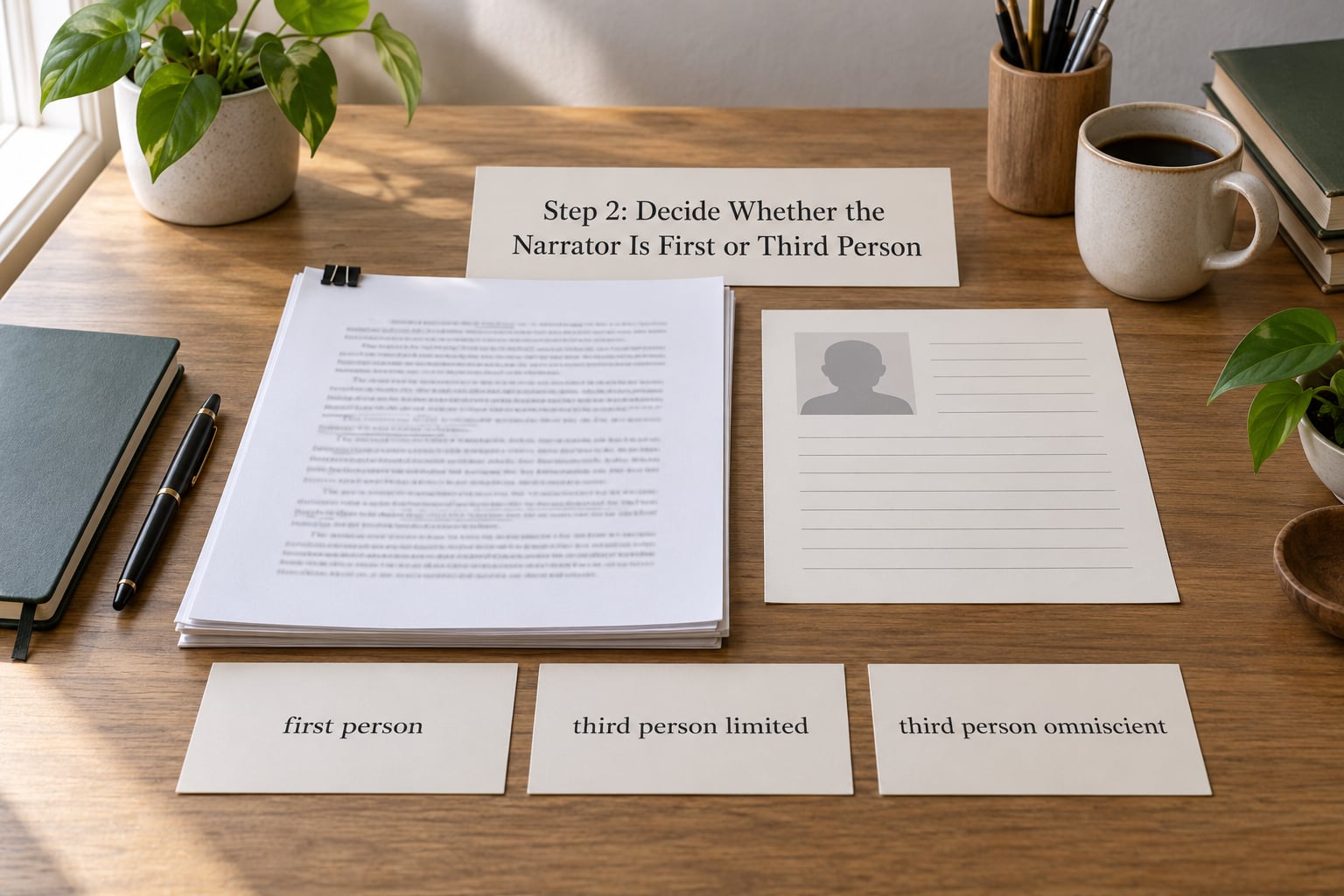
The grammatical signals readers use are unglamorous and reliable. First person uses I and my, and the narrator is a character who exists inside the story, so they can be mistaken, biased, or lying. Second person uses you and puts the reader’s own experience in the frame. Third person limited uses he, she, and they, and enters exactly one character’s interior per scene. Third person omniscient also uses he, she, and they, but moves between interiors, and often knows things the characters do not.
Watch the same moment change hands. A woman in a hospital corridor, hearing that her brother is in the next room:
First person. I knew before anyone said it. The way the nurse stepped back and gave me that wide empty look, the way the corridor seemed to lean. I had been waiting eleven years to walk through that door and now I could not make my legs do it.
Third person limited. Clara knew before anyone said it. The nurse stepped back and gave her that wide empty look, and Clara found the corridor leaning away from her. Eleven years of waiting, and her legs would not move.
Third person omniscient. Clara knew before anyone said it, though the nurse had been careful and the corridor was not. She had been eleven years in the waiting and she was about to walk into a room that would either give her a brother or a formal apology. In the next bed a man who did not know her was crying about a phone call he had made years ago, and Clara had no idea, and would not have cared.
The first two are nearly the same sentence with the grammar swapped. The third adds scope the first two could not hold, and it costs something real: we now know the nurse stepped back, which was information the limited versions kept as a guess.
Step 3: Filter Information Through the Viewpoint Character
Filtering is the actual work of point of view in fiction. Every detail on the page passes through one person’s attention before the reader receives it, and a detail the viewpoint character would not notice, remember, or understand should not be there.
Compare an unfiltered paragraph with a filtered one. Unfiltered: Sarah walked into the kitchen at seven, and she was hungry. The clock above the stove read 7:12. Her father had left the radio playing in the other room, and downstairs the boiler kicked on. She had not eaten since the previous afternoon. Filtered through a character who is anxious and distracted: Sarah came in at seven, and her stomach turned over before she had decided whether she was hungry. The radio was still going in the other room, so he was up. She did not look at the clock. She had eaten on Tuesday, or maybe Monday.
The second version tells the reader that her father is in the house and that she is not eating properly, and it tells them both through her fear rather than through information. The first version only reports. Nobody outside the kitchen could tell you the difference in plot terms, which is the point: the filter carries the characterisation for free.
Information control is what makes the technique work for plot, not just voice. A viewpoint character who does not know something means the reader does not know it either, and that gap is where suspense, misdirection, and twists live. If you narrate a character’s private knowledge, you have to un-tell the reader later, which most drafts never do well enough.
The practical move: before you write a scene, list the things the viewpoint character wants, the things they are afraid of, and the things they are wrong about. Then write only what those three lists produce.
Step 4: Use the Narrator’s Language, Bias, and Blind Spots
Two narrators describing the same door will not sound alike, and that difference is characterisation you did not have to state. A calm person notices layout. A suspicious person notices who came in and who did not. A frightened person notices exits and hands.
Same door, three people. Calm: The door stood open six inches. Beyond it a corridor ran the length of the house, lit at the far end by a window. Suspicious: The door stood open six inches, which it never had been before nine. He looked past it, down the corridor, and counted the lights. One was off that should have been on. Frightened: The door was open. She did not push it. She stood in the kitchen with the dish in her hand and counted to ten, and the door stayed open the whole time she counted.
Now try to tell which passage belongs to a thief, which to a nurse, and which to a child. If the answer came easily, you have an ear for it. If it did not, the fix is specific: write the same page three times, once for each state, and steal the sentences that surprise you.
Three levers give you that difference. Diction is the vocabulary a person reaches for, including the words they misuse. Attention is where the eye goes when nothing important is happening. Omission is what the narrator declines to mention, which is often the loudest signal of all. A narrator who reviews a meeting and skips over the moment she was asked to resign has told you what the scene is about.
Bias completes it. Every narrator has a version they are arguing for, and readers feel it long before they can name it. A character who insists the manager is a decent person, four pages after the manager lied, is making the story move.
Step 5: Adjust Distance and Scope Without Changing Identity
Distance and point of view are different dials, and beginners tend to turn both at once. Point of view answers whose mind governs the scene. Narrative distance answers how far the camera sits from that mind.
Close third keeps you inside the viewpoint character: interior, sensory, immediate, and largely present tense in effect even when the verbs are in the past. Medium third steps back a little, letting you narrate behaviour and habit with some room around it. Distant third pulls further, summarising periods of a life in a sentence or two, which is how a novel can cover fifteen years without stalling.
Distance helps when you need to compress time, establish a world, or show a character’s habits rather than one incident. Keep a name, a room, and a recurring worry and you can then widen out for a paragraph without losing the reader.
What distance must never do is change whose perspective governs the scene. Widening to summarise the week is fine. Widening and suddenly mentioning that the brother, in another town he was not present for, felt relieved is a head-hop, and readers notice even when they cannot name what went wrong. If you want his reaction, either put him in the scene, move his section to his own chapter, or let someone else report it.
Step 6: Check the Scene for Viewpoint Leaks
Revision is where point of view in fiction is won, and it is far easier to diagnose than writers expect. Four sweeps, in this order, catch almost everything.
The pronoun sweep. Read the scene and highlight every he, she, and they. Ask, each time, whose mind governs the sentence that uses it. A pronoun that only names who is walking somewhere is fine. A pronoun attached to a verb of thinking or feeling is a claim about interior access, and it has to be your viewpoint character. Writers who struggle to spot this can reduce the problem overnight: one commenter on a first-person workshop thread found that deleting most of the word I across three pages made the prose noticeably stronger, and the same trick works in third person with he and she.
The filter-word sweep. Search for saw, heard, thought, felt, realized, watched, and noticed. Filter words name the character perceiving, which is safe and often lazy. Cut the ones that add nothing and the narrator’s attention tightens. She looked at the empty shelf is weaker than She saw the empty shelf, which is weaker than She counted the spaces on the shelf and found the flour gone.
The knowledge test. Take every piece of information in the scene and ask whether the viewpoint character could know it. Not plausibly know it, could actually know it, by seeing it, being told it, or deducing it. Three facts fail this test in most drafts: what another character is thinking in another room, what happened before the character arrived, and what the reader will only learn later.
The emotion test. Emotional bleed is the subtlest leak. A viewpoint character who is grieving registers other people’s behaviour as slow and wrong. A frightened one reads threat into everything. If a reaction seems to belong to a different emotional state than the one you established, check whether you have let a second character’s feelings into the narration.
Then read the scene aloud. Ear and eye fail in different ways, and a sentence that sounds wrong is nearly always a POV problem even when you cannot yet say which one.
Common Mistakes
Head-hopping. Moving into a second character’s thoughts inside the same scene. It is the most common problem in draft fiction, and the most common anxiety on writing forums, where the same question arrives again and again: is what I am doing head-hopping, or is it allowed? Use the diagnostic above. If you cannot name the single viewpoint character for the scene, you have head-hopped. The exception is deliberate omniscient narration, which works when the narrator’s wandering is stylised and consistent rather than accidental.
The repair is mechanical, and it takes about ten minutes a scene. Decide which character owns the scene. Convert every other character’s interior into something the owner can observe: a face, a posture, a sentence, a silence with a shape. Delete whatever you cannot convert.
Before (two minds in one room): She knew Marcus was lying about the invoice, because she had seen the original. Marcus knew she was lying too, and he felt the room tilt, because he had counted the money twice and it was not enough for what he had promised.
After (one mind, one room): She had seen the original invoice, so she watched him hold it a half second too long. Marcus was sweating, she noticed. His hand went to his pocket twice in a minute, and both times came back empty.
The second version carries the same information, and more, because the reader now works it out. That is the trade you want every time.
Sliding tense. This is the mistake that gets manuscripts rejected, and it is not a point of view error even though writers often blame the person. A commenter on a NowNovel first-person thread described a 500-page manuscript that judges could not get past the opening twenty pages; the cause was flapping between present and past, not the choice of first person. Pick a tense, write a note on the front of your draft, and check it on every read.
This also settles a myth that confuses a lot of beginners. First person is not required to be present tense. The Hunger Games and The Catcher in the Rye are both first person, and the second is entirely in the past. Present tense in first person creates a specific effect, urgency and immediacy, and it is worth choosing deliberately or not at all.
Confusing point of view with narrative distance. Writers zoom out to cover a year of story and then feel they have broken their POV, when what they have actually done is change camera position. Distance is a tool for time compression. Identity is a tool for controlling knowledge. Turn them separately.
Writing events the narrator cannot witness. In first person this is a genuine structural problem, not a flaw in your plotting. Four options work: have another character report it in dialogue, have the narrator piece it together from evidence, have the narrator infer it wrongly and let the reader know something is off, or cut to a different viewpoint character in a clearly marked scene. The first option is the workhorse; use it freely.
Too many viewpoint characters. Four is a comfortable ceiling for a commercial novel, and the shift has to happen at a chapter or scene break so the reader never has to work out mid-page whose head they are in. If you cannot remember who is in the chair, you are past the number where the extra viewpoints are earning their keep.
Treating a rule as law. George R.R. Martin and William Faulkner both move between minds, and readers have not thrown their books across the room. The difference is that those shifts are patterned and announced, and they sit inside a book whose voice is clearly one author’s. Write a novel-length book in flawless close third first, then experiment. Learning the rule first is what lets you break it on purpose later.
Staying consistent in voice across a long draft. Voice drifts more than point of view does, and it is harder to see. Read three scenes from the beginning, middle, and end of your draft in one sitting, with no edits. If the voice wanders, the fix is small: check your dictionary habits, your sentence length, and how often you reach for your viewpoint character’s pet words.
Here is the summary rule, and it holds in almost every case: one viewpoint character per scene, switch only at a scene or chapter break, and never narrate what your viewpoint character could not know.
How Point of View Changes Reader Experience
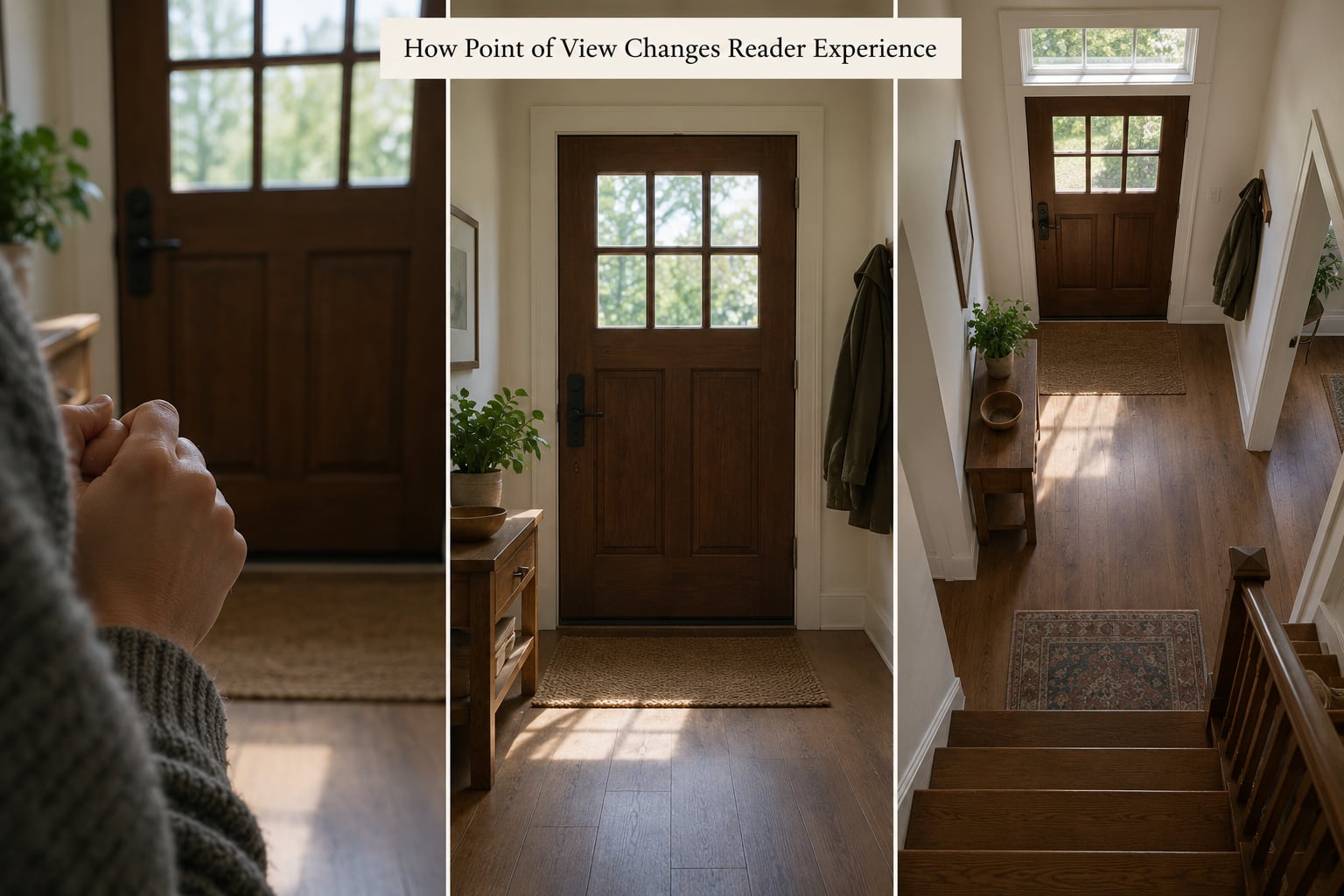
Point of view is not decoration. It is the mechanism that produces every effect readers talk about afterwards, because it decides what the reader knows, when they know it, and how close they are to the person having the experience.
Suspense lives in the gap between what the reader knows and what the character knows. In first person the gap is automatic, because the reader knows exactly what the narrator knows and no more. In third person limited you build the gap by simply staying out of other heads. In omniscient you close it every time you enter a second mind, which is why omniscient novels have trouble with surprise and are very good at dread.
Sympathy is an intimacy effect. First person and close third put the reader inside a nervous system, noticing what that person notices and skipping what they would not think about. An omniscient narrator who describes the same scene with a broad stroke, covering a whole room, keeps the reader interested in the situation rather than inside the person.
Dramatic irony needs a second pocket of knowledge somewhere, either with the reader or with another character. A third person limited book that reserves a chapter for a character who knows what is coming gives the reader a knot of anticipation that a single-viewpoint book cannot easily create.
Pacing follows information density. Omniscient can compress months into a page because it is not tethered to one person’s attention. Close third slows down, which is exactly what you want in a scene that is about a person rather than an event.
Unreliable narration is a first person speciality, and a good one. When the narrator is the only source of information, any gap or distortion in what they tell you reads as a clue. That is the machinery behind Gone Girl and Lolita, where the reader is asked to trust a voice that is not to be trusted. Unreliable narration is really a POV technique used deliberately rather than by accident.
Compare the same fictional doorway three ways and the mechanics are visible. A participant gives you a tilted frame, a held breath, and the detail they are counting. A limited observer gives you a level frame and a note of what the room looked like, with no account of the panic. An omniscient narrator gives you the corridor, the ceiling, the family photograph on the wall, and the reason the door was left open six inches. Different pictures of the same door, and a different night for the reader depending on which one you chose.
One more effect worth naming: world-building. A narrator who comments on the weather, the money, and the smell of the street delivers exposition without stopping the scene. A narrator inside their own worry delivers the same facts with no comment at all, and the reader absorbs them as situation rather than instruction.
If you are teaching this rather than practising it, the same framework works on a published novel. Ask students to mark every sentence in a chapter that reveals a character’s interior, name who is inside each one, and see the pattern of the book’s point of view emerge in about ten minutes. That exercise is a good fit for a unit on narrative technique, and it makes the abstract idea concrete faster than any definition.
Frequently Asked Questions
What does point of view mean in fiction?
Point of view in fiction is the narrative perspective a story is told from: the position of the narrator relative to the events. It decides what the reader can know. First person uses I or we, second person uses you, third person uses he, she, and they. Third person splits into limited, where one character’s inner life is available at a time, and omniscient, where the narrator can enter anyone’s mind. The choice sets a filter that every detail in the story must pass through.
How do I know which point of view to use?
Decide by what your story needs rather than by preference. First person suits a narrator with a voice worth hearing and a story full of information they cannot get. Third person limited suits most commercial fiction because it gives closeness with an extra layer of insulation for the writer. Third person omniscient suits family sagas and novels about a community. A personal narrative is usually first person, past tense, because you are the one who lived it.
Can a story switch between first person and third person?
You can, but not casually. Readers carry a mental map of who is narrating, and changing the person mid-book means rebuilding it. A scene break or chapter break is not always enough; the change usually needs a new opening page and a signal, such as a marked section break. Switching viewpoint characters in third person is far easier than switching person, and most writers who want variety get it by moving between characters rather than between first and third.
What is head-hopping, and how do I fix it?
Head-hopping is entering a second character’s thoughts inside a scene that belongs to one viewpoint character. Readers experience it as a lurch, and they often cannot say what went wrong. To fix it, choose which character owns the scene, then convert every other character’s interior into something your viewpoint character can see or hear. Run a pronoun sweep, a filter-word search, and a knowledge test, then read the scene aloud. Drafts usually survive the repair and improve.
Should the narrator know everything in a fiction story?
Almost never, unless you are writing omniscient fiction on purpose. A narrator who knows everything has to reveal nothing, and withholding under that pressure reads as gamesmanship. Limited knowledge creates suspense, character bias, and unreliable narration, which are the effects most readers notice. A deliberate exception is the unreliable first person narrator, where the gap between what the narrator says and what the reader can infer is the whole point of the book.
Conclusion
Point of view in fiction is one decision made properly and then held. Choose the character with the most at stake, decide whether they narrate as I or as he or she, and then write only what their attention would actually produce.
Start with a single scene today. Pick your viewpoint character, write their knowledge list before you start, and draft to it. When you finish, run the four checks in Step 6 and fix what leaks. One repaired scene teaches more about point of view than a chapter of theory, and after a few of them the choice stops feeling like a decision you have to make at all.