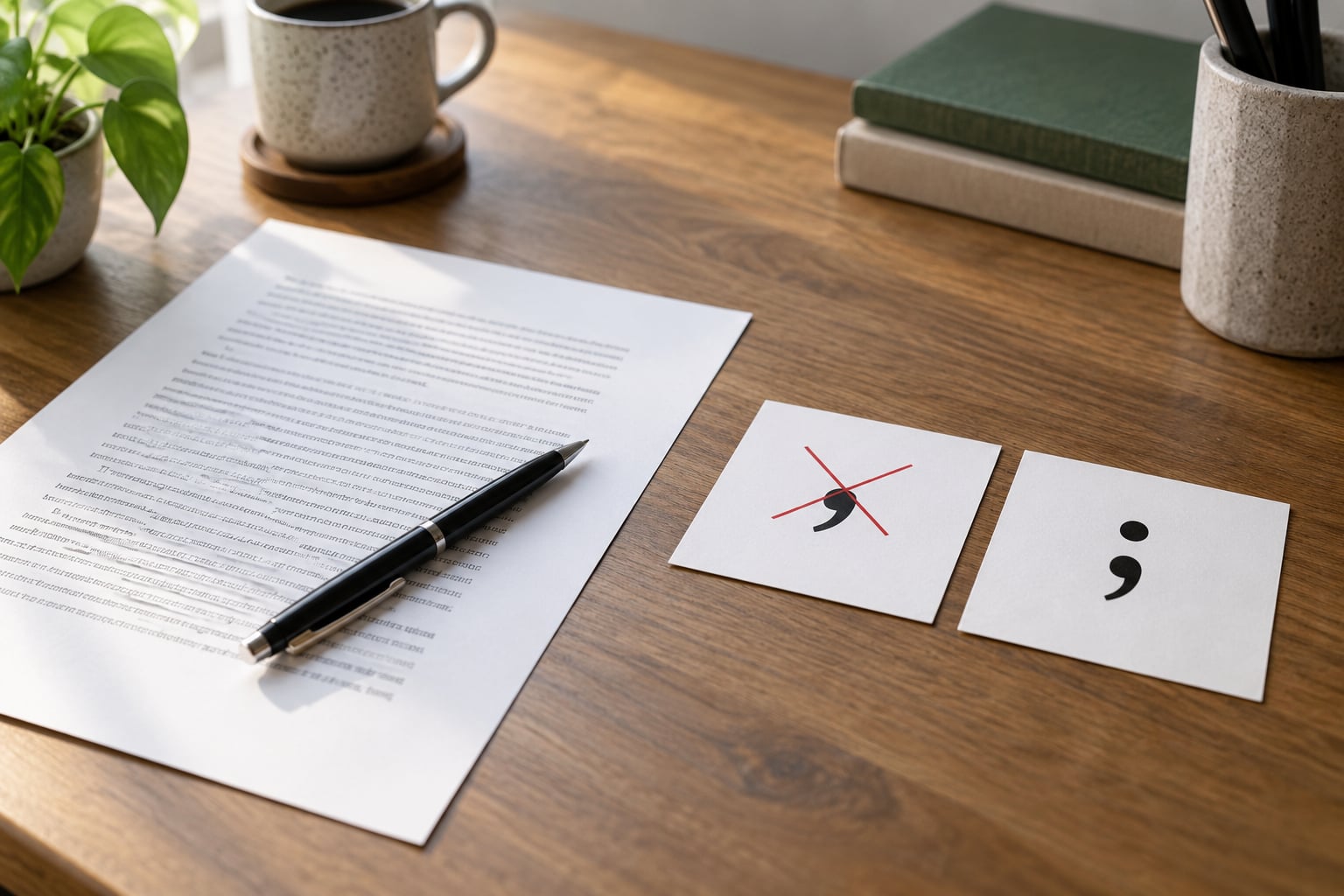
A comma splice happens when two independent clauses — clauses that can each stand alone as a complete sentence — are joined by a comma and nothing else. A comma is too light a mark to hold two complete sentences together, so the result reads as one broken sentence. Fixing one takes about a minute once you can spot the two clauses.
That last part is where most people get stuck. They know the sentence feels wrong but cannot say why, so they guess: add a period here, add a word there. This guide gives you a way to fix comma splices that does not depend on guessing — you look at the two halves of the sentence, work out what each one is, and pick a repair that matches.
Before the methods, one table. The confusion that sends people to the grammar checker in a panic is usually a three-way mixup.
| What you have | What it looks like | What to do |
|---|---|---|
| Comma splice | The train was late, we took a taxi. | Join or separate the two independent clauses |
| Run-on sentence | The train was late we took a taxi. | Add punctuation between the clauses |
| Sentence fragment | Because the train was late. | Add the missing subject and verb, or attach it to another sentence |
Notice the middle row. A run-on and a comma splice contain the same two clauses and differ only in the punctuation between them, which is why the two get confused constantly.
Table of Contents
- What You Need
- How to Fix Comma Splices: Step by Step
- How to Fix Comma Splices by Joining the Clauses
- How to Fix Comma Splices with Punctuation
- Practice: Six Sentences to Repair
- Common Mistakes
- When a comma splice is not a mistake
- Frequently Asked Questions
- What defines a comma splice?
- What are three ways to correct a comma splice?
- Does a semicolon fix a comma splice?
- Should I use a comma before or after FANBOYS?
- Should I use a colon or semicolon between two independent clauses?
- How do I stop creating comma splices when I try to avoid run-ons?
- Conclusion
What You Need
No software, no paid tool, no grammar checker subscription. What you need is four pieces of knowledge, and you probably already have three of them.
An independent clause has a subject, a verb, and a complete idea. “The train was late” qualifies. So does “we took a taxi.” Being able to point at each half of a sentence and say yes or no to that test is the whole skill.
A dependent clause, sometimes called a subordinate clause, has a subject and verb but cannot stand alone. It usually starts with a word like because, although, while, since, or if. “Because the train was late” is a dependent clause, which is why it cannot stand as a sentence.
The seven coordinating conjunctions — for, and, nor, but, or, yet, so, remembered as FANBOYS. These join two independent clauses of equal weight.
And a sense of which mark is stronger than which: period, then semicolon, then colon, then comma. Punctuation is a hierarchy, and a splice happens when you use the weakest mark in a job that needs a stronger one.
One habit helps more than the definitions do. Read the sentence aloud. A comma splice makes your voice run out of breath at exactly the wrong place, and a full stop makes it land. Your ear finds the boundary faster than your eye does.
How to Fix Comma Splices: Step by Step
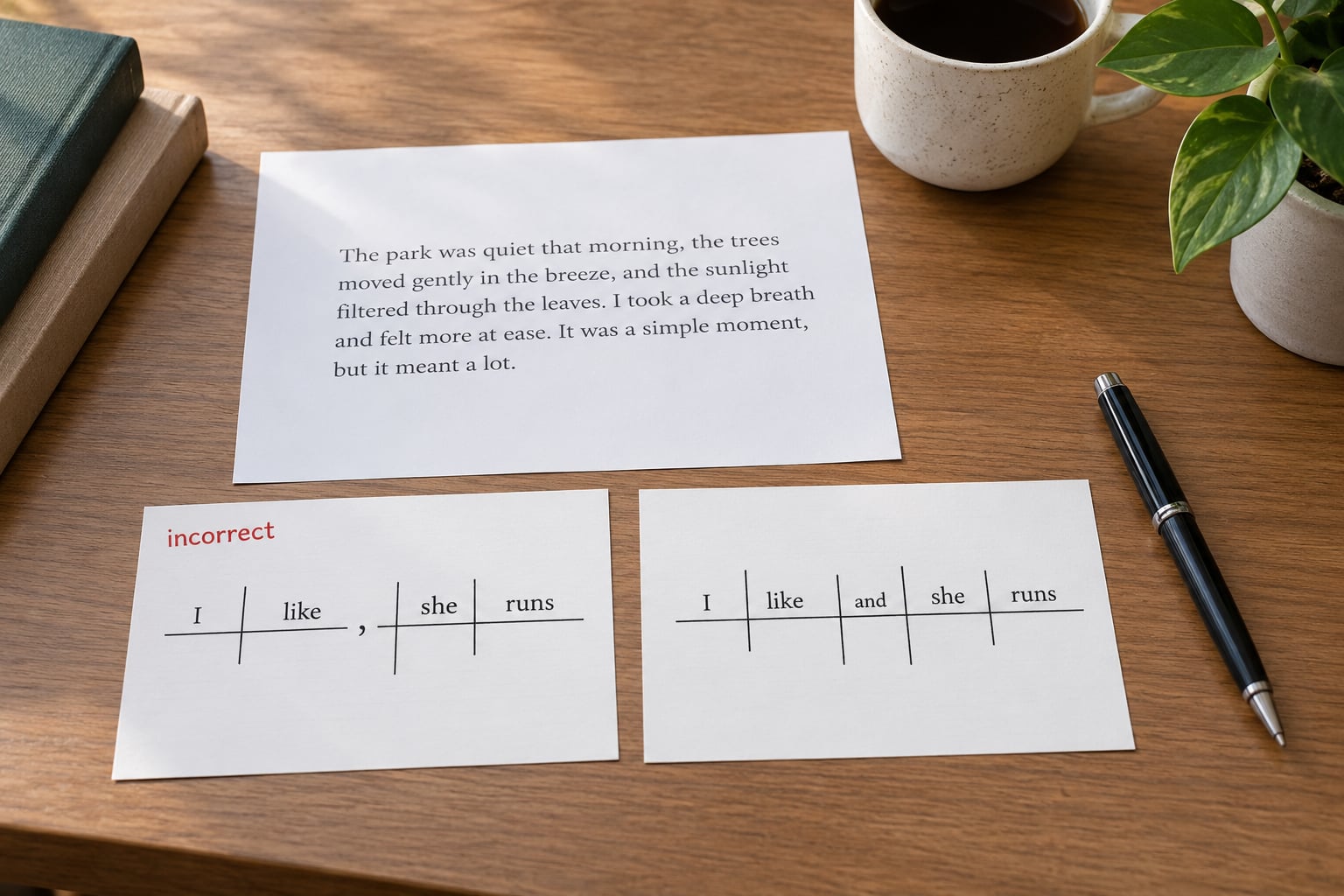
Four moves, in order, every time. The order matters, because most failed attempts start by picking punctuation and working backwards.
Step 1: Find the boundary. Read the sentence and locate the comma that is doing too much work. If there is more than one comma, look at the one sitting between two chunks that each look complete on their own.
Step 2: Test each half for independence. Cover the other half with your hand and read what is left. Can it stand as a whole sentence? If yes on both sides, you have two independent clauses and therefore a comma splice. If one half collapses without the other, you may have a different problem entirely.
Step 3: Decide the relationship, then pick the repair. Are the two clauses equal in importance, or does one explain, contrast with, or cause the other? Equal means a conjunction or a semicolon. Unequal means subordination, a colon, or a dash.
Step 4: Reread for rhythm. This is the step everyone skips and the one that turns a technically correct fix into good prose. Three short sentences in a row is as much a problem as the splice was.
Here is the same repair decision in one view.
| Method | Best used when | What it signals | Example |
|---|---|---|---|
| Add a coordinating conjunction | Two clauses of equal weight | Connection, addition, contrast | The train was late, so we took a taxi. |
| Replace with a period | The two ideas deserve separate emphasis | Full stop, strongest break | The train was late. We took a taxi. |
| Replace with a semicolon | Closely related, but still separate thoughts | A pause, not a full stop | The train was late; we took a taxi. |
| Add a colon | What follows explains or lists what came before | Here is the point | The delay had one cause: a signal failure. |
| Subordinate one clause | One clause is clearly less important | Unequal relationship | Because the train was late, we took a taxi. |
| Use an em dash | A sharp aside, a turn, or emphasis | Interruption | The train was late — again — so we took a taxi. |
Most student essays are marked down for the same mistake: they reach for the period because it is the fastest fix, then wonder why the paragraph sounds like a list of short announcements.
How to Fix Comma Splices by Joining the Clauses
This is the fix most teachers are looking for. You keep both clauses, keep them in one sentence, and put a coordinating conjunction between them.
Incorrect: The train was late, we took a taxi.
Correct: The train was late, so we took a taxi.
The comma goes before the conjunction, not after. “We took a taxi, so” is the standard pattern when the conjunction joins two independent clauses: comma, space, conjunction, space, second clause. Dropping that leading comma is the most common miss in student work.
The seven choices do different things, so pick the one that matches your meaning rather than defaulting to and every time:
- for — the second clause gives a reason: “I checked the schedule twice, for the platform had changed.”
- and — simple addition: “The train was late and the café had closed.”
- nor — a negative addition, always with neither or not: “She did not answer, nor did she look up.”
- but — contrast: “The forecast was clear, but the harbour was rough.”
- or — a choice: “We can wait for the next train, or we can walk.”
- yet — contrast with a sense of surprise: “The signal was fixed, yet the train still stopped.”
- so — result: “The signal was down, so we took a taxi.”
Three of these get flagged for a reason. For and so look like prepositions at the start of a sentence, and a period before them can be read as a fragment, so keep them after a semicolon or inside a longer sentence. Nor needs its own clause. And yet is the one people forget, because it is not the word they reach for by default.
The other way to join clauses is to make one of them dependent. Add a subordinating conjunction and the imbalance solves the problem:
Incorrect: The signal was down, we took a taxi.
Correct: Because the signal was down, we took a taxi.
Now because the signal was down cannot stand alone, so the comma is doing legitimate work. Swap in although, while, or after and you change the meaning, so choose the one that says what you mean. If both halves are genuinely equal, subordination is the wrong tool — use the conjunction or the semicolon instead.
You can also collapse the pair into a single clause, which often reads best of all:
Incorrect: The signal was down, we took a taxi.
Correct: The signal failure sent us to a taxi.
How to Fix Comma Splices with Punctuation
Sometimes joining words changes more than you want. When the two clauses should stay separate but connected, change the mark instead of adding a word.
Period: the strongest break, for when the second idea deserves its own weight.
Incorrect: The signal was down, we took a taxi.
Correct: The signal was down. We took a taxi.
Cap the next word and check the result sounds like speech. If you read it and feel yourself stopping mid-thought, the period is wrong here — the semicolon will fit better.
Semicolon: a pause that still holds the two clauses together. Use it when the clauses are related but each is a complete thought, and never when the second half is a dependent clause.
Incorrect: The signal was down, we took a taxi.
Correct: The signal was down; we took a taxi.
Semicolons are the fix students underuse and over-correcters overuse. Two semicolons in one sentence and it starts to sound like punctuation is being read aloud.
Colon: only when the material after it explains, defines, or lists the material before it. A colon after a complete clause that is not setting up an explanation is a splice wearing different punctuation. Correct: The delay had one cause: a signal failure on the eastern line. Incorrect: We reached the platform: nothing had changed since the morning.
Em dash: useful for a turn, a break in thought, or emphasis. It can replace the comma and hold two independent clauses together.
Incorrect: He had one year of teaching experience, the rest was guesswork.
Correct: He had one year of teaching experience — the rest was guesswork.
Use no more than one or two em dashes in a paragraph. Three turns a sentence into a road with four bends.
Conjunctive adverbs — however, therefore, meanwhile, nevertheless — need a semicolon or period on both sides, never just a comma. “The signal was down, however, we took a taxi” is still a splice; “The signal was down; however, we took a taxi” is not.
When you cannot decide between semicolon, colon and comma, ask what the second half is doing. Explanation, list or example means colon. A closely related but complete thought means semicolon. A detail that could have been spliced in mid-sentence means comma.
Semicolon when both halves are complete thoughts that belong together: “The article was long; it was worth every minute.”
Colon when the second half names or unpacks the first: “The article was long: four thousand words on a single statute.”
Comma only when a dependent clause follows, or when you are writing fiction and the interruption is deliberate.
Then there is dialogue, where most splices actually happen. Inside a quotation, you can join two independent clauses with a period and a capital instead of a comma:
Incorrect: “We are leaving now,” she said, I need my coat.
Correct: “We are leaving now. I need my coat,” she said.
The reverse also holds. A comma before a dialogue tag cannot join two independent clauses, and turning it into a period changes what the sentence says. If both halves stand alone, a semicolon inside the quotation is often the tidiest fix.
Practice: Six Sentences to Repair
Try these before reading the answers. Aim for a different fix on each one rather than defaulting to a period everywhere.
- The power failed, the whole street went dark.
- He had studied the map, he still took a wrong turn.
- The letter arrived, it was three weeks late.
- She finished the report, her manager had already left.
- Rain filled the gutters, the storm drain was blocked.
- We packed light, the flight was delayed twice.
One answer each, and more than one is defensible:
Answers. 1. Period, or add so: “The power failed, so the whole street went dark.” 2. Semicolon: “He had studied the map; he still took a wrong turn.” 3. Period: “The letter arrived. It was three weeks late.” 4. Subordination with although: “Although her manager had already left, she finished the report.” 5. Em dash: “Rain filled the gutters — the storm drain was blocked.” 6. Subordination with because: “Because the flight was delayed twice, we packed light.”
Common Mistakes
Fixing every splice with a period. This is the pendulum problem writers complain about most: they trade run-on sentences for a string of clipped sentences that read like a list. If your fix requires two full stops in three sentences, try a semicolon or a conjunction instead.
Adding a comma before a dependent clause. “Because the train was late, we took a taxi” is correct, but “Because, the train was late, we took a taxi” is not — a comma cannot follow a conjunction at the start of a clause. Check what actually sits beside the comma.
Using a semicolon in front of a dependent clause. “The report was late; because the data had not arrived” leaves the sentence unfinished. Semicolons join two independent clauses and nothing else.
Turning dialogue into one long breath. When you add “she said” to a quoted sentence, the tag and the quote each need to be able to stand alone. A period between them, not a comma, is usually what is missing.
Believing every flag a grammar checker raises. Automated tools mark commas that were doing their job, and they cannot tell a deliberate stylistic choice from a slip. Treat a flag as a question about the sentence, not a verdict on it.
Joining clauses that should not be joined. Two independent clauses are equal by definition, so if one is really an example or a result, it needs a colon or subordination, not a conjunction.
When a comma splice is not a mistake
Prescriptive grammar calls the splice an error, and in academic and professional writing it is one. In fiction, poetry and informal writing, it is a tool, and a deliberate one. A comma splice in a line of dialogue can carry a breath that a full stop would cut off.
Two rules keep it deliberate rather than careless. It has to be consistent within the piece, and the reader should feel a pause where the splice happens. A page of unmarked splices is a style. A single one in an otherwise clean paragraph is an accident.
Style guides acknowledge this. AP and Chicago both allow a comma splice in creative writing and in quoted material, while holding to the period, semicolon or conjunction in expository prose. If an assignment says formal or academic, that settles it: no intentional splices.
Frequently Asked Questions
What defines a comma splice?
A comma splice is two independent clauses joined by a comma with nothing between them. An independent clause has a subject, a verb, and a complete idea, so it can stand alone as a sentence. If both halves of your sentence can stand alone and only a comma separates them, you have a comma splice. Other names for it include comma fault and fused sentence.
What are three ways to correct a comma splice?
The three most common repairs are: replace the comma with a period, replace it with a semicolon, or add a coordinating conjunction from FANBOYS after the comma. A fourth common option is to subordinate one clause with a word like because or although, which removes the need for a break at all. Which one you pick depends on how closely the two ideas belong together.
Does a semicolon fix a comma splice?
Yes, when both halves are independent clauses. A semicolon joins two complete thoughts and is strong enough to hold them together, so it fixes the splice without adding a word. It does not work when the second half is a dependent clause, because a dependent clause cannot follow a semicolon. It also reads badly if used several times in one sentence.
Should I use a comma before or after FANBOYS?
Put the comma before the conjunction when it joins two independent clauses: we took a taxi, so we made the meeting. Never after it. Without the leading comma, the sentence is a splice, which is the error you were trying to fix in the first place. When the conjunction starts a sentence or sits inside a dependent clause, no comma is needed at all.
Should I use a colon or semicolon between two independent clauses?
Use a semicolon when the two clauses are complete thoughts that belong together, with no explanation between them. Use a colon when the second half explains, defines, or lists what the first half just set up, or when it names the first half outright. If neither test fits, the semicolon is the safer default.
How do I stop creating comma splices when I try to avoid run-ons?
Stop judging sentence boundaries by length and judge them by structure instead. Cover one half of the sentence and check whether it can stand alone; do the same with the other half. If both can, the sentence needs a conjunction, a semicolon, or a full stop between them. Fixing the boundary on paper, rather than by ear, is what keeps you from trading one error for the other.
Conclusion
To fix comma splices, stop looking at the comma and start looking at the two clauses on either side of it. If both stand alone, you choose the repair: period, semicolon, coordinating conjunction, subordination, colon, or dash.
A three-pass routine catches most of them in a draft. First, read every sentence aloud and mark the places your voice runs out of air. Second, underline the two independent clauses in each of those, then pick a repair that matches the relationship between them. Third, reread the paragraph and merge anything that turned choppy in the fixing.
Start with the sentence you are stuck on right now. Cover the left half and ask whether it stands alone. Then do the same with the right half. The answer tells you which repair belongs there, and the rest is just picking the right word.