
To develop a character for a story, you decide who they are, what they want, what is broken in them, and how both of those things change by the last page. Nine steps get you there, and the whole first pass takes about ninety minutes. The slower part, the part that decides whether readers care, happens later during revision.
I have rewritten the same opening chapter enough times to know where most drafts stall. It is almost never the prose. It is that the writer has a plot and a stranger inside it, and the stranger does not yet know what they want. Nine practical steps for developing a character fix that before you write a single scene.
Table of Contents
- What You Need
- How to Develop a Character for a Story: Step by Step
- 1. Decide What the Character Wants From the Story
- 2. Separate the Character’s Want From the Deeper Need
- 3. Build Beliefs, Contradictions, and a Weakness
- 4. Create Only the Backstory That Changes the Story
- 5. Give the Character Distinct Relationships
- 6. Find the Character’s Voice in Dialogue
- 7. Connect the Character to Stakes and Consequences
- 8. Decide How the Character Should Change
- 9. Revise the Profile Through Scenes and Dialogue
- Common Mistakes
- Frequently Asked Questions
- How do I make a fictional character feel realistic?
- How much backstory does a story character need?
- Can I create a character while outlining the plot?
- How do I check whether my character is consistent?
- What should I do if my main character feels boring?
- Conclusion: Begin With Desire and Conflict
What You Need
A notebook or a blank document. That is genuinely the whole tool list, because the failure mode here is tooling. Plenty of writers download a character profile app, fill in forty fields, and never look at the file again.
What you actually need is one page with ten headings you can fill in, in this order:
- Role in the story (protagonist, antagonist, ally, foil)
- Outer want, in one sentence
- Inner need, in one sentence
- Flaw or weakness
- Contradiction (two traits pulling against each other)
- Backstory, limited to what changes the present
- Two or three relationships and what each one pulls on
- Voice notes: vocabulary, rhythm, what they avoid saying
- Stakes: what they stand to gain or lose
- Where they are on page one and on the last page
Fill it in roughly, in order, and leave gaps. A page with three real answers beats a page with forty borrowed ones.
How to Develop a Character for a Story: Step by Step
Each step below feeds the next, so resist the urge to jump to the one you find most fun. Backstory means nothing until the character has a want, and a want means nothing until there is a flaw to get in the way. Work through them once, roughly, then start drafting.
1. Decide What the Character Wants From the Story
Start with function, not appearance. What does the plot need this person to do: carry it, oppose it, teach it, or show the protagonist something they cannot see on their own?
Then give them one central want and one immediate, scene-level objective. In a short story about a hotel during a storm, the night manager’s want is to keep the building running and keep his job. His immediate objective is to find out who cut the power before the guests panic.
Test the goal by asking whether it makes him move. If the story would unfold the same way if he sat quietly in the office for 200 pages, the goal is a mood, not a want.
2. Separate the Character’s Want From the Deeper Need
The want is external and visible: the promotion, the escape, the diagnosis, the win. The need is internal and rarely sayable out loud: to accept imperfection, to trust someone, to stop apologising for existing.
A junior architect who wants his firm’s approval is easy to write for plot reasons. What he needs is to trust his own judgment after his first building failed and nobody said so out loud. Once you know both, you can let him win the promotion and lose something, or get the approval and fail the thing that actually mattered.
When a want and a need point the same direction, the character has an easy story and no tension. Nudge one of them sideways.
3. Build Beliefs, Contradictions, and a Weakness
Give the character a worldview stated as a claim: people who ask for help are weak, grief has a deadline, expertise is the only real authority. Then add a contradiction that unsettles that claim. The best contradictions are behavioural, not decorative: the man who believes asking for help is weakness and who cannot stop apologising for every inconvenience.
This is the core of how to develop a character for a story without a surprise, because everything after this step is detail hanging off these two decisions. The flaw should be the character’s coping mechanism for the wound, not a random defect. Hurt and rejected as a teenager, he learned to prepare for the worst, so he hoards information and works alone.
Test the flaw by choice, not by description. Put the flaw in a situation where using it costs him something he wants. If the choice feels inevitable, it works. If it feels like authorial convenience, the flaw is wallpaper.
4. Create Only the Backstory That Changes the Story
Most backstory is biography that never surfaces. The test is simple: can this past event change something happening now, in the present tense of the story?
Before: he moved a lot as a kid, his parents divorced when he was twelve, he is a loner who doesn’t trust people. After: his mother moved out on a Tuesday and left a note saying she would come back, so he has spent twenty years leaving notes for other people and hates anyone who leaves without one. That past explains his behaviour in the present scene, which is what a reader needs.
If you cannot name the present behaviour it changes, cut the memory. You can always add it later when a scene demands it.
5. Give the Character Distinct Relationships
Characters get clearer in company. Map at least three: one close relationship, one source of pressure, and one ally or rival who sees them differently.
The close relationship shows what the character wants intimacy to look like. The pressure source, usually an authority figure or an old friend, shows the belief under stress. The contrasting rival shows the road not taken, and gives the reader a second opinion about your protagonist that they can argue with.
Give each of those three a want of their own that pulls against yours. Side characters who exist only to hand over information are the most common reason a cast feels thin, and the fix is usually one line about what they want instead.
6. Find the Character’s Voice in Dialogue

Voice is not an accent or a verbal tic. It is what the character reaches for when they are embarrassed, tired, or lying: word length, sentence rhythm, and what they refuse to say.
Learning how to develop a character for a story means giving every speaker a different filter on the same event. One character sorts information into lists and speaks in complete sentences under pressure. Another trails off, repeats the last word, and answers a question with a different question.
Here are two lines responding to the same news:
“I will need the file by Thursday, and I will need you to tell me before Thursday if you cannot produce it. That is the whole request.”
“Yeah. Yeah, no, I mean, Thursday is— is that— okay, tell me Thursday.”
Same information, same person maybe, completely different inner states. Read your dialogue aloud with the names removed and check whether a reader could tell them apart by sentence shape alone.
7. Connect the Character to Stakes and Consequences
Stakes are what the character stands to gain or lose, but they only bite when the loss is personal and when the character’s own weakness is what makes it likely.
For the hotel manager, professional stakes are obvious: the building, his job. Personal stakes need the flaw. If he hoards information and works alone, then the night he finally needs someone else is exactly the night he refuses to ask, and the reader feels the cost arriving.
Use the swap test. Take the outcome the character is fighting for and ask whether they would fight as hard for anyone else. If not, the stakes are attached to the plot rather than the person, and you need to move the loss onto something the character specifically cannot afford to lose.
8. Decide How the Character Should Change
An arc is a change in behaviour driven by a choice under pressure, not a line of realisation. Write down the pressure, the choice, and the turning point where the belief from step 3 breaks or holds.
There are three shapes worth knowing. A positive arc means the character learns to act against their own belief. A negative arc means the belief wins and they become more like themselves. A flat arc means the belief survives, and the change is in how they carry it, which is a harder and very effective choice for a short story.
Lajos Egri put the standard plainly: only in bad writing does a man change without regard to his characteristics. If the change arrives in the last chapter with no setup, no pressure, and no choice, that is what you have written.
9. Revise the Profile Through Scenes and Dialogue
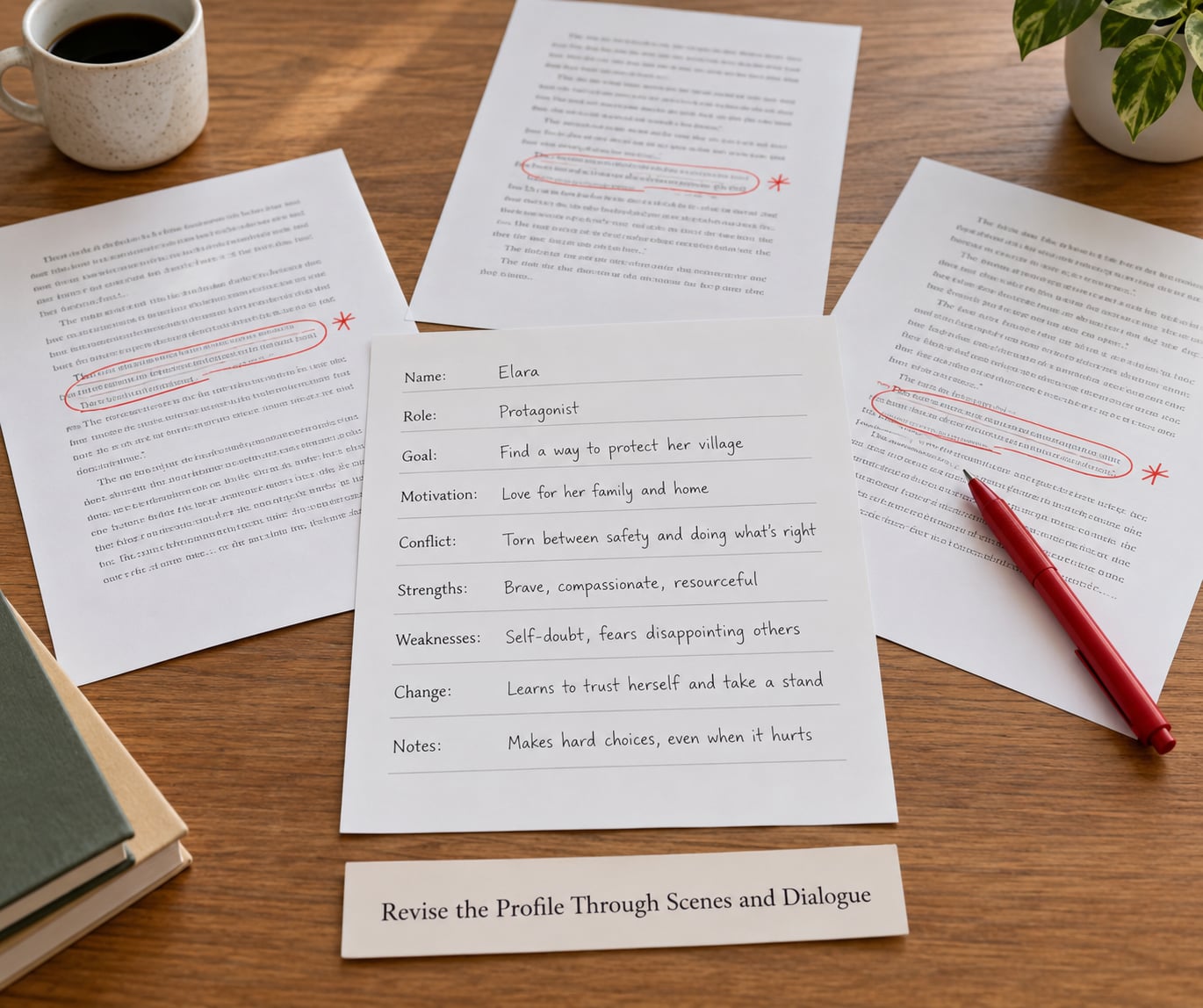
A profile is a hypothesis. You test it by putting the character in scenes with other people and watching what they do, which is also the most commonly repeated advice from writers comparing notes on forums.
Run five stress tests. Give them a scene where they must act on their want. Give them a scene where their flaw costs them something. Give them a scene with the person they are closest to. Give them a scene where they must lie. Give them a scene where they win.
If the answers come out identical in all five, the character is flat. The fix is never a new trait; it is a new pressure, or a change in what the character is willing to sacrifice.
Before you draft, check six things: can you state their want in one sentence, can you state the belief under it, does the flaw appear in a choice, do two relationships pull against each other, would you recognise their voice without the name tag, and is page one different from the last page in some visible way.
Common Mistakes
Flat characters. They are described carefully and change nothing. Fix: give them a want they would sacrifice comfort for, then put the sacrifice on the page.
Overlong biography. Nobody needs your character’s fourth-grade teacher. Fix: delete every memory that does not change a present-tense behaviour.
Contradictions with no consequences. A character described as cold and generous never becomes interesting, because nothing turns on it. Fix: pick the contradiction and make them pay for it once.
Generic dialogue. Everyone speaks in polished, neutral sentences. Fix: remove names and read the lines aloud; if they sound interchangeable, rebuild the rhythm, not the vocabulary.
Stakes that are only external. The building burns down and the reader feels nothing. Fix: attach the loss to a specific person and make the character’s flaw the likely cause.
Last-minute transformation. A speech in the final chapter converts a sceptic into a believer. Fix: plant three earlier moments where the belief cracked under pressure, then make the final choice the third.
Three revision habits help more than the rest. Read only your character’s scenes, skipping the others, and look for a choice on every page or a reason for the gap. Ask your most alert reader the question you would least like to hear the answer to: what does this person want that they have not admitted? And keep one rule sheet of their voice notes next to you while drafting, so the person on page 40 still talks like the person on page 1.
Frequently Asked Questions
How do I make a fictional character feel realistic?
Give them a specific want, a belief that distorts how they read the situation, and a flaw that costs them something. Realism comes from choices that make sense to that person even when they hurt the reader. Borrow mannerisms from people you have actually watched rather than inventing traits cold, and let them be wrong about themselves for most of the book.
How much backstory does a story character need?
Only enough to explain behaviour you are about to show. A useful test: can you name the present-tense habit, fear, or assumption that the past event produces? If you cannot, cut the memory. Long childhood histories usually add nothing except a chapter of setup nobody asked for, and most of that detail is better decided once the scene demands it.
Can I create a character while outlining the plot?
Yes, and many writers do both at once. A lighter approach is to sketch three or four characters with quick motivations and personalities, then write a short scene with each pair interacting. Whatever they choose in that scene tells you more than a profile page would, because you can watch them behave instead of guessing. You can also alternate, outline three chapters, then let a character surprise you.
How do I check whether my character is consistent?
Read only their scenes in order, without the plot summary, and mark every choice they make. Check that each one follows from their want, their flaw, or their belief. Then ask what this character would never do, and see whether you have already written them doing it without cause. Inconsistency usually shows up as a line of dialogue that exists to hand information to another character.
What should I do if my main character feels boring?
Check whether they want anything badly enough to be uncomfortable, and whether the story makes them pay for it. Boredom usually means the protagonist is reacting rather than choosing, or that their personality is never tested. Add a relationship that disagrees with them, raise the cost of their usual strategy, and let their flaw cause a genuine loss somewhere in the middle third.
Conclusion: Begin With Desire and Conflict
If you do one thing this week, write four lines: the role your character plays in the plot, the thing they want out loud, the thing they need and will not say, and the belief that stops them getting it. Everything else, backstory, voice, relationships, is detail that hangs off those four.
Then check it the only way that counts. Put your character in a scene with someone else who wants the opposite, write the choice they make under pressure, and see whether it follows from who they are. That single exercise tells you more than a full profile.
That is really the whole method. How to develop a character for a story is less about the profile you fill in on day one and more about what you watch them do in scenes that cost them something. Expect a few evenings rather than an afternoon, and expect the profile to change once real scenes exist.