
Myths matter in modern storytelling because they carry questions that never go away — who are we, what is justice, what does power cost — in shapes audiences already recognise. A writer who borrows a mythic pattern or character is not copying an old plot. They are giving a new story a floor that holds weight, and a reader the shortcut of understanding.
The best modern retellings do something stranger than reuse. They take a question a culture asked thousands of years ago and answer it badly, or answer it differently, or refuse to answer it at all. That gap between the old story and the new one is where the meaning lives.
Table of Contents
- What Is a Myth in Modern Storytelling?
- Myth, legend, folktale, and fable at a glance
- Why Myths Matter in Modern Storytelling
- How Myths Create Meaning and Emotional Impact
- How Mythic Characters Still Shape Modern Stories
- How Modern Stories Reinterpret Cultural Values
- How Mythical Questions Make Modern Stories Think Harder
- What Mythic Patterns Do Modern Storytellers Reuse?
- Examples of Myths Shaping Modern Literature, Film, and Games
- Literature: Madeline Miller’s Circe
- Film: the superhero origin story
- Games: the mythic quest in an interactive world
- How Writers Can Use Myths Without Copying Them
- How to Retell a Myth Responsibly
- What Makes a Modern Mythic Retelling Effective?
- Frequently Asked Questions
- What is the difference between a myth, a legend, and a folktale?
- Why are myths still used in modern books and films?
- What are common examples of myths retold in modern media?
- Can any story be called a myth?
- How can a writer adapt a myth without copying it?
- Is Wonder Woman an example of a modern myth?
- Conclusion: Start With a Story’s Deeper Question
What Is a Myth in Modern Storytelling?
A myth is a traditional story that explains how the world works and who we are in it. It deals with natural forces, human origins, divine beings and social customs, and it passes those meanings along through retelling rather than through literal belief. Calling a myth a lie misses the point entirely. Myths are true in the way a recipe is true: they work.
Writers and teachers use the word loosely, and that causes confusion. In literature it carries three overlapping senses: a body of sacred or traditional stories, a single narrative from that body, and a recurring pattern that keeps turning up in modern work. A fantasy novel that borrows a descent into an underworld is using myth in the third sense even if no god appears.
Myth, legend, folktale, and fable at a glance
| Type | What it claims | How it is passed on | Example |
|---|---|---|---|
| Myth | How the world, gods or humans came to be as they are | Oral tradition, ritual, scripture, then retelling | Prometheus stealing fire for humanity |
| Legend | A single event or person that may have happened in history | Written record, historical sources, later embellishment | King Arthur and the Knights of the Round Table |
| Folktale | Nothing historical, but a story told as belonging to a people | Oral tradition, folklore collectors, variants across regions | The tale of the cunning fox and the wolf |
| Fable | A short tale built to land one moral or practical lesson | Written collections, textbooks, retellings | Aesop’s fox and the grapes |
Five elements show up in most myths, whatever the culture. They centre on beings or forces that explain the world. They carry a rule, a prohibition or a debt. They include a transgression and its consequence. They deal with creation, origin or transformation. And they were performed, repeated or believed, which is why they survived at all.
One boundary question comes up constantly, usually from writers: where does myth stop and fantasy begin? Myth answers for a community. Fantasy builds a world that answers for no one in particular. A dragon guarding a mountain in a Welsh tale is myth because the mountain is real to the people telling it. The same dragon in an invented kingdom is fantasy that borrowed a mythic shape.
Why Myths Matter in Modern Storytelling
Myths matter because they give modern stories shared emotional logic. Audiences arrive already knowing what a descent means, what a bargain costs and why a betrayer’s return should feel wrong. That head start lets a novel spend its energy on character and theme instead of on inventing the basic shape of the plot from nothing.
Here is the short version of the argument, point by point.
- They compress hard questions into story. A myth answers “why are we mortal” in three hundred words and an image. A novel can then spend a chapter on that answer without losing the reader.
- They supply characters readers recognise instantly. The trickster, the grieving mentor, the shape-shifter, the guardian at the threshold. You can name the role and half the cast is understood.
- They give structure without dictating plot. Departure, ordeal, return. Readers feel the shape holding the story together, and they never see the scaffolding.
- They carry a culture’s values, not just its plot. Greek myth is full of pride and consequence. Norse myth is full of loyalty and debt. Bringing one into a modern story imports a whole way of thinking.
- They make the ordinary feel consequential. Losing a wedding ring, breaking a promise, opening a door. Mythic stakes let small acts carry enormous weight.
- They cross languages and borders intact. A reader in Osaka, Lagos and Dublin all know what a flood or a resurrection means as a story beat, even if the details are local.
- They explain the world, which is the job fiction still has. Science explains mechanisms. Story explains what a mechanism means to live with. A story about why lightning strikes leaves a reader knowing something about fear that a meteorology textbook will not.
- They let writers argue with the past. Retelling a myth in which the victim wins is not decoration. It is a position.
How Myths Create Meaning and Emotional Impact
Recognition is the mechanism. A reader does not need a footnote to know that descending into an underworld is dangerous, that a flood will wash something away or that a deal made in desperation will come due later. The body of the story has already been told in their head, so the new version lands emotionally on contact rather than after three paragraphs of setup.
That is why mythic scenes hit harder than invented equivalents. A stranger crossing a threshold into a hostile land is mildly interesting. The stranger crossing a threshold where everything they knew stops working is a story that a reader has been waiting their whole life to read.
Myth also carries meaning through its objects, not only its events. A ring given under a promise, a name surrendered, a weapon pulled out of stone. These are symbolic shortcuts that work because the symbol has a long history of use.
How Mythic Characters Still Shape Modern Stories
Modern heroes, tricksters, mentors, guardians and monsters keep showing up because those roles solve structural problems. The wise mentor exists so a plot can hand over knowledge without the hero having to earn it. The threshold guardian exists so the hero proves something before entering. The trickster exists so a story can move its plot sideways, past rules a straight protagonist would not break.
The mistake is substitution rather than transformation. Swapping a Norse god’s name for an alien’s and keeping the plot identical produces a costume, not a story. A retelling earns its place when the mythic figure changes function — when the mentor’s price is named, or when the guardian turns out to be protecting the wrong thing entirely.
Carl Jung proposed that recurring figures like the mother, the trickster and the shadow reflect a collective unconscious, patterns shared across cultures that never exchanged stories. Joseph Campbell’s monomyth, laid out in The Hero with a Thousand Faces (1949), catalogued the stages he believed thousands of hero stories share. Both frameworks are contested by scholars, and neither is a law. They are still useful as a shared vocabulary for reading and writing.
How Modern Stories Reinterpret Cultural Values
A retelling is a claim about what the old story meant and what it should mean now. It can preserve the original values, question them or revise them outright, and the choice shows in the plot before it shows in the prose.
Take the Flood. A story that keeps the flood and keeps the covenant inherits a worldview in which disruption is followed by restoration and obedience is rewarded. A story where the flood arrives and no covenant follows inherits something else entirely: that survival is luck, that the rules were never fair, that the people who drowned were as good as the people who lived.
Madeline Miller’s Circe keeps nearly every character and event from the Greek cycle and simply changes who tells the story. Circe narrates her own exile, so the reading flips: the witch becomes the wronged party, and the transformations she performs on men become survival rather than cruelty. Same myth, different theology about power and consent.
Careful writers resist flattening traditions into one another. A Norse story is not a Greek story with colder weather, and neither is a stand-in for “myth” in general. Collapsing distinct traditions into a generic fantasy pantheon is the fastest way to make a retelling feel thin, because nothing from any culture survives the merge.
How Mythical Questions Make Modern Stories Think Harder
Contemporary work keeps returning to mythic questions because these questions have no settled answers. Origins, justice, power, mortality, identity, nature and belonging all fall into the category of problems a culture argues with rather than solves, which is exactly the material fiction needs.
Ask why something happened and you get a plot. Ask why it happened and you get a character study with an antagonist who might be right. Mythic questions turn plot engines into philosophical pressure: the flood, the sacrifice, the creation of a monster by a god’s mistake, the transformation of someone who did not ask for it. Each one hands the writer a conflict that is still live.
Identity questions are the most useful today. Myths are full of figures defined by a single accident of birth or change — a god’s child, a person turned into an animal, a mother made from clay — and modern stories about gender, migration and family keep reaching for exactly that kind of premise.
It also explains why myth survived the scientific era. What replaced literal belief was not silence but remythologization: storms became personal rather than divine, and the question of why migrated from the sky into the self. Myth lost its monopoly on explanation without losing its grip on meaning.
What Mythic Patterns Do Modern Storytellers Reuse?
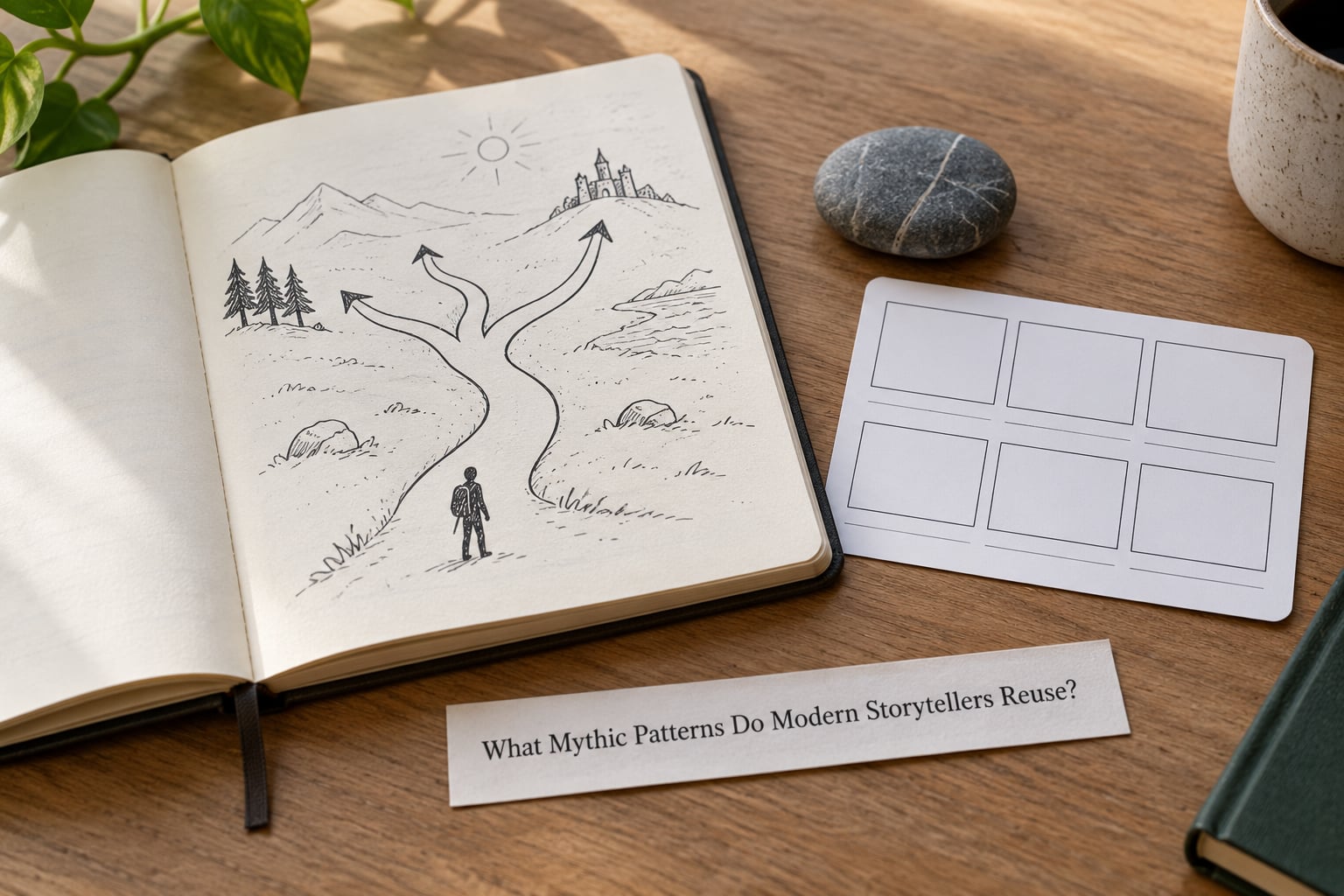
These seven patterns do most of the reuse. Knowing them lets you recognise a plot you might otherwise have to invent from scratch.
- The quest or quest structure. A goal, an obstacle, a cost. It drives almost every adventure plot because it is easy to track and hard to fake.
- Transformation. The protagonist ends as a different kind of being than they started. This is the oldest engine in the set.
- The trial or test. Suffering, endurance, a line crossed. Useful for revealing character under pressure.
- The descent. A move into an underworld, a nightmare realm or a buried past, and an imperfect return.
- Creation. Making something out of nothing, usually at a price, usually with consequences that outlast the maker.
- Prophecy or fate. A future that is fixed, misread, or fought against. Works best when the interpretation is wrong.
- The return. The exile comes home changed, and the home has not waited.
Recognisable structure is not the same as predictability. Readers already know roughly how these patterns run, which frees the story to be interesting elsewhere — in the choices, the voice and the cost. Formula and surprise are not opposites; a good retelling keeps the frame and breaks the expectation inside it.
Mythological creatures work the same way, as symbols with a fixed set of associations. A dragon in a European tale tends to hoard, demand tribute and embody a threat that pride creates. A water dragon in an East Asian tradition is a different creature with a different job. Use the version whose meaning you actually want, and use it consistently.
Examples of Myths Shaping Modern Literature, Film, and Games
Three cases show what a responsible adaptation looks like, each with a clear point of transformation.
Literature: Madeline Miller’s Circe
Mythic source: the sorceress on Aeaea from Homer’s Odyssey, with the wider Greek cycle behind her. Modern theme: what it means to be changed against your will, and who gets to call that change a curse. Transformation: the narrator. Every scene survives, but the vantage moves to the woman who was turned into a pig and turned people into pigs. New meaning: her power stops being the story’s danger and becomes its argument about consent and authority.
Film: the superhero origin story
Mythic source: a tested outsider who receives power from elsewhere and must decide how to use it, which is a comic-book retelling of the demigod’s dilemma. Modern theme: responsibility without consent. Transformation: the city replaces the village, and the cost is watched by cameras rather than a god. New meaning: the mythic question becomes a civic one. The origin story works precisely because audiences already know the shape of the pattern and are waiting to see what will change inside it.
Games: the mythic quest in an interactive world
Mythic source: the pattern of gathering the separated parts of a scattered whole, found in countless traditions and hard to attribute to any one of them. Modern theme: patient, earned effort rather than destiny. Transformation: the pattern is spread across environments the player controls, so the trial is played rather than watched. New meaning: because the player chooses the order, the story is retold in a different sequence every time, which is something a book or a film cannot offer.
Rick Riordan’s Percy Jackson series works on the same principle with less subtlety: the gods are still present, but they are treated as an unhelpful bureaucracy, and the hero is a teenager who does not want the job. Neil Gaiman’s American Gods goes further and treats the gods as immigrants with expired visas and no legal standing.
How Writers Can Use Myths Without Copying Them
A workable process takes most of the guesswork out. Writers on writing forums tend to ask two questions endlessly — how much can I change it, and how do I do it respectfully — so here is a concrete order of operations.
- Find the pattern, not the plot. Decide which mythic move you need. A trial, a descent, a bargain. Patterns carry across cultures; specific plots belong to their sources.
- Identify the source properly. Name the tradition, the version and the tellings you consulted. Read a primary or near-primary account rather than a one-paragraph summary, because the interesting details live in the variant details.
- Choose one meaningful change. One change, made deliberately, is stronger than five made for variety. Flipping who holds the power, or what the protagonist wants, is usually enough.
- Connect it to a modern theme. Ask what the change argues about now. If the answer is “it looks nicer,” the retelling has no reason to exist and readers will feel it.
- Test whether it stands alone. Someone who has never read the original should find your story complete and worth reading. Recognition is a bonus, not a prerequisite.
How to Retell a Myth Responsibly
Creative reuse and cultural extraction are separated mostly by context and intent. Attribution matters: name the source in the text rather than hiding it. So does context, since a myth stripped of its meaning becomes decoration. Where a retelling centres a people who are alive today, consultation or reading work by people from that culture goes a long way, and so does paying attention to who gets to speak.
Stereotype is the usual failure. Wise old hermit, exotic princess, warlike god, mystical land where time works differently. When a character fits a stereotype exactly, that is usually a sign the writer stopped researching. Giving the figure an interior life, contradictions and their own reasons is the cheapest fix available.
None of this means avoiding other cultures’ material. It means doing the reading and being able to say why the story changed.
What Makes a Modern Mythic Retelling Effective?
Use this as a checklist before you query. Thematic relevance: does the myth serve a theme the original did not have? Transformed characters: has someone gained a motive the source did not give them? Emotional stakes: what does the protagonist lose that is specific rather than generic? Structural originality: is your version different in shape, not only in names?
Then check the harder items. Cultural respect: could someone from the source culture read this and recognise themselves rather than a costume? Independent ending: does the last page land because of what you built, not because the original ending is famous? And voice: is the narrator someone with a perspective, or just a camera pointed at the plot?
For teachers, the same checklist works in reverse as a reading tool. Hand students two versions of the same myth and ask which change carries the most meaning. It turns a memorisation exercise into an argument, and it is one of the easier ways to get reluctant readers discussing literature seriously.
Frequently Asked Questions
What is the difference between a myth, a legend, and a folktale?
A myth explains how the world came to be as it is, covering origins, gods and natural forces, and it is passed on through ritual and oral tradition. A legend claims a single event or person happened in history, so King Arthur belongs here. A folktale makes no historical claim at all but is told as belonging to a people, such as the cunning fox stories found across many regions. The line between them blurs because storytellers mix them freely.
Why are myths still used in modern books and films?
Because myth carries questions into a story in a form audiences recognise without being told. A descent, a bargain or a return already means something to most readers, so a modern film can raise a huge emotional event without building the groundwork from nothing. Writers also use myth to import a culture’s values, and to give themselves an argument to disagree with. The pattern supplies the floor while the character work stays new.
What are common examples of myths retold in modern media?
Madeline Miller’s Circe retells the Greek sorceress of the Odyssey from her own point of view, turning the curse into an argument about consent. Neil Gaiman’s American Gods treats gods as displaced immigrants in contemporary America. Rick Riordan’s Percy Jackson series keeps the Olympian pantheon but presents it as a bureaucracy the hero does not want to deal with. Superhero origin stories follow the demigod pattern, and the 2018 God of War moves the Norse cycle into a playable form.
Can any story be called a myth?
Any story can be called a myth loosely, but that loses the useful meaning of the word. In its strict sense a myth explains how a community understands the world, carries sacred or traditional weight, and was passed down rather than invented for a single telling. Folk tales and modern fiction can use mythic patterns, and plenty of writers deliberately build new myths for contemporary life. Just label which sense you mean, especially in a classroom.
How can a writer adapt a myth without copying it?
Start from the pattern rather than the plot, then identify the source properly and read past a summary. Make one deliberate change, such as shifting who holds the power or what the protagonist wants, and tie it to a theme the original did not have. Check that someone who has never read the source finds the version complete on its own. Recognisable structure plus a changed meaning is what makes a retelling feel like a story instead of a rewrite.
Is Wonder Woman an example of a modern myth?
It is easier to describe as a retelling than as a myth in the traditional sense, because it does not claim to explain how a world works for a real community. It does borrow heavily from mythic material, including the Amazons, the Amazonomachy and the warrior-goddess tradition, then relocates them to a modern setting. By the loose literary definition it is a modern myth-making project, and it reads as one because the retelling keeps its source visible.
Conclusion: Start With a Story’s Deeper Question
Myths matter in modern storytelling because they are the shortest path to a question a reader cannot walk away from. They supply patterns, characters and cultural weight that would take a whole book to build from scratch, and they give modern work something worth arguing with.
Try this today. Pick one mythic question — why we die, who owns justice, what a bargain really costs — and find a modern story that dramatises it. Then decide which perspective of yours will change its meaning, and write the change you cannot stop thinking about.