Why some novels are written in present tense? Because a present-tense narrator tells the story at the same moment the viewpoint character lives it, so the reader has no foreknowledge to lean on. That single technical fact produces almost everything writers want from the tense: immediacy, tighter suspense, emotion that stays in its live state, and a narrator limited to what one person can actually know.
Present-tense narration is a deliberate narrative choice, not a grammar mistake and not a fashion that has gone out. Plenty of acclaimed novels use it, from Suzanne Collins’s The Hunger Games to Chuck Palahniuk’s Fight Club, and some of the most-cited examples were published decades ago. It is also genuinely harder to write well than past tense, which is the trade most authors make knowingly.
Here is the short version, and the rest of the article unpacks each point:
- Immediacy. The reader receives action and thought at the same instant as the character.
- Live emotional state. In present tense, a character still loves, still doubts, still hasn’t worked out what happened.
- Suspense without telegraphing. Nobody, narrator included, knows what happens next.
- Narrative limits. The narrator can only report what has been seen, heard or felt.
- Memory and dream as experience. The past can be rendered as it is recalled rather than as it occurred.
- Prose rhythm. Present-tense verbs are short, sharp and percussive, which changes sentence music.
Readers who study narrative technique, and writers deciding how to open their own next chapter, tend to want the mechanics underneath those effects. That is where the rest of this piece goes.
Table of Contents
- What Does Present-Tense Narration Mean?
- Scene-level versus narration-level tense
- What stays in past tense anyway
- Why Some Novels Are Written in Present Tense
- Immediacy puts you inside the moment
- It keeps the emotion in its live state
- Suspense without telegraphing
- It limits the narrator to what the character can know
- It turns memory and dreams into experience
- It gives the prose a distinct pace and voice
- How Present Tense Creates Suspense and Proximity
- How Present Tense Shapes Character and Voice
- Present Tense vs. Past Tense in Novels
- When Writers Choose Present Tense
- Real-time action and unfolding crisis
- A viewpoint character with no distance from events
- Unreliable or unstable narration
- Fragmented or non-linear time
- A diary, transcript or frame device
- Character-led rather than plot-led stories
- How to Analyze a Novel Written in Present Tense
- Step 1: Establish the viewpoint and the tense boundary
- Step 2: Track who knows what
- Step 3: Log every time jump and tense shift
- Step 4: Examine the verbs around a key scene
- Step 5: Ask what the tense conceals as well as reveals
- A mini-experiment you can run in ten minutes
- What to Watch for in Present-Tense Fiction
- Backsteps into past tense
- Viewpoint changes
- Ambiguous time references
- Retrospective remarks
- Frequently Asked Questions
- Is a novel written in present tense difficult to read?
- Does present-tense narration mean the story happens right now?
- Why do writers use present tense for events that happened long ago?
- Can a novel switch between present tense and past tense?
- How can I tell whether a novel has an unreliable narrator?
- Conclusion
What Does Present-Tense Narration Mean?
Present-tense narration means the story’s verbs are in the present: she opens the door, not she opened the door. The narrator reports events as they occur rather than looking back on them from a later vantage point.
The distinction that trips up most students is between narration and dialogue. Dialogue is nearly always in the present tense, because people speak in the present. That is true in past-tense novels too, and it is not what makes a novel present-tense. The label describes the narration only.
Scene-level versus narration-level tense
A novel can be narrated in past tense and still contain present-tense scenes, and vice versa. What identifies the tense is the grammar of the reporting verbs, not the calendar date of the events. A novel set in 1974 and narrated in present tense is still a present-tense novel, because the narrator speaks from inside the moment rather than from after it.
It also helps to separate two things writers use at once: summary and scene. Summary compresses months into a paragraph. Scene slows down and stays in the moment. Present-tense fiction leans on scene, so it tends to feel like a series of nows rather than a story being told to you.
What stays in past tense anyway
Backstory inside a present-tense novel still usually appears in past tense. A character thinking about childhood says, I was seven when the flood came, and the narration continues in the present. That small backstep is not a slip; it is the signal that the writer has moved from happening now into remembering. Consistent present-tense novels handle it deliberately, and handling it badly is one of the most common errors discussed in writing forums.
Why Some Novels Are Written in Present Tense
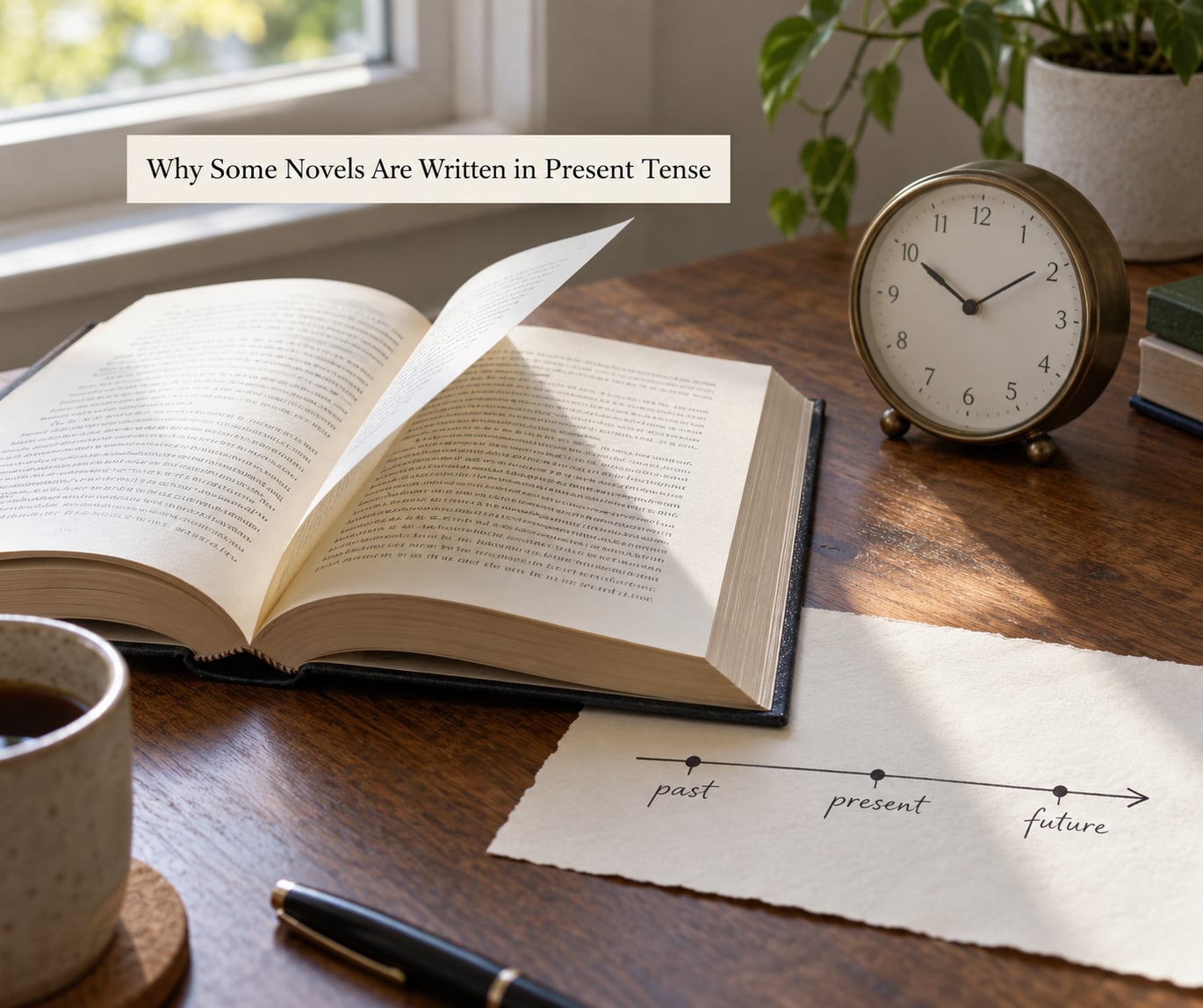
There is no single reason. Authors reach for present tense when the story’s work is happening inside a person rather than between a cast of people, or when the plot demands real-time pressure. Six effects account for most of the choices I see in published fiction.
Immediacy puts you inside the moment
This is the big one, and everything else follows from it. A past-tense narrator has already survived the events, and so has the reader. A present-tense narrator is standing in them, which means the reader’s only option is to keep up.
The Hunger Games runs in first person present partly so that Katniss’s fear arrives before the reader has any time to assess it. Readers often report not noticing the tense at all, which is the highest compliment you can pay this effect. If you are constantly noticing a technique, it has failed.
It keeps the emotion in its live state
This is the most precise reason, and the one least often explained. Verb tense changes the meaning of an emotion, not just its grammar. Consider the same line written two ways: I love him and I loved him. The first is unfinished. The second is over, with the narrator standing outside it and looking back at a state that has already closed.
In past tense, every feeling a narrator reports is by definition a feeling they no longer feel. Present tense is the only way to write a character who is still inside their own doubt, still waiting to find out how they feel, still lying to themselves about it. Sara Gruen’s Water for Elephants uses this: the narrator’s memories press forward into the moment of telling them, and the feeling of the earlier life never settles into a summary.
Suspense without telegraphing
Suspense usually depends on the reader suspecting what is coming. Past-tense narration has an unfortunate built-in signal: the narrator knows how the story ended, and their tone can leak it. Present tense removes that leak by construction.
There is no narrative distance between the reader and the not-knowing, because the narrator does not know either. In Fight Club, the first-person present voice and the narrator’s deteriorating grip on events work together; both story and narration are unstable at the same time.
It limits the narrator to what the character can know
Present tense pairs naturally with a restricted point of view. The narrator is inside one consciousness, so they cannot deliver information from outside it. That constraint tends to generate atmosphere, inference and unreliable self-reporting, all of which read as intensity on the page.
Third person present is the riskiest version. Writers on craft forums describe it as reading like stage direction, because the third person pronoun creates distance at the exact moment the tense is supposed to be closing it. First person present usually does the job better.
It turns memory and dreams into experience
When a novel is about consciousness rather than events, present tense lets the writer show a memory as it is lived rather than as it is recalled. The recall is smudged, softened, edited. The experience is not.
Jim Grimsley’s Dream Boy takes this further into material that resists past tense altogether. Audrey Niffenegger’s The Time Traveler’s Wife uses the tense to make memory plot-bearing: what a character remembers and what actually happened to them are different categories, and the present-tense voice keeps them in tension.
It gives the prose a distinct pace and voice
Present-tense verbs are short. She walks. He stops. The door opens. That physical fact changes rhythm, and rhythm changes how a book feels in the mouth. Some prose that would sag in past tense sits up straight in present.
It also does something to voice. A narrator who can only report what is happening now sounds like someone talking, not someone summarising, and that conversational pressure is one reason present-tense fiction often reads as more intimate than it objectively is.
How Present Tense Creates Suspense and Proximity
Present tense produces suspense through a simple mechanism: the narrator’s grammar forbids foreknowledge. If the narrator says I put the letter in my coat, the reader cannot know whether it ends up in a drawer, a fire or the postbox. The sentence stops where the narrator’s knowledge stops.
That produces three specific effects. Decisions happen live, because the narrator has not made them yet. Sensory detail does the work that plot would do in a slower book, because there is no plot machinery to carry the tension forward. And small physical actions carry enormous weight, since each one might turn out to be the one that matters.
The cost is that present tense asks more of the reader. There is no settled narrative to fall back on during a quiet stretch, and the reader has to hold everything in mind at the level of not-knowing. Readers describe the sensation variously as exhausting, gripping or dreamlike. Those are not contradictory reports.
One structural trick worth knowing: a single chapter written in present tense inside an otherwise past-tense novel reads as a spike in voltage. A commenter described a Guy Gavriel Kay novel that shifts only its climax into present tense as feeling like your face pressed against the screen. The device works precisely because it breaks a contract the reader did not know had been made.
How Present Tense Shapes Character and Voice
Tense is a characterisation tool more than a pacing one. A narrator who can only report the present cannot summarize their own motives, which means the reader has to read the gap between what a character says and what they do.
That gap is where self-deception becomes visible. Free indirect discourse, where a character’s language slides into the narration without quotation marks, depends on tense to signal that we are inside a mind rather than listening to a transcript. Present tense gives that signal by default.
It also makes confession feel earned. When the tense restricts the narrator to live experience, a confession reads as an act happening rather than a report of something processed. That is why the form suits narrators whose account you are meant to distrust.
At the limit, present-tense narration is a natural home for unreliability. If the narrator is living inside the moment, they cannot tell you how it turns out, and neither can they give you the calm overview that a lying narrator would need in order to lie well.
Present Tense vs. Past Tense in Novels
The difference is easier to judge side by side than in the abstract. Most novels are written in past tense, which is the default, so a present-tense novel reads as a deliberate departure the moment it starts.
| Criterion | Past tense (the default) | Present tense |
|---|---|---|
| Narrative distance | Wider; the narrator has survived the events | Narrow; the narrator is inside them |
| Foreknowledge | Often leaks through tone | Structurally impossible |
| Emotional state | Feelings reported as finished | Feelings reported as live and unresolved |
| Sentence rhythm | Longer verbs, more flowing prose | Short verbs, clipped and percussive |
| Handling backstory | Natural and unmarked | Needs deliberate backstepping into past |
| Writing difficulty | Lower; errors are obvious | Higher; slips are easy to miss |
| Reader tolerance | Universal | Polarising; small segment actively avoid it |
| Best fit | Story-led fiction, reflection, distance | Character-led fiction, pressure, real time |
Read the same beat both ways and the difference is audible. Past tense: She watched him take the envelope and understood, too late, that it had never been addressed to her. That is retrospective and knowing. Present tense: She watches him take the envelope and something in her chest goes very still, and she still does not know what it means. Same event, entirely different posture, and the present-tense version cannot be written by a narrator who already knows.
That single difference explains why present tense suits certain stories better than others. It suits stories about not knowing.
When Writers Choose Present Tense
Writers writing in present tend to be responding to a specific story need. If your book needs one of the following, the choice is probably earning itself.
Real-time action and unfolding crisis
Thrillers, horror and survival fiction gain from the reader feeling the clock rather than being told about it. Nothing is summarised, so nothing is softened.
A viewpoint character with no distance from events
Children, trauma survivors and inexperienced narrators have no framework for what is happening to them. Present tense reproduces that: the character is reporting, not analysing.
Unreliable or unstable narration
When the telling is the story, a narrator who cannot look ahead is a narrator you should not fully trust.
Fragmented or non-linear time
When chronology is already disordered, present tense keeps the reader inside a character’s shifting experience of when things happened rather than imposing an external timeline.
A diary, transcript or frame device
Present tense suits writing that is supposed to sound recorded or spoken. Writers on craft forums use it as a frame marker: present tense for the trial, past tense for the memories, purely so the reader can tell the two apart.
Character-led rather than plot-led stories
This is the cleanest dividing line. If your plot is complicated enough to carry itself, past tense gives you room to breathe. If your book is about one person’s interior weather, present tense puts the reader inside it.
Genre conventions push the same way. Young adult and dystopian fiction lean heavily on first person present, partly because the convention is well established there and partly because the interior voice suits a coming-of-age plot. Literary fiction uses it for texture. Horror and science fiction use it for dread.
How to Analyze a Novel Written in Present Tense
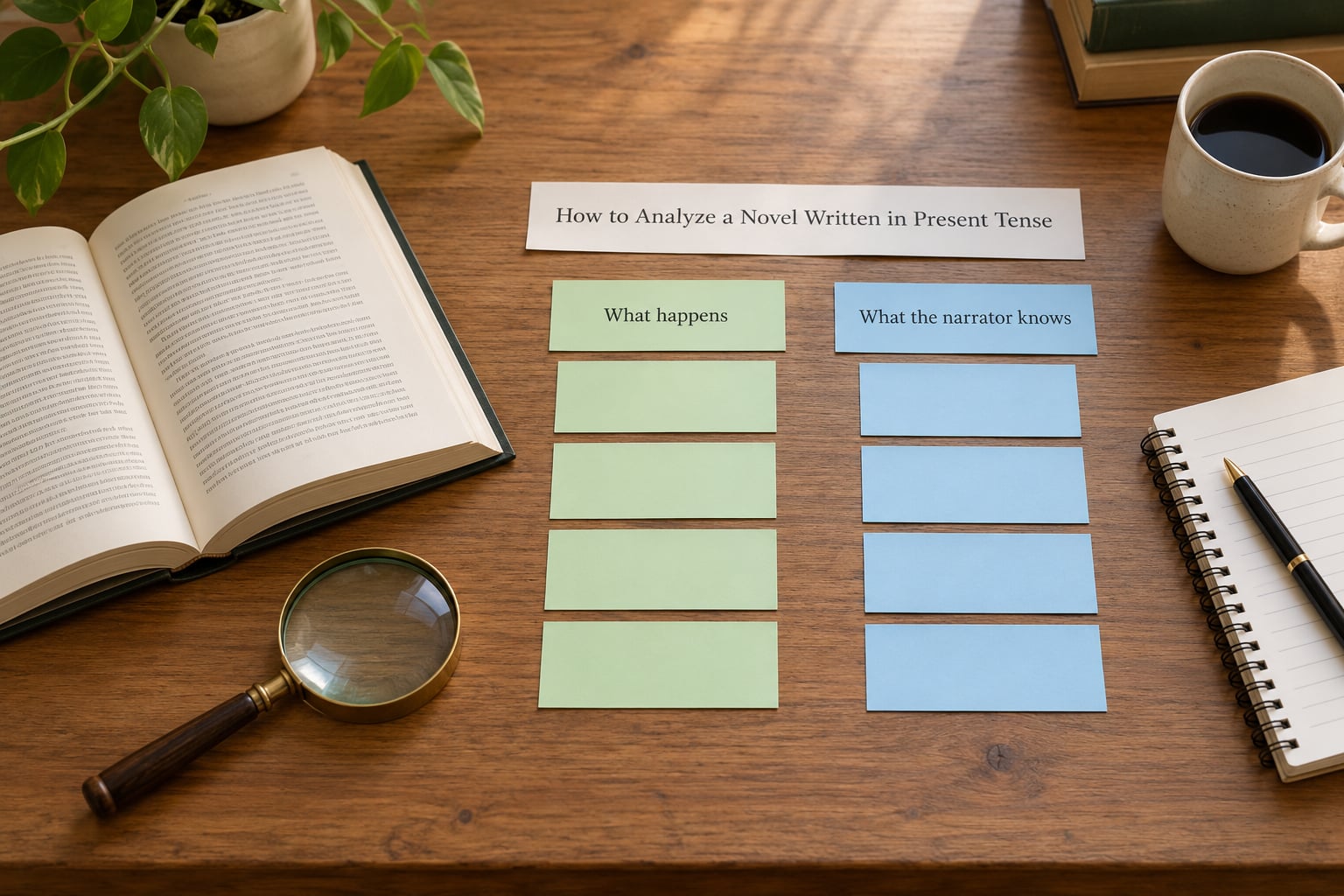
Analysing a present-tense novel is close reading with one extra question attached. The method I use with students takes about twenty minutes for a chapter.
Step 1: Establish the viewpoint and the tense boundary
Find the first page that is narrated rather than quoted, and note whose head we are in. Then find the first moment the narration moves into past. That line is a deliberate authorial decision, not a slip.
Step 2: Track who knows what
At any point in the chapter, ask whether the narrator could know that. If the answer is no, the information is either coming from another viewpoint (a shift you should note) or it is being withheld on purpose. Both are findings.
Step 3: Log every time jump and tense shift
Make a column with time, tense and trigger. Most present-tense novels have more entries than readers expect, and the pattern tells you what the author thinks is important.
Step 4: Examine the verbs around a key scene
Circle the action verbs in the passage that matters most. If they are all short and concrete, the author is building immediacy. If you find long verbs with suffixes, the scene is doing retrospective work that the tense has to accommodate.
Step 5: Ask what the tense conceals as well as reveals
The best analyses say both directions. Present tense grants access to live thought and takes away the option of hindsight, and a novel about a character who is avoiding something can use that second effect deliberately.
A mini-experiment you can run in ten minutes
Rewrite one scene in the other tense, changing nothing else. Keep the same words and the same sentences if you can, only shifting the verb forms. Then read both aloud. Most people find the present-tense version faster to read and the past-tense version easier to remember, which is a useful thing to be able to state in an essay.
What to Watch for in Present-Tense Fiction
Readers new to present tense often assume confusion means error. Usually it means a feature is working on them. These are the four things that trip people up.
Backsteps into past tense
The narrator slips back to report something that already happened before them, then returns to the present. Consistent novelists mark these moments with signal phrases such as ten years earlier or all my life I’d been. If you cannot find a signal, that may be a genuine slip.
Viewpoint changes
Present-tense fiction keeps everything in one head, so a change of head can feel like a jump cut. Check the chapter break before deciding the author lost control of the narration.
Ambiguous time references
Earlier that day and the next morning carry less weight in present tense, because there is no narrative timeline to orient you. Good writers supply the anchor; less careful ones leave you to hold it yourself.
Retrospective remarks
A narrator saying I had no idea what was coming is quietly reaching outside the present. When it appears rarely it adds poignancy. When it appears often, it signals that the author needed a way to mention something the tense technically forbids.
If you find yourself lost, reading a sample in another tense by the same author can retrain your ear in about fifty pages. The reflex forms fast once you know what to look for.
Frequently Asked Questions
Is a novel written in present tense difficult to read?
Most readers who finish a present-tense novel say the difficulty is shorter than expected. Your brain often silently converts present-tense verbs into past tense, which is exactly the habit that breaks immersion. Two or three chapters usually reset the reflex. The real difficulty belongs to the writer, who has no foreknowledge to fall back on.
Does present-tense narration mean the story happens right now?
No. The tense describes when the narrator tells the story, not when the events occur. A novel set across thirty years can be narrated entirely in present tense, and a novel about this morning can be narrated in past. What changes is the narrator’s position: inside the moment rather than looking back on it.
Why do writers use present tense for events that happened long ago?
Because the tense renders experience instead of report. When a present-tense narrator remembers childhood, the memory arrives with the emotion still active rather than summarised, so a line reads as I love him rather than I loved him. That makes present tense the natural choice for memory novels, dream sequences and anything narrated by someone still living inside what they are describing.
Can a novel switch between present tense and past tense?
Yes, and writers use deliberate shifts for specific effects: a memory section dropping into past, a trial scene in present against past-tense testimony, or a single climax chapter switching tense. The shift has to be signposted, otherwise readers experience it as a mistake. A shift used for one scene can raise tension sharply because the reader has quietly learned a rule the author then breaks.
How can I tell whether a novel has an unreliable narrator?
Look for three signals: statements that contradict earlier ones, gaps where a narrator avoids a topic that keeps returning, and an insistence on details that serve them rather than the reader. Present tense makes all three harder to spot, because the narrator has no room to step outside and explain. Keep a short timeline of what each narrator claims, then look for where the versions collide.
Conclusion
Present tense is a decision about where the narrator stands, not a label for a book that is current. It removes hindsight, and in exchange it gives immediacy, unresolved emotion and a voice that reports rather than explains. Used well, it does not announce itself, which is the test every technique has to pass.
Start your analysis with one question: what can the viewpoint character know at this exact moment, and how does the tense enforce that? Once you are tracking that boundary, the rest of the mechanics fall into place.