
Symbolism matters in literature because it lets a writer carry an entire theme on the back of one object, colour or gesture. Instead of telling you that a character is obsessed with the past, an author hands you a green light at the end of a dock and lets you work it out. Here is the short version: symbolism is the technique of using a person, place, object or action to stand for an idea beyond its literal meaning, and studying it changes how you read everything else on the page.
That definition covers the mechanics. The interesting part is what the device does for the story itself, and why readers who understand it tend to remember books far longer than readers who skim.
Table of Contents
- What Is Symbolism in Literature?
- Why Symbolism Matters in Literature
- How Symbolism Adds Layers of Meaning in Literature
- Common Types of Symbols in Literature
- Why Symbolism Deepens as a Story Develops
- Symbolism, Motif, Allegory, and Metaphor Compared
- How to Identify Symbolism in a Text
- How to Write About Symbolism in an Essay
- Discussion Questions for Teaching Symbolism
- Common Mistakes When Interpreting Symbols
- Frequently Asked Questions
- Is every object in a novel a symbol?
- How can I tell whether something is symbolism or allegory?
- Do literary symbols have one fixed meaning?
- Should I use a symbol’s dictionary definition in my analysis?
- What makes a good thesis about symbolism in literature?
- How do I find symbolism when reading a poem?
- Conclusion
What Is Symbolism in Literature?
A symbol is a concrete thing in a text that carries an abstract idea. The bird is a bird; the bird is also freedom, or surveillance, or a warning. Symbolism is the practice of setting those two readings side by side so the abstract one lands without a line of dialogue announcing it.
Five examples cover most of what you meet in high school and undergraduate reading:
- The green light in The Great Gatsby — Gatsby’s unreachable future, and the money and class standing between him and Daisy.
- The mockingbird in To Kill a Mockingbird — Tom Robinson’s innocence, and the harm done to something that cannot defend itself.
- The conch shell in Lord of the Flies — the fragile order the boys agree to follow, which collapses the moment authority does.
- The yellow wallpaper in Charlotte Perkins Gilman’s short story — the narrator’s confinement, and a mind starting to fray under it.
- The white elephant in Hemingway’s story — a gift the couple cannot dispose of, standing in for the whole marriage.
Keep the term precise, because students routinely blur it with three neighbours. A symbol is a single element carrying extra weight. A motif is a pattern of symbols that recurs. An allegory is a whole second-level narrative with one character standing for an abstract type. A metaphor is a comparison carried by the language itself rather than by a recurring object. Our comparison table below sorts all four.
Why Symbolism Matters in Literature
Five reasons, in rough order of how much they change your reading.
1. It delivers theme without exposition. A lecture on grief takes a page and sounds like a lecture. A dead bird in the yard takes four words and lands harder. When you see why symbolism matters in literature, this is usually the first thing that clicks: writers use it to state a theme through action and image, so the reader absorbs it rather than receives it.
2. It builds character in a handful of scenes. Watch how Atticus Finch behaves towards his children, and the scene where he takes down a rabid dog with a single shot, and you know what he values without anybody narrating his morality. Track what a character reaches for, wears or keeps, and you get their inner life in a fraction of the space an interior monologue would take.
3. It produces subtext. Subtext is the meaning sitting underneath what is literally said. In The Great Gatsby, Gatsby’s awkward stretching of the word “old” is a person, an age and a class ambition in one word. Symbolism is how authors keep subtext available across a whole conversation scene.
4. It rewards rereading. First-time readers often track plot. Second-time readers track pattern, and symbolism is the pattern layer. That is why a book feels noticeably different the second time through: you are no longer asking what happens next, only what the recurring images were doing.
5. It lets one book speak across centuries and cultures. A snake, a storm, a garden, a locked door. Readers who share nothing with Tolstoy or Woolf still recognise these, which is how a nineteenth-century novel still lands in a classroom a hundred and fifty years on. It also travels into politics and public life, where animals and colours get recruited for arguments far heavier than fiction.
How Symbolism Adds Layers of Meaning in Literature
Any detail operates on at least two levels at once: what it is, and what it is standing in for. Darkness in Macbeth is night, and it is concealment, guilt, evil breaking cover, and a Scotland the characters cannot see clearly. The literal reading is never discarded; it sits under the figurative one, and the tension between them is where the interest lives.
What fixes a symbol’s meaning is context, not a dictionary. Repetition tells you an author wants you watching. Change of condition tells you more: a conch that is carried, then broken, then hidden has a different charge each time. Most weak readings happen because someone imports a meaning from outside the text rather than tracking what this particular book does with that object.
Common Types of Symbols in Literature
Symbols sort by what they are, and by whether their meaning is shared or built in the text.
- Objects — a necklace, a diary, a key, a wallpaper.
- Nature — a storm, a garden, a barren tree, a river.
- Colours — white for innocence or a blank identity, red for violence or passion, green for money or envy.
- Animals — birds for freedom or warning, wolves for pack loyalty or predation.
- Places — a decaying house, a border crossing, a schoolyard.
- Gestures and actions — a hand waved off, a door closed, a name not said.
- Events — a funeral, a fire, a death in winter.
- Settings and seasons — a garden in spring against a field in late autumn.
Sort by origin and you get two families. Universal symbols carry associations most readers bring with them, so a white lily in a romance rarely needs explanation. Contextual symbols mean nothing in particular until this book gives them meaning, which is why the conch works: the boys invest it with power through ceremony, and the reader learns the code alongside them.
Most good fiction mixes both. A universally loaded image plus a locally specific twist produces the surprise that makes a novel feel alive.
Why Symbolism Deepens as a Story Develops
Symbols rarely arrive finished. A useful four-stage model tracks them.
Introduction: the element appears in its plain sense. A door is a door.
Association: it attaches to a character or event. The door gets closed on someone, or locked against them.
Repetition: it recurs in changing condition, and the changes are the point. Locked, then closed, then open.
Transformation: by the end the object cannot be read literally again. Gilman’s narrator has moved through that wallpaper; the door is no longer furniture.
Symbols embedded in the action of a story land better than symbols explained in the text. All four stages happen before a narrator turns around and names the pattern, which is exactly why the last one can still surprise somebody who read the book ten years ago.
Symbolism, Motif, Allegory, and Metaphor Compared
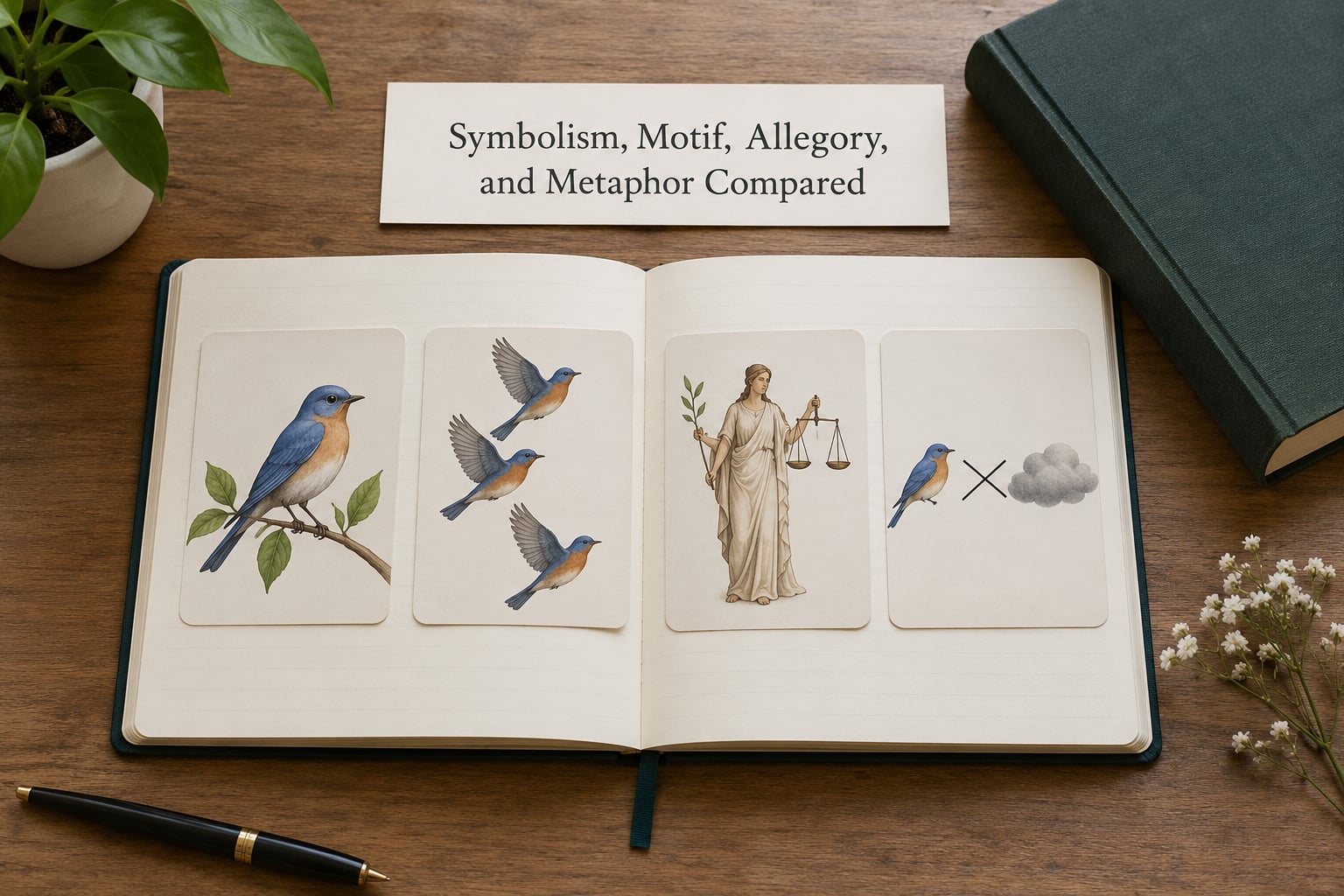
These four get used interchangeably in student essays, which costs marks. Each has a test you can apply.
| Device | What it is | Test question | Example |
|---|---|---|---|
| Symbol | A single element carrying meaning beyond itself | Does this one thing mean something larger? | The mockingbird |
| Motif | A recurring element or pattern that reinforces a theme | Does it keep coming back? | Hand imagery throughout a novel |
| Allegory | A whole second-level narrative where figures stand for abstract types | Is there a complete hidden story? | Animal characters holding up a political system |
| Metaphor | An implied comparison carried by language | Is the meaning inside the phrasing? | “The world was a stage” |
Symbols combine into motifs, motifs can build an allegory, and metaphors work inside any sentence. A novel can use all four at once without the terms needing to be exclusive.
How to Identify Symbolism in a Text
This method works on anything, including poems and short stories where the repetition is easy to miss.
Step 1. Notice the unusual attention. Look for a detail that gets more words than it seems to need: a colour described three times, an object named every time a character enters a room, a description that lingers a beat past the action.
Step 2. Name what it literally does. Before interpreting, state the observable fact. “The narrator mentions the darkness eleven times” is observation. “The darkness shows her confusion” is inference. Keeping the two apart is the single habit that separates a strong essay from a vague one.
Step 3. Check repetition and change. A detail seen once is atmosphere. A detail that returns in an altered state is doing work.
Step 4. Trace its associations in the text. Who touches it, who avoids it, what happens near it. The pattern of those relationships is where the meaning lives.
Step 5. Connect it to a theme and cite the text. Ask which theme the symbol serves, then find the sentence that proves it. No quotation, no claim.
Worked example, darkness in Macbeth. Observation: darkness and night press in repeatedly. Banquo remarks that the night is thick and the hall full of shadows, and Macbeth later admits he has stained his hands, so the play keeps tying night to what he has done. Inference: the darkness tracks guilt arriving in daylight. Theme: guilt as a condition you cannot switch off. That paragraph went from a repeated adjective to an argument in five steps.
Second worked example, the door in The Yellow Wallpaper. Observation: the locked door and the key under the pillow anchor the narrator’s confinement, and she studies that wallpaper for hours as her condition worsens. Inference: the door stands for the limits of her life, and the wallpaper for what isolation does to the mind behind it.
How to Write About Symbolism in an Essay
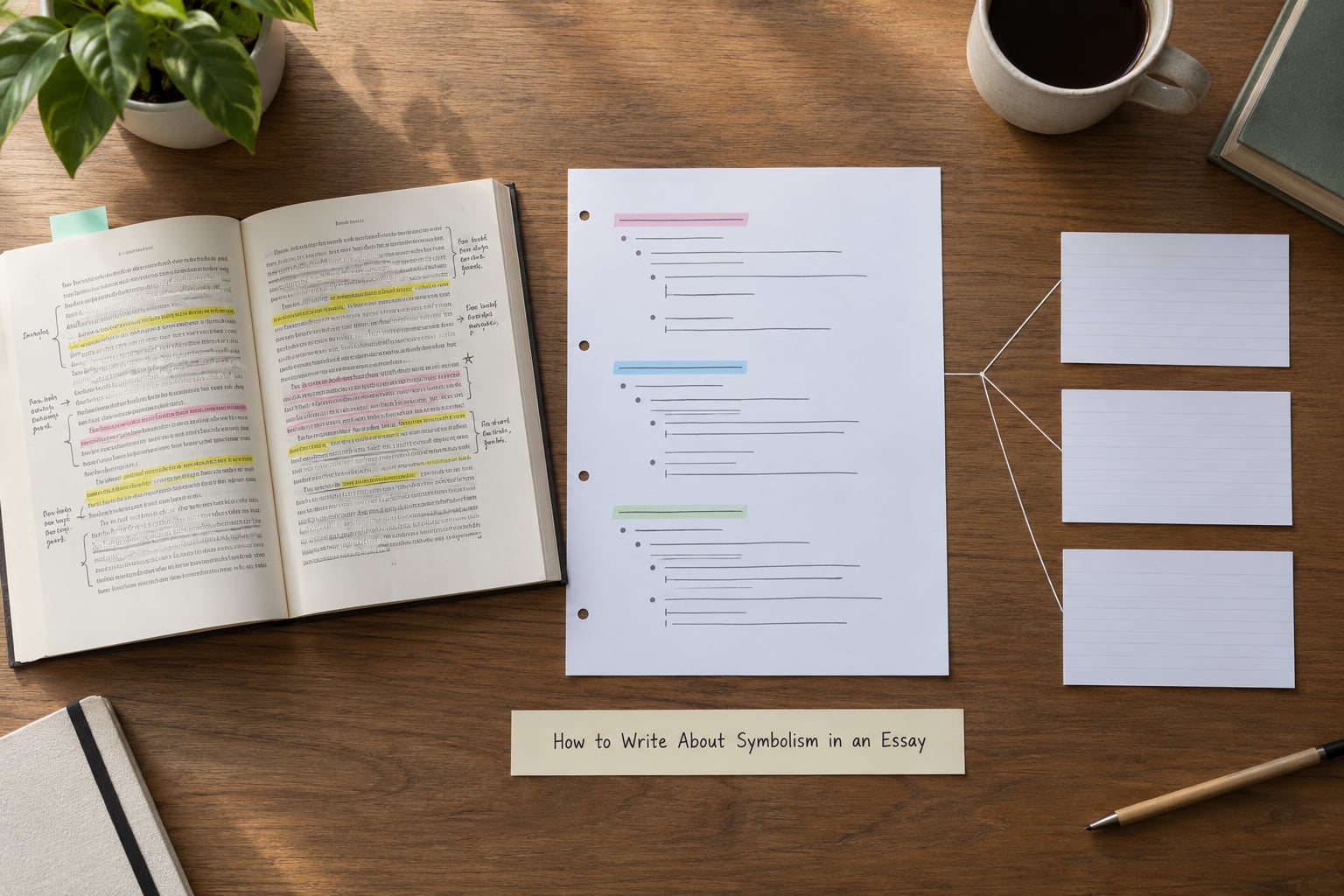
A weak thesis names the symbol. “This essay discusses the green light in Gatsby” tells the reader nothing to argue with. A strong thesis names the symbol, claims what it does, and points at the evidence.
Here is one that works: Throughout the novel, Fitzgerald lets Gatsby’s green light shift from an object he stares at into a word he invents for Daisy, which turns a private longing into a public claim he can never make.
Then structure the paragraph in four beats: observation of the detail, quotation of the text, interpretation of what the symbol is doing, and connection to theme. One or two quotations is plenty. A paragraph that stacks six quotations and never explains them is a list with punctuation.
Two habits help more than anything else. Separate observation from inference explicitly in your notes, so you can see which claims have textual backing. And state your inference with confidence but not with certainty — “the green light functions as” rather than “the green light means”, because an essay that admits ambiguity tends to be argued well rather than dismissed.
Discussion Questions for Teaching Symbolism
These work for a seminar or a written response:
- Which detail in this story receives more attention than its plot role requires, and why?
- Does any symbol change meaning between the first and last chapter? Trace the change.
- Where does the text explain a symbol, and does that explanation add or subtract?
- Which is doing more work here, the symbols or the dialogue?
Common Mistakes When Interpreting Symbols
Reaching for a dictionary meaning. A red rose is not love by definition; it is love because this text puts it beside a confession. Correct: find the association inside the book before you name the idea.
Calling every repeated detail a motif. If it appears twice by accident, you have repetition, not a pattern. Correct: look for three or more deliberate returns, ideally in changed condition.
Confusing symbolism with allegory. If the whole plot maps one-to-one onto a hidden meaning, you have allegory, and your point about a single object will sound thin. Correct: name the level you are analysing.
Assuming symbols are universal. A white lily in a Shakespeare comedy and a white lily in a modern horror story point in opposite directions. Correct: read the convention the author is working inside, and where you can, the period it was written in.
Over-reading. This is the failure readers describe most often: an interpretation that rests on one word rather than a pattern. Correct: test the reading against every appearance of the symbol. If it only fits the first one, you have inference where you wanted evidence.
Explaining the symbol away. If a character spells it out, the device has done its job and been undone. Correct: describe the effect, not the author’s intention.
Frequently Asked Questions
Is every object in a novel a symbol?
No. Most objects are set dressing, and treating every one as symbolic is the fastest way to a weak essay. A reliable object either recurs in altered form, draws unusual descriptive attention, or sits beside a character’s important decisions. Objects that fail all three tests are usually there to make the world feel furnished rather than to carry meaning.
How can I tell whether something is symbolism or allegory?
Check how much of the text the second meaning covers. A symbol is one element carrying extra weight, like the mockingbird in To Kill a Mockingbird. An allegory builds a complete second-level narrative in which characters stand for abstract types and the whole plot maps onto a hidden argument. One object means more than itself; an entire story means something other than what it says.
Do literary symbols have one fixed meaning?
Within a single text, the meaning is stable enough to argue about but rarely fixed forever. Symbols also shift with context, period, and the reader’s own experience, which is why two careful readers can defend different readings. The best approach is not to hunt for the one correct answer but to show how your reading is supported by the text.
Should I use a symbol’s dictionary definition in my analysis?
Use it only as a starting point, never as the evidence. A dictionary tells you what a snake conventionally signifies; it cannot tell you what the snake in your novel is doing. Quote the text instead and build the association from what happens around the symbol in that specific book. Examiners are marking your use of evidence, not your recall of symbolic convention.
What makes a good thesis about symbolism in literature?
A good thesis names the symbol, states what it does rather than what it is, and gestures at the evidence. Compare these two: u0022the mockingbird is a symbol in the novelu0022 and u0022Harper Lee keeps returning to the mockingbird so that Scout’s empathy for Tom Robinson becomes something she has to defend against a crowd.u0022 The second is arguable, and each part of it sends you to a different passage.
How do I find symbolism when reading a poem?
Read it three times. First for surface sense, then for repeated words and images, then for what the repeated material is circling. Poems compress, so the same device can appear in a single line rather than across chapters. Mark every instance of a repeated noun or colour, and the pattern usually becomes obvious in the third pass even when you missed it on the first.
Conclusion
Symbolism matters in literature because it is how stories think in images rather than statements, and how a theme, a character or a whole argument travels inside a single repeated image. Read once for plot, then read again with a pencil and mark every detail that comes back changed. Take that one symbol, find three passages where it appears, and connect it to the theme. That single exercise does more for your reading than any amount of summary.