
If you have a long paper due and no idea where your sources went, here is how to organize a long research paper: treat it as a chain, not a pile. Every source becomes a note, every note becomes an idea, every idea becomes an outline slot, and every slot becomes a paragraph with a citation attached to it. Most of the chaos students describe comes from a break somewhere in that chain.
This guide walks through that chain in order. If your paper is already in disarray — 90 open tabs, a folder of PDFs you cannot search, and a document that has three different arguments in it — start with the source map and the paragraph checklist, then work backward through the outline.
A 20-page paper is a multi-week project, not a weekend. The organizing part takes about a fifth of the total time, and skipping it is the reason the writing part takes twice as long as it should.
Table of Contents
- What You Need
- How to Organize a Long Research Paper: Step-by-Step Process
- Set the paper’s scope and deadline
- How to Organize a Long Research Paper Before You Draft
- Build a source map
- Create a working thesis
- Draft a detailed outline
- Assign sources to outline sections
- Write from evidence to analysis
- Build the introduction and conclusion around the paper’s purpose
- Use a paragraph and evidence checklist
- Leave time for revision, citation checking, and proofreading
- Common Mistakes
- Frequently Asked Questions
- How long should a research paper outline be?
- Should I write the thesis before or after researching?
- How do I organize sources for a research paper?
- How many sources should a long research paper use?
- When should I start organizing a long research paper?
- Conclusion
What You Need
Six things, and none of them are expensive or hard to find.
- The assignment prompt. Required length, citation style, formatting rules, number of sources, deadline.
- A research question. Not a topic. A question with an arguable answer.
- A working thesis. One sentence you are willing to change once the evidence is in.
- A citation manager. Zotero or Mendeley handle this, and both have free tiers. Whichever you pick, use only one.
- A single note file. One place where your ideas live, separate from your PDFs.
- An outline template and a calendar. The template holds section headings and evidence slots. The calendar holds milestones.
Google Scholar works fine as a discovery tool, but it is not a reference manager. It does not know what you kept or why, and it does not generate a bibliography. Use it to find papers, then add the ones you will actually cite to your citation manager.
How to Organize a Long Research Paper: Step-by-Step Process
Ten steps, in the order they should happen. The first six are organizing; the last four are writing and revision. Skipping ahead to step seven with a half-formed thesis is how papers end up with an introduction that promises something the body never delivers.
Set the paper’s scope and deadline
Work backward from the due date and write down four milestones: research done, outline done, first draft done, revision done. For a 20-page paper on a six-week timeline, that looks like research finished in week two, outline in week three, draft in week four, and the last two weeks for revision.
Then note the requirements that constrain everything else — page count, citation style, whether the literature review is a section or a separate chapter, how many sources the rubric expects. These are not details to check later. A switch from MLA to Chicago on the last day means reformatting every in-text citation by hand.
How to Organize a Long Research Paper Before You Draft
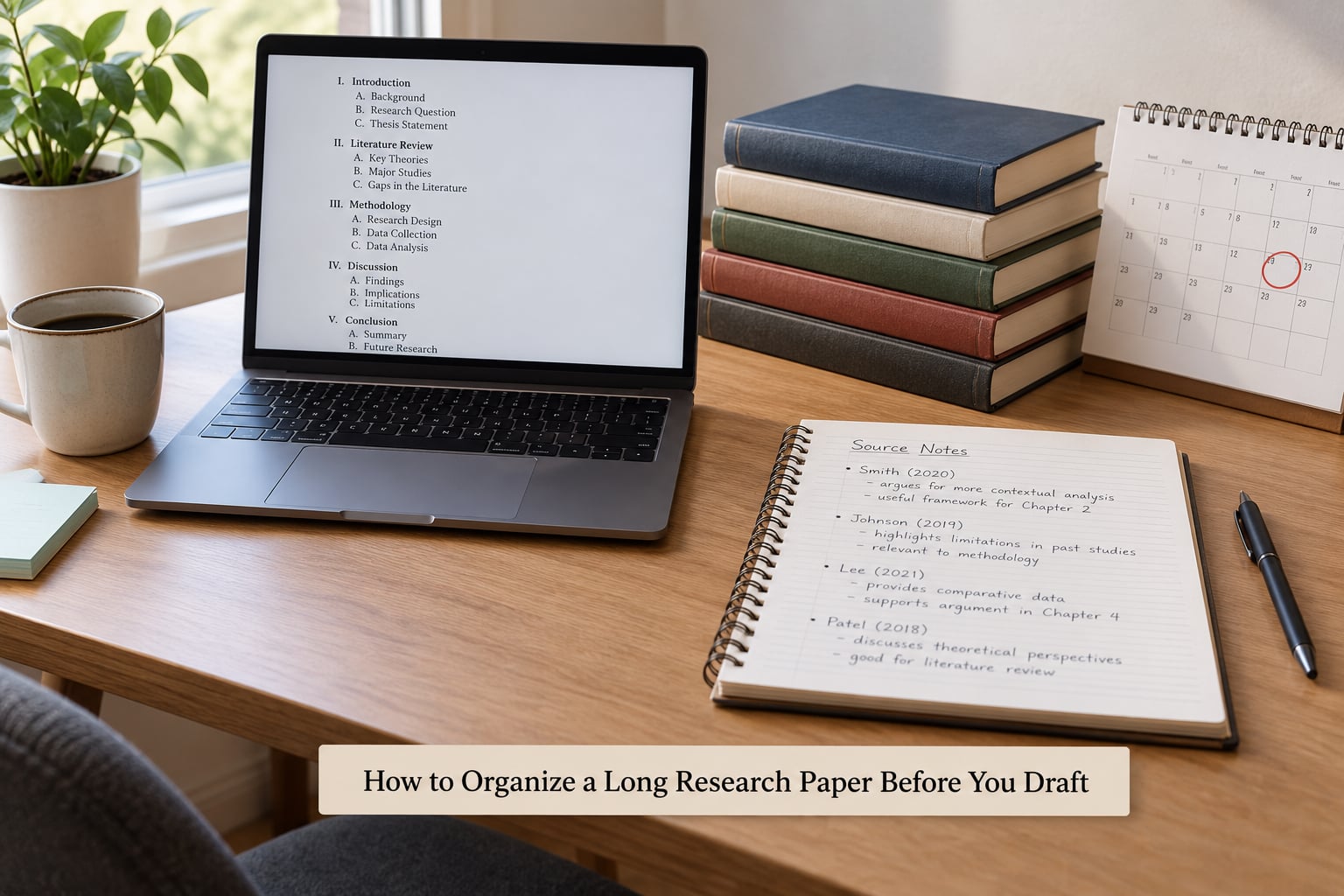
Turn the broad topic into a focused question, then into a working thesis, then into a scope you can finish. A topic like “social media and mental health” will produce a literature review with no argument in it. A question like “what does the research show about sleep duration and adolescent mood, and how strong is that evidence?” produces a paper.
Scope means drawing a boundary you can defend. Pick a population, a period, a mechanism, and a set of disciplines. “Sleep and mood in adolescents aged 13 to 18, drawing on studies published since 2015” is a scope. Everything outside it is a distraction you do not need to resolve.
The working thesis comes next, and it is allowed to be wrong. Its job is to tell you what evidence to look for, not to be the sentence you defend in week six.
Build a source map
A source map is a table that answers, for every source: what is its main idea, what evidence does it offer, how strong is it, and which part of the paper might it support. Five columns is enough.
Group by idea, not by source type. When you sort twenty papers by “journal article” or “book,” you learn nothing. When you sort them by “sleep duration as predictor,” “confounders in self-reported sleep data,” “intervention studies,” and “critiques of actigraphy methodology,” you have discovered your paper’s structure before you have written a word.
Mark each entry as primary evidence, background, or counterargument. A long literature review usually runs 60 to 80 percent primary evidence, 15 percent background context, and 5 to 10 percent sources that push against your claim. That last category is the one students skip, and it is the one markers notice.
Create a working thesis
A thesis names your topic; a working thesis makes a claim about it that someone could reasonably disagree with. “Social media affects mental health” is a topic with a verb nobody can argue with. “The link between social media use and adolescent anxiety is weaker than popular accounts suggest, because most studies rely on self-reported screen time” is a claim.
Test it by asking what evidence would change your mind. If nothing could, it is not a thesis — it is a belief. Keep the working version in the top of your outline file so you read it before every writing session.
Draft a detailed outline
Build the outline before you write prose. One level of subheadings under each major section is usually enough for a 20-page paper, and every subheading should be arguable enough to support at least two or three paragraphs.
Give every slot a word budget. Arbitrary targets are better than no targets, because they force you to notice when a section is doing two jobs.
| Section | Pages in a 20-page paper | What it must carry |
|---|---|---|
| Introduction | 1.5 to 2 | Context, the gap, the research question, the thesis |
| Literature review | 6 to 7 | Themes, not a list of summaries; synthesis across sources |
| Methodology | 2 to 3 | Design, sample, measures, limits, how you analyzed |
| Results or findings | 3 to 4 | What you found, organized by question, not by document |
| Discussion | 3 to 4 | Interpretation, comparison to prior work, counterargument, limits |
| Conclusion | 1 | Answer to the research question, implication, no new claims |
| References | 1 to 2 | Auto-generated from your citation manager |
Adjust the ratios to your discipline, but keep the total honest. If your literature review is 12 of 20 pages, your discussion is missing, and that is a problem worth solving in the outline rather than after submission.
Assign sources to outline sections
Now move from the source map to the outline. For each section, list the two to four sources that will appear there, and note the specific evidence each one supplies: the number, the finding, the limitation.
Then look at what is empty. A section with no sources is either a section you cannot support or a question you have not answered yet — both are useful to learn now. A source sitting in your library that appears in no section is not part of the paper, and pulling it out is a relief most writers have not given themselves.
Assigning early also exposes imbalance. If six sources are queued for one section and the introduction has none, you know before drafting that your paper has no funnel into the argument.
Write from evidence to analysis
Each body paragraph follows the same four beats: a claim, the evidence for it, your explanation of what that evidence means, and the analytical link to your thesis. Drop the fourth beat and you have written a summary, which is the most common reason a literature review scores badly.
Keep quotations brief and use them for language you cannot paraphrase well — a disputed definition, a striking phrase, a finding you need to quote exactly. Anything longer than about two lines should be paraphrased with a citation, and the paraphrase should be harder to match with a search engine than the original phrasing.
Write the section with the most evidence first, not the introduction. The introduction is much easier to write correctly once you know what the body actually argues.
Build the introduction and conclusion around the paper’s purpose
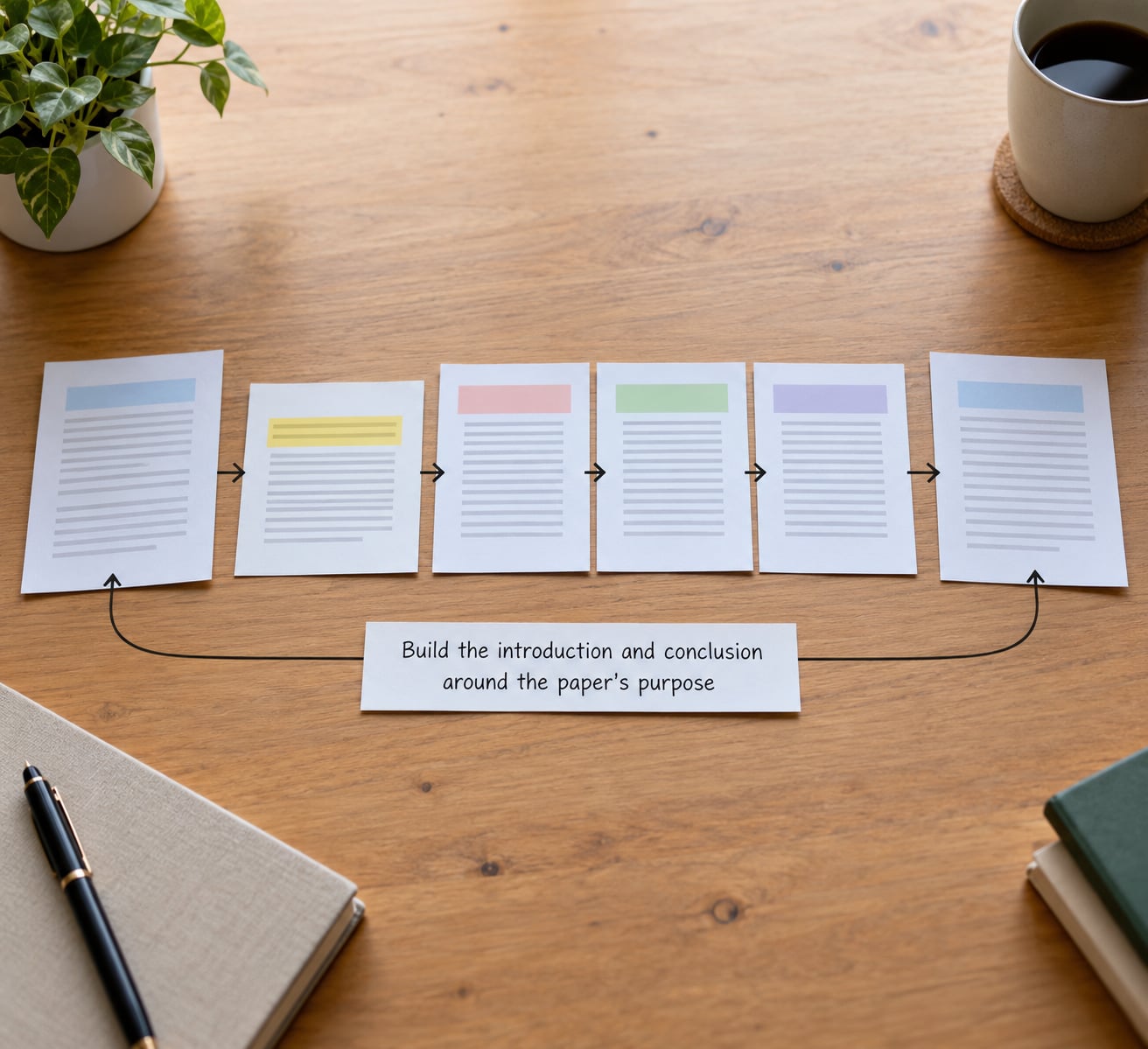
The introduction has a fixed job: move from a broad area to your specific thesis. Context first, then what is already known, then the gap, then your question, then the thesis sentence. Five moves, and the thesis comes last so it lands on the reader’s ear at the end.
The conclusion mirrors it in reverse. Answer the research question directly, state what the answer means for the field, acknowledge the main limitation, and stop. Introducing a new source or a new argument in the conclusion is the most common structural error in student papers, because it is the only place where writing feels easy and nobody has told you it is closed.
Use a paragraph and evidence checklist
Run each section through six questions before you move on.
- Does the first sentence make a claim, or just announce a topic?
- Does every piece of evidence here actually support this claim?
- Have I explained the evidence rather than just quoted it?
- Is there a citation for every source, and a bibliography entry for every citation?
- Is there a transition carrying the reader from the previous claim to this one?
- Does the paragraph sound like one person wrote the whole paper?
If a paragraph fails the first question, rewrite the first sentence. That single fix resolves most weak paragraphs, because the rest of the paragraph tends to be written to support whatever the opening claims.
Leave time for revision, citation checking, and proofreading
Revision done as one pass produces mush. Do it in separate passes instead: one for argument, one for organization, one for evidence, one for formatting, one for grammar. Each pass ignores the others, which is what makes it useful.
The argument pass only asks whether the thesis is supported, whether the order of sections makes sense, and whether the counterargument is addressed. The organization pass only checks whether a paragraph belongs where it sits. The citation pass is mechanical and matters more than most writers expect: every in-text citation needs a reference list entry, and every reference list entry needs an in-text citation. Orphans in either direction are flagged immediately.
Generate the reference list from your citation manager rather than typing it. Auto-generated bibliographies cannot contain formatting errors, which removes a whole category of lost marks.
Common Mistakes
Starting too broadly. Fix: write the question you will actually answer, then add a scope sentence — population, period, mechanism — beneath it. A scope you can defend is a boundary, not a limitation.
Collecting sources with no plan. Fix: stop browsing and build the source map. Twenty sources organized by idea will tell you what is missing; twenty sources in a downloads folder will not.
Using a topic where a thesis belongs. Fix: apply the disagreement test. If no reasonable person could argue the opposite, rewrite the sentence until they could.
Writing summaries instead of analysis. Fix: after each paragraph, add one sentence beginning “This matters because…”. If you cannot write it, the paragraph is not doing work.
Overcrowding paragraphs. Fix: split at the point where the claim changes. One paragraph, one claim, and the evidence that supports it.
Inconsistent citations. Fix: pick one style, set it in your word processor once, and let the citation manager handle the reference list.
Proofreading the night before. Fix: proofread a printed copy, on paper, slowly. Reading on a screen makes your brain skip errors it would otherwise catch, and a fresh 45-minute pass catches more than a frantic hour of scrolling.
One more failure mode deserves naming, because it is common among graduate students: the project outgrew the system it started in. Twenty sources in a spreadsheet is fine. A hundred and forty sources across a reference manager, a shared drive, and three notebooks is not the same problem, and it needs a different structure. When you hit that point, migrate rather than patch — set up the tag structure in your citation manager, move the notes into one file, and rebuild the outline from the tags.
Frequently Asked Questions
How long should a research paper outline be?
It depends on the assignment, but a long paper needs a detailed outline rather than a sketch. For a 20-page paper, aim for one level of subheadings under each major section, with a one-line claim and two or three sources listed under each. If a section has no subheading, you cannot see whether it is doing one job or three.
Should I write the thesis before or after researching?
Write a working thesis before you research, then revise it once the evidence is in. The early version tells you what to look for and stops you collecting material that serves nothing. Expect to change it. A thesis written before any reading should be treated as a hypothesis you are testing, and a strong one usually narrows considerably after a week of source work.
How do I organize sources for a research paper?
Build a source map: one row per source, with its main idea, the evidence it offers, how strong that evidence is, and which section it might support. Sort the rows by idea rather than by source type, because sorting by idea is what reveals your argument. Then assign each row to an outline section and drop the ones that land nowhere.
How many sources should a long research paper use?
There is no useful universal number, and anyone who gives you one is guessing. What matters is coverage: enough independent sources to support each major section, enough to represent disagreement in the field, and no padding. A 20-page paper commonly draws on 25 to 40 substantial works. If a section rests on a single source, that is thinner than the page count suggests.
When should I start organizing a long research paper?
Start the moment you receive the prompt. Record the requirements, narrow the topic into a question, set your four milestones, and create an empty outline with the section headings your assignment expects. That takes under an hour and it tells you what evidence you need before you waste a week reading material you cannot use.
Conclusion
Organizing a long research paper is one connected chain: source to note, note to idea, idea to outline slot, outline slot to paragraph, paragraph to citation. Nearly every organizational problem is a break somewhere along it, and you can find the break by walking the chain once, end to end.
Start with three things this week. Write down the requirements and the four milestones, work backward from the due date. Narrow the topic into a question and a working thesis, and be ready to change that thesis when the evidence lands. Then build the source map, sort it by idea, and let the outline write itself from the clusters you find.
The paper gets easier the moment you know where each piece goes. That is the whole job.