Short stories end abruptly because the writer stops the story the moment its central tension peaks or resolves, skipping the denouement and leaving you to supply the rest. That is a deliberate craft decision far more often than it is a mistake, and understanding why the technique exists changes how you read the last page.
If you have ever closed a literary short story feeling slightly annoyed that nothing was explained, you are in good company. On r/literature, readers describe contemporary stories that seem to “just end, kind of mid-flow,” and writers on writing.stackexchange answer with something blunter: the story is over when it feels over.
Below I break the technique into its moving parts, separate endings that resolve from endings that leave you hanging, and give you a checklist for telling the difference yourself.
Last updated: October 2026
Table of Contents
- What Does It Mean When Short Stories End Abruptly?
- Why Do Writers Make Short Stories End Abruptly?
- 1. The climax already did the work
- 2. The word budget has no room for aftermath
- 3. What is left unsaid is the actual subject
- 4. The story is about an interruption
- 5. A hard stop makes the image stick
- 6. A snapshot of ordinary life needs no resolution
- How Does an Abrupt Ending Create Surprise?
- Withheld information, released at the end
- A tonal shift on the last page
- Juxtaposition
- Why Can an Unfinished-Seeming Story Still Feel Complete?
- What Techniques Do Writers Use to End Short Fiction Abruptly?
- Cut away before the explanation
- End on an image instead of a statement
- Stop right after a decisive action
- Use silence and omission
- Let the last sentence carry an implied consequence
- Is Abrupt the Same as Short or Unresolved?
- How Can Readers Tell an Intentional Abrupt Ending from an Unfinished One?
- Why Do Short Stories End Abruptly in Literature?
- Frequently Asked Questions
- Why do short stories end abruptly?
- Does an abrupt ending mean a short story is unfinished?
- What is the difference between an open ending and an abrupt ending?
- Why does a story sometimes end in the middle of a scene?
- How can I write an ending that feels surprising but not random?
- Is an abrupt ending always a cliffhanger?
- Conclusion: Pay Attention to the Final Beat
What Does It Mean When Short Stories End Abruptly?
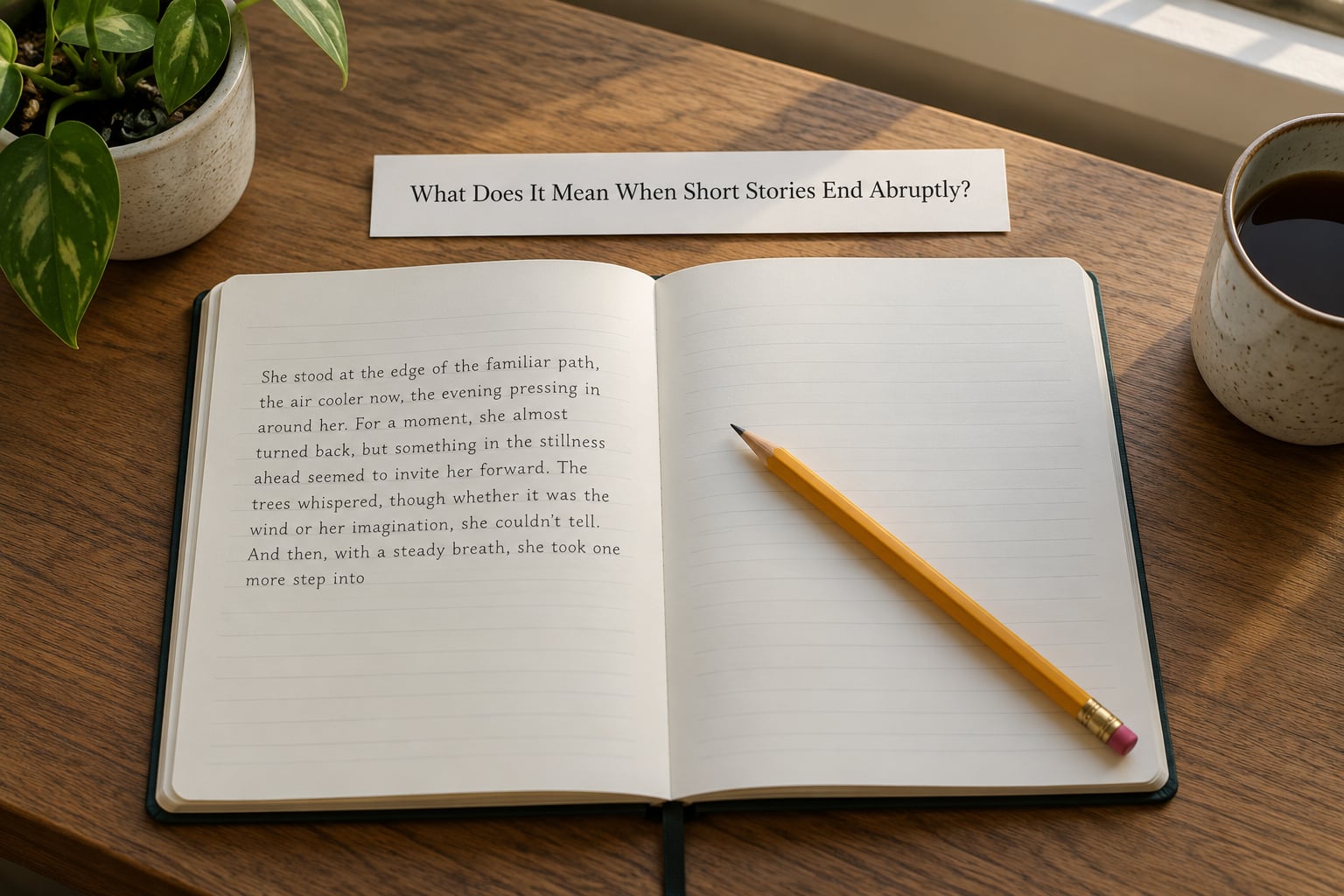
An abrupt ending stops a story the instant its central tension peaks or resolves, with no denouement and no account of what happens to the characters afterward. The last line lands on a moment rather than a conclusion, and the story simply ends there.
That is different from a story that has been abandoned. An abandoned story has no shape at all. An abrupt ending sits on top of a complete arc and then declines to add anything, which is exactly why readers tend to describe it as ending too soon even when the ending works.
Three craft terms help sort it out. The denouement is the unwinding section after the climax where loose threads get tied. An anticlimax is a resolution that undercuts the tension the story built. And a deus ex machina is a solution that arrives from nowhere, usually a coincidence or a new character, purely to save the plot.
An abrupt ending is often the author refusing to write any of those three. If the climax already resolved the conflict, a denouement only dilutes it.
Why Do Writers Make Short Stories End Abruptly?
There are six reasons that come up again and again, and only the last one is a fault. The rest are choices writers make on purpose.
1. The climax already did the work
The most common reason. A short story usually has one central question, and the climax answers it. Once the answer lands, everything after it is commentary, and commentary in a compressed form tends to read as padding.
Writers whose stories end this way frequently say the opposite of what you expect. They are not withholding the ending out of cruelty. They have nothing left to add that the last scene did not already say.
2. The word budget has no room for aftermath
Nobody covers this, and it is the most practical explanation. A novel can spend forty pages on what happens next. A 3,000-word short story cannot, without cutting the story in half to make space for an epilogue.
So the compressed form often builds to a peak and then simply stops, because extending past the peak would cost more than the ending would earn.
3. What is left unsaid is the actual subject
Some stories are about the gap between what people say and what they mean. End them with a summary and the subject disappears. Hemingway’s iceberg method is the clearest example: the author supplies the visible tenth, and the reader supplies the rest from their own experience.
4. The story is about an interruption
Sometimes the last event in the story is a door opening, a phone ringing, or a knock. The cut is the point, not a dodge. Stories that begin in medias res, in the middle of action with no setup promised, often owe the reader an ending that refuses to tidy up what it never untangled.
5. A hard stop makes the image stick
Ending on a line of dialogue or a single sharp image gives the reader something physical to carry away. That is why many writers end a story on a repeated image rather than a conclusion. The repetition makes the last beat feel like a pattern closing, even when the plot has not closed.
6. A snapshot of ordinary life needs no resolution
Not every story is a plot. A short piece can be a record of one afternoon, and afternoons do not have a climax. If the writer was documenting a moment rather than building toward a turn, stopping when the moment has passed is the honest shape of the thing.
Japanese kishotenketsu, a form built around the turn of seasons and a gradual fading rather than conflict and climax, is the formal version of this idea.
How Does an Abrupt Ending Create Surprise?
Surprise at the end of a short story comes from a pattern the reader thinks they have solved being broken in the last two sentences. It works because the pattern was built honestly first.
Withheld information, released at the end
The story gives you a set of facts and lets you assemble them into one conclusion. The final line adds a single fact that makes the old conclusion wrong. You reread the whole story differently, which is the reason to do it at all.
A tonal shift on the last page
When a story has been steady and even in tone and the final lines go flat, quiet, or suddenly ordinary, the register change registers as disturbance. Nothing has happened, yet something has shifted, and readers cannot always say why.
Juxtaposition
The last line sets an image next to a fact established earlier and lets the reader make the connection. Nothing in the ending is new information on its own. The surprise is the pairing.
What keeps surprise from feeling random is preparation. Writers on r/suggestmeabook say plainly that these endings work as a feature rather than a bug, but only when the earlier story earned them. If the last line introduces a rule the story never established, the reader feels cheated rather than surprised.
Why Can an Unfinished-Seeming Story Still Feel Complete?
Because an unresolved plot and an unresolved story are not the same thing. A plot is a question the story asks. A story is the work of asking it well. When the central conflict has been answered, a story can stop mid-scene and still be finished.
Three questions separate a complete abrupt story from a truncated draft:
Did the central conflict get answered? Every story has one question driving it. If the ending settles that question, even without telling you what happens next, the story has done its job.
Did something change? Look at the character in the first paragraph and the character in the last line. If something shifted, the story moved. Change matters more than closure.
Is there enough material to interpret? A good abrupt ending gives you a specific detail to work with, not just an absence. An image, a repeated phrase, a small unexplained object. That is the material a discussion group actually needs.
The reverse test matters too. If the central question is still open, nothing has changed, and the ending is pure atmosphere, the story probably stopped because the writer ran out of room, not because the story was finished.
What Techniques Do Writers Use to End Short Fiction Abruptly?
Cut away before the explanation
Stop one beat before the character understands what has happened. The gap does the work, and the reader’s own conclusion is more affecting than the author’s.
End on an image instead of a statement
A concrete object, a view from a window, a sound that has been running through the story. Images survive rereading in a way that explanations do not.
Stop right after a decisive action
The protagonist does the thing they have been building toward, and the story ends on the doing rather than the aftermath. This is the classic climax-as-ending and it is the cleanest version of the technique.
Use silence and omission
A line break where a line should be, or a paragraph that reports an event without describing how anyone felt about it. Omission is a technique only when you know what you are leaving out.
Let the last sentence carry an implied consequence
End on something small and let the reader extrapolate. A character says a polite goodbye and the reader understands from forty pages of context that it is the last time.
For writers, here is the practical version. Try cutting your current ending and stopping at the moment of greatest change. Read it aloud. If it leaves a specific image rather than a vague feeling of unfinished business, you have found your ending. If it leaves nothing at all, the story was probably carrying a second half you do not want to write.
The temptation to cover this with an epilogue is where a lot of drafts go wrong. An epilogue can widen the world of a story, but it can also explain the one image you wanted left alone. If you add one, ask whether it changes anything or just reassures the reader.
Is Abrupt the Same as Short or Unresolved?
No, and the words get mixed up constantly. A very short story can end completely, and an abrupt ending can resolve the plot while leaving everything else open. Here is how the common types differ.
| Ending type | What happens | Reader feeling | Central conflict resolved? |
|---|---|---|---|
| Resolved and abrupt | Climax answers the question, story stops there | Clean, slightly stunned | Yes |
| Ambiguous | Story stops with two or more readings available | Restless, turning it over | Usually, in one reading |
| Open | Ending leaves future deliberately unstated | Curious, suspended | Partly |
| Cliffhanger | Stops on danger or a question with no answer | Frustrated or thrilled, depending on the book | No |
| Circular | Ends where it began, with meaning shifted | Settled, sometimes rueful | Yes |
| Truncated | Draft simply stops | Confused, cheated | Usually no |
Two different things get confused under the word “short.” A flash fiction piece may run under a thousand words and close its arc completely. A 5,000-word story can end with nothing resolved. Length has nothing to do with it.
How Can Readers Tell an Intentional Abrupt Ending from an Unfinished One?
Here is the checklist I use, and it works for a first reading as well as for a classroom discussion.
- Pattern. Did the story set something up that the ending pays off, even partially?
- Tone. Does the final passage shift register deliberately, or does it read like the writer simply ran out of sentences?
- Character change. Is the person at the end different from the person at the beginning?
- Motifs. Does a detail from earlier in the story return in the last few lines?
- Structure. Does the shape of the ending echo the shape of the opening?
- Final impression. Do you close it with a specific image in mind, or with nothing at all?
- Afterthought. Do you find yourself mentally writing the next chapter, or just the next paragraph?
That last test is the useful one for a book club. Readers on r/unpopularopinion put it well: a disappointing ending is a feeling, not a verdict on the writing. If you finished the story arguing with it, the ending did something. If you finished it wondering whether you missed a page, it probably stopped early by accident.
Audiobook listeners run into a specific version of this. A narrator who stops mid-sentence with no closing signal makes a designed ending feel like a technical error, which is why the same story that felt deliberate on the page can feel careless in your ears.
For teachers, the last three items make good discussion prompts. Ask students where the conflict was answered, which detail from the first paragraph returned at the end, and what the story chose not to tell them. That last question is usually the one that gets the best answers.
Why Do Short Stories End Abruptly in Literature?
The technique is not a modern invention or a symptom of a trend. It comes out of a long argument about what a story owes its reader.
Aristotle set the terms in the Poetics: a plot should form a complete whole with a beginning, middle, and end, and the change at the end should be probable or necessary rather than merely convenient. Two thousand years of writers have been arguing with the second half of that sentence ever since. An abrupt ending satisfies the first requirement, the whole, and deliberately refuses the second, the probable consequence.
Modern and postmodern fiction pushed further. Where an older story tied its threads, a twentieth-century one might present the last moment of a life and simply stop, trusting the reader to supply a lifetime of consequence. Flash fiction took the same instinct and compressed it to a few hundred words, where a denouement has no room to exist at all.
Dialogue-centered stories end this way too. When the whole story is two people talking, the last thing said is often the whole ending, and any explanation afterward is a narrator stepping in to interpret what the reader already has.
If you want examples to go read, these are worth the time, and each one does something different.
- Hemingway, “Hills Like White Elephants.” The story returns in its final lines to the same landscape it opened with, and the repetition tells you the decision has been made without ever stating it. The last image does the resolution the dialogue refuses to.
- Chekhov, “The Lady with the Dog.” A man promises to return, and the story ends on that promise rather than on the return. The ending settles the emotional question while leaving every practical one open.
- Shirley Jackson, “The Lottery.” The ritual is completed and the story ends immediately, before any aftermath, with no account of what anyone feels about it. The refusal to comment is what makes it last.
- Kafka, “The Metamorphosis.” The last section abandons Gregor entirely and moves to the family’s ordinary life in his room. The story stops following the person it was about.
- D. H. Lawrence, “The Rocking-Horse Winner.” The closing lines introduce a knock at the door and a new voice, then end. The reader learns the boy’s fate only in fragments, and the story refuses to give a straight answer.
- Mavis Gallant and Alice Munro. Both are known for endings that turn a small domestic moment into something larger, then close without a summarizing line. Munro in particular will hand you a scene and then walk away from it.
Frequently Asked Questions
Why do short stories end abruptly?
Mostly because the climax has already resolved the central conflict, and anything written afterward would weaken it. In a compressed form, a denouement is also expensive in words. Some writers end abruptly because what is left unsaid is the real subject, and others because a snapshot of ordinary life has no aftermath to give. A much smaller number simply stop because the draft ran out.
Does an abrupt ending mean a short story is unfinished?
No. An unresolved plot and an unresolved story are different things. If the central conflict has been answered and the character has changed by the last line, the work is complete even when the future is left unstated. The sign of a truncated draft is different: the central question is still open, nothing has changed, and the ending offers no specific detail to hold on to.
What is the difference between an open ending and an abrupt ending?
An abrupt ending describes the technique, stopping the story without a denouement. An open ending describes the result, leaving the future undecided. So a story can end abruptly and still be open, and an open ending can arrive after a long, slow fade-out rather than a hard stop. The two words describe different things: how the story ends, versus what it leaves unanswered.
Why does a story sometimes end in the middle of a scene?
Because the moment of greatest change is not the same as the moment of greatest explanation. A protagonist can change completely in one line of action, and everything after that line is commentary. Writers on writing.stackexchange describe the test they use plainly: if you cannot write the next line without making the story smaller, that is where it ends.
How can I write an ending that feels surprising but not random?
Plant the fact early and let the reader misread it. The last line should introduce nothing the story has not already given the reader a reason to believe. Test it by rereading the story with the final line in hand. If every earlier detail now points at the ending, it lands. If the ending needs a new rule to work, the reader will feel tricked rather than surprised.
Is an abrupt ending always a cliffhanger?
No. A cliffhanger stops on unresolved danger or a question and is a feature of serialized fiction, where the next installment supplies the answer. An abrupt ending can resolve the plot completely and simply decline to describe the aftermath. A resolved abrupt ending usually feels calm, and that calm after tension is often what stays with the reader.
Conclusion: Pay Attention to the Final Beat
Short stories end abruptly because the writer believes the story is complete, and usually that belief is right. Understanding why short stories end abruptly comes down to one habit: read the last page for the image, the repeated phrase, and the change in the character, then decide for yourself whether the question was answered.
Start with the final line. Ask whether it leaves you a detail to work with or just an absence. In most cases you will find that the ending is doing exactly what it was built to do, and the discomfort you felt was the technique working on you rather than failing.