Transcendentalism began in New England because a cluster of conditions happened to exist there at the same time: ministers who had already broken with Calvinist doctrine, a small educated class with time and money to read and argue, the nearest American universities to Europe, and a hard, wooded countryside that made nature look like a rival to the church.
No one person invented it. Transcendentalism is the name people later gave to ideas that were already in circulation around Boston, Cambridge and Concord in Massachusetts when Ralph Waldo Emerson published Nature in 1836. Ask why transcendentalism started in New England and you are really asking why that particular set of pressures lined up in one region rather than anywhere else in the country.
The short version: New England had the religious disputes that loosened the ground, the philosophy imported from Europe that found a ready audience there, and the reform politics that gave the whole thing something to argue about besides God.
Table of Contents
- Why Transcendentalism Started in New England
- The historical setting in New England
- How Puritan ideas created a spiritual starting point
- How Romanticism changed American intellectual life
- Why Ralph Waldo Emerson became the movement’s leading voice
- How Henry David Thoreau put transcendentalist ideas into practice
- Why transcendentalism developed in the context of reform
- Why the movement began in New England
- Frequently Asked Questions
- When did transcendentalism start in America?
- Is transcendentalism the same as Romanticism?
- Who invented transcendentalism?
- What was transcendentalism mainly about?
- Did transcendentalists reject Christianity?
- Why is New England important to transcendentalism?
- Conclusion: Begin with the meeting of influences
Why Transcendentalism Started in New England
Transcendentalism is best understood as the point where four separate histories met: liberal Congregationalists who had already broken with orthodox Calvinism, German idealism arriving through British translators, Romantic faith in intuition and nature, and an abolitionist reform movement looking for a moral vocabulary of its own. New England had all four, plus the printing presses, colleges and reading public needed to move the ideas from conversation to movement.
Three concrete facts carry most of the weight. Liberal Congregationalism had emptied the pulpits of Harvard and Boston of Calvinist doctrine decades before Emerson was born, which left ministers and their congregations free to argue about spirituality without the threat of excommunication. Kant’s Critique of Pure Reason and the poems of Wordsworth and Coleridge were reaching American readers through British writers by the 1820s and 1830s. And the region around Boston was dense with small towns, wood lots and ponds within walking distance of a printing house.
The result was an intellectual culture where it was normal to treat intuition as a serious source of knowledge. That assumption is what “transcendental” originally meant, and it is worth keeping in mind before the word gets flattened into “deep” or “nature-loving.”
| Date | Event | Why it mattered |
|---|---|---|
| 1819 | William Ellery Channing argues for liberal Christianity in Unitarian Christianity | Names the freedom of the individual conscience and invites ministers to follow reason into scripture |
| 1833 | Frederic Henry Hedge reviews Coleridge in the Christian Examiner | Gives New England readers a vocabulary of German idealism and Romantic reaction against mechanism |
| 1836 | Emerson publishes Nature; the Transcendental Club forms | Gives the loose group of thinkers a name, a text and a meeting place |
| 1838 | Emerson’s Harvard Divinity School Address | Provokes the backlash that forces the movement to state its position on Jesus and the Bible |
| 1840–1844 | The Dial is published in Boston and New York | Turns a conversation circle into a national readership, with Fuller and Thoreau as key writers |
| 1847–1849 | Resistance to Civil Government; Brook Farm runs; Margaret Fuller travels west | Tests whether self-reliance survives contact with slavery, money and the frontier |
| 1854 | Thoreau’s Walden appears | Publishes the two years at Walden Pond and makes simple living a national subject |
The historical setting in New England
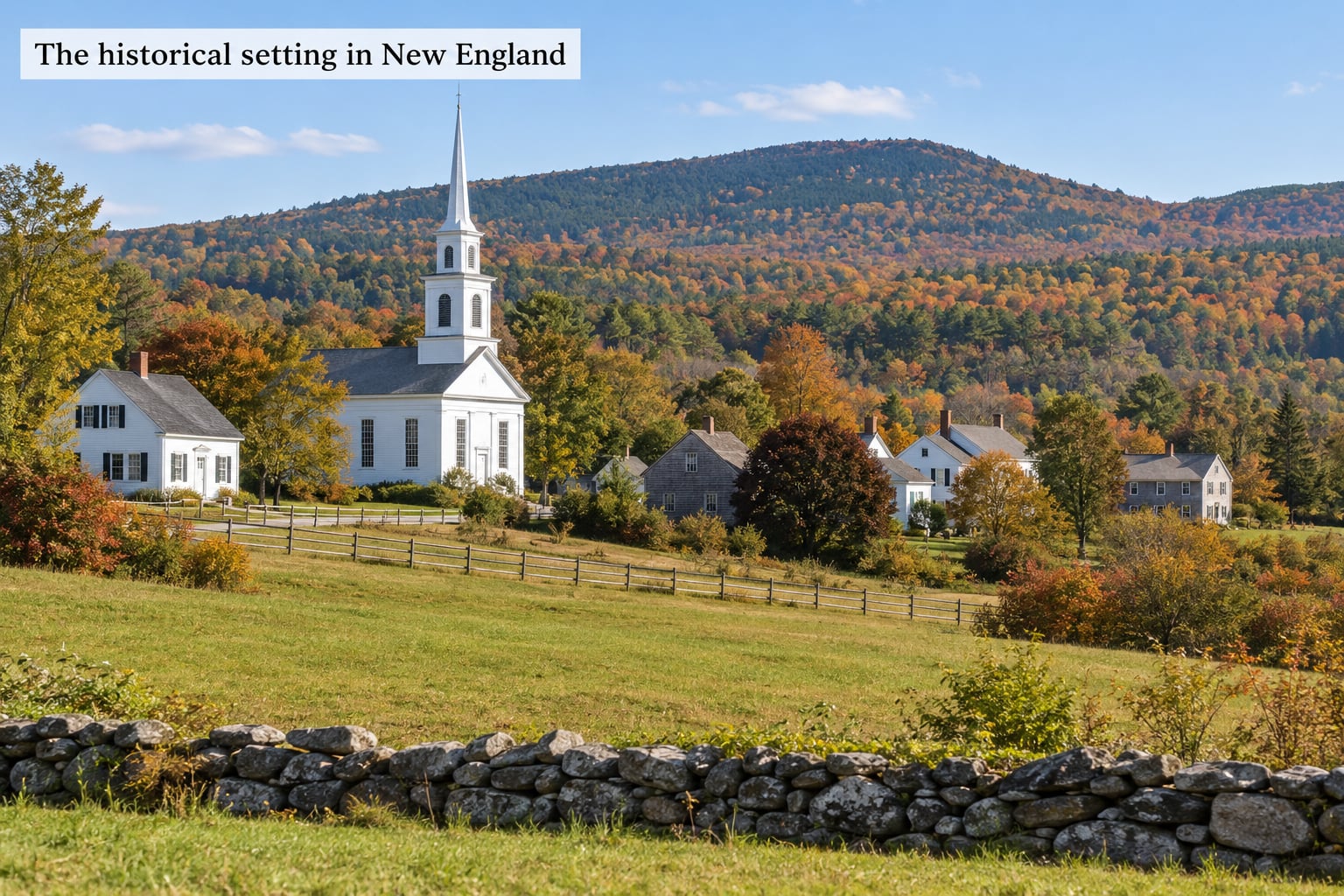
Transcendentalism needed an audience that read seriously and had spare hours. In the 1830s, the northeastern Massachusetts population was small, largely Anglo-American, concentrated in compact towns, and unusually well supplied with institutions. Harvard and its Divinity School sat in Cambridge. Boston was a publishing center with a literate middle class that attended lectures, joined debating clubs, and argued about religion in the Christian Examiner.
Economics mattered more than most accounts admit. The market revolution had created a stratum of people with family money, inherited land, or modest salaries from teaching and trade, and no agricultural season demanding their full attention. That group could walk to a lecture hall in the evening, subscribe to a periodical, or spend two years in a cabin on someone else’s land. Emerson’s father left him a modest inheritance in 1834, and Thoreau’s family had its own small holdings at Walden.
Two other features of the region sharpened the debate. The Second Great Awakening had pushed New England toward revival preaching and then left many congregations feeling that emotion alone was not enough, producing religious argument from the 1820s onward. And the abolitionist question was impossible to ignore in a region whose economy depended on cotton and whose merchants were tangled with the slave trade. Transcendentalist talk about the dignity of the individual landed in a place that needed to hear it.
How Puritan ideas created a spiritual starting point
Puritan theology gave the first generation of dissenters a habit that turned out to be useful: treating the individual’s inner experience as a real channel of truth. Jonathan Edwards’s account of a “sense of the heart,” and the wider Awakening conviction that conversion begins in the soul rather than in a ceremony, left a lasting inheritance even as the specific doctrine was abandoned.
What broke next was orthodox Calvinism, with its doctrines of predestination, human depravity and scriptural infallibility. Liberal Congregationalists rejected the worst of this first, sometimes arguing that Jesus himself was more rational and humane than the Calvinists made him out to be. Channing’s 1819 sermon gave the movement a name and an argument: unity in God, diversity in human understanding.
What replaced it was thinner. Once ministers stopped speaking for the congregation from an infallible text, they needed to say something about individual conscience and moral feeling instead. Transcendentalism is best understood as a plausible answer to that vacancy, not as a rejection of Christianity. Emerson was an ordained minister who resigned his pulpit over the Lords Supper. Thoreau read the Bible seriously and kept Sunday as a day of rest. What they shared was a conviction that a person’s own intuition could be checked against something real.
How Romanticism changed American intellectual life
Emerson’s generation read Kant through Coleridge and Carlyle, and read Wordsworth, Shelley and De Quincey directly. What travelled was not the German system but the mood: distrust of mechanical explanations, the claim that imagination perceives more than analysis can prove, and a conviction that a person standing alone in a wood is doing something philosophically serious.
“Transcendental” entered English through Kant, where it named the forms of understanding that structure experience rather than the objects of experience themselves. Emerson’s 1842 lecture “The Transcendentalist” is where he tries the term on his own position, arguing that the movement’s method is a practical use of a deeper sense of fact than science offers.
The Romantic contribution to New England was that nature was treated as a text worth reading closely. The Unitarian “natural religion” of the early 1800s had already argued that design was visible in the created world. The transcendentalists radicalized that: nature was not a set of evidence for God’s existence but the vehicle of the divine itself.
Why Ralph Waldo Emerson became the movement’s leading voice
Emerson did not start transcendentalism. When Nature appeared anonymously in 1836, the ideas behind it had circulated for years, and he had not yet written the essays that made him its most quotable writer. What he did was publish, and publish where readers were.
Nature (1836) is short, expensive to produce, and built on the claim that the natural world is a manifestation of the divine. “Self-Reliance” (1841) turns that cosmology inward, arguing that every person’s access to truth is immediate and does not need institutional permission. The Divinity School Address (1838) is the useful corrective to the image of him as a pure individualist: he argues that Christ should be understood as a moral reformer rather than as a supernatural rescuer, and is attacked for it.
The Divinity School Address was important less for its content than for its reception. Andrews Norton called it atheism in print, Harvard’s president condemned it, and the row sent the movement’s loose coalition into sharper focus. Emerson’s later lectures and essays, “The Over-Soul” and “The American Scholar” among them, widened what had been a sectarian quarrel into a public argument about what America was for.
How Henry David Thoreau put transcendentalist ideas into practice
Thoreau is the movement’s experimenter. Emerson wrote about self-reliance; Thoreau tested whether anyone could actually live it, which is why “Walden” carries a running argument about economics, measurement and honest accounting.
He spent two years and two months in a cabin on the Emerson family’s land at Walden Pond, building, planting, keeping accounts of what it cost and what it earned. The point was never that everyone should build a cabin. It was to ask which desires were real and which were inherited, and to show that the answer could be tested rather than argued.
“Resistance to Civil Government” (1849, published 1854) puts the same principle against slavery. Thoreau was jailed briefly for refusing to pay a poll tax, and the essay argues that a just government requires the consent of the governed, which is where Emerson’s appeal to individual conscience meets a harder question: what do you do when conscience and law disagree?
The contrast between the two men explains a lot. Emerson grew famous by lecturing and publishing; Thoreau preferred measuring, walking and writing a very great deal about beans. Their friendship lasted, but they disagreed sharply about whether civil disobedience should be organized, which was the argument that eventually split the movement.
Why transcendentalism developed in the context of reform
The transcendentalist claim that every human being has direct access to truth sounds abstract until you notice what reformers did with it. Abolitionists used it to argue against slavery as an insult to the soul. Women’s rights advocates used it to argue against the legal and ecclesiastical subordination of women. Theodore Parker’s preaching on the same grounds brought him threats and eventually a mob attack in Boston in 1853.
Emerson’s own commitment to abolition grew over these years and cost him friends in the South who had been readers of Nature. Fugitive Slave Law of 1850 and the Fugitive Slave Act turned a philosophical disagreement into a moral emergency. Margaret Fuller carried the same argument in a different form: her demand in “A New England” for women to think for themselves and share the full work of nation-making drew on the very doctrine Emerson was expressing about the individual soul.
Brook Farm, Fruitlands and Concord were attempts to build the philosophy as a household. The experiments mostly lost money, which did not make them pointless but did weaken the utopian strand after the late 1840s.
It also left an obvious contradiction at the center. A philosophy built on the universal dignity of every human being was spoken by a small group of men and women who were not extending that claim equally. Alcott’s utopian schemes ended; the assumption that universal claims required everyone to be equal to everyone else did not. It is easier to understand transcendentalism if you hold both facts at once.
Why the movement began in New England
Pulling these strands together, six conditions explain the geography.
1. A religious argument that had already been settled by force of argument. Liberal Congregationalists had displaced Calvinism in the 1820s and 1830s. Once doctrine loosened, the question of what a person could know without a church became askable.
2. Access to European philosophy, in translation, on a short delay. Kant, Fichte, Schelling and Schleiermacher reached Harvard students through Coleridge, Carlyle and James Marsh’s translation of Herder. American readers met post-Kantian idealism already Romanticized.
3. An audience with the money and the hours to argue about it. The market revolution left a thin but real layer of readers in the Boston area, with lecture series, debating clubs and print circulation already in place.
4. A countryside that behaved like evidence. Small New England towns with nearby woods and ponds let a naturalist and a theologian use the same walk as a proof. Walden Pond was not a symbol of the region so much as one of its better arguments.
5. A live political emergency. Abolitionism gave the philosophy a test case, and the failure of Brook Farm and Fruitlands in the 1840s ended the movement’s utopian phase without ending its moral reach.
6. People able to run institutions. Harvard, the Harvard Divinity School, and a small number of magazines could turn conversation into something with a shape. That is why transcendentalism stayed a Massachusetts movement, although after 1850 the names involved were famous well beyond it.
Frequently Asked Questions
When did transcendentalism start in America?
Most historians mark the beginning around 1836, when Emerson published Nature anonymously and the informal group that met in Cambridge became known as the Transcendental Club. The groundwork was laid earlier, especially in William Ellery Channing’s 1819 Unitarian Christianity and Frederic Henry Hedge’s 1833 review of Coleridge. The high period runs to the mid-1840s, when The Dial published from 1840 to 1844.
Is transcendentalism the same as Romanticism?
No. Romanticism is a broad European movement that elevated emotion, imagination and nature against Enlightenment rationalism. American transcendentalism is one regional expression of it, but with a distinct religious argument and a distinct Kantian epistemology. Emerson and Thoreau also wrote toward reform in ways that most European Romantics did not, and their work depends on conversations about American Unitarianism that had no European equivalent.
Who invented transcendentalism?
Nobody. The term was borrowed from Kant, and the ideas were developed collectively by liberal Congregational ministers, Germanist scholars and students through essays, lectures and conversations. Emerson is the leading voice because he published Nature in 1836 and wrote the most influential essays, but Frederic Henry Hedge introduced the philosophical vocabulary, William Ellery Channing had already made the religious argument, and the movement only coalesced once several people were arguing the same general position.
What was transcendentalism mainly about?
It held that a person can know truth directly through intuition, that this intuition is trustworthy, and that the natural world is pervaded by the divine rather than merely designed by it. From that the movement drew a practical conclusion: trust your own conscience, examine nature closely, live simply, and question any authority that cannot survive being questioned. The philosophy was about how a human being knows, and what follows from that.
Did transcendentalists reject Christianity?
Mostly no. They rejected Calvinist doctrine, and they rejected the claim that scripture alone settles religious questions, but they kept writing about God, the soul and moral obligation. Emerson’s Divinity School Address argued that Jesus should be read as a moral reformer and a man rather than as a supernatural rescuer, and that reading cost him his Harvard audience. What vanished was the authority of institutions, not the faith itself.
Why is New England important to transcendentalism?
Because the conditions that made the movement possible were all concentrated there: liberal Congregationalism, Harvard and its Divinity School, a dense print and lecture culture, a small class of readers with leisure, and a wooded countryside within reach of Boston and Concord. Emerson, Thoreau, Fuller, Alcott and Parker all lived and published within a few miles of each other. Transcendentalism stayed a regional movement for its whole main period.
Conclusion: Begin with the meeting of influences
Transcendentalism started in New England because several histories converged in one small region: ministers who had left Calvinism behind, German philosophy arriving through British translators, a Romantic conviction that intuition and nature are trustworthy, and a reform crisis over slavery that demanded exactly that kind of moral vocabulary. Any one of those alone would have been interesting. Together, around Concord and Cambridge in the 1830s, they produced a movement that is still being read.
If you are studying this, start with Emerson’s Nature and “Self-Reliance,” then read Thoreau’s Walden and “Resistance to Civil Government” and see where the argument gets harder. Read the Divinity School Address next, because the backlash tells you what the surrounding society thought it was hearing.