
Postmodern literature is writing from the second half of the 20th century that distrusts straight stories, reliable narrators and fixed meanings. It mixes high and low culture, breaks up the plot on purpose, and often points at itself while it does it. If you have ever finished a chapter and felt the floor tilt, that reaction is the point, not your mistake.
The label gets used loosely, so this guide sticks to what you can actually see on the page. We will cover where the movement came from, the ideas running underneath it, the jargon you will meet in any decent study guide, and a reading method that makes these books easier. Updated for 2026, because the last two decades have changed where the argument sits.
Table of Contents
- What Is Postmodern Literature?
- What postmodernism is actually doing
- Where postmodernism came from
- Three misconceptions worth dropping now
- How Postmodern Literature Explained Simply Differs From Modernism
- The Main Ideas Behind Postmodern Literature
- 1. Uncertainty replaces certainty
- 2. Metafiction: the book comments on being a book
- 3. Intertextuality: no story is told alone
- 4. Fragmentation and non-linear time
- 5. Irony as a default tone
- 6. Pastiche and parody instead of style
- 7. Authoritative truth collapses
- 8. Fiction and reality blur
- 9. Flattened characters, blurred high and low
- Postmodern Literature Explained Simply: Key Terms and Examples
- Unreliable narrator
- Metafiction and metanarrative
- Pastiche, parody and satire
- Hyperreality and simulacrum
- Deconstruction
- Indeterminacy and the death of the author
- Magical realism and maximalism
- The five theorists, in one line each
- How to Read a Postmodern Novel
- Step 1: Track who is speaking
- Step 2: Notice when the timeline slips
- Step 3: Catch the self-conscious moments
- Step 4: Log references to other texts
- Step 5: Ask what the book wants questioned
- Important Postmodern Authors and Books to Know
- The 1960s pioneers
- The 1970s and 80s
- The 1990s
- Where to start, ordered easiest to hardest
- Is postmodernism worth reading? The criticism, fairly stated
- Postmodern Literature in Poetry, Drama, and Other Forms
- Frequently Asked Questions
- When did postmodernism start, and what is its main idea?
- Why is postmodernism so confusing?
- Can you give me an example of postmodern literature?
- What is the relationship between postmodernism and literary theory?
- What are the best books for a beginner, and how is it studied in class?
- What are the flaws of postmodernism?
- Conclusion: Start with the Questions, Not the Labels
What Is Postmodern Literature?
Postmodern literature is 20th-century fiction, poetry, drama and criticism that treats storytelling itself as an object of suspicion. Instead of presenting a world as real and settled, it breaks the narrative apart, mixes registers, borrows from other texts and invites you to doubt the version you are being handed.
What postmodernism is actually doing
Modernism tries to find the meaning. Postmodernism questions whether there is a meaning to find. That one line, which recurs constantly in reader discussions, gets you most of the way there, but it leaves a false impression of despair.
Postmodern writers are not nihilists. They are playful about certainty. A novel that shows you three contradictory accounts of the same afternoon and then declines to rank them is making a precise argument: that truth in late 20th-century culture is produced by systems, not discovered by geniuses. The joke is usually delivered deadpan.
Where postmodernism came from
The movement took shape after 1945, in the shadow of the Holocaust, the atomic bomb and the collapse of European empires. Add the rise of television, advertising, cheap paperback mass culture and a suspicion of the Enlightenment promise that reason alone would sort things out, and you have the pressure postwar writers were working under.
It overlaps with literary theory of the same era. Roland Barthes, Jacques Derrida, Michel Foucault and Jean-François Lyotard published the ideas that later critics use to explain what the novels are doing. By the 1980s and 1990s the label spread from novels into architecture, film, visual art and music, and it also picked up a political meaning: the sense that the “end of history” had been declared and was worth disputing.
Three misconceptions worth dropping now
- It is not “modernism but worse.” Modernism and postmodernism are neighbours with different bets, and plenty of books sit on the border.
- It is not just confusing writing. Some of it is very funny. The trouble for readers is that the joke is aimed at the story, not at them.
- It is not dead. The techniques are so normal now that you have to look hard to spot them, which is usually the sign of a successful style.
How Postmodern Literature Explained Simply Differs From Modernism
Modernism and postmodernism are two different answers to the same anxious century. Modernism still believes a text can be made coherent, even if the coherence is fractured, strange and hard-won. Postmodernism asks whether coherence was ever available, and treats the attempt to achieve it as a habit worth parodying.
| Criterion | Modernism | Postmodernism |
|---|---|---|
| Belief about truth | Truth can be approached, often through difficulty, art or discipline | Truth is a story told by whoever has the loudest medium |
| Relation to the reader | Reader works to decode symbols and order fragments | Reader is told the order was arbitrary all along |
| Narrator | Unreliable but interpretable, a lens you can correct for | Unreliable on purpose, with no stable version underneath |
| Narrative shape | Experimental but still fundamentally chronological | Non-linear, circular, recursive or openly assembled |
| High vs low culture | Art elevates the everyday | The gap is a joke, so both are used as raw material |
| Typical tone | Austere, anxious, occasionally grand | Wry, ironic, deadpan, sometimes slapstick |
| Historical driver | Industrialisation, world wars, the shock of mass society | Postwar consumer culture, television, media saturation |
| Familiar authors | Woolf, Joyce, Eliot, Kafka, Beckett | Vonnegut, Pynchon, DeLillo, Barth, Eco, Auster, Wallace |
The boundary is genuinely soft, and pretending otherwise wastes your time. The useful working rule is this: ask what the text does with doubt. A modernist novel that complicates experience but still moves toward a shape reads modernist. A novel that announces the shape is a costume and keeps changing costumes reads postmodern.
One novel can do both. A late Beckett play is grim, stripped down and formal, yet the form keeps undermining its own solemnity. If you cannot place a book confidently, study how it handles its own form, not its subject matter.
The Main Ideas Behind Postmodern Literature

Postmodern literature explained simply comes down to a handful of recurring ideas. Here they are with a named book attached to each, because an idea without an example is the thing beginners complain about most.
1. Uncertainty replaces certainty
When a text no longer guarantees a single correct interpretation, that discomfort is deliberate. Kurt Vonnegut’s Slaughterhouse-Five follows a man unstuck in time, so the bombing of Dresden arrives before the reader meets the man who will survive it. Meaning is real; the order that would let you hold it is refused.
2. Metafiction: the book comments on being a book
Metafiction is fiction that draws attention to its own construction. John Barth’s Lost in the Funhouse narrates its own composition, hesitates, starts again and admits the author is lost too. Robert Coover’s The Origin of the Brunists does it as a broad parody, mocking the idea that a novel has to look spontaneous.
3. Intertextuality: no story is told alone
Intertextuality means a text openly leans on other texts, and postmodern works make that leaning loud. Umberto Eco’s The Name of the Rose hides murders inside a detective plot built on Sherlock Holmes, so the detective convention is quoted as much as used.
4. Fragmentation and non-linear time
Plot order dissolves. Thomas Pynchon’s Vineland moves through decades, nested memories and a character’s various versions of the same parents, none of which fully reconciles. David Foster Wallace’s Infinite Jest has footnotes with endings of their own, which sounds like a gimmick until you notice the plot depends on them.
5. Irony as a default tone
Irony is when the text says one thing and means another, and postmodern fiction leans on it so heavily that sincerity becomes suspicious. Paul Auster’s The New York Trilogy is full of sentences that are quietly admitting to themselves, and the reader never quite settles on how sincere to be back.
6. Pastiche and parody instead of style
Pastiche imitates another writer’s manner without mocking it; parody imitates in order to expose something. Satire, detective fiction, science fiction and the western all get sampled in the same book. Don DeLillo’s White Noise borrows the vocabulary of advertising and consumer research to make its own deadpan point about noise as a condition.
7. Authoritative truth collapses
Experts, governments, historians and the narrator all turn out to be limited. In The Crying of Lot 49, the heroine searches a conspiracy behind a postal code and finds only the faces of the dead staring back. Her suspicion is not disproved, which is the uncomfortable part.
8. Fiction and reality blur
Documents, quotations and citations sit inside the story with no reliable frame around them. Don DeLillo’s Underworld and Wallace’s Consider Phlebas both work in this mode, treating images circulated by media as more durable than the events behind them. Jean Baudrillard’s writing on simulacra is the theory that grew out of this.
9. Flattened characters, blurred high and low
Characters are often types, names on labels, or people defined mainly by consumption. Aristocrats, brand names and television sit in the same sentence without a register change. The effect is funny at first and slightly hollow on the hundredth page, which many readers honestly report as the hardest part to enjoy.
Postmodern Literature Explained Simply: Key Terms and Examples
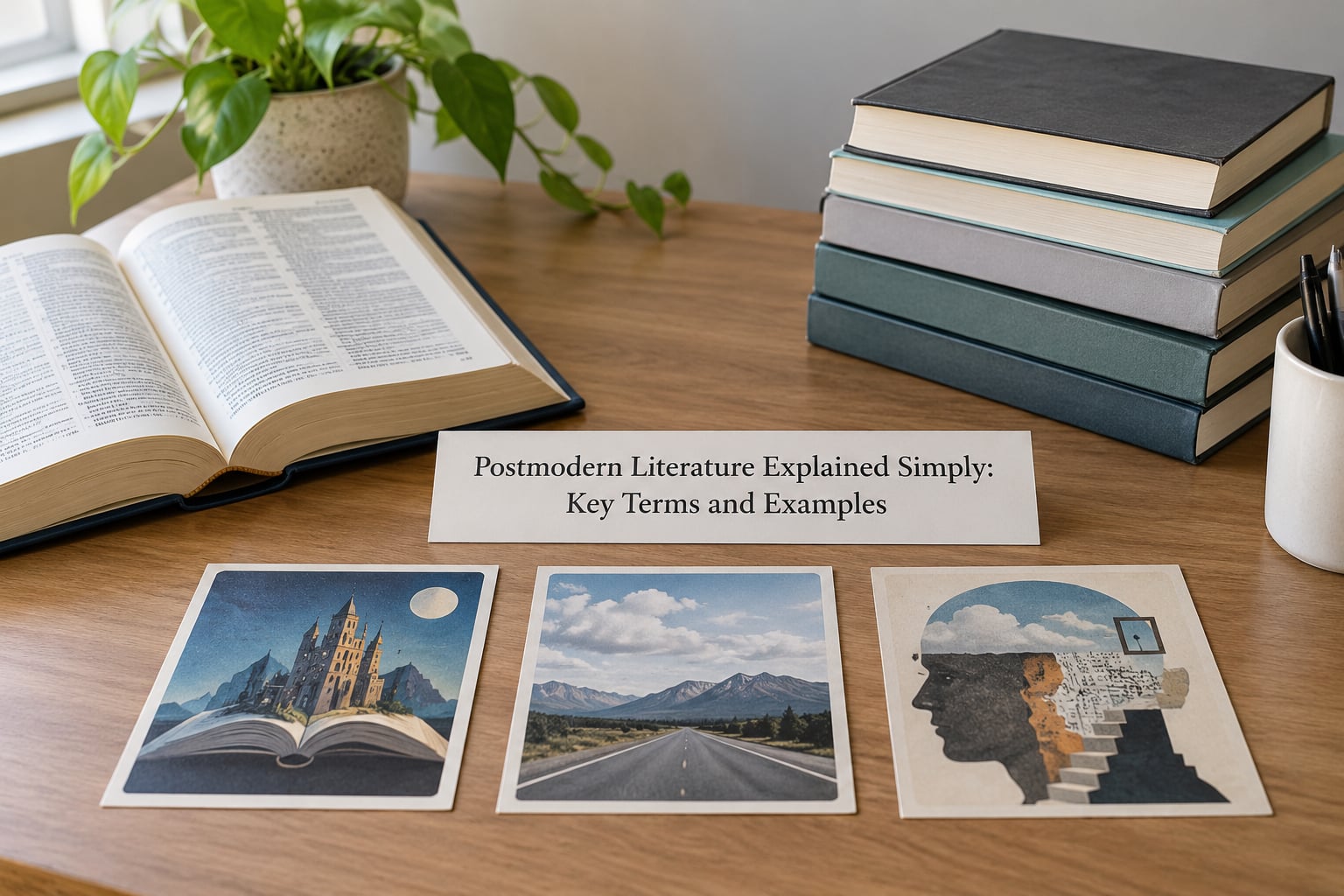
Jargon is the main reason beginners give up on this subject, so here is the working vocabulary with a plain meaning and one example each. Learn these and most explainer pages become readable.
Unreliable narrator
A narrator whose account you cannot fully trust, either because they are limited, biased or lying. In Slaughterhouse-Five Billy Pilgrim is a reliable witness to events he keeps reliving, which is a different problem and a more interesting one.
Metafiction and metanarrative
Metafiction is fiction that foregrounds its own status as fiction. Metanarrative is the same idea at the level of a whole culture: a big story about progress, science or history that other stories keep undercutting. Lyotard’s famous phrase for postmodern culture is a loss of faith in these big stories.
Pastiche, parody and satire
Pastiche is affectionate imitation of a style. Parody is imitation with a comic edge aimed at the original. Satire attacks a target directly. Eco distinguished parody, which “goes beyond the author’s specific text”, from pastiche, which “remains on the same level as the text it parodies”.
Hyperreality and simulacrum
Hyperreality is a state where a model or image of a thing becomes more influential than the thing. A simulacrum is a copy with no original behind it. Baudrillard used both to describe a media environment in which images circulate without anyone checking them.
Deconstruction
A method of reading that takes a text apart to show it does not hold together in a single stable way. Derrida’s core claim was that meaning is produced by differences between words and defers indefinitely, so a text can never be fully closed off. In practice it means asking what a word depends on to mean what it means.
Indeterminacy and the death of the author
Indeterminacy is the deliberate building in of ambiguity. The death of the author, from Barthes, is the idea that an author’s biography no longer unlocks a text’s meaning. Both push the work of interpretation out to the reader.
Magical realism and maximalism
Magical realism treats extraordinary events as ordinary, a technique that overlaps with postmodernism without being identical to it. Maximalism means piling on detail until excess becomes the subject, as in Pynchon, where a single page can carry a joke, a conspiracy and a footnote.
The five theorists, in one line each
Barthes argued the reader writes the text. Derrida argued words never quite settle. Foucault argued that knowledge and power shape each other. Lyotard argued that grand narratives have lost their authority. Baudrillard argued that signs now refer mainly to other signs. You need no more than this to read any secondary source.
How to Read a Postmodern Novel
You do not need a theory degree to read these books. You need a different set of habits, mostly about what you write down while reading.
Step 1: Track who is speaking
Write down each change of voice, narrator or tense as it happens, even if the book seems continuous. Authors like Auster and Barth make voices blur, and the moment you notice a switch, the technique stops being noise and starts being the point.
Step 2: Notice when the timeline slips
Mark the places where a chapter opens later than the last one ended. Then mark the places where it does not. Postmodern books are rarely as chaotic as they look; a handful of dates usually reappear and give you the real order underneath the apparent one.
Step 3: Catch the self-conscious moments
Sentences that describe the act of telling the story, or that a character is writing, reading or narrating, are the seams showing. Highlight them. This is where metafiction lives, and it is usually the most quotable material in the book.
Step 4: Log references to other texts
Keep a second list for named books, films, songs and genres. In Eco and Pynchon this list grows fast, and reading it together is a fair bit more fun than reading the novel alone.
Step 5: Ask what the book wants questioned
Finish by writing one sentence answering each of these questions in turn. Does it doubt that history is objective, that a person is a stable self, that a story can be told at all, that expertise is objective? The question the book raises matters more than the moral you draw from it.
One permission, since this trips people up: you are allowed not to enjoy these books. Forum threads about postmodern fiction are full of readers who understand exactly what a book is doing and still find it cold. A technique can be clever and the book can still not be for you.
Important Postmodern Authors and Books to Know
There is no fixed canon, but these titles come up in classrooms, criticism and reading lists constantly. Grouped loosely by period, with a reason to pick each one up.
The 1960s pioneers
- Jorge Luis Borges, Ficciones and The Aleph – short fiction that treats infinity, libraries and labyrinths as puzzles, and that later writers openly borrowed from.
- Samuel Beckett, Waiting for Godot – modernism’s bleakest stage, and a template for the absurd tone that follows it.
- John Barth, Lost in the Funhouse – the clearest early statement that a novel can be about being a novel.
- Kurt Vonnegut, Slaughterhouse-Five – the most accessible door into the whole subject, and genuinely funny for most of it.
The 1970s and 80s
- Thomas Pynchon, Catch-22 and Vineland – dense, funny, structurally demanding. Read Catch-22 for the entry point, not Vineland.
- Robert Coover, The Origin of the Brunists – a satire that disassembles the myth of progress and science.
- Italo Calvino, If on a winter’s night a traveler – a novel that keeps interrupting itself and telling you the reader is in charge.
- Don DeLillo, White Noise – consumer culture and flat irony, and the easiest DeLillo to start with.
- Lan Cao, The Eyes of the Rainbow – postmodernism with a political engine, not just a joke.
The 1990s
- Douglas Coupland, Generation X – postmodern mood in a wrapper, and an easy entry point for younger readers.
- Paul Auster, The New York Trilogy – deadpan, self-aware and short, which makes it a good door for adults.
- David Foster Wallace, Consider Phlebas – satire in footnotes and brackets; Infinite Jest is the famous one but not the first to read.
Where to start, ordered easiest to hardest
- Slaughterhouse-Five – short, warm, funny, and every core idea arrives inside it.
- The Remains of the Day – a formally tight novel with a devastatingly unreliable narrator, easier than its reputation.
- If on a winter’s night a traveler – playful, fragmented, and it teaches self-consciousness without lecturing.
- White Noise – add the cultural critique once the techniques are familiar.
- Catch-22 – only when you want the argument at full volume.
Is postmodernism worth reading? The criticism, fairly stated
Worth stating plainly, because almost nobody does. Critics charge that the movement is elitist, since the jokes require knowledge other people do not have. They argue it treats real subjects, race, class, empire and suffering, as material rather than experience, which many readers experience as evasion. They say it ends in a fog of relativism, where nothing is judged, and they point to a canon that is overwhelmingly white, male and ageing.
Those complaints have force, and the fact that you do not enjoy the books is not a personal failing. The fairer defence is that these novels took the critique of media and reality seriously enough to give up the tools of the old story, and everything written since has quietly borrowed the tools back. Wallace, Auster and Douglas Coupland exist because this style proved the form could carry popular reading, not just seminar reading.
Postmodern Literature in Poetry, Drama, and Other Forms
Postmodernism is not limited to the novel, and in some forms it did more visible work. In poetry, John Ashbery and Kenneth Koch blurred the line between a serious lyric and a conversational one, so a poem could be an art object and a shrug at once.
Drama borrowed from theatre of the absurd. Beckett’s Endgame traps four characters in a single room with no exit, using stage mechanics to perform its own hopelessness. Later, Heiner Müller’s The Hamlet Machine disassembles Hamlet into components, showing that a classic can be re-run as machinery.
Film made the techniques mainstream without calling them that. Pulp fiction mixes crime, westerns and operetta in one running conversation. The Wachowskis’ Matrix treats a simulation as a place you can be injured in. Christopher Nolan’s Memento plays a narrative backwards, so the audience reconstructs the chronology the protagonist cannot hold.
Visual art and music run on the same logic. Jasper Johns painted the same flag over and over, questioning whether repetition creates meaning. Hip-hop sampling, from The Great Adventures of Slick Rick onwards, takes a fragment of someone else’s record and makes it do a new job, which is intertextuality with a beat.
And in the digital forms themselves, the influence is everywhere. Memes, deepfake videos, brand content and machine-written text all produce a reality that competes with the real one, which is the condition White Noise and Baudrillard described decades before any of it existed. That is also why the argument has moved on. Metamodernism describes writers who swing between sincere belief and knowing irony, oscillating rather than committing to either, and post-postmodernism is the looser label some critics prefer now.
Frequently Asked Questions
When did postmodernism start, and what is its main idea?
Most dates are given as post-1945, with the movement gathering pace from the 1960s through the 1990s. Its main idea is that truth, meaning and the self are not fixed things waiting to be discovered, but stories produced by language, power and media. So the writing is designed to make you doubt the account you are reading rather than simply accept it.
Why is postmodernism so confusing?
Because the books deliberately withhold the things readers rely on. A stable narrator, a clear timeline and one intended meaning may all be missing, and the vocabulary critics use to describe that is heavy. Confusion is also common among teachers, who often disagree about where modernism stops and postmodernism starts. The confusion is a real design feature, not evidence that you missed something.
Can you give me an example of postmodern literature?
Kurt Vonnegut’s Slaughterhouse-Five is the clearest one: a war novel where time is broken, the narrator steps outside the story to address you directly, and the central question is not whether the bombing was tragic but whether any story could hold that meaning properly. Umberto Eco’s The Name of the Rose, Don DeLillo’s White Noise and Paul Auster’s The New York Trilogy work just as well.
What is the relationship between postmodernism and literary theory?
Theory came first in many cases. Critics such as Barthes, Derrida, Foucault, Lyotard and Baudrillard described how meaning is made, and writers then used those ideas in fiction. In practice the two run together: metafiction is a technique in a novel and a theory in an essay, and the same vocabulary covers both. Students who learn the five key names can read almost any secondary source.
What are the best books for a beginner, and how is it studied in class?
Start with Slaughterhouse-Five, then The Remains of the Day, then If on a winter’s night a traveler, since they are short, plot-led and cover most of the core techniques. In class the subject is usually taught through close reading: you pick a passage, name the technique, track the narrator and explain what it does to the reader. Essays then argue about whether the book has a point of view at all.
What are the flaws of postmodernism?
The standard criticisms are elitism, since the jokes assume insider knowledge, and a habit of treating real suffering as material. Critics also point to the collapse of moral judgment, where everything is treated as one more text, and to a canon that stayed largely white, male and ageing. Others argue it hollowed out the novel by making everything a joke. The strongest reply is that these novels changed how all later fiction is written.
Conclusion: Start with the Questions, Not the Labels
Postmodern literature is writing that treats the story itself as the subject. It shifts time, distrusts the narrator, borrows from other books, mixes registers and asks you to notice how much of your faith in the text was voluntary.
So do one concrete thing next. Choose a single accessible book, read no more than fifty pages, and write down two things: who is narrating, and which moment made you least sure what to believe. That is the whole method. Everything else, including the labels, follows from the habit of looking.