
Mary E. Wilkins Freeman (1852-1930) wrote short stories set in small Massachusetts towns, usually from the point of view of a woman whose life has narrowed to a kitchen, a parlour and a difficult marriage. Her plots are quiet and her sentences are short, but the pressure underneath them is enormous. This mary e wilkins freeman short stories guide walks through how her settings, silences and controlled reversals actually work, and gives you a question bank you can reuse for almost any story in the collections.
Table of Contents
- What makes Mary E. Wilkins Freeman’s short stories distinctive?
- How should students read Mary E. Wilkins Freeman’s settings and atmosphere?
- The house as a record of who holds the power
- The village as a single watching eye
- The road, the fields and the edge of the town
- How do Freeman’s main characters use silence, secrecy, and social roles?
- What themes recur in Mary E. Wilkins Freeman’s best-known stories?
- Domestic power held by women
- Silence as protest and as damage
- Isolation inside a crowded life
- Inheritance, property and who counts as family
- Memory that will not settle
- Gardens, flowers and women’s culture
- How does Gothic atmosphere appear in otherwise realistic stories?
- How can you analyze Freeman’s use of irony and dramatic irony?
- What study questions help with Mary E. Wilkins Freeman short stories?
- Plot and conflict
- Character
- Setting
- Point of view and language
- Theme, symbol and context
- How can you build a strong literary analysis paragraph?
- Frequently Asked Questions
- Who was Mary E. Wilkins Freeman?
- What are Mary E. Wilkins Freeman’s best short stories?
- Is Mary E. Wilkins Freeman a feminist writer?
- What themes run through Mary E. Wilkins Freeman’s short stories?
- Is The Wind in the Rose-Bush a ghost story?
- Where can I read Mary E. Wilkins Freeman for free?
- Conclusion
What makes Mary E. Wilkins Freeman’s short stories distinctive?
Freeman was distinctive because she took the ordinary village as seriously as other writers took murder and inheritance. She grew up in Randolph, Massachusetts, spent her career there, and set nearly everything within walking distance of her own family’s houses. That closeness is her advantage: when a narrator mentions a certain kind of pie, a specific kind of widowhood, or the exact quality of light in a mill town in March, it comes from a place she knew from the inside.
The second thing to understand is how her endings work. A Freeman story usually builds like a staircase with the top step missing. A woman is standing on the second-to-last stair, perfectly respectable, perfectly quiet, and then she does one thing that nobody in the story predicted. Nothing explodes. A pie is carried out to the road. A funeral is attended alone. The shock is in the composure.
Here are the basics before you read anything else.
- Born 3 May 1852, Randolph, Massachusetts, as Mary Eleanor Wilkins.
- Died 11 March 1930, Methuen, Massachusetts.
- Genres regionalist realism, domestic fiction, ghost story.
- Best-known collections A Humble Romance and Other Stories (1887), A New England Nun and Other Stories (1891), Silence and Other Stories (1898), The Wind in the Rose-Bush (1903).
- Signature stories “A New England Nun,” “The Revolt of Mother,” “Luella Miller,” “The Wind in the Rose-Bush,” “The Cat,” “The Lost Ghost.”
- Who backed her William Dean Howells placed her first collection. Herman Melville called her a tremendously impressive personage, and Henry James was another early admirer.
One word you will meet constantly in criticism is local colorism: writing that treats a specific region as valuable in itself, with its speech, weather, work and customs rendered closely. Critics used the word approvingly at first, then as a mild insult, since it implied the writer was more interested in scenery than in larger America. Freeman outgrew the label during her career, which is part of why the label is still argued over. More useful for you: she is doing the same work as a realist and as a Gothic writer, and the two strains sit side by side in her books.
How should students read Mary E. Wilkins Freeman’s settings and atmosphere?
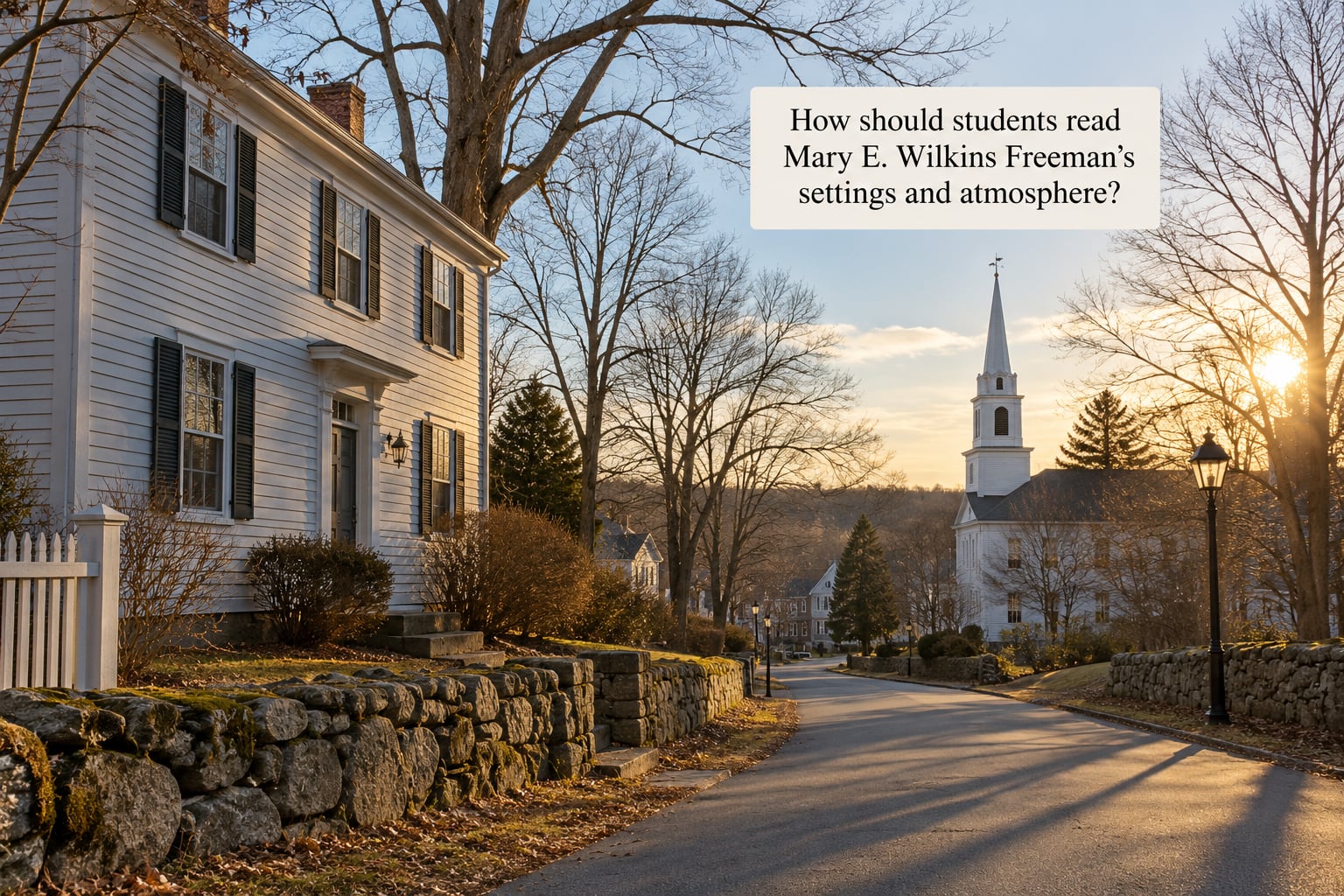
Read her settings as active pressure, not as wallpaper. A Freeman village is never merely located; it is watching. Neighbours know who has been widowed and how long, shops keep ledgers of credit, and the church sits at the centre of a gossip network that functions very much like a court. When a character steps outside in front of other people, the reader should assume the whole village is reading her.
Three setting patterns show up repeatedly.
The house as a record of who holds the power
Look at rooms, not just houses. Who has the front parlour, and who is allowed to use it? Who sits by the window? Who is standing? In “A New England Nun,” the kitchen is the whole government of the story, and the woman who has arranged her own life in that kitchen has arranged it with an economy that would shame a treasurer.
The village as a single watching eye
Freeman rarely names many characters in a village. There is often one family, one storekeeper, one minister, one neighbour who talks. The effect is that private decisions have no privacy left. “The Revolt of Mother” depends entirely on this: the conflict exists only because the community has decided a certain arrangement is permanent.
The road, the fields and the edge of the town
Any time a Freeman character walks out of the village and towards something on the far side of a field or down a turn in the road, the story changes temperature. The Revolt of Mother, “The Vacant Lot” and “The Lost Ghost” all use movement away from the centre as the plot’s engine. Notice what the character is carrying. Objects carry more argument in Freeman than speeches do.
Weather works the same way. Snow, fog and hard frost appear just before decisions, so if you are marking text, put a bracket around the weather and ask what it is doing to the mood.
How do Freeman’s main characters use silence, secrecy, and social roles?
Her characters almost never say the thing they mean. They say something tidy, domestic and deniable, and the meaning sits underneath. That is the single most useful thing to understand about her characterisation, and it is where most of the credit for her skill belongs.
Split what a character does from what a character says, and the gap is the story. In “The Revolt of Mother,” the husband says nothing for most of the story and the narration argues on his behalf in a calm, fair, devastating way that makes him look reasonable while marking every cost. In “A New England Nun,” the suitor’s letter is carefully worded, formally correct, and completely ignored.
There are four recurring social roles, and you can usually spot them within a page.
- The respectable sufferer who converts her own frustration into duty. Watch what she calls her situation.
- The quiet authority who knows the family’s history and uses tact instead of force.
- The returning outsider who has been somewhere else and comes back to a town that has moved on without her.
- The unnamed neighbour whose few sentences carry the town’s judgment.
A practical exercise: cover the dialogue in a story and read only the reported speech in summary. Whatever disappears is what Freeman thinks is unsayable.
What themes recur in Mary E. Wilkins Freeman’s best-known stories?
Her themes come out of the marriage plot, and the marriage plot almost always turns on money, work and who is permitted to decide.
Domestic power held by women
The central question in “A New England Nun” and “The Revolt of Mother” is not whether the marriage works. It is who runs the household when the husband stops functioning, and what the village does about it. Freeman’s heroines generally win, but they win by reorganising logistics rather than by arguing.
Silence as protest and as damage
Silence appears as strength in her heroines and as avoidance in everyone else. When a story ends in silence, ask whether the silence is chosen or imposed. In “The Wind in the Rose-Bush,” the silence at the end is chosen, and it is the most frightening thing in the story.
Isolation inside a crowded life
Freeman’s characters are rarely alone. They are surrounded, watched and not known, which is a different and worse condition.
Inheritance, property and who counts as family
Money, houses, farms and remarriage drive more of her plots than romance does. “The Gentle Barometer” and “The Vacant Lot” turn on what people own and who inherits it.
Memory that will not settle
Several stories reopen an old death or an old scandal after twenty years of village silence, which is Freeman’s main route into the uncanny.
Gardens, flowers and women’s culture
Flowers carry real weight in Freeman. Scholarship on her treats gardens as a space where women form bonds with each other that family and village do not offer. If you write about a garden scene, ask who the woman is speaking to there.
How does Gothic atmosphere appear in otherwise realistic stories?
Freeman’s ghost stories do not need a change of genre. The same village kitchen becomes frightening the moment the narration admits that everyone else knows something the protagonist does not. If you were put off by the domestic reputation, this is the strand to read, and it contains some of her best work.
Ranked by how easily they work on a reader who has never heard of her:
- “Luella Miller” – a girl dies, and the village refuses to let her go. Grief becomes enclosure. The shortest and most accessible place to start.
- “The Wind in the Rose-Bush” – an aunt is asked to take in a bereaved child and must choose between returning the child and keeping her. Widely considered the strongest of them.
- “The Lost Ghost” – a man is assigned to a house where a woman’s disappearance was never explained. The neighbours know more than they say.
- “The Shadows on the Wall” – a country house, an old story of brothers and a bet, and a present-day investigator who realises the house knows things.
- “The Vacant Lot” – a woman buys a bare lot because something happened there, and the neighbours react in a way that tells you what they believe.
The 1974 collection The Collected Ghost Stories gathers these and more, and it is the volume to buy if ghosts are what you are after. Note that Freeman generally leaves the cause unresolved. A story can be read as haunting, as shared delusion, or as a family protecting a secret it would rather die than state. Your essay will be stronger if you pick one reading and argue it rather than hinting at all three.
How can you analyze Freeman’s use of irony and dramatic irony?
Freeman builds irony out of a gap between the public surface of a scene and what is actually happening under it. The narration tells you plainly how respectable the moment looks, and keeps telling you, until you notice that every respectful detail is evidence of something else.
Two kinds do most of the work. Situational irony is when the outcome is the opposite of what the arrangement was meant to produce: a wedding called off precisely when the couple appear suited, a kitchen that turns out to be a kingdom. Dramatic irony is when the reader knows something a character does not, which is Freeman’s specialty. In “The Revolt of Mother,” we understand the household’s arithmetic long before the husband admits anything, so his silences arrive already explained and already damning.
Her verbal irony is drier. Deadpan understatement, where a devastating observation is delivered as a neutral remark about the weather, is her signature register. Mark every place the narration sounds calm and ask what has just happened underneath it.
A workable analysis sentence: The narrator’s insistence that the arrangement is harmonious performs the irony, because the accumulated domestic detail shows exactly what the arrangement has cost. That sentence states a claim, points at a technique and names the effect.
What study questions help with Mary E. Wilkins Freeman short stories?
Work through these in order. Each group answers a different part of the story, and the later groups need the earlier ones.
Plot and conflict
- What does the main character want in the first paragraph, and when does that want change?
- Which single decision causes the ending, and could it have been avoided?
- What does the title predict, and does the story keep that prediction?
Character
- What does this character say she wants, and what does her behaviour show instead?
- Whose opinion of her matters, and what does she fear that opinion is?
- Trace one character from their first appearance to the last sentence.
Setting
- Which room or building does the story turn on, and who controls it?
- What does the weather do at the moment of the climax?
- Who is watching, and how would the story change if nobody were?
Point of view and language
- Is the story told in first person, third person or second person, and what does that choice allow?
- Find one sentence that is unusually calm. What is it hiding?
- Collect five examples of dialect or plain speech. What does the register establish?
Theme, symbol and context
- Name the story’s central conflict in one sentence, without using the word society or fate.
- What object is used as a symbol, and where else does it appear?
- What does the story assume about women’s work and wages in the 1880s or 1890s?
- Where is the uncanny admitted and where is it explained away?
If you only have time for three, use these: name the central conflict in a single sentence, find the calmest sentence in the story and explain it, and trace one object through the text. Between them those three touch plot, style and theme.
How can you build a strong literary analysis paragraph?
Build it in four moves: claim, evidence, explanation, connection. Most weak paragraphs only do the first two.
The claim must be arguable. “The story is sad” cannot be argued with. “Freeman makes the reader complicit in the village’s judgement by letting us hear the gossip before we hear the woman it is about” can be.
The evidence is one short quotation with a line reference, not a paragraph of summary. Choose the sentence that does the most work, which is usually not the one that sounds the most dramatic.
The explanation is your analysis, and it is the sentence markers are looking for. Say how the language functions, not what it means.
The connection ties the point to a theme, another story or the historical moment, in one clause.
A model:
Freeman withholds the narrator’s judgement in “A New England Nun” and lets the reader supply it. Louisa Ellis waits four hours for her cousins to arrive and then, instead of marrying, tells them she has chosen her own life. The narration reports this decision in the same measured tone it used for the arrival time, so that a refusal to eat with her future husband is presented as a scheduling outcome. By refusing to tell us whether she is relieved or ruined, Freeman makes the reader do the moral work, and the reader’s verdict reveals what the story was built to expose.
What loses marks: summarising plot without evidence, quoting too much, explaining a quotation you could have written more precisely in your own words, and using themes as a list rather than an argument. Also watch the past tense habit. Freeman’s present-tense narration is a deliberate choice, and copying it into your own sentences without comment loses the technique.
Frequently Asked Questions
Who was Mary E. Wilkins Freeman?
Mary E. Wilkins Freeman (1852-1930) was an American short story writer from Randolph, Massachusetts. She attended the Mount Holyoke Female Seminary, married a local man whose alcoholism ended their working marriage without a divorce, and supported herself by writing. William Dean Howells placed her first collection, A Humble Romance and Other Stories, in 1887. She is remembered for psychologically precise stories of women in rural New England and for a shorter supernatural strand, including Luella Miller and The Wind in the Rose-Bush.
What are Mary E. Wilkins Freeman’s best short stories?
Most readers start with A New England Nun, The Revolt of Mother or Luella Miller. If you want the uncanny, add The Wind in the Rose-Bush, The Lost Ghost and The Shadows on the Wall. For theme and conflict work, The Cat and The Vacant Lot give you clear symbolic objects and village pressure. A sensible order is one realist story, one ghost story, then one of each back to back so you can compare the two strands.
Is Mary E. Wilkins Freeman a feminist writer?
She is read that way often, but the label needs care. Her heroines gain economic and psychological independence inside the domestic sphere rather than by leaving it, and the stories are as interested in grief, inheritance and friendship between women as they are in marriage. Critics who call her a local colorist point to the same evidence. The honest position is that she wrote women who think, and left it open to the reader whether that counts as feminist.
What themes run through Mary E. Wilkins Freeman’s short stories?
Domestic power, women’s unpaid work, silence as both protest and damage, isolation inside a crowded life, property and inheritance, memory that will not settle, and the gap between respectability and inner feeling. Gardens and flowers recur as a space where women form bonds with each other. A good analysis question is which theme the title of your story names and which one the plot actually argues for, since Freeman frequently sets those two against each other.
Is The Wind in the Rose-Bush a ghost story?
It is generally read as one, though Freeman never confirms a supernatural cause. An aunt agrees to care for a young girl whose parents have died, and must eventually choose between sending the child back to relatives and keeping her. The story’s power comes from the village’s refusal to interfere, from the child’s unchildlike calm, and from the aunt’s final silence. It appears in the 1903 collection The Wind in the Rose-Bush and in The Collected Ghost Stories.
Where can I read Mary E. Wilkins Freeman for free?
Nearly all of her work is public domain and can be read at no cost from Project Gutenberg, Standard Ebooks, Wikisource and the Internet Archive. Search by collection title rather than by author page, because different editions split the stories differently. The Wind in the Rose-Bush (1903) and Silence and Other Stories (1898) are the easiest full texts to find. A New England Nun and The Revolt of Mother also appear free in open American literature textbooks.
Conclusion
Freeman rewards a slow first read because almost all of her meaning sits in restraint. When you open a story for this mary e wilkins freeman short stories guide, find four things: the ordinary setting and who controls it, the central conflict stated in one sentence, the emotion that is never spoken aloud, and the single moment where the social surface starts to slip. After that, work outward through dialogue, objects and irony. If you want the shorter route, read “A New England Nun” for the domestic strand and “The Wind in the Rose-Bush” for the uncanny one, then compare how each one ends.