
Gwendolyn Brooks wrote about what it feels like to be Black in America: the daily texture of poverty, childhood, motherhood, work, and dignity in Chicago’s Bronzeville neighborhood. Her poems are short, but nothing in them is simple. Sound, repetition, and carefully chosen household objects carry arguments about race, class, grief, and survival.
If you searched gwendolyn brooks poems explained and want the short version first, you are in the right place. Below you get ten of her most-taught poems in plain English. Each section gives you the meaning first, then the main theme, then the devices with short quoted lines, then one image worth remembering and one question to argue about. You do not need to know anything about Brooks before you start.
Table of Contents
- Gwendolyn Brooks Poems Explained at a Glance
- Who Was Gwendolyn Brooks?
- What Makes Gwendolyn Brooks’s Poetry Distinctive?
- How Do You Analyze a Gwendolyn Brooks Poem?
- 1. Read it aloud, twice, before you analyze anything
- 2. Underline the words that carry weight
- 3. Find the part the poem withholds
- 4. Treat form as meaning, not as packaging
- 5. Name the social context last, then test it
- The Mother: grief, memory, and defiance
- The Bean Eaters: love, poverty, and old age
- We Real Cool: youth, risk, and self-destruction
- What “thin gin” actually means
- What “We sing sin. We thin gin” is doing
- Why the last three lines are indented
- A Song in the Front Yard: domestic confinement and resistance
- The Lovers of the Poor: judgment, poverty, and discomfort
- Beverly Hills, Chicago: movement, hunger, and opportunity
- The Sundays of Satin-Legs Smith: temptation and moral conflict
- Boy Breaking Glass: violence, grief, and the limits of storytelling
- The Rites for Cousin Vit: death, belief, and reconciliation
- A Sunset of the City: beauty beneath urban hardship
- What Do the Major Themes in Brooks’s Poems Mean?
- What Literary Devices Does Brooks Use Most Often?
- How Do Brooks’s Sound and Form Shape Her Poems?
- Frequently Asked Questions
- What does Gwendolyn Brooks’s poetry usually focus on?
- Which Gwendolyn Brooks poems are most important for students?
- What is the main message of Brooks’s poem The Mother?
- How do you interpret We Real Cool?
- What literary devices appear most often in Brooks’s poems?
- Is Gwendolyn Brooks associated with the Harlem Renaissance?
- Conclusion
Gwendolyn Brooks Poems Explained at a Glance
This table maps each poem to its form, central subject, main themes, and the device that does the most work. Use it as an index: read the theme column first, then jump to the poem your assignment actually names.
| Poem | First collected | Form | Central subject | Main themes | Key device |
|---|---|---|---|---|---|
| A Song in the Front Yard | Annie Allen (1949) | Free verse, quatrain-like stanzas | A young woman held inside while a yard beckons | Confinement, freedom, longing | Contrast and repetition |
| The Mother | The Bean Eaters (1960) | Five sestets, closing tercet | A mother who chose not to carry her child to term | Grief, defiance, memory | Rhetorical questions and anaphora |
| The Sundays of Satin-Legs Smith | The Bean Eaters (1960) | Free verse, four sections | A neighborhood man choosing between desire and duty | Temptation, morality, second chances | Shift between routine and interruption |
| Beverly Hills, Chicago | The Bean Eaters (1960) | Free verse | A brochure’s promise read by a hungry child | Want, class, critical distance | Juxtaposition |
| Boy Breaking Glass | The Bean Eaters (1960) | Three sections, compressed narration | A small accident that ends in death | Violence, grief, responsibility | Ellipsis and flat narration |
| The Rites for Cousin Vit | The Bean Eaters (1960) | Four long free-verse sections | A young man buried after a fall | Death, belief, renewal | Christian imagery set against ordinary tasks |
| The Bean Eaters | The Bean Eaters (1960) | Fourteen-line narrative poem | An elderly couple eating beans in the same room | Love, poverty, aging, dignity | Symbolic objects and contrast |
| A Sunset of the City | The Bean Eaters (1960) | Free verse, four quatrains | An older woman watching her family look past her | Decline, acceptance, dignity | Shifting perspective |
| We Real Cool | The Bean Eaters (1960) | Three quatrains plus an indented tercet | Schoolboys reciting what they think they are | Youth, risk, self-destruction, race | Dialect, irony, indentation |
| The Lovers of the Poor | Selected Poems (1963) | Free verse in numbered sections | Volunteers visiting a family they intend to help | Judgment, charity, discomfort | Ironic diction and satire |
Her most famous single poem by a wide margin is “We Real Cool,” published in 1960 and the one line nearly every student meets first. If you are starting from nothing, this is the order I would use.
- We Real Cool — short, punchy, and the easiest entry point into Brooks’s method.
- The Bean Eaters — a whole life compressed into fourteen lines, and the best poem for close reading.
- The Mother — harder and longer, and the one most often misread as simple.
- A Song in the Front Yard — short, formally regular, good for teaching sound patterns.
- The Lovers of the Poor — the widest canvas, and the sharpest satire.
Brooks’s collections remain in print and in classroom anthologies well into 2026, so any edition you borrow from a library will carry her poems in the order above.
Who Was Gwendolyn Brooks?
Gwendolyn Brooks was born in Topeka, Kansas, in 1917, and her family moved to Chicago when she was a child. She grew up in Bronzeville, a neighborhood on the city’s South Side that her poetry maps so thoroughly that teachers often use her poems to teach Chicago geography alongside poetry.
She arrived as a teenager into a literary world still shaped by the Harlem Renaissance, whose major figures were getting attention while Chicago’s Black writers were not. Brooks noticed that gap early and wrote from inside Bronzeville rather than describing it from outside. That is one reason her poems feel like records of a place instead of commentary on it.
In 1950 she won the Pulitzer Prize for Poetry for Annie Allen, the first African American to win it. The milestone matters beyond trivia: it confirmed that a formally demanding poet writing about ordinary Black domestic life could be judged against the same standards as anyone else, and it moved her career from “interesting” to canonical almost overnight.
Her career runs through two broad phases. Early poems such as “A Song in the Front Yard” are controlled, patterned, and shaped by traditional forms. Later work, especially In the Mecca (1968) and Riot (1969), moves into long, irregular free verse that handles public violence and collective memory. She served as Consultant in Poetry to the Library of Congress in 1985 and 1986, one of the highest honors a working poet can receive.
Brooks also wrote craft advice. A Capsule Course in Black Poetry Writing (1975) is short and blunt, and it argues that a poem should be judged as a made object, not as a political speech. That is the standard she held her own poems to, and it is why explaining them without quotation and close attention to form goes wrong.
What Makes Gwendolyn Brooks’s Poetry Distinctive?
Brooks writes about ordinary people in ordinary rooms. A pool hall, a kitchenette, a jar on a shelf, a plate chipped at the edge: these are her subjects, and she treats them as serious material rather than decoration for a “message about struggle.”
Sound does argumentative work. Rhythm and repetition can make a poem sound confident, chant-like, playful, grieving, or uneasy, and the meaning changes if you ignore that. Reading her poems silently often produces the wrong interpretation, which is why teachers assign them aloud.
Chicago is a character. Bronzeville buildings, streetcars, churches, and back yards carry history without being asked to. Even when a poem never names the city, the conditions in it are specific to it.
Beauty sits next to suffering without either cancelling the other. Brooks does not offer consolation as a reward for endurance, and she does not reduce hardship to something inspirational. A poem can be gorgeous and still refuse to comfort you, and holding both facts at once is the hardest part of reading her work. That double effect is the thread running through gwendolyn brooks poems explained below.
How Do You Analyze a Gwendolyn Brooks Poem?
Use the same five steps in the same order every time. The order matters, because students routinely skip step two and then argue about a theme the diction never supported.
1. Read it aloud, twice, before you analyze anything
Listen for the beat. Where does the rhythm speed up, stall, or get heavier? In “We Real Cool,” the short clipped lines create a chant; in “The Mother,” the longer lines and repeated openings create something closer to a formal argument. If you have only read silently, you have not heard the poem yet.
2. Underline the words that carry weight
Brooks chooses words for their sound and their social charge at the same time. Circle ordinary words that carry an unexpected tone, such as anything domestic used in a strange context, and star any word whose meaning depends on where you are from. Then ask what each one implies beyond its plain dictionary sense.
3. Find the part the poem withholds
Brooks frequently ends by stepping back rather than explaining. The last three lines of “We Real Cool,” the closing of “A Song in the Front Yard,” and the final stanza of “The Lovers of the Poor” all stop short of a stated lesson. Ask what the poem refuses to say and why that silence is doing more work than another line would.
4. Treat form as meaning, not as packaging
Indentation, stanza length, rhyme scheme, and line breaks are arguments. A word set apart in the margin is a different statement from the same word in running text, and a poem that breaks its own pattern at the end is telling you something changed.
5. Name the social context last, then test it
Now ask who could read this poem in 1960, what pressure they were under, and who was excluded from the version of the good life being advertised. Use history to test your reading, not to replace it. If a claim about society does not attach to a specific word or image in the poem, cut it.
The Mother: grief, memory, and defiance
In plain English: a mother is telling her child, presumably years later, that she did not carry the pregnancy to term. She says she will not pretend the choice was joyful. She says she remembers the child’s fingers and small body, and she says plainly that she will never let this child live, meaning she will never let the loss go quietly or let anyone convince her it was the wrong choice.
The main theme is grief held as defiance. Brooks refuses the two easy responses to the subject, which are pity and condemnation. The speaker owns the decision and the cost of it, and her closing line, “Believe me, I loved you all,” insists on love without asking to be forgiven.
The devices are doing heavy lifting. Anaphora carries the argument: “You do not understand me,” she begins, and the poem repeats that you do not understand in several guises. Rhetorical questions turn accusation into argument, asking who has the standing to tell her what she should have felt. And the poem’s shape is argumentative too, five six-line sections plus a closing three-line section, closer to a legal statement than a lyric cry.
Memory hook: the damp small pulps of the child she remembers. It is the most concrete image in the poem and the reason it cannot be softened.
Study question: does the final line comfort the child, absolve the mother, or do both at once? Defend whichever answer you choose with a specific line.
The Bean Eaters: love, poverty, and old age
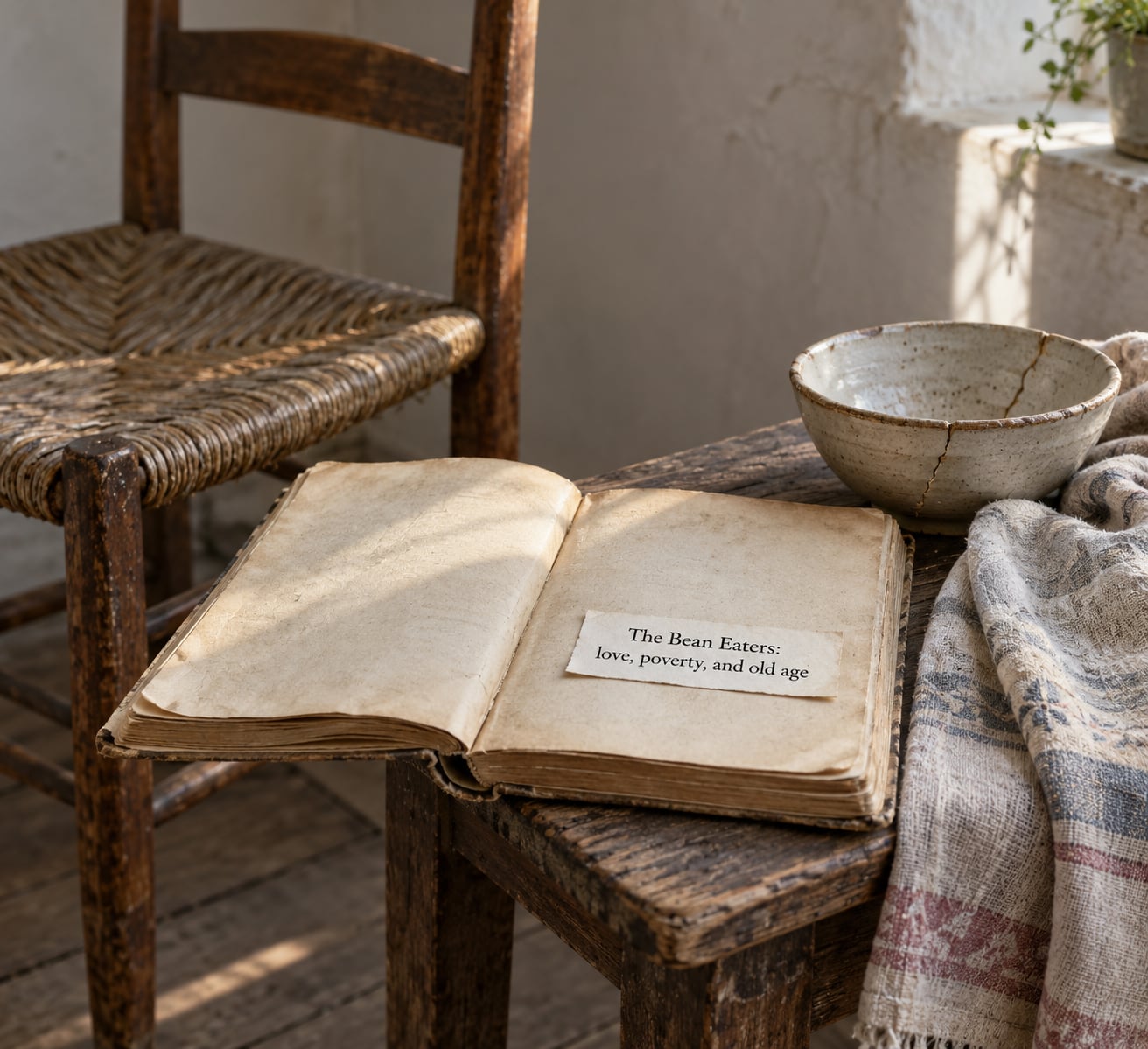
In plain English: an old couple eats a simple dinner of beans facing each other in the room they have lived in for decades. Nothing dramatic happens. The whole poem is a careful inventory of their worn belongings and their quiet habits, including the fact that their kisses are infrequent and their eyes meet rarely.
The theme is that love survives poverty and aging without becoming grand. Brooks refuses to sentimentalize them. She shows affection as habit, and habit as a form of fidelity that does not need to announce itself.
Her devices do the work through objects. A jar that is “one of the three important belongings,” a chipped plate, an old kettle, a bent ironing board: these are not poverty props, they are the record of a life, and their wear marks time passing the way a clock does. The poem runs fourteen lines of narrative verse, and the place name in the title shifts from kitchen table to a painter’s subject, which quietly places the couple inside a long artistic tradition of ordinary people.
One word is genuinely contested. The couple is called an “old yellow pair,” and readers have argued for generations over what yellow means here: old age and skin tone, jaundice, the faded yellow of old paper and old light, or a slang sense of light-skinned passing. Brooks does not resolve it, which is probably deliberate. Treat it as a question to raise in class rather than a fact to assert.
Memory hook: a chipped plate and a jar that matter more than furniture ever did.
Study question: what does the poem gain by refusing to explain the couple’s feelings? Find two lines where the objects do the emotional work instead.
We Real Cool: youth, risk, and self-destruction
In plain English: a group of schoolboys tell you who they are. They are tough, they drink, they have left school, they carry each other. The poem says this in their own voices, and then, at the very end, removes the group and leaves the pronoun standing by itself. The poem is about belonging and what belonging costs them.
The theme is youth as a performance that becomes self-fulfilling. Brooks is not scolding boys for drinking gin; she is showing how loudly a person has to insist they are fine, and how the insistence starts doing the damage.
What “thin gin” actually means
Two things at once. “Thin” is the ordinary word for watered-down liquor, cheap and weak, so the phrase means bad gin. But Brooks also drops the g, so it sounds like “thing gin,” which is the boys’ own speech pattern. The wordplay is characterization, not decorative rhyme: the dropped letters tell you how these boys talk before the line says anything about their lives. This is the single most-asked question about Brooks and the one most often left unanswered.
What “We sing sin. We thin gin” is doing
Sin and gin rhyme and mean opposite things, a pairing that puts the whole poem’s danger into one line. These boys think sin is fun. The rhyme tells the reader it is neither fun nor small.
Why the last three lines are indented
The poem is three quatrains plus a closing tercet, and in that last section every line begins with an indented “we.” As the lines go, the word “we” gets pushed further toward the margin until the poem ends with that pronoun alone, cut off from the group it kept claiming to belong to. Formally, the rhyme pattern that carried the quatrains breaks here, and the chant that felt like confidence starts to sound like a group losing its members. Students often read the closing as redemption, meaning the boys finally see themselves clearly. Read the indentation instead: what is left is the pronoun without the boys.
Common misreading: that Brooks is warning teenagers about juvenile delinquency. She is not. The poem is about race and poverty as pressures that shape what “cool” has to mean for a Black boy in Bronzeville, and about the gap between the self a group invents and the individual standing outside it.
Memory hook: the word “we,” marching toward the margin until there is nobody left in it.
Study question: Brooks told a teacher in 1961 that the poem was written for a group of boys who were not in school. How does knowing that change who you think the poem’s “we” is?
A Song in the Front Yard: domestic confinement and resistance
In plain English: a young woman is kept inside a house she does not want to be in, while a front yard full of color, movement, and strangers sits just beyond her reach. Brooks describes people with no children as cruel for treating her like a piece of furniture, and then describes what she would do if the yard took her.
The theme is a want for freedom that nobody will grant her, complicated by the fact that the yard offers no real shelter either. Brooks refuses the simple reading of a woman who wants out, and refuses the opposite reading too.
The diction and contrasts carry it. The house is described with cold, hard words while the yard is bright and open, and that opposition repeats at the level of sound. The poem uses rhythmic repetition to build pressure, then stops short of a resolution, because the speaker’s situation has not changed and the poem will not pretend otherwise. The narration also stays outside, giving us a viewer’s distance rather than the woman’s interior, which makes the judgment sharper.
Memory hook: a song sung from an enclosed porch at a yard she never enters.
Study question: is the ending hopeful or bleak? The evidence is in the last two lines, not in the emotional temperature of the poem overall.
The Lovers of the Poor: judgment, poverty, and discomfort
In plain English: a group of well-meaning women arrive at a tenement to give charity, and they cannot get through the door. What they want to do is good. What they find on the other side is a poor, crowded, chaotic family who do not match the picture in their heads, and the visitors’ certainty about their own generosity collapses on the page.
The theme is judgment, and specifically who has the standing to judge whom. Brooks sets the volunteers’ language against what they actually encounter, and the poem’s real cruelty falls on the visitors rather than on the family.
The techniques are ironic diction and structural contrast. The Ladies’ Betterment League gets a grand institutional name while the poem punctures it with plain, unsentimental detail. Sections are numbered, which creates a mock-official rhythm that keeps getting broken. Point of view stays inside the visitors’ assumptions so the reader sees the gap from the outside, and by the end the readers have been made as uncomfortable as the visitors, which is the whole design.
It is also one of the longest poems Brooks wrote, and it is where her later free verse is most visible: long lines, controlled repetition, no rhyme to soften the edges.
Memory hook: charity arriving with a committee’s vocabulary and meeting a family that does not fit inside it.
Study question: whose side is the poem on, really? Argue for one reading of the final section using two pieces of diction.
Beverly Hills, Chicago: movement, hunger, and opportunity
In plain English: the poem begins as an advertisement for Beverly Hills, describing sunshine, lawns, and palm trees. Then it moves to a Black child standing on a street corner watching a bus go by, hungry, wanting that life to come to him. The advertisement keeps talking while the child keeps waiting, and neither one touches the other.
The theme is want measured against distance. A child can see the good life clearly and still be excluded from it by money and color, and Brooks is precise about the difference between the two conditions.
The device is juxtaposition. A promotional voice and a hungry voice share the same poem, and the gap between them is the argument. Imagery shifts from bright and open to hard and hot, and repetition of the brochure’s language at the poem’s end does not soften the contrast, it sharpens it. The voice keeps a critical distance the whole way through, which is why the poem can describe beauty without believing in the sale.
Memory hook: an advertisement for a paradise, read by a child who cannot get in.
Study question: whose point of view controls the first section, and what changes when the poem hands over to the second voice?
The Sundays of Satin-Legs Smith: temptation and moral conflict
In plain English: the poem names a neighborhood man and follows him through the Sunday choices available to him, the women, the street, the small money, and the ordinary duties that hold him in place. He is tempted by something easier and more exciting than the life he has, and the poem walks him up to the edge of that choice repeatedly without letting him off the hook.
The theme is moral conflict as a daily condition, not a single dramatic fall. Brooks is interested in how much a person’s conscience actually costs, and in whether a life can be turned around at all.
The poem works by shifting between routine and interruption. Ordinary details, a hat, a coin, a street at a certain hour, set up a rhythm that keeps getting broken by desire. The final image of calm matters enormously: after four sections of tension, the poem resolves into something quiet rather than dramatic, and whether that calm is peace or surrender is the argument the poem deliberately leaves open.
Memory hook: a man on a Sunday, deciding again.
Study question: what specifically makes the ending hopeful rather than a verdict on the man? Quote the lines that support your position.
Boy Breaking Glass: violence, grief, and the limits of storytelling
In plain English: a boy on a street wants to show off. A glass breaks, a shard reaches a young girl’s eye, and she dies of the injury. The death is an accident built out of showing off, and the boy is the one who caused it.
The theme is how small a cause can be for an enormous loss, and how a person carries that afterward. The poem also seems interested in storytelling itself, in what a narrator can and cannot hold.
The technique is compression and ellipsis. Brooks narrates the whole thing in a handful of sections, using short declaratives, and she skips almost everything a reader wants: what the boy said, what he thought, what the family said afterward. That gap is the point. The absence of mourning language is itself the sound of someone who cannot narrate it, and the ending gives the reader an image rather than an explanation.
Note what the poem does not do. It never names the girl, and it never tells you she deserved or did not deserve what happened. That refusal to assign meaning is uncomfortable, and it is the poem’s argument about loss you did not ask for.
Memory hook: a breakable thing, a boy wanting to be seen, and everything that follows in a few flat sentences.
Study question: why does Brooks give us so little about the boy’s feelings? What does the flatness of the narration do to the reader?
The Rites for Cousin Vit: death, belief, and reconciliation
In plain English: Cousin Vit, a young man, has died after a fall, and his family carries out strange, half-religious, half-domestic funeral rites. They argue about details. They prepare food and clean and remember. The grief does not tidy itself, and the poem keeps both the rites and the mess in view.
The theme is death held inside ordinary life rather than lifted out of it. Brooks refuses a clean grief and offers, faintly, the idea that belief survives the details it is wrapped in.
The devices are Christian imagery placed against household tasks, and sensory detail that turns ritual into something you can see and hear. Burns, greens, sour smells, and food sit next to prayer, and because they sit together, neither is left pure. A single recurring image of the earth and growing things returns at the end, which is where the poem places its small hope. It is renewal, but earned hard, and it is not a claim that the death was fine.
Memory hook: a funeral carried out with prayer, food, and arguments in the same room.
Study question: track the poem’s images of the earth across its four sections. What changes about them between the beginning and the end?
A Sunset of the City: beauty beneath urban hardship
In plain English: an older woman sits while the light goes out over the city. Her children have grown past her and no longer look at her with the attention she was used to. Her husband and her lovers are polite. She looks at the fading light and decides that summer really is over, rather than telling herself it is not.
The theme is aging as a quiet loss of visibility that nobody announces and nobody can undo. Brooks writes it without self-pity, and without an offer of rescue.
The device is perspective, and it works quietly. The poem describes the sunset’s colors and the city’s cooling surfaces with real attention, and it keeps asking what that light reveals about people who are used to not being looked at. The tone shifts across the four sections, from observation to memory to plain statement, and the closing stanza is the shortest and least decorated, which is what makes it land. Hope here is not consolation. It is the accuracy of naming something accurately.
Memory hook: a woman watching the light go out and being accurate about it.
Study question: what is the speaker’s attitude toward her family by the end of the poem? Find the line that settles it.
What Do the Major Themes in Brooks’s Poems Mean?
Race and class. These never operate separately in Brooks. The pool hall in “We Real Cool” matters because of who is inside it and what the neighborhood offers. A poem about one family on one block is about a system.
Gender and identity. Mothers, grandmothers, young women, and girls carry decisions and consequences they did not choose alone. Brooks writes them as decision-makers, not symbols.
Family. Family in her poems is a web of obligation, grief, and stubborn care. “The Bean Eaters” and “The Rites for Cousin Vit” are the clearest cases.
Faith. Religious language shows up without arriving as belief. In “The Rites for Cousin Vit” it is one tool among several for handling death.
City life. Bronzeville is a character with its own memory, not scenery. Streets, kitchens, and porches do the same work that scenery does in other poets.
Beauty and suffering. Brooks never treats beauty as payment for pain. Several poems here are formally lovely and refuse to comfort you, and that double effect is deliberate.
Aging, freedom, and responsibility. “A Sunset of the City,” “A Song in the Front Yard,” and “Boy Breaking Glass” each turn on a person who wants something and must answer for it.
Do not reduce any of this to a single message. Brooks’s poems argue with themselves, and the ones that stay with people are usually the ones where two readings can both be defended from the text.
What Literary Devices Does Brooks Use Most Often?
Below are the devices you will meet most often, with a short quoted line and what it does.
| Device | Example line | What it does |
|---|---|---|
| Dialect | Thin gin (for thin, watery gin) | Drops a g so the boys’ speech pattern becomes part of the rhyme |
| Indentation | The repeated indented pronoun at the end of We Real Cool | Pushes the group toward the margin until it separates from itself |
| Anaphora | Repeated “You do not understand me” openings in The Mother | Turns a confession into an argument |
| Oxymoron | We sing sin | Puts joy and moral damage in the same breath |
| Symbolism | The chipped plate and the jar among three important belongings | A worn object carries a whole life without stating it |
| Ellipsis | The unmourned death in Boy Breaking Glass | Leaves out the feeling, so the reader feels the gap |
| Irony | The Ladies’ Betterment League arriving to help | The grand name undercuts the visit’s real effect |
| Juxtaposition | Advertisement voice set against the hungry child | Puts a promise and a person in the same poem |
| Contrast | Enclosed porch against bright front yard | Makes the wanted thing visible and unreachable |
| Shift in perspective | Closing stanza of A Sunset of the City | Moves from observed light to a plain verdict |
Two terms students mix up. Simile compares using like or as; metaphor states the comparison as fact. And diction means word choice as a matter of register and connotation, which is why “thin gin” is a diction argument as much as a sound device.
How Do Brooks’s Sound and Form Shape Her Poems?
Sound is not decoration in Brooks. It carries point of view, and it changes the poem’s meaning when you change the pace of reading it. In “We Real Cool,” clipped monosyllables make a group sound confident and bored, which is exactly what confidence looks like before it fails. In “The Bean Eaters,” longer narrative lines with plain rhymes slow the poem to the pace of a household.
Form shifts across her career, and reading a poem without noticing which phase it comes from will mislead you. Early work leans on patterned stanzas, rhyme, and regular beats. The later long poems run in irregular free verse where line breaks, repetition, and section numbers carry the structure instead.
Her rhyme is often loose rather than perfect, which keeps the sound conversational and stops the poem from sounding posed. Repetition does three jobs at once in her work: it builds a chant, it argues a point, and it makes a pattern that can be broken. Every time a Brooks poem repeats itself and then changes, the change is the poem’s actual event.
One practical tip for close reading: read a Brooks poem aloud twice, once at your normal pace and once slowing down and exaggerating the line breaks. If the second reading reveals a line ending that carries more weight than you noticed, the form is doing more work than the summary suggested.
Frequently Asked Questions
What does Gwendolyn Brooks’s poetry usually focus on?
Brooks writes about ordinary Black life, especially the daily texture of poverty, childhood, motherhood, work, and aging in Chicago’s Bronzeville neighborhood. She is equally interested in form: sound, repetition, rhyme, and line breaks carry meaning rather than decorate it. Expect her to hold beauty and suffering in the same poem without offering comfort as a reward for endurance.
Which Gwendolyn Brooks poems are most important for students?
The most assigned are We Real Cool, The Bean Eaters, The Mother, A Song in the Front Yard, The Lovers of the Poor, and the ballad of Emmett Till. If you are new to Brooks, read We Real Cool first because it is short, then The Bean Eaters, because it shows how much a poem can compress into a handful of objects.
What is the main message of Brooks’s poem The Mother?
The speaker tells her child that she chose not to carry the pregnancy to term, and she refuses to describe that choice as either joyful or monstrous. The message is that grief and love can exist without apology, and that the person who made the decision still has to live inside it. Her closing insistence that she loved the child throughout refuses forgiveness she was never asked for.
How do you interpret We Real Cool?
Read it as a poem about belonging, not simply about bad behavior. The boys recite a self-image to prove they are fine, and Brooks shows what that performance costs them. The closing tercet indents the word we over and over until it stands alone, cut off from the group. Formally the rhyme breaks exactly where the group does, so the structure carries the reading.
What literary devices appear most often in Brooks’s poems?
Her most frequent devices are dialect, imagery, repetition and anaphora, irony, contrast, and shifts in perspective, plus figurative language such as simile, metaphor, oxymoron, and ellipsis. Dialect is the one students miss: the dropped g in thin gin is her rendering of the boys’ own speech, so the wordplay characterizes the speakers instead of decorating them.
Is Gwendolyn Brooks associated with the Harlem Renaissance?
Broadly yes, with a caveat. She began writing during the Harlem Renaissance and is taught alongside Langston Hughes, Countee Cullen, and Zora Neale Hurston. Her work is distinct because it comes from Chicago’s Bronzeville rather than Harlem, and because her early interest was in ordinary working people rather than in the performance of race for a mainly white readership.
Conclusion
Brooks’s poems explain themselves more slowly than most people expect. The reliable method is simple: read the poem aloud, mark the words that carry weight, find the part it refuses to say, treat the shape of the stanza as an argument, and only then bring in history to test your reading.
Start with one poem. Reread it aloud, name the speaker and the situation in a single sentence, and trace one image or one sound pattern through it from first line to last. Once you can do that with “We Real Cool” or “The Bean Eaters,” the rest of her work stops being intimidating and starts being readable.