Romeo and Juliet is a tragedy by William Shakespeare, written around 1594 to 1596, about two teenagers from feuding Verona families who fall in love at a masquerade, marry in secret, and kill themselves after a chain of misunderstandings. This Romeo and Juliet study guide for students covers the plot, characters, themes, key scenes and quotes, with act and scene references so you can build a real analysis rather than a summary.
It is the most widely taught Shakespeare play in English-speaking schools, and it stays on the syllabus because it does something rare: it lets you argue about almost anything. Fate or free will? Love or infatuation? Does the Nurse get Juliet killed? Is the ending the lovers’ choice or the family’s fault? You need plot clarity before any of that means anything, which is why this guide starts with the story and then builds outward to themes, devices and exam technique.
Key facts:
| Detail | Answer |
|---|---|
| Author | William Shakespeare |
| Date written | Around 1594 to 1596 |
| First performed | Probably 1596; the first printed text appeared in 1597 |
| Genre | Tragedy, in the Elizabethan and Jacobean five-act structure |
| Length | Five acts and roughly 29 scenes, depending on the edition |
| Time span | About four days |
| Setting | Verona, Mantua and a street outside Verona |
| Main source | Arthur Brooke’s 1562 poem The Tragical History of Romeus and Juliet, itself based on earlier Italian versions by Luigi da Porto and Matteo Bandello |
Table of Contents
- What Is Romeo and Juliet About?
- Romeo and Juliet Plot Summary: What Happens in the Play?
- Act 1: The feud and the meeting
- Act 2: The marriage and the balcony
- Act 3: The turning point
- Act 4: Waiting, and a wasted journey
- Act 5: The tomb
- Who Are the Main Characters in Romeo and Juliet?
- What Are the Main Themes in Romeo and Juliet?
- How Does Shakespeare Show Conflict in Romeo and Juliet?
- What Are the Most Important Scenes to Know?
- Act 1 Scene 1: the brawl
- Act 1 Scene 5: the feast
- Act 2 Scene 2: the balcony
- Act 3 Scene 1: the duel and the banishment
- Act 3 Scene 5: the secret marriage
- Act 5 Scene 3: the tomb
- How Do You Analyze Romeo and Juliet Quotes?
- Romeo and Juliet Study Guide for Students: How to Study the Play
- Step 1: get the shape before the detail
- Step 2: one character per card
- Step 3: build a theme and evidence grid
- Step 4: learn six quotations properly
- Step 5: practise the essay shapes
- Exam boards and grade levels
- Common misconceptions worth losing marks to
- Hard words in the play
- Study questions by act
- Frequently Asked Questions
- What are the 5 main themes in Romeo and Juliet?
- Is Romeo and Juliet appropriate for 12 year olds?
- Did Juliet actually kiss Romeo?
- Why is the Nurse blamed for the deaths?
- What does the ending actually mean for the feud?
- How long does Romeo and Juliet take to read and study?
- Conclusion: Start with the Plot and Build Your Analysis
What Is Romeo and Juliet About?
Romeo and Juliet is about two young lovers from opposite families whose private happiness is destroyed by a public feud they did not start and cannot stop. Shakespeare wrote it in the 1590s, when England was dealing with religious division, the threat of Spanish invasion and constant street violence between rival households. The play takes that private world very seriously.
The central conflict has three layers. The first is external: two families, the Montagues and the Capulets, are locked in a blood feud, and the Prince of Verona has banned public fighting. The second is social: Romeo and Juliet are teenagers with almost no authority over their own lives, so love has to work through a friar, a nurse and a letter nobody can read. The third is internal: the lovers keep making urgent decisions at a speed the world cannot match.
That compression is deliberate. Four days, roughly 2,000 lines and 29 scenes give the play its speed. Every character who could slow the lovers down is killed, delayed or absent, and the one adult who tries to help them, Friar Laurence, is the one character who cannot act quickly enough.
Students often get stuck because they treat it as a love story. It is closer to a warning. Shakespeare pairs the lovers’ passion with a language of disease, night, death and madness, and he never lets the ending arrive as a surprise: the Prologue tells us the ending before the first scene begins.
Romeo and Juliet Plot Summary: What Happens in the Play?
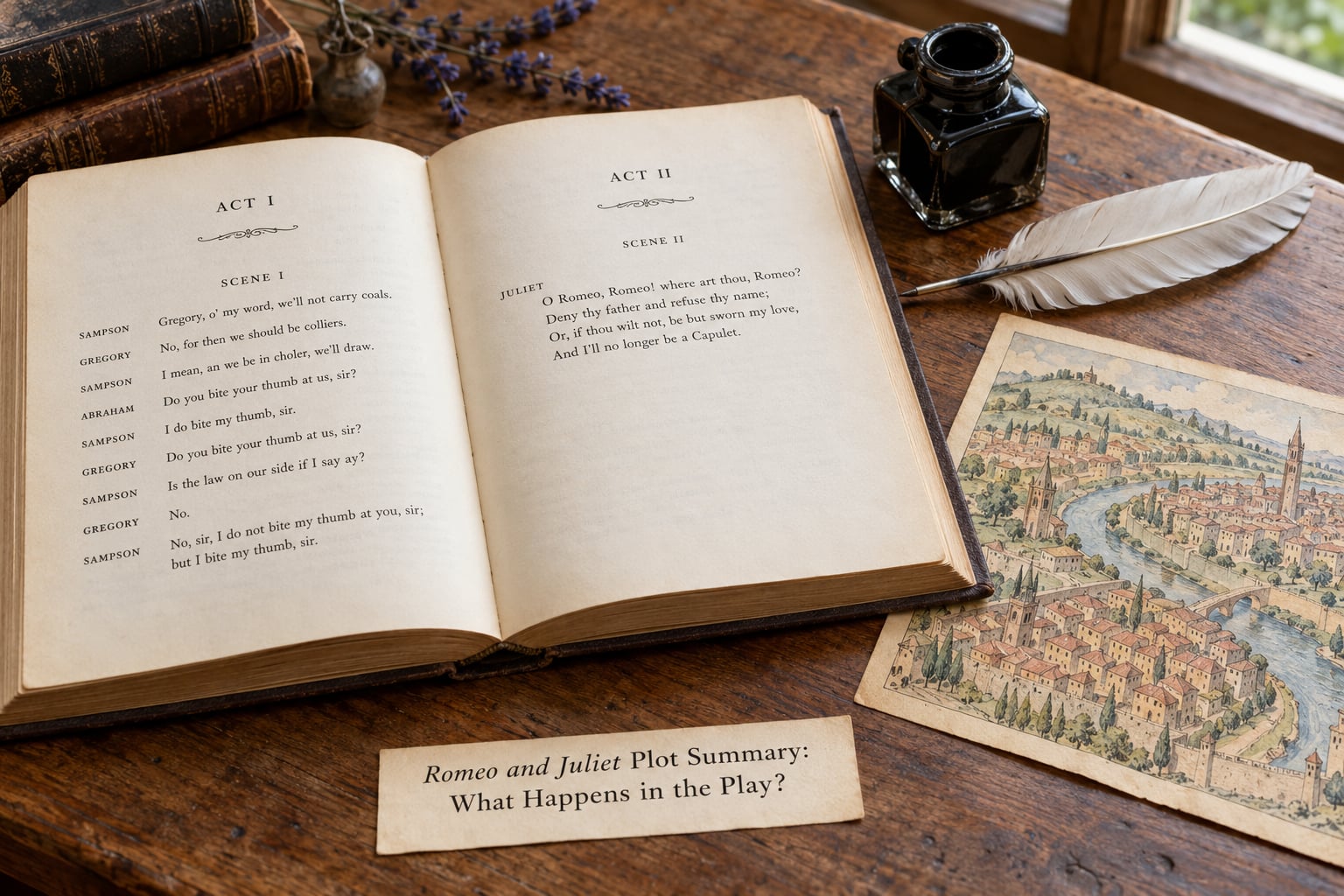
Here is the whole play in order. Read the cause and effect between events, because that chain is what you will be asked about in an exam.
Act 1: The feud and the meeting
The play opens with servants Sampson and Gregory fighting in the street over a servant of Romeo’s friend Benvolio, which escalates into a brawl. Prince Escalus of Verona stops it and threatens to kill anyone who breaks the peace again. Two feuding households, the Montagues and the Capulets, are bound together by a blood feud, and the Prince’s word is law.
Offstage, Romeo is moping over Rosaline, a Capulet who has no interest in him. Benvolio and Romeo meet at the feast Capulet has organised for the masquerade. Romeo ignores the warning about going in disguise and uses the night to meet Juliet. She is not yet fourteen, and her marriage to Paris is being arranged.
The moment they see each other, both fall in love. They exchange vows, and Juliet asks Romeo to marry her. Romeo agrees, but they cannot do it immediately: a friar who married them could be executed, and Juliet says she needs time to test his commitment. The act ends with both of them alone, thinking about each other.
Act 2: The marriage and the balcony
Romeo returns to ask Friar Laurence to marry them. The Friar agrees more readily than expected, and even admits that it may end the feud. He needs time to prepare, so Romeo sends word to Juliet through a letter.
Meanwhile, Romeo is repeatedly banished from the city, once for fighting Tybalt in Act 1 Scene 1 and again for killing him in Act 3. The Nurse acts as messenger throughout, which is convenient until it is catastrophic. In the most famous scene of the play, Romeo waits while Juliet leans out of her window and the two exchange vows. The balcony itself is unremarkable; what matters is the imagery of the sun, the night and the rash lover acting before reflection.
Act 3: The turning point
Tybalt challenges Romeo, and Romeo initially refuses to fight. Tybalt calls him a coward, Mercutio steps in, and Romeo draws his sword and kills Tybalt. The Prince bansishes Romeo rather than executes him, a ruling Tybalt’s family demands. Romeo learns of the exile in the same scene, and immediately threatens suicide.
Friar Laurence tells him to marry Juliet anyway and use the marriage to end the feud. Romeo refuses, which is more consistent than he realises. Juliet goes to the Friar, and he gives her a sleeping potion that will make her look dead for two days. The plan is for Romeo to arrive, take her to Mantua, and the letter to summon him must reach him first.
Capulet then makes a final, desperate decision: he will give Juliet to Paris. Juliet tells the Friar she will refuse. She drinks the potion, is mistaken for dead, and is carried to the family tomb, where Romeo’s livery helps place her there.
Act 4: Waiting, and a wasted journey
The household mourns, the Nurse is dismissed, and Juliet lies alone and alive in a tomb. Romeo returns to Verona, learns of Juliet’s death, and buys poison from an apothecary. Meanwhile Friar Laurence goes to write to Romeo explaining the plan.
This act is the engine of the tragedy. The Friar’s letter to Romeo, delivered by a friar who was barred from crossing the city after the plague, arrives at exactly the wrong moment. Romeo and his servant Balthasar ride out of the city without the message, and Romeo arrives at the tomb believing Juliet is truly dead.
Act 5: The tomb
Paris arrives at the tomb and calls Romeo a thief. A fight breaks out, and Romeo kills him. Juliet wakes to see Romeo beside the tomb and believes he has come to kill her. She swallows the poison he bought, and only in her last moments learns he is her husband. He learns the same about her.
Each dies by the other character’s means, in a detail the audience watches with painful clarity. Friar Laurence arrives with a spade, enters, and leaves shocked. When the watch arrives, Romeo and Juliet are dead. The Prince visits the bodies, and news comes of Montague’s wife, then of Montague’s death from grief. The feud ends because both families have nothing left.
The play’s last line is Juliet’s, arranged by Friar Laurence: a bell and a churchyard, with the feast still on. The final stage direction has him carry the bodies out, and the two families’ monuments are the only thing left standing.
Who Are the Main Characters in Romeo and Juliet?
Shakespeare built the play around a small group of teenagers, their families, and three adults who could have stopped it and one who tried.
| Character | Role | Key trait and change |
|---|---|---|
| Romeo Montague | One of the lovers | Impetuous, poetic, and a coward when provoked. He moves from sulking over Rosaline to genuine devotion in about forty lines. |
| Juliet Capulet | One of the lovers | Desperate, clear-eyed and younger than anyone realises. Her fatal flaw is how little time she believes she has. |
| Mercutio | Romeo’s friend and wit | Verbose, sardonic, and loyal. His death is the clearest sign that the lovers’ private world has become violent. |
| Tybalt | Juliet’s cousin, Capulet | Hot-headed and loyal to the feud. He treats the feud as a matter of honour, not policy. |
| The Nurse | Juliet’s carer and confidante | Talkative, comic and decisive. She carries every message between the lovers and loses her job when Juliet refuses to marry Paris. |
| Friar Laurence | A Franciscan friar in Verona | A political realist who hopes marriage ends the feud. He acts slowly, and his letter never arrives. |
| Prince Escalus | Prince of Verona | Impatient with everyone. He bansishes rather than executes Romeo, a decision made in fury and regretted later. |
| Lord and Lady Capulet | Juliet’s parents | Publicly welcoming, privately impatient. Capulet calls Juliet a widow on the morning of her death. |
| Lord and Lady Montague | Romeo’s parents | Almost absent from the crisis, and most upset about money. Their reaction to Romeo’s death is about the cost. |
| Benvolio | Montague, and a peacemaker | Tries to stop the fights. He is a foil to Mercutio, who provokes them. |
| Paris | Juliet’s intended husband | Kind and approved of by her parents. He dies at the tomb in a fight he did not start. |
| Rosaline | Romeo’s unrequited first love | Never appears on stage. Her absence matters: Romeo and Juliet never discuss her, which some students read as a love too fast. |
Juliet is the most argued-about character in the play. Asked what her fatal flaw is, the honest answer is that she has no adult support, believes her parents’ anger is temporary, and acts on her own at thirteen. That is not a flaw so much as a set of conditions, and it makes her death an act of desperation rather than bad judgement.
The Nurse is the other one worth a paragraph in an essay. She is a servant, a woman with no wealth or family, and the play gives her more speech than anyone except Romeo and Juliet. She loses everything when Juliet refuses to go to Paris, and she dies offstage. Her decision to leave Verona for the gatehouse is the moment the plot leaves the lovers’ control entirely.
What Are the Main Themes in Romeo and Juliet?
The play runs on five themes. Love, fate and free will, the family feud, the cost of haste, and youth against age are the ones that appear in every act, and each has text behind it.
| Theme | What it means | Text |
|---|---|---|
| Love | The lovers’ passion is real and destructive at the same time | Act 1 Scene 5, Act 2 Scene 2, Act 3 Scene 5 |
| Fate and free will | The Prologue declares the ending; the characters argue it back | Prologue, Act 3 Scene 1 |
| Family and honour | The feud is inherited, financial and political, and it shapes every marriage | Act 1 Scene 1, Act 3 Scene 1 |
| Haste | Rash decisions kill four people in four days | Act 2 Scene 2, Act 3 Scene 1, Act 4 Scene 5 |
| Youth against age | The lovers see the world clearly; the adults do not | Act 1 Scene 3, Act 2 Scene 4 |
| Light and dark | Love is described as sun and lightning, and as darkness and disease | Act 2 Scene 2, Act 3 Scene 2 |
Love. Shakespeare never lets the lovers talk about each other for long. Romeo gives the play’s only sonnet to Rosaline, not Juliet, and he and Juliet trade a fourteen-line sonnet in Act 1 Scene 5 before the relationship has any substance behind it. Their love is expressed through images rather than plans, which is the reason it never becomes safe.
Fate and free will. The Prologue, spoken before any character appears, tells the audience that the lovers are star-crossed and that the feud will end only through their deaths. The characters spend the play arguing with it. Romeo says his name is an unfortunate prediction, and the Friar asks whether they know what they are doing. Critics disagree here: some read the deaths as a warning about accepting fate, others as a warning about blaming fate for choices already made.
Family and honour. The feud is never explained in detail, which is part of Shakespeare’s point. Benvolio and the Prince treat it as a public order problem. Mercutio, by contrast, is almost casual about it, which makes his death in Act 3 the moment the play turns from comedy of manners to tragedy.
The cost of haste. The lovers plan a life, a potion and a suicide in a matter of days. Romeo’s petulant reaction to being banished, Juliet’s quick marriage to Paris rather than another argument with her father, and the Friar’s failure to send a messenger are all decisions made for speed. The play is short because Shakespeare wanted the audience to feel the pressure.
Youth against age. The Nurse, Lady Capulet and Friar Laurence all speak in a different register from the lovers, and the lovers talk about adults as obstacles. When Juliet’s mother tells her she was the most important child she ever bore, the line lands as comedy and as neglect in the same breath.
How Does Shakespeare Show Conflict in Romeo and Juliet?
Conflict runs on four channels, and the play is at its most persuasive when you track all of them at once.
The first is the feud, which Shakespeare keeps offstage where possible. We hear of it in the first scene and see it in the street in Act 3. Because the audience rarely sees the two families together, the feud exists as a force rather than a relationship, and Prince Escalus, who spends the play trying to hold it down, becomes its enforcer.
The second is the lovers’ conflict with their families. Juliet’s parents arrange her marriage without asking, Romeo’s father calls his son’s death a loss of money, and the Capulets throw a wedding for Paris in the same week that their daughter dies. The adults are not cruel so much as unavailable.
The third is the conflict inside the lovers themselves. They argue about the shape of their own relationship. Romeo will not tell Juliet why he cannot marry her at once, and Juliet will not tell her father that she is married. The person who cannot read the letter that would save both of them is a servant with a laughing, helpful manner, which is a good example of Shakespeare’s structural irony.
The fourth is dramatic irony: the audience knows about the sleeping potion, the duel and the letter, so the characters’ mistakes are visible before they happen. A solid essay will use this to show that the tragedy is not a surprise but a design.
What Are the Most Important Scenes to Know?
Not every scene matters equally. If you learn six scenes well, you can answer most questions on the whole play.
Act 1 Scene 1: the brawl
Three men and a Prince establish the feud, the tone and the theme of honour in under a hundred lines. Watch how Mercutio’s jokes sit beside real violence. This is also where you can see the play’s wordplay: when Romeo refuses to fight, he calls it a “swordless prove” of provocation.
Act 1 Scene 5: the feast
The meeting at the Capulet ball is a comedy scene that turns serious in about forty lines. Romeo talks with Juliet in sonnet form, and the scene ends with them alone, thinking about each other. It is the best place to show love and haste in one quotation.
Act 2 Scene 2: the balcony
Better described as the window scene, but nobody calls it that. Romeo has to leave just as the sun appears, which is the visual reason Shakespeare gave for the lovers’ urgency. Juliet’s speech about the sun and the birds and the night is the play’s most quoted writing, and it is where you can point at imagery, metaphor and dramatic irony in one answer.
Act 3 Scene 1: the duel and the banishment
The turning point. Mercutio dies under Romeo’s sword, Tybalt dies after, and the Prince exiles Romeo instead of executing him. The scene is the hinge of the play, and exam questions on cause and effect almost always land here.
Act 3 Scene 5: the secret marriage
The Friar agrees to the plan, and Juliet walks out of the church with a bottle. It is the moment where the play moves from characters to machinery: a potion, a letter, a plague, a feisty servant, and a great deal of optimism.
Act 5 Scene 3: the tomb
The climax. Romeo and Juliet each believe the other has betrayed them, both are wrong, and neither speaks a word while there is still time. The scene depends on dramatic irony to work, and it is the most commonly quoted and most often written about.
How Do You Analyze Romeo and Juliet Quotes?
Analysis is not summary. A sentence that says Romeo calls Juliet the sun earns nothing; a sentence that says the sun cannot be seen, only felt, so Romeo is describing a presence he cannot reach, earns a good mark. Work through the same six questions every time and you will be able to write about a quotation you have never read before.
What is the literal meaning? Put it in modern English first. “O Romeo, Romeo, wherefore art thou Romeo” is not about the name. Juliet is calling out to him; she does not know he is there. Get that wrong and the whole paragraph collapses.
Which words are doing the work? Underline the image word before you write anything. Sun, star, lightning, fever, plague, tomb, night, eyes. Those are the words you will analyse, not the sentence around them.
What kind of language is it? Metaphor, simile, oxymoron, extended metaphor, rhetorical question, pun, or repetition. Romeo’s “O heavy lightness, serious lightness” in Act 1 Scene 1 is an oxymoron that tells you how he feels without naming the feeling.
Who is speaking, and to whom? Mercutio and Romeo speak in couplets; a soliloquy is speech with no listener. Romeo’s Act 3 Scene 3 speech to the empty street is not a letter, it is a man refusing to accept what has happened.
What is the effect on the audience? Shakespeare writes for people who cannot turn the page. The Prologue and Juliet’s Act 3 speech about the gallop of night are rhetorical questions aimed at the audience, and they are there to make us feel the pressure of time.
Where does it sit in the structure? The play runs in alternating patterns of comic and serious scenes. Knowing that Act 3 Scene 1 is a turning point tells you whether a quotation is part of a rising or falling action, and examiners reward that.
A model paragraph in four moves: make the point, quote, explain the words, link to theme. Point, evidence, explain, link, usually taught as PEEL, does the same job in a form you can remember under time pressure.
Romeo and Juliet Study Guide for Students: How to Study the Play
Read it once for the story, then read it again for the argument. Most students fail the first time because they stop every ten lines to look up a word.
Step 1: get the shape before the detail
Start with the act and scene list in this guide and mark where each act turns. If you can say in one sentence what changes at the end of each act, you understand the structure, and structure is worth marks on its own.
Step 2: one character per card
Write a card for Romeo, Juliet, the Nurse, Mercutio, Tybalt and Friar Laurence. On each, put their motivation in one line, the first scene they appear in, the scene where they change, and a quotation that proves it. The most useful card is the Nurse’s, because she carries the plot and is usually skipped in essays.
Step 3: build a theme and evidence grid
Draw a table with themes down the side and acts across the top, then fill in one quotation per cell. You will see immediately that haste and fate have evidence everywhere, while light and dark concentrate in Act 2 and Act 3. That pattern is itself an essay idea.
Step 4: learn six quotations properly
Do not memorise twenty. Choose the Prologue, Romeo and Juliet’s first exchange, the balcony speech, “A plague o’ both your houses”, Romeo’s banished speech, and the tomb. For each, write three sentences: what it means, what technique it uses, and which theme it proves.
Step 5: practise the essay shapes
Most marks come from answering the question asked, so write out three plan types. A theme essay: define the theme, argue it, counter it, conclude. A character essay: one person’s motive, the pressure on it, what it costs them. A “how does Shakespeare present” question: one technique per paragraph, tied to audience effect.
For a timed paper, do one full essay under exam conditions. Time spent planning is not wasted time, and the plan is usually worth more than the last paragraph.
Exam boards and grade levels
Romeo and Juliet appears across most English literature qualifications, usually as a complete text and sometimes as an extract. The differences are in what they ask you to do with it.
| Course | Usual approach |
|---|---|
| GCSE English Literature (UK) | Whole play, coursework plus one exam essay, with extract questions in the exam |
| IGCSE English Literature (Cambridge) | Set text coursework, plus extract-based comprehension questions |
| A-level English Literature (UK) | Close reading of a set extract, with comparison against another text |
| IB English Literature | Paper 1 extract analysis, with the whole play as the wider reading context |
| AP English Literature | Close reading of the whole play, with emphasis on authorial choices and meaning |
| Common Core / state standards (US) | Usually taught in grades 9 or 10, sometimes as a paired text with a modern retelling |
It is usually a year 9 or year 10 text in US middle and high school, and a GCSE or IGCSE text in the UK, often over a term with about a scene a week. Because the play contains violence, a suicide and sexual language, most schools introduce it at 13 or 14 rather than younger, and they will tell parents in advance.
Is the play appropriate for 12 year olds? The honest answer is that it is usually taught at 13 or above, and schools choose it for mature Year 9 or Year 10 classes. The play includes a double suicide, three deaths on stage, a sexual scene that is implied rather than shown, and language that includes a reference to a figure of bestiality in Act 2 Scene 4, which is genuinely shocking. Most teachers prepare students for those moments rather than skipping them, and parents should ask about the school policy.
Common misconceptions worth losing marks to
Juliet is “not quite fourteen”, stated in Act 1 Scene 3. Romeo’s age is never given, and the common reading is that he is a few years older, around sixteen. Rosaline never appears on stage, and the Nurse never tells Romeo his name, which is why he calls her “my strumpet”. Peter the servant cannot read, which is part of why the letter never reaches Romeo. And the “star-crossed lovers” line is spoken by the Chorus in the Prologue, not by either of the lovers.
Hard words in the play
Banishment is exile, not imprisonment. Plague refers to an outbreak that closed the city gates, and it is why Friar John cannot leave Verona. Reconcile means to make peace. Fortune means fate, not luck. A soliloquy is a speech to nobody. Blank verse is unrhymed iambic pentameter, which is most of the play, while the Nurse, the Prologue and street scenes are in prose. An aside is a remark to the audience the other characters do not hear.
Study questions by act
Use these to test yourself rather than to answer from memory. Act 1: why does Romeo attend the Capulet feast, and what does the Prologue let you know that the characters do not? Act 2: why does the Friar agree so easily, and what does Romeo’s “wisely and slow” speech add? Act 3: what does the Prince’s banishment change, and who could have prevented Mercutio’s death? Act 4: how much of the catastrophe is the letter, and how much is the timing? Act 5: at what point could each character still have been saved, and did the lovers choose to die or run out of options?
Frequently Asked Questions
What are the 5 main themes in Romeo and Juliet?
The five most taught themes are love, fate versus free will, the family feud and honour, the cost of hasty decisions, and youth against age. Shakespeare adds a sixth run of imagery, light and dark, that crosses all of them. Each theme has text in every act, so you can answer a question on any of them without reading the whole play again.
Is Romeo and Juliet appropriate for 12 year olds?
Most schools teach it from age 13 or 14, so a 12 year old would usually meet it a year or two early. The play contains a double suicide, several deaths on stage, sexual language and a genuinely shocking line in Act 2 Scene 4. If you are reading it younger, ask a teacher or parent to talk through those scenes first rather than skipping them.
Did Juliet actually kiss Romeo?
No. In Act 1 Scene 5 Juliet says she has never touched a man, and by Act 2 Scene 2 they have not kissed. Romeo admits in Act 1 Scene 5 that he has not touched her either. The first kiss is implied rather than described, which is part of why teachers often use the scene for close reading of implication.
Why is the Nurse blamed for the deaths?
She carries every message between the lovers, she is dismissed when Juliet refuses to marry Paris, and she leaves Verona to raise her own children at exactly the wrong moment. She is not the villain, but the play uses her to show how far a tragedy can run on one servant’s errands. Examiners usually want you to argue that she shares responsibility without being the cause.
What does the ending actually mean for the feud?
The Prince enters to find both lovers dead, and then learns that Montague’s wife has died of grief and that Montague followed. Both houses are emptied, so the feud stops from loss rather than from reconciliation. Shakespeare makes the point that the feud destroys the people on both sides, including the people who never fought in it.
How long does Romeo and Juliet take to read and study?
A student meeting Shakespeare for the first time can read the whole play in a long weekend, but studying it properly takes a term. The most efficient route is a first pass for plot, then one focused act at a time with a character card, a theme grid and a small quote bank built as you go.
Conclusion: Start with the Plot and Build Your Analysis
Start with the plot, and the rest of this study guide follows from it. Know what happens in each of the five acts, know which characters cause each turn, and the themes, devices and quotations will fall into place rather than sit in a list you have memorised.
Then do the work only you can do: take one quotation, work out which words are doing the work, and connect it to a theme and to a moment in the structure. That is the difference between a student who has read Romeo and Juliet and one who can write about it under exam conditions.