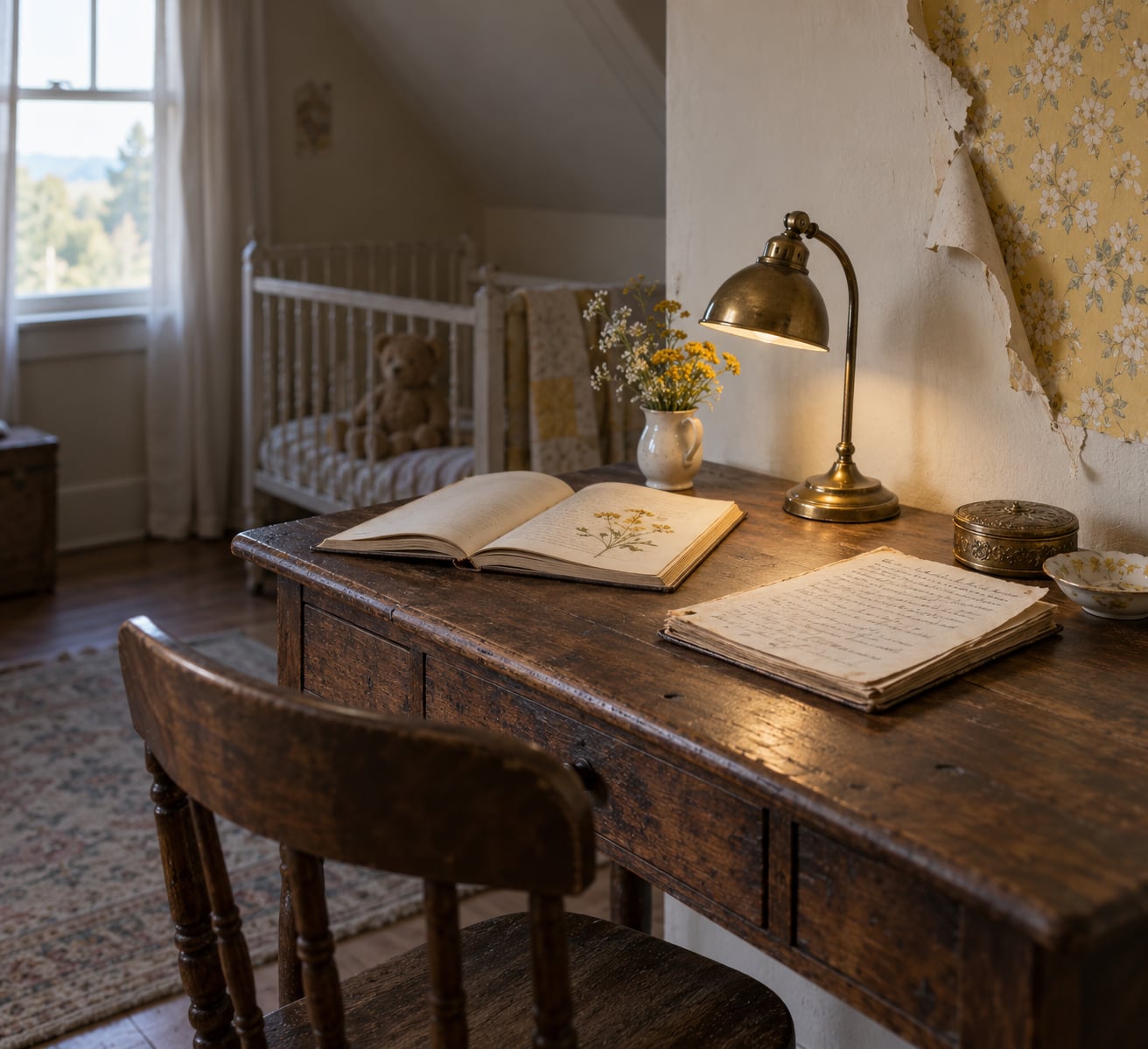
Charlotte Perkins Gilman’s The Yellow Wallpaper is an 1892 short story told through the private journal of an unnamed woman whose physician husband keeps her in an upstairs nursery for a nervous condition after childbirth. By the end she has torn the room’s yellow wallpaper off the wall and is convinced she has set a woman free. Her account blurs illness, confinement, and revolt into one image, which is exactly why it is still argued over.
If you are writing an essay, start from the journal form itself. Almost every question students bring to this story — the smell, the bars on the windows, the woman behind the pattern, whether the narrator is simply unwell — comes back to the fact that we only ever hear her private side, kept from her husband by stealth.
Table of Contents
- What Is The Yellow Wallpaper About?
- What Happens in The Yellow Wallpaper?
- Why Did Charlotte Perkins Gilman Write The Yellow Wallpaper?
- Charlotte Perkins Gilman and the rest cure
- What Does the Wallpaper Symbolize?
- What Are the Major Themes in The Yellow Wallpaper?
- Is the Narrator in The Yellow Wallpaper Crazy?
- How Does the Ending of The Yellow Wallpaper Work?
- The Yellow Wallpaper: Key Facts and Literary Context
- Frequently Asked Questions
- What does the yellow wallpaper represent in Charlotte Perkins Gilman’s story?
- Is the narrator of The Yellow Wallpaper actually insane?
- What is the rest cure in The Yellow Wallpaper?
- Why does the narrator tear down the wallpaper?
- What does the ending of The Yellow Wallpaper mean?
- Conclusion
What Is The Yellow Wallpaper About?
The story covers a few months in the life of a woman recovering from childbirth. Her husband, John, is a physician, and he diagnoses a slight hysterical tendency, temporary nervous depression, and orders her to bed, away from work, company, and anything that might stimulate her.
He chooses the room for her himself. It is a former nursery at the top of a colonial mansion, papered in a yellow pattern, furnished with a bed, a couch, a desk, a floor lamp, and wall paper the color of fungus. Windows look out on a lovely garden view, and they are barred.
Her real condition is that she wants to write. She keeps a journal in hiding, sneaks at it at night, and hides the pages from John in a locked drawer or under the loose floorboard in the wallpapered room. What she writes about — her disbelief in her husband’s treatment, her hatred of the room, her growing certainty that a woman is trapped behind the pattern — is the reason the story matters. It is a document smuggled past a man who thinks he already knows what she needs.
What Happens in The Yellow Wallpaper?
The action is delivered in dated journal entries, twelve of them in the standard text, and it moves fast. Here is the sequence in order.
- Arrival in the room. She records the yellow wallpaper as a smouldering, unclean color, and she and John argue immediately about her writing. He asks whether she can write in front of him; she says not easily.
- She starts the journal. She tells herself she must not let the condition get her, keeps the entries hidden, and hides them in a locked drawer topped with a folded piece of paper, then later in a box in the attic and under the floorboards.
- Physical decline. Her health gets worse rather than better. Her appetite disappears, she is seriously thin, and John restricts visitors. Her cousins Henry and Julia ask to visit; John refuses them, and she tells him the visit would be good for her.
- The baby’s arrival. A nurse, Jennie, and a baby come into the room. The narrator feels torn between wanting the child and fearing the extra strain.
- The pattern appears to move. Sitting by the window in the moonlight, she thinks she sees the front pattern lift and a second shape behind it. She decides it is only optical illusion, but she cannot stop looking.
- Work is forbidden. She attempts to work on her writing again and stops when John objects. She also reports she hates her room, the wallpaper, and the bars on the windows.
- Confusion between the two patterns. She argues with herself about the sub-pattern behind the front pattern and whether the woman behind it is moving or if she is imagining it. Her entries become shorter and more tangled.
- The smell. She reports a smell coming off the wallpaper that reminds her of a smouldering, unclean yellow. She tries to trace it to the roses and lilacs outside, and cannot, and begins to suspect the room itself is rotten.
- Decision to remove the paper. She starts pulling it down by night, in small strips, hiding the pieces under the bed and dropping the paper into the fireplace.
- Jennie returns. Jennie finds her in the room and treats her. The narrator decides against rejoining the household downstairs, and refuses the sedative Jennie offers her.
- John faints at the sight of her. On the last night she creeps on the floor, John comes in and faints, and the journal ends there.
- The ending. The last entry says she has pulled off most of the paper so John cannot put her back. She creeps over his body, asks why he fainted, and the line has the answer: he is asleep, and he is lying across her path.
Read those entries side by side and the shape is clear. Every step forward in the wallpaper means a step backward in her health, and every rule John imposes — no visitors, no work, no sunlight, no exit — tightens the frame around the room she is trapped in.
Why Did Charlotte Perkins Gilman Write The Yellow Wallpaper?
Gilman wrote the story out of direct experience and fury. In 1887 she had a serious breakdown, was treated by the Philadelphia physician Silas Weir Mitchell, and found the treatment worse than the illness. The prescription involved isolation from friends and family, a diet of milk and beef tea and no fresh air, and a rule that she see nobody but her physician.
She spent months in this regime, and the experience stayed with her. Her fictional narrator’s diagnosis, a slight hysterical tendency and temporary nervous depression, is drawn from the language of the period, and the treatment John imposes is the treatment Gilman had survived.
Charlotte Perkins Gilman and the rest cure
The rest cure was the fashionable response to what doctors then called nervous disease in women. It involved prolonged bed rest, isolation, restricted diet, and often complete suspension of work and intellectual activity, sometimes combined with forced feeding or a rigid feeding regime. Weir Mitchell was its most famous promoter, and later reforms kept his name attached to it.
The practice lasted into the early decades of the twentieth century and had largely fallen out of favor by mid-century. For today, depression and anxiety after childbirth are treated differently, and anyone who is unwell should get a diagnosis and support from a doctor rather than relying on any single account of a century-old novel.
Gilman herself later wrote that she changed the title at an editor’s suggestion, replacing The Wallpaper with The Yellow Wallpaper, and she expressed regret that it had not kept the original sense, which pointed at what the paper was doing rather than how it looked. The story is fiction, not a disguised diary, but the difference matters: the character is invented, while the treatment she describes was not.
What Does the Wallpaper Symbolize?
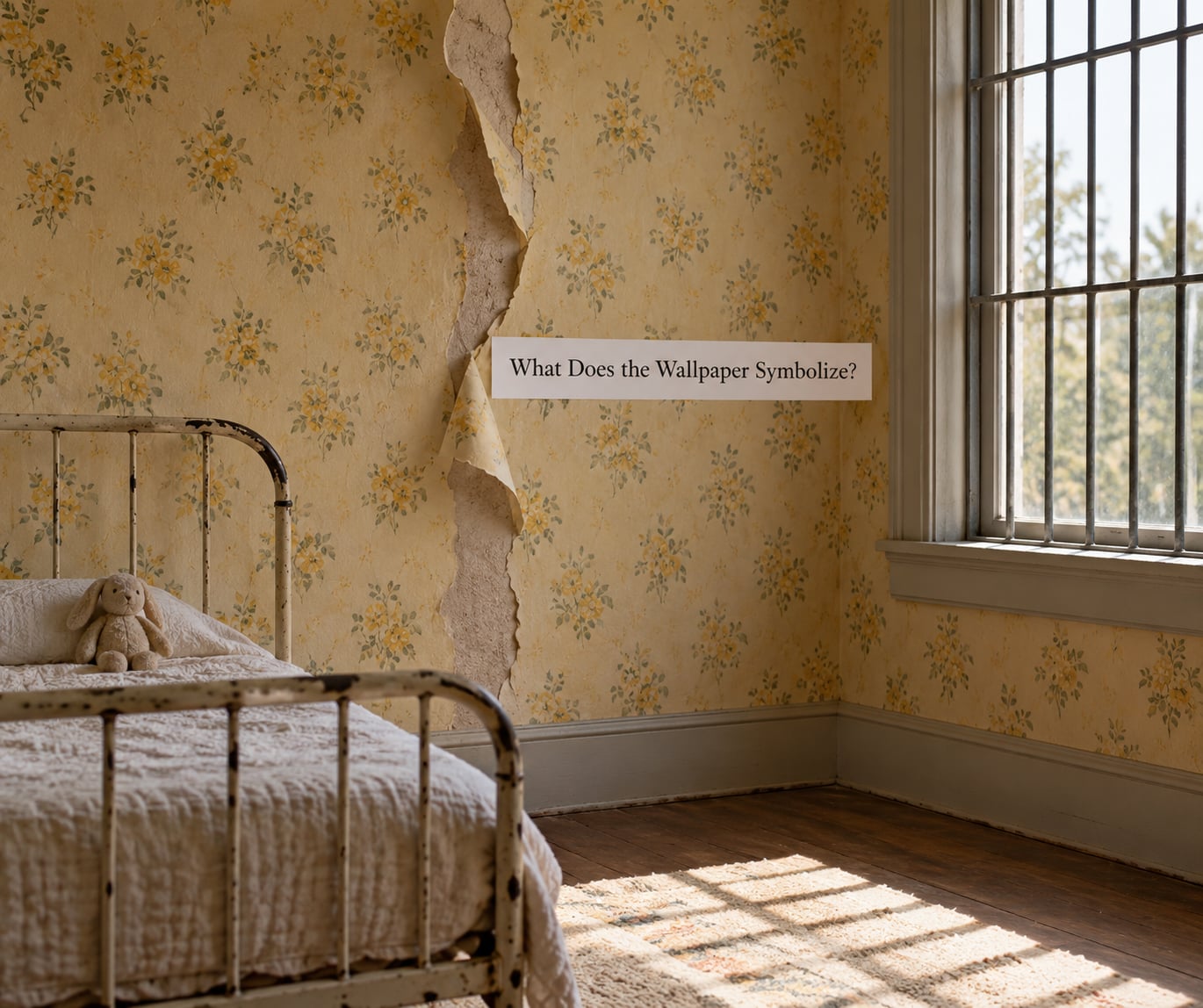
Start with the surface detail. Yellow is a sick color here. She calls it smouldering and unclean, and she repeats the words, so the reader meets the smell before seeing the pattern.
The wallpaper stands for the domestic cage itself. It is chosen by John, it goes up without her consent, and it covers the windows, which he then nails over and bars so she cannot see the garden she is supposed to enjoy. As the narrator picks at it she does not find wallpaper. She finds a sub-pattern, and behind that a woman who is also trapped and who moves around the room at night.
The room works the same way. A nursery is a room built for an infant, with bars on the windows, and it is used to hold an adult woman. The choice of room is the whole argument of the story in one detail.
The smell is the detail many readers remember. The wallpaper reeks, and so does the room, and the smell is usually linked to mold, rot, and the smell of a closed, unhealthy house. Read this way, the pattern is not just a wallpaper but the smell of a sick building and a sick household.
The woman behind the pattern is the trickiest symbol. At first the narrator refuses to see her, then she sees a woman who shakes the pattern and creeps around. As the entries go on the two figures merge. Some readers take the woman as a symbol of the self, buried under roles, and some read her as the narrator’s own suppressed self finally breaking through.
Moonlight and the barred windows work as a pair. Outside is the garden, the road, the white church and the hilltops; inside are bars, nailed paper, and locked doors. That contrast is the story’s picture of freedom and captivity.
What Are the Major Themes in The Yellow Wallpaper?
Gender inequality and control. John decides her treatment, supervises her diet, chooses her room, decides who visits, and refuses the cousins. Every restriction is administered by a man who believes he is being kind.
Marriage as medical authority. The narrator’s private pages are the only place she can state her own opinion, which is why she writes secretly. The journal is the space outside her marriage, and it is also the space she is being punished for using.
Isolation and mental health. The story was written in the era of nervous disease, when women’s distress was treated as a private domestic matter rather than a public health one. The narrator is not simply fragile. She is starved of company, work, light, and being believed.
Self-determination. She ends by telling him that he cannot put her back. That line matters because it is the first moment in the story where she claims the future tense on her own terms.
The cure as a cause. Her illness deepens in proportion to the treatment. That inversion is the story’s central criticism of the rest cure, and it is also why readers keep arguing over the ending.
Is the Narrator in The Yellow Wallpaper Crazy?
The short answer is that the story never settles this, and that is the point. If the narrator of The Yellow Wallpaper is described as insane, the story becomes a Gothic horror about a mind that breaks under isolation. If you read it as feminist fiction, the breaking is the only escape available inside a system that has no other door.
Both readings sit on the text. She is unwell, and the story never asks you to doubt that. What it does ask you to doubt is her husband’s account of her, and the difference between a woman who is unwell and a woman who is confined is the whole moral of the piece.
Two notes before you write about her. First, she has no name in the story. Most study guides call her Jane, but that is an invention, and in the original text no name is ever given to her as a fixed fact. Second, a narrator whose perceptions are unreliable is not the same as a narrator who is lying to you, and treating the wallpaper as pure hallucination throws away the detail the story spends most of its length building.
How Does the Ending of The Yellow Wallpaper Work?
At the end the narrator has pulled off most of the paper, and the woman she saw behind the pattern is out. She says she has got out at last, in spite of you and Jane, and that he cannot put her back. The Jane in that line is not the narrator’s name; in Gilman’s later explanation it stands for herself, and the narrator herself is never named anywhere in the story.
John faints, and the ending explains why: he is asleep, and he has fallen across her path by the wall. That detail is deliberately anticlimactic, and it deflates the reader who was waiting for a violent climax. It also means the collapse is his, not hers. She is standing, and he is on the floor.
From there the story can be read three ways. As psychological breakdown, she has merged with an image she built out of boredom and isolation. As liberation, she has freed the woman trapped behind the pattern, which is herself, and the room’s rules no longer apply to her. And as both at once, which is where most careful readings land, because the woman is also the only thing in the story that has ever been free.
John fainting has been read three ways too. It is literal exhaustion, it is the shock of seeing his wife in a wrecked room, and it is the symbolic defeat of the doctor whose treatment produced this. Nothing in the text picks one of these.
The Yellow Wallpaper: Key Facts and Literary Context
The table below is the quick orientation most readers want before reading the text.
| Author | Charlotte Perkins Gilman |
| Published | 1892, in The New England Magazine |
| Original title | The Wallpaper, later changed at an editor’s suggestion |
| Setting | An upstairs nursery in a colonial mansion, three miles from a village |
| Form | Short story in first-person journal entries, with no explicit chapter titles |
| Key historical influence | The rest cure, associated with Silas Weir Mitchell |
| Genres | Gothic horror and early feminist fiction |
Frequently Asked Questions
What does the yellow wallpaper represent in Charlotte Perkins Gilman’s story?
It represents the domestic cage John builds around his wife: a pattern he chose, papered over the windows, and barred. As she peels it back she finds a sub-pattern and then a woman trapped behind it, which most readers read as her own buried self. The sickly yellow smell adds the sense of a rotten house and a rotten household.
Is the narrator of The Yellow Wallpaper actually insane?
The story never settles it. She is unwell, and the text never asks you to deny that, but her perceptions are unreliable and the wallpaper changes shape as her health fails. The more useful question is whether she is crazy or confined, because the rest cure, the barred windows, and the forbidden writing all argue for confinement rather than madness alone.
What is the rest cure in The Yellow Wallpaper?
It is the treatment John prescribes: prolonged bed rest, isolation from friends and family, a restricted diet, and no work or intellectual activity. The practice is associated with the physician Silas Weir Mitchell, who treated Gilman after her own breakdown in 1887. By the early twentieth century it had largely fallen out of use in favour of other approaches.
Why does the narrator tear down the wallpaper?
She begins pulling it off in strips at night, hiding the pieces under the bed and burning the paper, after deciding that the woman she sees behind the pattern is trapped there. Her stated motive is that she has got out at last and that John cannot put her back. The act is also the only physical act of resistance available to her in the room.
What does the ending of The Yellow Wallpaper mean?
He faints because he is asleep and lying across her path, a detail that undercuts any expectation of a violent climax and leaves him on the floor while she is standing. Readers take it as breakdown, as liberation, or as both at once. Her line that he cannot put her back is the first time she claims a future tense as her own, which is why the ending feels like an escape rather than an accident.
Conclusion
The Yellow Wallpaper stays alive because it never separates illness from captivity. The plot is simple, but the question it leaves open is the one that matters for study: is she losing her mind, or losing her freedom, and can a reader even tell the difference from inside a room like that?
Start with the journal format, because it explains the rest. Then read the rest cure, the barred windows, and the wallpaper’s smell as the story’s three pieces of evidence. Whatever you decide about the ending, those three details are what support it.